Connect with us

WITNESS RADIO MILESTONES

Media “switch-off” in Kenya: a looming threat to pluralist society

Published

on

Guest post by Grace Mutung’u (@bomu)

On Tuesday, January 30, the Communications Authority of Kenya switched off three main television stations and a local language channel ahead of a mock swearing-in ceremony for opposition leader Raila Odinga. A day later, the “switch-off” was extended indefinitely as the government proceeded with investigations into the role of the media in broadcasting the swearing-in ceremony, which the government considers an illegal act. Okiya Omtata, a human rights activist, obtained court orders requiring that TV broadcasting be restored, with no more interference until the case is heard and a legal determination is reached. One week later, the government restored two of the four stations.

Regardless of the government’s rationale for cutting off TV broadcasting, it’s a disproportionate measure that interferes with the right to free expression, which includes the right to access information. This right is protected under the law.

One would think that this type of broad shutdown would be met with furious condemnation. But the rebukes have come mostly from media freedom veterans and organizations. In perhaps an indication of changes in foreign policy, the international community has taken a “balanced” diplomatic approach. The public wants vindication, as they have time and again raised concern over the media’s cosy relationship with the state. Should a media company’s purportedly dirty hands prevent us from defending its freedom? If we stay silent, could this TV switch-off lead to a full internet shutdown — despite the government’s pledge to keep the internet on?

For many years, Kenyans congregated in homes, entertainment venues, and other public spaces to watch the 7 o’clock news. In past eras, news content was largely from the executive point of view. In spite of the controls, people appreciated the news for its value in broadcasting information, regardless of the opinion it was clothed in. Fast forward to the present situation with Raila Odinga, leader of opposition, reading an oath before a crowd at Nairobi’s main public space, Uhuru Park.

Public curiosity about the Uhuru Park rally was high. Parts of the event were shared online and despite the fact that attention has shifted to the TV shutdown, analysis of the rally is ongoing. The government contends that by airing “an act of subversion,” the media is an accessory.

Public opinion is divided on the merit of Raila Odinga’s oath, with U.S. foreign policy reflecting support for the Kenyan government’s view that it is destabilizing for the nation. The three media houses that were shut down have taken cover under the constitutional guarantee of press independence.

Kenya’s Constitution protects speech online and off. The Constitution is relatively young, having been passed in 2010 with approval from 67% of Kenyan voters. It protects both the right to freedom of expression (art. 33), “which includes freedom to seek, receive or impart information or ideas,” and freedom of the media (art. 34), affirming people’s right to broadcast without interference or penalty based on the viewpoint or content transmitted. Both of these rights are subject to limited exceptions. On the policy side, Kenya is one of 30 governments in the Freedom Online Coalition, a partnership of states “working to advance internet freedom” that has spoken out against network disruptions.

A point of contention in the debate is whether the media has acted in good faith. Take for instance how and why the switch-off story became known in the public sphere: news editors were in a meeting with the government and they disagreed on coverage of the Uhuru Park event.

For its part, the public has warned the press about the dangers of an opaque relationship with the government. Examples range from the widely discussed media high tea at Statehouse in 2013, the creation of the government advertising agency, the running of government promotions during the 2017 election period, and the drafting of “conflict-sensitive” guidelines for the election period. Not to mention that the media framed the election as a binary between the ruling coalition, Jubilee, and the opposition forces under Raila Odinga, thereby contributing to polarization of the society. This is not to say that all of these policies were wholly wrong, but to point out that they were made with little or no public involvement, as if they were purely business and not public-interest decisions. These are not inclusive, multi-stakeholder processes.

Among urban populations, switching off four television stations does not appear to have had made much of an impact yet. This might be because there are alternative news sources, including the content from the four stations that is available online. But the problem with the switch-off is not just what it reveals about the relationship between the media and the public, but what it says about how our society is organized and how the rules are made.

In the past, Kenya went through a “one party era,” where the executive was in total control of policy, law, and practices, and everyone was expected to toe that line. Now we have a dispensation that envisages a plural society with a separation of powers. The executive should not be the last word on what information should be available in the public sphere and a dispute involving some content should not be resolved in a manner that affects whether the public can make choices in the marketplace of ideas.

For those who depend on “free-to-air” channels (which you can watch without paying for a subscription), the switch-off significantly limited their access to information. In one online discussion about the switch-off, a young Kenyan lamented that those without internet access were calling their friends and relatives in Nairobi to get a picture of the ongoings at Uhuru Park. A journalist from one of the switched-off stations discussed how his programs, which cover government technical and vocational institutions, were cancelled because of this action. Those who work under contract for content producers are also out of work during the switch-off.

Outside the broadcast media, businesses that provide access to information — for example, internet service providers (ISPs) — are undertaking economic, tech, and regulatory risk assessments, simulating scenarios in case they get a government directive. What happens if the switch-off targets online media? Will ISPs push back?

It may be that government had legitimate reasons for the action it took — that’s not clear — but even if it did, switching off four television stations goes too far for fixing the problem it’s trying to address. Restrictions like this on free expression should be targeted and necessary to achieve a legitimate aim. The message the switch-off has sent to the Kenyan people, allies, prospective investors, and the world, is that under this administration, one can never be sure of what will happen, even when a freedom is clearly spelled out in the Constitution.

This switch-off is therefore bad for our society. As Article 19, Amnesty International, and others stated, the blocking is “unacceptable” and curtails press freedom. We add that the switch-off fails to respect the values of openness and inclusivity that are essential to internet policy making, and threatens the new balance of powers in pluralist Kenya.

While we call upon the media to improve its relationship with the public, let us defend our freedom to access information and ideas, consider them, and judge for ourselves whether they are good for us.


Continue Reading
Click to comment

Leave a Reply

Your email address will not be published. Required fields are marked *

WITNESS RADIO MILESTONES

The 2nd edition of East Africa Business and Human Rights opens in Nairobi, highlighting the critical issue of African States’ limited participation in global treaty-making, which risks leaving the continent’s specific needs unaddressed.

Published

on

By the Witness Radio Team

Nairobi, Kenya: Prof. Damilola Olawuyi, Chairperson of the United Nations Working Group on Business and Human Rights, has urged African countries to take an active and leading role in international treaty negotiations to ensure that global treaties address the continent’s unique challenges, warning that passive participation could result in agreements that overlook Africa’s needs.

He said that in international law, you don’t get what you deserve; you get what you negotiate.

Delivering the Keynote at the Dialogue, Prof. Olawuyi stressed that African governments are not sufficiently engaged in negotiations to create a legally binding international treaty on business and human rights—a lack of involvement that could undermine African interests.

The two-day dialogue, convened by DCA and partners, has the theme: “Beyond Compliance: Strengthening Accountable and Rights-Centered Supply Chains in East and Horn of Africa.” It brings together governments, businesses, civil society organizations, development partners, and human rights defenders. Participants discuss how growing investments can better align with human rights standards and responsible business conduct.

Building on the momentum of the 2023 inaugural conference in Kampala, the event aims to shift discussions from commitments to implementation. It focuses on rapidly expanding investments in land-based sectors and their impact on communities.

He reiterated that the persistent absence of African states from these talks may result in global rules that ignore African priorities.

He warned the end result might be an instrument that does not reflect African priorities and interests. It could contain pre-packed solutions that impose higher environmental, sanitary, climate, and ESG standards on African products, limiting their competitiveness and market access.

He urged the EAC, AU, and member states to unite around a common position in negotiations, underscoring the importance of African leadership in ensuring investments support both economic growth and human rights.

Prof. Olawuyi argued that the absence of binding international standards continues to undermine efforts to hold corporations accountable for human rights abuses, particularly in sectors such as agribusiness, mining, and large-scale land-based investments.

He cited an upcoming report on agribusiness, food security, and human rights. He said investment-driven agricultural projects in several countries continue to be linked to child labor, sexual exploitation, modern slavery, gender injustice, forced displacement, land grabbing, and other rights violations.

He recommended that National Action Plans must be rigorously implemented across all sectors, including agribusiness, to effectively address human rights abuses.

The concerns voiced by the UN expert were also reflected in discussions throughout the forum. Karen Poore, Country Director for DanChurchAid Kenya (DCA), spoke on behalf of the event host. She called on governments, businesses, civil society organizations, and local communities to work together proactively, urging them to take concrete steps that ensure investments respect human rights and deliver equitable benefits for all involved.

Poore described DCA’s role as both a convener and bridge-builder, creating spaces where different actors can engage honestly on difficult issues surrounding business conduct and human rights.

She said spaces like this, where honesty and constructive challenge are possible, are important. More transparency and openness about root causes, and a willingness to move beyond appearances, are needed, as business and human rights are evolving quickly and new standards are shaping expectations.

She stressed that responsible business conduct is not only about accountability but also about creating fairer and more sustainable economic opportunities.

“Access alone is not enough if it does not come with dignity and rights,” Poore noted, adding that transparency and long-term thinking are increasingly linked to resilient and sustainable business models.

She called for immediate action to address structural barriers affecting women, youth, and marginalized communities, ensure equal access to grievance mechanisms, and actively promote participation in decision-making processes.

Matthew Brooke, Head of Governance, Digital and Macroeconomics at the European Union Delegation to Kenya, represented the European Union Delegation. He acknowledged that past investment projects have been linked to human rights violations, exploitation, and abuse.

“Human rights violations in investment projects, exploitation and abuse have all been seen and witnessed, and they need to continue to be documented,” Brooke said.

He argued that such practices are unsustainable investments. He also explained that the European Union is shifting away from purely voluntary approaches toward stronger due diligence requirements. These requirements aim to prevent human rights and environmental harm in global supply chains.

According to Brooke, the EU’s Corporate Sustainability Due Diligence Directive (CSDDD) requires large companies operating in the EU market to identify and address human rights and environmental risks throughout their operations and supply chains, engage affected stakeholders, and take measures to prevent or mitigate harm.

Continue Reading

MEDIA FOR CHANGE NETWORK

Uganda moves toward a Bamboo Policy to boost environmental conservation and green growth.

Published

on

By Witness Radio team.


Uganda’s move to develop a national bamboo policy aims to boost environmental conservation and create green jobs, addressing the country’s urgent unemployment issues among the working class.


Bamboo is a critical tool in fighting climate change due to its rapid growth, high carbon sequestration capacity, and ability to produce 35% more oxygen than equivalent trees. As a fast-growing, renewable resource, it restores degraded land, provides sustainable materials that replace emission-intensive products like concrete, and offers a resilient, low-carbon bioenergy source. 


Bamboo’s potential is outlined in the existing National Bamboo Strategy. Still, stakeholders stress that a formal policy involving entrepreneurs, farmers, and processors is essential to remove regulatory uncertainty and foster sector growth.


“The strategy is a good document, but it was developed largely through desk research. It did not fully involve entrepreneurs, farmers, and processors who are already working in the bamboo industry,” said Sjaak de Blois, chairman of Bamboo Uganda, encouraging stakeholders to see their role as vital.


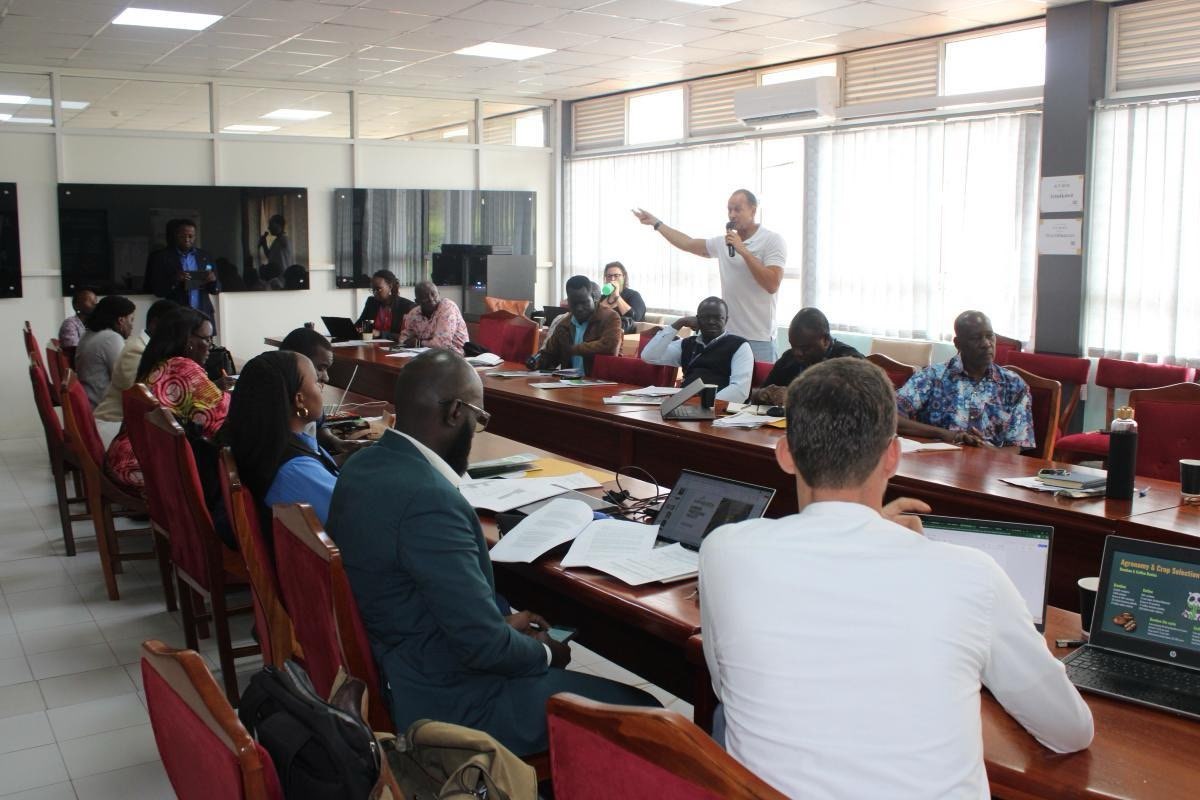
The bamboo policy is currently at an early consultative stage, with no draft yet submitted to the cabinet or parliament. Recent consultations brought together representatives from eight government ministries, private-sector bamboo actors, and development partners to begin aligning the strategy with practical regulatory needs.


“What we have now is the starting point,” De Blois mentioned. “The next step is to take the strategy and make it more practical, more market-driven, and more Ugandan. The next step is to move from having a plan to adopting a policy.


Bamboo currently falls under several regulatory frameworks, with no single authority overseeing the sector. The policy push is being driven in part by Bamboo Uganda, a membership-based organization bringing together bamboo farmers and processors, among others. The organization aims to play a coordinating role similar to that historically played by the Uganda Coffee Development Authority in the coffee sector.


“If you want to make a sector meaningful for a country, you need coordination. Coffee became what it is because of an institution that aligned farmers, traders, exporters, and regulators. Bamboo needs the same kind of coordination.” He said.


The policy process is supported by the Belgian development agency, which is funding consultations and facilitating dialogue between the government and the private sector.

Industry players say the absence of clear regulations has constrained investment despite growing demand.

“At the moment, bamboo is everywhere and nowhere at the same time. As a farmer, you talk to forestry, as a charcoal producer, you talk to energy, as a builder, you talk to works. There is no single framework that enables the industry to function.” De Blois added.


Supporters of the policy argue that bamboo could play a significant role in environmental conservation. Bamboo grows rapidly, regenerates after harvesting, and can be harvested annually for decades, reducing pressure on natural forests.


According to Global Forest Watch (GFW), Uganda lost 1.2 million hectares of tree cover between 2001 and 2024, representing a 15% decline from the 2000 baseline. Bamboo has been identified as a key species for restoration.


“One acre of bamboo that is harvested sustainably can prevent the destruction of hundreds of acres of natural forest,” De Blois said. “If we get this right, bamboo can help reverse deforestation rather than contribute to it.”


Ms. Susan Kaikara, from the Ministry of Water and Environment, emphasized bamboo’s potential to drive Uganda’s green-growth agenda.


“Establishing a coherent national policy framework will strengthen coordination, inspire investment, and unlock bamboo’s full potential as a pillar of Uganda’s green economy,” she said.


Uganda’s charcoal market alone is estimated to be worth hundreds of millions of dollars annually, much of it supplied through unsustainable wood harvesting. Industry actors say certified bamboo charcoal plantations could offer a cleaner alternative.


“If they allow us to certify bamboo charcoal plantations, then we can get a trade license to compete or to work together with the existing market. We will reverse deforestation. We would enter an industry of about 500,000 hectares, creating smart, green jobs. We can digitalize them to make them attractive through bamboo agroforestry. So again, those things need a policy.” He adds.


Bamboo is also viewed as a climate-friendly crop due to its high capacity for carbon sequestration. Its rapid growth enables it to absorb large amounts of carbon dioxide, while its extensive root system improves soil structure and increases long-term carbon storage.


“When you look at carbon sequestration, bamboo offers several advantages. Residues from harvested bamboo can be converted into biochar, locking carbon into the soil for long periods. When you also see the sequestration per acre compared to many other trees, it is five or six times higher. So, we sequester a lot,” De Blois said


Stakeholders say that if the policy process progresses as planned, bamboo could emerge as one of Uganda’s key green growth sectors within the next decade.


“Policy making takes time. But what is important is that we have started the conversation with all the right ministries in the room. From here, it is about taking steady, practical steps.” He concluded.

Continue Reading

WITNESS RADIO MILESTONES

A Global Report reveals that Development Banks’ Accountability Systems are failing communities.
Published

on

By Witness Radio team.

For decades, development projects have been funded to address some of the World’s most pressing problems, including poverty, wildlife conservation, and climate change. However, what unfolds on the ground is sometimes the opposite of development. Instead of benefits, these projects have often harmed the very people they are supposed to support.

The effort to address such harm has led to the establishment of Independent Accountability Mechanisms (IAMs) by various development banks. Yet, communities affected by these projects often face betrayal by national court systems, leaving them feeling overlooked and vulnerable, emotions that underscore the urgent need for effective justice.

According to experts in development financing, since the early 1990s, development banks have sought to address and mitigate harm through IAMs—non-judicial grievance mechanisms that provide a direct avenue for impacted communities to raise concerns, engage with project implementers, and obtain remedies for the harm they have experienced.

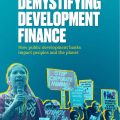
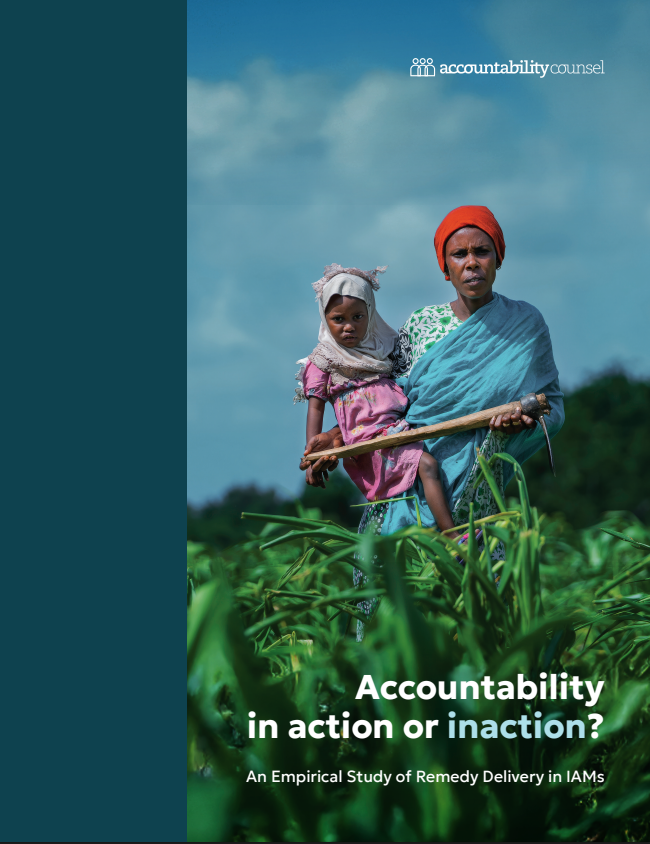
The study, conducted by Accountability Counsel and titled Accountability in Action or Inaction? An Empirical Study of Remedy Delivery in Independent Accountability Mechanisms shows that while IAMs exist, their relevance has fallen short, underscoring the urgent need for reform to restore community trust and hope.

In compiling the report, researchers reviewed 2,270 complaints across 16 IAMs and conducted 45 interviews covering 25 cases globally.

The report reveals a persistent gap between the promise of remedies and their realization, highlighting that only 15% of closed complaints led to commitments, and just 10% achieved full completion, underscoring the urgent need for effective remedies for communities.

The findings highlight ongoing challenges, including inadequate implementation, limited monitoring, and persistent power imbalances, which continue to block communities from accessing meaningful remedies and demand immediate reform.

“The consequences of these institutional gaps are severe. As these cases show, institutional silence can exacerbate risk, while meaningful intervention can help de-escalate it.” The Report adds.

Uganda is among the countries where communities have sought justice using these accountability mechanisms. Between 2006 and 2010, communities in one of the districts of Uganda were brutally evicted by the UK-based Company, which was growing trees in the area.

The company was formerly an investee of the Agri-Vie Agribusiness Fund, a private equity fund supported by the International Finance Corporation (IFC), the private sector arm of the World Bank Group. The community filed a Complaint with the IFC’s accountability mechanism, the Compliance Advisor Ombudsman (CAO).

“We complained to this body in 2011, hoping for justice, but over 15 years later our people are still struggling, living miserably, some without homes,” a community land and environmental defender told the Witness Radio team.

According to the affected residents, the CAO process did not lead to success or meaningful compensation, as they had hoped.

Between 2013 and 2014, the communities, with support from the CAO, signed a final agreement with the Company to address the harm. Among other commitments, this included resettlement of the affected communities.

In its 28-page report published in 2015 titled: A Story of Community-Company Dispute Resolution in Uganda, the CAO wrote,” With the agreements concluded, implementation is gathering pace. As agreed, the company has begun extending development assistance to both cooperatives, and the process of restoring and enhancing livelihoods has commenced.

The first step taken by both cooperatives was to acquire land. In late 2013, the Mubende Cooperative bought 500 acres of ‘fertile agricultural land’ in the Mubende district. Their vision was to allocate a certain percentage of the land for resettlement, with the remainder utilized for farming projects.

Reports from the ground indicate that communities remain dissatisfied with the process, claiming it failed to address their concerns fully and highlighting the urgent need for more effective remedy systems.

“When you say that people are well, it is really a total lie. Many people were never compensated or resettled. Even those who got a portion of land say they have never seen a fertile land—I have never seen it, because people are living or cultivating on rocky, infertile lands,” the defender further revealed.

The struggle faced by the Ugandan community is not unique. Their experience mirrors what the Accountability Counsel report identifies worldwide. Despite registering more than 2000 complaints by communities harmed by bank-financed projects globally, there has been no comprehensive system-wide analysis of whether and how often these mechanisms deliver meaningful remedies, defined as tangible, material outcomes that repair harm and improve lives.

In addition to the slow success of such IAMs, the report notes that, across interviews covering 25 complaints, 84% referenced retaliation, violence, or threats of violence-an alarming indicator of the risks faced by communities seeking justice, demanding immediate attention and action.

“Government officials and company representatives were frequently implicated in efforts to suppress dissent. This not only reduces the likelihood of achieving a substantial remedy, but also suppresses the willingness of community members to speak honestly and openly about Complaint outcomes.” The report further adds,

Further, it reveals that communities described a range of retaliatory tactics, including physical clashes, arrests, detentions, fatalities, intimidation and harassment, death threats, and anonymous warning letters, among others.

“Remedy must be reimagined not as a peripheral concern but as a core responsibility of development institutions. It must be adequately resourced, independently monitored, and centered around the needs and voices of affected people,” the report adds.

The report recommends that development banks and IAMs establish a Remedy Framework with clear standards to ensure remedies are timely, adequate, and community-centered, and to encourage stakeholders to prioritize systemic reform for better justice outcomes.

The report also urges development banks and their accountability mechanisms to make remedies a foundational element of responsible finance. Adopting institutional frameworks that prioritize redress, empowering IAMs to oversee and enforce commitments, and incorporating the outcomes of IAM processes into project evaluations and institutional learning.

Continue Reading

Resource Center

Legal Framework

READ BY CATEGORY

Facebook

Newsletter

Subscribe to Witness Radio's newsletter


Trending

Subscribe to Witness Radio's newsletter