Connect with us

MEDIA FOR CHANGE NETWORK

Court issues criminal summons against Dodoviko, FFU commander

Published

on

Ndeeba Demolished Church

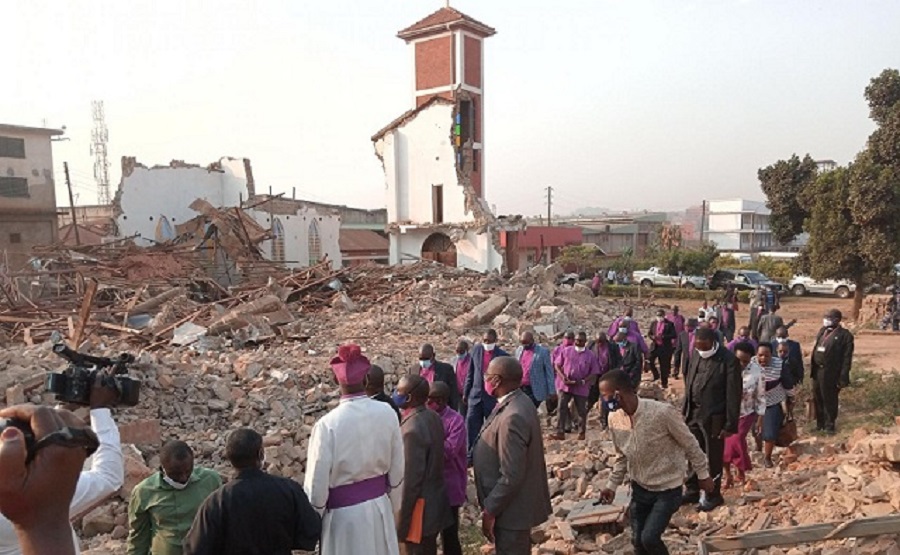
Kampala, Uganda |  The Grade One Magistrate Court in Makindye has issued criminal summons against city businessman Dodoviko Mwanje and the Field Force Unit-FFU Commander for the Kampala Metropolitan Police South Region Martin Adero, over the demolition of St Peter’s Church in Ndeeba.

The duo will be jointly charged with 17 others who appeared before Grade One Magistrate Jude Okumu, on Thursday, in a session held between 6:30 p.m. and 7: 20 p.m. However, during the session, the State Attorney Jacqueline Akao noted that Dodoviko and the commander had evaded arrest, yet they are key, to the case.

The Court heard that Mwanje, Adero and four senior police officers, between March 20 and August 10, 2020, conspired to illegally demolish St Peter’s Church, Ndeeba,  a property of the Church of Uganda. The senior officers include the Kampala Metropolitan Police FFU commander Rashid Agero, Katwe District Police Commander David Epedu,  The Officer in Charge of Ndeeba Police Station Mugira Yeko Kato, and Isabirye Kaloli, an officer attached to FFU-Katwe.

The police officers were also charged with disobeying lawful orders when they disregarded orders issued by the Commissioner of Police Moses Kafeero to deploy guards at St Peter’s Church Ndeeba and avert any possible demolition or destruction of the said Church.

Two other police officers; Assistant inspector of Police Anthony Kiro and Corporal Richard Kasule together with 11 civilians were also charged with malicious damage and theft of church property. The civilians, mostly casual labourers, who were found at the scene include Kawooya Mohammad, Bbosa Muniru, Kiberu Amza, Mutebi Abbasi, Bulega Ali, Matovu Simon, Kalika Ali, Mujuzi Andrew, Ssekito Badru, Isirinya John and Maruti Bashir. They all denied the charges. 

Their attempts to secure bail through their lawyer Joel Allan Kabona were also rejected because of the time at which the session was held. They return to the Court on August 24.

Meanwhile, prosecution notes that they are still investigating circumstances under which St. Peter’s Church was brought down in the middle of the night. Available documentation indicates that the Church demolition was as a result of a court decision in a four-decade property wrangle between the Church of Uganda and the joint administrators of the estate of the late Evelyn Nachwa, a Buganda Kingdom Princess.

The paper trail indicates that the court ruled on the matter of the ownership of the land in question noting that it had been fraudulently registered in the names of Bishop Danistan Nsubuga, Rev. Yuda Kitaka, and Esau Kizito, thus ordering the church to vacate.

Basing on the court ruling, the victors acquired an order to demolish the Church structure. However, Kampala Metropolitan Police spokesperson Patrick Onyango recently noted that Police had not been informed about the eviction and demolition as the practice is.

Original Post: The Independent

Continue Reading
Click to comment

Leave a Reply

Your email address will not be published. Required fields are marked *

MEDIA FOR CHANGE NETWORK

Peruvian communities have launched a global petition to halt a mining project they say threatens the water supply of over 10 million people.

Published

on

By the Witness Radio team

Communities and environmental organizations in Peru have launched an international petition urging people around the world to pressure financiers to withdraw support for the Ariana copper-zinc mining project, which they say could jeopardize the water supply of more than 10 million people in Lima and Callao.

The campaign, led by international advocacy group EKO Movement and backed by the Peruvian environmental organization CooperAcción, targets Banco Santander, which campaigners say provided a US$100 million refinancing facility to Alpayana S.A.C., the Peruvian company that owns the Ariana mining project.

The Ariana project is an underground copper and zinc mine located in the Marcapomacocha district, Peru’s Junín region. Alpayana acquired the project from its previous owner, Southern Peaks Mining, in 2025. That same year, the company secured a US$100 million refinancing facility from Banco Santander Perú S.A. and Banco Santander S.A. (Spain).

“Banco Santander has enormous leverage over the company. We want Santander to understand that the environmental and reputational costs of supporting this project are greater than any economic benefits,” Paul Maquet, a campaigner with CooperAcción, told Witness Radio Uganda.

The petition is the latest chapter in a campaign that has lasted more than six years. Environmental organizations first challenged the project in court in 2019, arguing that its location within the Marcapomacocha water system poses unacceptable risks that the project’s Environmental Impact Assessment (EIA) failed to address.

“The mining project is located in the heart of the Marcapomacocha water system, a natural and artificial infrastructure network that is the main source of water for Peru’s capital, Lima, and the city of Callao, which together have more than 10 million inhabitants,” Maquet added.

He said campaigners’ concerns are echoed by SEDAPAL, which has identified significant risks in its own technical assessments.

According to the petitioners, Lima’s public water utility, SEDAPAL, warned that the project could reduce both the quantity and quality of water reaching the capital by disrupting groundwater flows and exposing water sources to heavy metals from mining operations. The utility also raised concerns that vibrations from underground mining could affect the structural integrity of the Trans-Andean Tunnel, an essential component of Lima’s water supply system, and that the proposed tailings storage facility, located about 100 meters from the tunnel, could collapse.

The Ariana project received environmental approval in 2016 and was expected to begin operations in 2019. However, legal challenges have delayed its development.

In 2025, Peru’s Constitutional Chamber of Lima, ruling on a constitutional appeal filed by a group of Lima citizens, found that the project poses an imminent threat to the fundamental rights to water and to a healthy environment. The court ordered additional studies to better assess the mine’s potential impacts on Lima’s water supply before the project can proceed.

Campaigners argue that while Ariana is promoted as a source of copper needed for the global energy transition, the race for critical minerals should not come at the expense of environmental protection and fundamental human rights.

“This is an example of the global rush for strategic minerals. If the water supply for a country’s capital is not a limit, then where are the limits?” Maquet asked.

Rather than focusing solely on the mining company, campaigners are directing their efforts toward its financiers, calling on banks to use their leverage and responsibility to ensure investments do not contribute to environmental harm or human rights violations.

The international petition calls on Banco Santander to withdraw financial support for the project and use its influence to encourage Alpayana to abandon the mine.

Witness Radio Uganda contacted Alpayana S.A.C. and Banco Santander for comment on the concerns raised by campaigners and the international petition. Neither company had responded by publication time.

But Alpayana, on its website, says it is committed to being a responsible and sustainable mining company with deep respect for the environment, social responsibility, and people at the core of its values.

Continue Reading

MEDIA FOR CHANGE NETWORK

NEMA says it is restoring wetlands, but poor urban families say it is using the exercise to grab their land for new infrastructure projects – now they demand compensation and resettlement.

Published

on

By Witness Radio Team.

Hundreds of residents of Kawaala Zone II in Kampala accuse the National Environment Management Authority (NEMA) of double standards and of targeting their land for upcoming mega projects. They say they have lawfully occupied it since the 1940s.

NEMA has already evicted dozens of urban poor families, but the operation was halted after engagement with the Kampala Capital City Authority (KCCA) until a district environmental community is established.

NEMA is using the 1995 NEMA Act to carry out what it calls a “wetland restoration exercise,” but victim families call it an institutional failure to verify who lawfully occupies the land, conduct a feasibility study, and establish the cause of flooding before designating the area as wetlands.

The urban poor families, many of whom possess legally recognized land ownership documents, argue that earlier government projects such as the Uganda National Road Authority’s Northern By-Pass Road in 2004, the National Water and Sewerage Corporation’s sewage plant in 2010, and the Second Kampala Institutional and Infrastructural Development Project (KIIDP2) in 2020 compensated them, with the matter ending in World Bank-led mediation in 2024.

NEMA, which participated in the KIIIDP2 mediation as an expert agency and agreed that Kawaala is not part of the designated wetlands in Kampala, is now carrying out an eviction against the Kawaala families without due process, including sensitization, consultation, or resettlement.

“We have lived on this land for decades. We did not find a wetland here; the flooding has been caused by infrastructure projects, and we found ourselves in floods, but this is not a wetland,” Mrs. Namala Christine, who occupied the said land in 1968, told Witness Radio.

According to the residents, NEMA neither verified their ownership records nor afforded them an opportunity to be heard before issuing eviction notices.

“We only received notices ordering us to vacate. We don’t even know where the wetland is found because NEMA has never indicated that to us and sensitized us about what a wetland is,” said Abbas Ssegujja.

Kasozi says the infrastructure projects that compensated residents also changed the area’s natural landscape. He explained that the construction of the Northern Bypass, the Lubigi Sewerage Treatment Plant, commissioned in 2010, and drainage works under the first Kampala Institutional and Infrastructure Development Project (KIIDP I) altered water flows and gradually turned formerly dry land into waterlogged areas by diverting drainage water.

The second phase of the Kampala Institutional and Infrastructure Development Project (KIIDP II), financed by the World Bank, further affected residents as water flooded their homesteads.

In 2020, the Kampala Capital City Authority (KCCA), supported by government agencies including the Uganda Police Force, the Uganda People’s Defense Forces (UPDF), and NEMA, moved to evict residents to facilitate the expansion of the Lubigi Drainage Channel. The operation was carried out without prior consultation or compensation, while KCCA alleged that the affected residents had illegally settled in a protected wetland.

Following advocacy by Witness Radio and Accountability Counsel through the World Bank’s accountability mechanism, residents were eventually compensated for losses from that project.

“Every project that took our land compensated us. But the environmental impacts they left behind have been devastating. What was once dry land has gradually become waterlogged, making life increasingly difficult,” Kasozi said.

Asked about the recent Kawaala evictions, NEMA Public Relations Officer William Lubuulwa said the Authority is carrying out environmental restoration under the National Environment Act, Cap. 181.

“It may be true that some people in Kawaala have land records or title deeds. NEMA is not saying they do not own land. What concerns us is how that land is used. Wetlands are not supposed to accommodate residential developments. Our role is to guide and sensitize these people on how to use this land. We therefore required them to vacate,” Lubuulwa told Witness Radio through WhatsApp.

However, when asked whether NEMA had previously guided the community on lawful land use or undertaken public sensitization before issuing eviction notices, he did not respond.

Regarding residents’ demands for compensation, Lubuulwa said the law does not allow compensating individuals responsible for degrading wetlands, and the residents are asking the Authority to reconsider its position.

“The Act does not work that way. A person who destroys a wetland may face a fine of up to Shs600 million or up to 12 years’ imprisonment. Government cannot compensate people for degrading wetlands,” he said.

The residents dispute NEMA’s characterization of them as wetland encroachers, saying many settled on the land decades before Uganda enacted the National Environment Statute in 1995, and when their land was not flooding.

The Buganda Land Board (BLB), which administers the land on behalf of the Buganda Kingdom, has acknowledged NEMA’s mandate to regulate environmentally sensitive areas while urging authorities to respect landowners’ rights.

It should be remembered that the evictees are bibanja holders on Buganda Kingdom mailo land in Uganda. According to documents our team has seen, they have paid busuulu, or ground rent, which they say legitimizes their land ownership.

Uganda has four tenure systems: Mailo, Freehold, customary, and leasehold. Mailo is categorized into two: private Mailo and official Mailo. In Kawaala Zone II, residents have been settling on official Mailo owned by the Buganda Kingdom.

Under Ugandan law, a Kibanja holder is a tenant who uses land without an official, registered title. Under the 1995 Constitution of Uganda and the Land Act (Cap 236), Kibanja holders are legally recognized as lawful or bona fide occupants. This gives them security of tenure and protects them from arbitrary or illegal evictions.

In a 2024 statement, the Kingdom’s Minister for Information and spokesperson, Israel Kazibwe Kitooke, cited Section 44 of the Land Act, noting that although NEMA regulates land use in wetlands and forest reserves, enforcement should follow proper procedures that protect people’s property rightThe Kingdom further urged NEMA to ensure that affected residents are not deprived of their property without due process and proper consideration, and to act accordingly.gly.

Speaking to Witness Radio, BLB Land Relations Officer Fred Kibuuka explained that paying busuulu, or ground rent, to the Buganda Land Board does not determine how land may be used.

“BLB does not regulate land use. NEMA has the responsibility to ensure environmental protection while also respecting landowners’ rights,” he said.

It should also be noted that both the Buganda Land Board and bibanja holders in Kawaala Zone II received compensation during the World Bank-funded Lubigi drainage project, KIIDP II. According to Kibuuka, this happened because each held legally recognized interests in the land, which appears inconsistent with NEMA’s current position that compensation should not be paid in wetland cases.

Victim families alleged that NEMA is targeting their land for a mega project and that their eviction is not about wetland encroachment. They said officials had earlier leaked information that several projects were being considered for their land before NEMA demolished their homes.

NEMA’s nationwide wetland restoration campaign intensified in 2024 as the government stepped up efforts to reclaim degraded wetlands. Restoration operations have since been carried out in some parts of the country before some of the Kawaala families were evicted and left homeless.

Continue Reading

MEDIA FOR CHANGE NETWORK

“No Land, No Life” – Women at the East Africa Convergence Refuse to Move out Quietly

Published

on

They came from forests, coastlines, grazing territories, and farmlands. In total, 45 women from Kenya, Uganda, Tanzania and communities across DRC, South Africa, and Zimbabwe gathered in Limuru, Kenya, for the East Africa Land and Climate Justice Convergence. Through plenaries and group discussions, storytelling, drawings and celebrations, they shared stories of trauma, injustice and despair. But they also told stories of resilience, movement building and leadership in the fight against land dispossession and big extractive projects. Each discussion reinforced that protecting the commons through collective stewardship is a powerful alternative to the current development model that encloses, destroys and dispossesses people and the environment.

(Day One Women’s Land and Climate Convergence 2026 graphic documentation. Image: WoMin)

A central theme throughout the convergence was the role of indigenous knowledge systems in the protection and care of communal land. The women participants shared various examples of governance practices that enable balance between human and non-human life, resolving conflicts, and sustained territories across generations.

Identifying the patterns across struggles

The women were very clear about the struggles they faced and could name the forces behind them. Across all the countries represented, women identified the same patterns: government gazette communal land and other resources, corporations move in, laws are poorly enforced, and Indigenous voices are pushed out. In this process, women suffer the most. They suffer twice — they lose land, and they carry the burden of survival when food, water, and dignity disappear.

Participants pointed to problems within their communal governance, which often grants women little to no control of the communal resources even though women are the primary users and the most consistent stewards of these resources. Alongside privatisation, male dominating structures in the governing systems of the commons continue to undermine women’s rights, agency and leadership.

Despite enclosure and violence, communities keep holding each other. In Namakwaland, South Africa, women organise protests against mining related dispossession. In Loliondo, Tanzania, a union of 50 women is taking land cases to the African Court in Arusha. In Kenya, the Ogiek fought 17 years through domestic courts until the African Court ordered reparations in 2022. In each of these iconic struggles, and many others across the continent, women are at the centre of the evidence, the advocacy, and the resistance.

(Day Two Women’s Land and Climate Convergence 2026 graphic documentation. Image: WoMin)

“Protecting land means protecting life”

The convergence was not an end. It was a vessel to bring women together to deepen analysis and understanding of the struggles of the commons as well as to identify collective action. And the women planned – they spoke of the need for cross-country radical solidarity, mental health support programs for the women in the frontline of the resistance, political and leadership development trainings, and support for strategic litigation as tools to enhance the struggle.

While the convergence is over, the struggle is not. As one participant said: “Maybe the biggest thing we found here is each other. We are not just fighting for land. We are fighting for a way of living where no one is left behind.”

Because as women from Turkana reminded us: “No land, no life. Protecting land means protecting life.”

(Day Three Women’s Land and Climate Convergence 2026 graphic documentation. Image: WoMin)

The graphic documentation shown throughout this article was developed in collaboration with Kenyan artist, MariaStella Kamuti. Each piece offers visual representation of the daily critical conversations and knowledge-sharing that took place throughout the convergence. They also serve as important popular education tools as we cultivate and expland the Land Commons and Care thematic area of work in East Africa and across the continent.

Source: Womin.africa

Continue Reading

Resource Center

Legal Framework

READ BY CATEGORY

Facebook

Newsletter

Subscribe to Witness Radio's news and report updates


Trending

Subscribe to Witness Radio's news and report updates