Connect with us

MEDIA FOR CHANGE NETWORK

News: Kapapi Land dispute: Security investigate gunfire exch

Published

on

HOIMA — Security in Hoima district is investigating circumstances under which police personnel and Uganda People’s Defence Forces (UPDF) officers deployed at the disputed Kapapi land in Kapapi sub-county, Hoima district, exchanged gunfire and left two vehicles damaged.

The incident occurred last Sunday at night as UPDF officers deployed on the disputed land attempted to arrest Capt. Rogers Karamagi, the manager of Brig. Gen. Peter Akankunda Nabasa on the land.

Brig. Gen. Nabasa got involved in the Kapapi land dispute after Moses Byangire, the administrator of the late Tito Byangire’s estate leased 700 acres of land to the general for 10 years in Kigorobya, Hoima District.

The deployment of UPDF soldiers on the land was after the 2,000 residents who were evicted from the land measuring about three square miles petitioned the former lands state minister, Dr Sam Mayanja (now Attorney General), seeking his intervention.

When Mayanja visited the land in October last year, he ordered the Commander of the Field Artillery Division based in Masindi, Maj. Gen. Daniel Kakono, to deploy security on the disputed land to protect the evictees and to disarm private security personnel who had deployed there.

Since then, UPDF soldiers have been deployed on the land and have not been allowing any agent to step on the land covering over four villages, including Waki South, Waki North, Runga, Kapapi Central and Kiryateete, all within Kapapi sub-county.

How it startedAccording to Brig. Gen. Nabasa, on the fateful day, Karamagi was coming from Kapapi sub-county driving a Toyota Mark X registration number UBR 117L when soldiers started trailing him.

Nabasa explained that when Karamagi realised that some people were following him, he drove off the main road and hid the car at the home of a one Nyakahara Mudede in Kapapi 1 village.

While in his hideout, Karamagi reportedly called police officers from Kigorobya police station to intervene and rescue him from the group, which wanted to arrest him.

However, shortly after police arrived at the scene in a Toyota Corolla XS, UAK 227D, one of the UPDF officers also showed up and attempted to grab Karamagi.

The Toyota Corolla (UAK 227D) used by police officers from Kigorobya sub-county to rescue Karamagi was also damaged during the scuffle. (Photo by Peter Abaanabasazi)

The Toyota Corolla (UAK 227D) used by police officers from Kigorobya sub-county to rescue Karamagi was also damaged during the scuffle. (Photo by Peter Abaanabasazi)

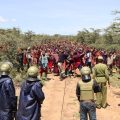
According to eyewitness, a scuffle ensued during which police and the UPDF officers exchanged gunfire. In the process, Karamagi’s car and another used by police officers had their tyres flattened.

“Karamagi was my manager before they had blocked us from this land. All along, they have been tracking him; I do not know what they need from him,” Nabasa said.

Mudede said that several bullets that were fired left the residents in the area in panic.

Authorities speak out

When contacted for a comment, Christopher Ayine, the Hoima deputy resident district commissioner, confirmed the incident.

Ayine said they have instructed the Hoima district police commander and the Albertine regional police commander to investigate the matter. “Whoever will be found in the wrong will be arrested.”

The Albertine Regional Police Spokesperson, Julius Allan Hakiza, declined to comment on the matter and referred New Vision to the UPDF.

Maj. Flavia Terimulungi, the UPDF 1st division public information officer, said that the army was following up on the issue.

Source: newvision.co.ug/

Continue Reading

MEDIA FOR CHANGE NETWORK

Thirteen years after the Karuma Hydropower Project broke ground, countless people forced from their homes are still waiting for the compensation and resettlement they were promised.

Published

on

By the Witness Radio team.

Envisioned as a cornerstone of Uganda’s energy future, the Karuma Hydropower Project aimed to boost the nation’s power supply, lower electricity costs, and secure lasting energy stability.

In 2013, work began on the 600-megawatt Karuma Hydropower Station, nestled along the River Nile in Kiryandongo District. Led by China’s Sinohydro Corporation, the project transformed over 465 hectares with an underground power station and sprawling infrastructure.

China largely financed the project, with the Ugandan government contributing alongside the Export-Import Bank of China.

Karuma was heralded as a game-changer for Uganda’s electricity landscape, set to light up more homes and fuel the nation’s ambitions for industrial and economic growth.

Yet as the power station finally became reality in 2024, many who gave up their land and homes say they are still waiting for the government’s decade-old promises of compensation and resettlement.

Over 400 households remain caught in the heart of an unresolved compensation battle, urging the government to honor its responsibility and ensure those who lost everything are finally compensated or resettled.

According to the Parliamentary Committee on Environment and Natural Resources’ report on the Ministerial Policy Statements for the financial year 2026/27, the government owes approximately UGX 70 billion to Project Affected Persons (PAPs) under the Karuma Hydropower Project.

For many victims, these delays have meant years without the land and livelihoods that once sustained them.

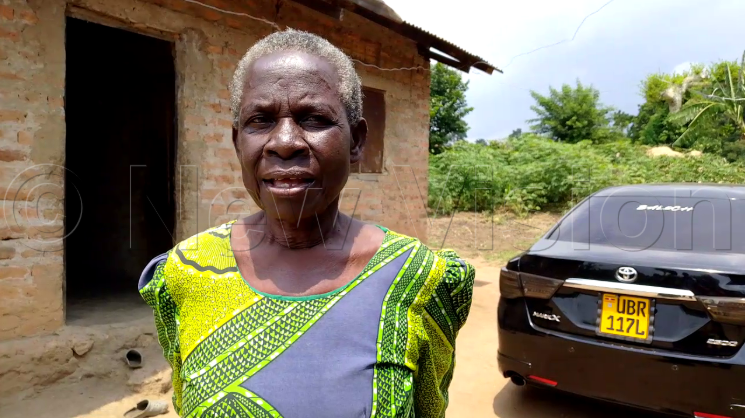
“I am growing old and don’t have a permanent job. It is becoming hard to survive after losing my land that was my family’s source of livelihood,” Owelo told the Witness Radio team.

Owelo Patrick, now 53, is still waiting for compensation. When the project claimed his eucalyptus plantation in Ayuda Village, he lost not just land, but the lifeline that once supported his family.

Thirteen years on, he finds himself renting a modest house and scraping by on odd jobs to survive.

“At this age, I work for anyone who calls me because I want to survive with my family,” Owelo adds.

He says the wait has grown more painful as some fellow claimants have died before seeing justice.

“The government should keep its promise because most of our colleagues promised compensation are dying, and for those of us alive, our patience has run out,” he says.

Apaco Suprianto Adyeeri is another whose life the project upended.

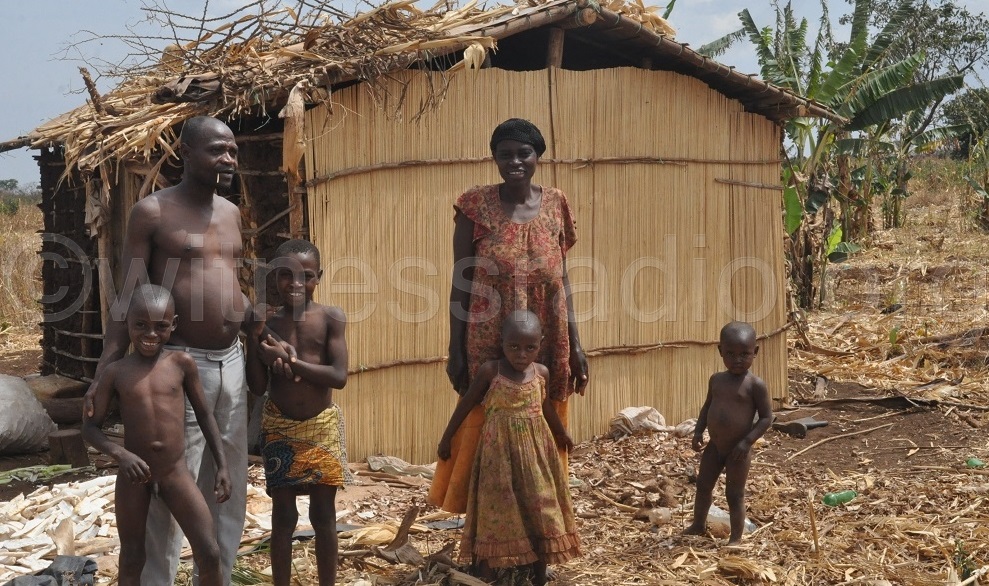
Now renting a small house along Obote Road in Karuma Town, Apaco recalls losing two acres of fertile land where she once grew cassava and other crops.

“Life is difficult because I have no money and struggle to care for my grandchildren. I don’t have a permanent house and survive on a small bar business that raises minimal income, which cannot support my family,” she says.

To make ends meet, Apaco now hires small plots of land to grow cassava, maize, and beans, hoping to earn just enough to get by.

“If the government can’t compensate us, let them give us land elsewhere to live. We expected help to rebuild our livelihood after losing our land. But 13 years later, we continue to suffer,” she reveals.

The $1.7 billion Karuma project swept through Kiryandongo District, displacing residents from villages like Nora, Akuridia, Karuma, Bedmot, and Awo.

Residents recResidents say they were forced to leave their homes and fields before any compensation arrived, destroying their farms, businesses, and means of living. Affected residents interviewed by Witness Radio said that after the eviction, the government also promised to resettle some of the affected families in Nwoya District, with each family expected to receive two acres of land and a constructed house.

Yet residents say the promised resettlement remains little more than words and has never fully materialized.

For farming families, losing land meant scrambling to rent plots elsewhere to grow food or earn a living. Others have been pushed into rented homes and still struggle to survive.

The long wait has come at a steep human cost, with some affected residents dying before receiving the compensation promised.

Seeking justice, affected families have sent repeated petitions to the President and government bodies, pleading for action on their long-overdue compensation and resettlement.

Some of their concerns are also documented in a written complaint dated 14 August 2024, signed by William Ogik and other Project Affected Persons from Karuma.

The letter, addressed to relevant authorities and copied to the Permanent Secretary in the Ministry of Energy and Mineral Development, Kiryandongo District leadership, the Chief Government Valuer, the Speaker of Parliament, Sinohydro and the Chinese Embassy in Uganda, formally outlines the communities’ grievances and calls for government intervention.

The communities voiced grievances over delayed compensation, claims of undervalued property, and the devastating loss of their farmland.

Ochaya Washington, former District Councilor and chief petitioner for the vulnerable, warns that the situation is now dire for elderly and at-risk residents who have waited years for the government to keep its word.

“People are all dying. I call upon the government and the Ministry to intervene and help these people before they perish,” he says.

Uganda’s drive for progress comes with a lesson from Karuma: true development must include timely compensation, real resettlement, and safeguarding livelihoods. Thirteen years later, many families are still waiting to piece their lives back together.

Continue Reading

MEDIA FOR CHANGE NETWORK

Ahead of COP17, development banks must confront mining’s role in accelerating desertification

Published

on

Environmental defenders warn ahead of UNCCD’s COP17 in Mongolia that development banks are financing critical mineral projects that accelerate desertification, water depletion and deforestation while claiming to support a just energy transition.

When governments gather in Ulaanbaatar from 17 to 28 August for the 17th Conference of the Parties (COP17) to the UN Convention to Combat Desertification (UNCCD), they will pledge to restore degraded land and strengthen resilience to drought. Yet many of these same governments, as shareholders of public development banks, continue to finance large-scale mining projects that degrade fragile ecosystems, deplete scarce water resources, and accelerate desertification.

That contradiction is already evident in the run-up to the summit. In a communiqué ahead of COP17, Mongolia’s foreign minister highlighted the country’s ambition to combat desertification through artificial intelligence data centres powered by renewable energy. But while presented as part of a green future, data centres and the infrastructure that supports them are driving demand for critical minerals such as copper, lithium and rare earth elements. Their expansion risks intensifying the very mining impacts that contribute to land degradation and water scarcity in arid regions.

The production of one metric ton of lithium, for instance, requires between 1 and 2 million liters of water to produce. Gold and copper mining operations use chemicals for exploration and extraction, which need further water to be diluted; and this water, once contaminated, is then discharged back into the natural world. Over the years, the mining sector has developed standards to address or mitigate these impacts. Way too often, however, companies fail to comply with such benchmarks.

Mongolia, this year’s COP17 host, illustrates this tension well. Nearly 80 per cent of the country’s land is already degraded or affected by desertification, according to the government. Yet,  development banks are expanding support for critical mineral mining in the country, while failing to ensure compliance with social and environmental safeguards.

For more than a decade, pastoralist communities and environmental defenders in Mongolia have warned that Rio Tinto’s Oyu Tolgoi copper mine is heavily affecting South Gobi’s scarce water resources. Herders report that their land and wells have become increasingly dry since the mine began operating. Yet, the European Bank for Reconstruction and Development (EBRD) and the International Finance Corporation (IFC) invested a combined US$350 million in the project in 2024.


Oyu Tolgoi mine with caption

Development banks are financing desertification

Historically, public development banks have been cautious about investing directly in large-scale mining projects, due to the high social and environmental risks involved. In recent years, however, they have been heavily investing in this sector.

In November 2025, the Asian Development Bank (ADB), after avoiding mining investments for four decades, approved a controversial new Energy Policy that opens the door to financing critical mineral extraction. One of its flagship projects is the Reko Diq mine in Balochistan, Pakistan, which several development banks are funding. The mine, which sits in a highly militarised and conflict-affected region, threatens an already hyper-arid desert ecosystem with further land degradation and desertification.

In May 2026, also the World Bank Group unveiled a new strategy for metals and minerals, pledging to “quintuple support to the sector in the next five years”. Argentina is one of the target countries for this new strategy: since 2024, the World Bank has already committed nearly USD 2 billion in loans and an additional USD 1.9 billion in guarantees to support projects involving reforms and deregulation of the energy and mining sectors, as well as investments in logistical and strategic infrastructure for those sectors. These investments feed into the Incentive Scheme for Major Investments (RIGI), a government program granting extensive fiscal, legal and export benefits to large-scale extractive projects.

The World Bank and IDB Invest also funded the controversial Sal de Vida lithium mine, in a salt flat in the Catamarca province affected by seven other lithium mines. Water, already scarce in this arid territory, is disappearing quickly. As a result of mining activities, the Trapiche River has completely dried up and for local herders finding water and food for their llamas, goats or sheep is becoming a daily challenge.

Protest against lithium mining by indigenous communities in Salinas Grandes, Jujuy, Argentina. Credit Tomas Saraceno

In Zambia’s Copperbelt, approximately 5,000 people across eight communities surrounding the Nchanga and Konkola copper mines have endured decades of water and soil pollution. These impacts are rarely described as desertification, yet the loss of fertile soil, vegetation, water and agricultural livelihoods feeds directly into the wider degradation of productive land.

Zambia’s own commitments under the UNCCD set a target to rehabilitate all land degraded by mining and quarrying by 2030, in part to mitigate current desertification trends. Nevertheless, the World Bank’s US$65.6 million Zambia Mining and Environmental Remediation and Improvement Project, which explicitly targeted polluted mining areas in Chingola, brought no direct remediation to these eight communities.


Mining-affected communities call for stronger safeguards

From Mongolia to Pakistan, to Zambia and Argentina, local communities and civil society groups are sounding the alarm around the irreversible harms of this new wave of extractivist projects undertaken in the name of the “just” energy transition.

According to the UN, “up to 40% of the world’s land is degraded, affecting more than 3 billion people worldwide and with dire consequences for our climate, wildlife and livelihoods.” Drought, land degradation and desertification are already costing the global community an estimated US$ 878 billion every year. Yet, the concerns of mining-affected communities and environmental activists are either being ignored or used as a pretext to stigmatise them as “anti-development”, criminalise them and attack them.

The UNCCD promises, “we have the power to bring land back to life”. But to do so, governments and public development banks need to go beyond slogans and explicitly recognise the impacts that productive sectors like large-scale mining have on land degradation, water resources and the ecological integrity of ecosystems.

Ana Pandigracio, Biodiversity Director at Fundación Ambiente y Recursos Naturales (FARN), a former elected member of the UNCCD CSO Panel for Latin America and the Caribbean (2022–2024) and former elected IUCN Councillor (2021–2025), recommends that, to mitigate these impacts, they commit to not supporting further mining expansion in arid zones and require existing projects to comply with robust environmental safeguards and the highest applicable standards, including those set out by the  International Union for Conservation of Nature (IUCN).

As a group of CSOs recommended during a previous UNCCD conference, governments and development banks should also support community-led initiatives, particularly those led by women, youth, pastoralists and Indigenous Peoples, and integrate their knowledge into drought management strategies.

Economic development should not come at the cost of greater land degradation, worsening water scarcity or mounting social and environmental harms for current and future generations. Instead, public development banks need to invest in community-led solutions that protect, restore and sustainably manage ecosystems while respecting the rights of the communities that depend on them.

Source: rightsindevelopment.org

Continue Reading

MEDIA FOR CHANGE NETWORK

Smallholder farmers and civil society organizations have launched a dynamic media campaign for the inaugural Eastern Africa Indigenous Seed Conference, inviting more smallholder farmers to join the agroecology movement.

Published

on

By the Witness Radio team

NAIROBI, Kenya: Seed sovereignty champions, farmers, researchers, and civil society groups from across East Africa have united to launch a media campaign for the first Eastern Africa Indigenous Seed Conference. Their call is urgent: recognize and protect farmer-managed seed systems as seed regulations, commercialization, and the loss of indigenous diversity threaten the region. The campaign aims to rally smallholder farmers for the conference, highlighting how indigenous seeds and ancestral wisdom can revive biodiversity, combat climate change, and secure food sovereignty.

Set for 17 to 20 November 2026 at the Catholic University of Eastern Africa in Nairobi, the four-day conference will gather farmers, pastoralists, researchers, policymakers, seed guardians, civil society, and development partners to shape the future of indigenous seeds and food systems in the region.

The conference will be held under the theme “Realizing the Right to Food through Seed Sovereignty.”

This launch comes as farmers and seed sovereignty advocates question whether East Africa’s seed laws and regulations truly honor the farmer-managed systems that for generations have allowed communities to select, conserve, exchange, and replant their own seeds.

Activists warn that the growing focus on certified and commercial seed systems threatens traditional knowledge, reduces local seed diversity, and undermines farmers’ freedom to save, exchange, and reproduce varieties adapted to their land.

Daniel Wanjama, Executive Director of Seed Savers Network, said farmer-managed seed systems remain central to food production across the region, arguing that commercial seed systems cannot provide the seed diversity farmers need in different environments.

Wanjama added that about 80 percent of the seeds farmers use in the region come from farmer-managed seed systems, underscoring the importance of supporting farmers in conserving and developing their own varieties.

“There is no commercial seed system that can provide the seeds that farmers need because diversity is part of a resilient mechanism,” he said.

He emphasized that preserving a wide variety of locally adapted seed varieties is crucial as farmers face mounting challenges from climate change.

Wanjama also pointed out a troubling disconnect between current seed policies and the realities faced by smallholder farmers across face across “The policies across the region are not aligned, and just to give you an example, recently last year in Kenya, the high court found the act that is governing the seed sector in Kenya was unconstitutional because it is limiting the farmers’ rights in being able to access seeds,” he said.

He argued that some African seed laws borrow regulatory models from highly commercialized agricultural systems abroad, making them ill-suited for local contexts.

“The laws are cut and paste from the global north where farming is largely commercial and large-scale; they don’t fit our circumstances. That’s why we need to come together and discuss what we can do about it,” he added.

Amid the seed sovereignty debate, African farmers and civil society organizations are championing Farmer-Managed Seed Systems, building community seed banks, and pushing for greater recognition of farmers as stewards of seed conservation and exchange.

In Uganda, farmers and civil society groups are increasingly turning to community-driven seed conservation, offering a grassroots alternative or complement to formal seed supply systems.

Nancy Mugimba, National Coordinator of the Eastern and Southern Africa Smallholder Farmers Forum (ESAFF) Uganda, said farmers sometimes face planting delays because existing support systems provide inadequate access to seed.

She said some of the seeds provided to farmers are also not necessarily suited to the conditions of particular communities.

Mugimba noted that efforts are now focused on strengthening community seed banks, empowering farmers to cultivate and safeguard the varieties they know and trust.

“We have introduced seed banking in communities, which is not new because farmers were already doing it at home. We have just increased capacity to ensure it works effectively,” she said.

She observed that farmers are more motivated to protect indigenous varieties when they see their vital role in sustaining food supplies and ensuring seed access within their communities.

Panelists urged governments to boost support for farmer-managed seed systems, advocating for multiplying indigenous varieties beyond research and breeding. They stressed that empowering community seed banks and local seed multiplication would expand access to diverse, locally adapted varieties.

The discussions also showcased the diverse strategies emerging across East Africa to revitalize and improve seed systems.

In Tanzania, the seed sector is undergoing reforms to expand access to and use of improved seed while strengthening seed production, quality assurance, and commercial distribution. The Tanzania Seed Sector Development Strategy (TSSDS), approved in May 2026 and covering up to 2030, aims to double the area under improved seed from about 3 million to 6 million hectares and expand the agro-dealer network from around 3,000 to 12,000 to improve farmers’ access to quality seed.

Daud Manongi, Program Lead for the Biodiversity Conservation Program at Tanzanian organization TABIO, said farmers still face restrictions on selling seed within the country’s formal regulatory framework.

“Our farmers are currently not allowed to sell their seeds within the developed framework, but so far we have approved seeds,” Manongi said.

He said the Tanzanian government has approved 13 local varieties for wider production and use. At the same time, discussions are ongoing with the Tanzania Seed Certification Agency (TASC) on how to make registration and market processes more accessible to smallholder farmers.

Manongi noted that farmers and organizations championing local varieties still face hurdles like taxation and limited dialogue with policymakers.

“There is inconsistent engagement with policymakers, and sometimes it is difficult for them to cooperate with farmers on accessing locally adapted varieties because of tax issues,” he said.

He also said agricultural extension services often prioritize commercial seed production, leaving farmers with little support for indigenous varieties.

According to Manongi, farmers urgently need access to knowledge about indigenous seed production and conservation to boost the availability of locally adapted varieties.

Activists insist that farmers’ power to conserve, exchange, and reproduce seeds is deeply tied to food security, biodiversity, cultural heritage, and the resilience of communities facing climate change.

The inaugural Eastern Africa Indigenous Seed Conference, organized by Seed Savers Network with partners like Witness Radio, promises to be a vital regional platform for these urgent issues.

This November, the conference will spotlight the defense of farmer-managed seed systems against corporate and legal pressures, while also strengthening climate resilience, safeguarding biodiversity, and weaving stronger regional networks among farmers, researchers, policymakers, and civil society.

The event comes as climate change, biodiversity loss, commercial agriculture, and shifting policies intensify strain on traditional farming systems across the region.

For smallholder farmers, seed sovereignty is about more than where seeds come from. Advocates say it is a question of who holds the power over food production, and whether farmers will retain the freedom and ability to save, share, and reproduce the seeds that sustain their communities.

Continue Reading

Resource Center

Legal Framework

READ BY CATEGORY

Facebook

Newsletter

Subscribe to Witness Radio's news and report updates


Trending

Subscribe to Witness Radio's news and report updates