
SPECIAL REPORTS AND PROJECTS
Surveillance forces journalists to think and act like spies

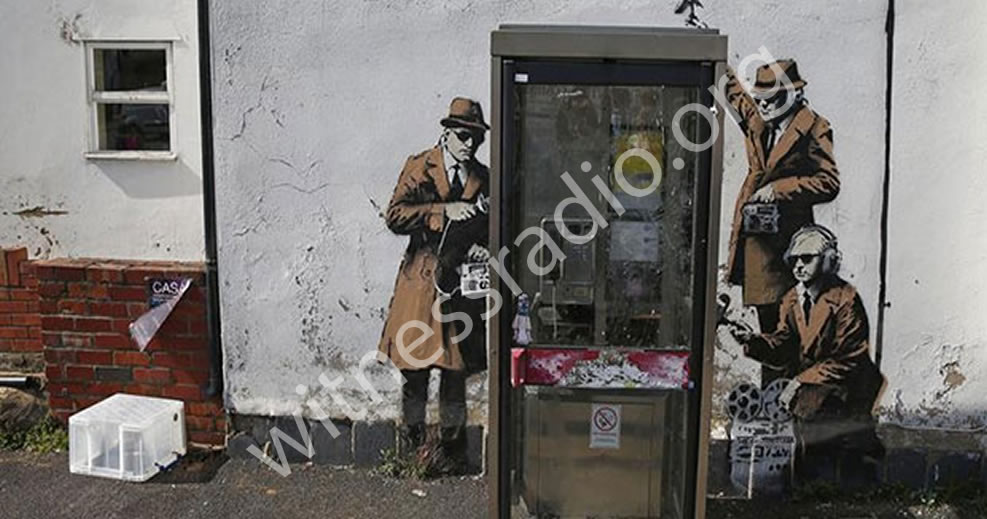
Once upon a time, a journalist never gave up a confidential source. When someone comes forward, anonymously, to inform the public, it’s better to risk time incarcerated than give them up. This ethical responsibility was also a practical and professional necessity. If you promise anonymity, you’re obliged to deliver. If you can’t keep your word, who will trust you in the future? Sources go elsewhere and stories pass you by.
Grizzled correspondents might recall this time with nostalgia. For many young journalists, it’s more like historical fiction–a time when reporters could choose not to give up a source, gruff editors chain-smoked cigars, and you could spot a press hack by the telltale notebook and card in the brim of a hat.
The experience of a new generation of news writers tells a different story. Whether you choose to yield a source’s name is secondary. Can you even protect your source to begin with? Call records, email archives, phone tapping, cell-site location information, smart transit passes, roving bugs, and surveillance cameras–our world defaults to being watched. You can perhaps achieve privacy for a few fleeting moments, but, even then, only with a great deal of effort.

Yet this is journalism’s brave new world. In the United States, the National Security Agency, otherwise known as the NSA, seeks to listen to every electronic communication sent or received. In the U.K., the Government Communications Headquarters, or GCHQ, has succeeded in intercepting and storing every peep that passes over the wires. Commercial spy software FinFisher (also called FinSpy) monitors citizens in at least 20 other countries, according to a report by The Citizen Lab, a research group based at the Munk School of Global Affairs at the University of Toronto in Ontario, Canada. Global Information Society Watch’s global report details the state of communications surveillance in plenty more. Even Canada’s spy agency may be watching Canadians illegally, though the GISWatch report could not say so conclusively.
If journalists can protect the identity of their sources at all, it’s only with the application of incredible expertise and practice, along with expensive tools. Journalists now compete with spooks and spies, and the spooks have the home-field advantage.
Shadowy worlds of subterfuge and surveillance should not be a journalist’s habitat. The time journalists spend learning to play Spy-vs.-Spy could be better spent honing their craft. Every hour spent wrangling complex security tools could be an hour spent researching and writing. All the staff on a newsroom’s security team could be writers and editors instead. Each geeky gizmo and air-gapped computer (a computer that is never connected to a network) could be another camera or microphone, or the cost could be spent on payroll. All the extra labor and logistics dedicated to evading espionage is a loss.
This poses sometimes-steep financial costs on newsrooms. If journalists and media organizations are to protect themselves, they must buy more tools and adopt practices that limit their efficiency. Robust security practices are complex and time-consuming, imposing logistical costs. The psychological toll of constant surveillance leads to exhaustion and burnout. Few journalists do their best work when they know that government thugs could break down the door at any moment–as they did at the home of independent New Zealand reporter Nicky Hager in October 2014, according to The Intercept.
Many have worked to slow the swing of the pendulum from privacy to panopticon, increasing development of anti-surveillance tools and advice for journalists. The response to widespread knowledge of the long arm of the surveillance state has been gradual but impressive. Developers have increased work on surveillance–resistance projects and anonymous tip lines. Experts have put together numerousdigital security guides and training programs, all intended to help reporters from falling under the focused gaze of government surveillance.
Perhaps the flagship of this proliferation is SecureDrop, a secure and anonymous submission system for journalists. First pioneered by the former hacker and current digital security journalist Kevin Poulsen and the late programmer and political activist Aaron Swartz under the moniker DeadDrop, SecureDrop is intended to allow potential sources or whistleblowers to get in touch with journalists without leaving any dangerous records of their identity.
SecureDrop combines several pieces of security and privacy software into an integrated system, ensuring that only the journalists can read anonymous tips. Messages are protected with PGP, the tried-and-true gold standard for this task. Sources’ anonymity is provided by Tor, the anonymity network that underpins private communications for everyone from the U.S. Navy and CIA to large businesses and survivors of domestic abuse. The result is safely encrypted messages and no metadata trail. With SecureDrop, journalists don’t just choosenot to reveal a source’s identity. Unless sources choose to reveal their identity, the reporters could not unmask sources even if they tried.
Initially just an idea and some prototype code, SecureDrop was mostly theoretical until early 2013. The first major deployment was at The New Yorker. The project was soon adopted by the nonprofit Freedom of the Press Foundation, which was founded with the specific mission of facilitating journalism that governments oppose. FPF, as the foundation is known, soon took over SecureDrop’s development and maintenance, as well as outreach and funding. More than a dozen other news organizations and prominent journalists have now deployed SecureDrop. With an ongoing crowdfunding campaign, FPF plans to bring it to many more.
SecureDrop works hard to evade even targeted attacks and surveillance. Making use of cutting-edge technology and contemporary security best practices, SecureDrop separates different tasks onto different computers. Each machine only performs part of the puzzle, so it’s very difficult to compromise the whole system at once.
This makes SecureDrop quite expensive to deploy. FPF estimates that a single SecureDrop installation would set a newsroom back around $3,000, which is a lot to ask for a tool designed to protect the most important of tips from the most advanced of snoops.
Other organizations have developed and distributed best practices and training materials. Universities have deepened their research into the threats journalists face. The Citizen Lab, already discussed in this piece, is dedicated to deep research about how technology and security affect human rights and is the source of some of the most detailed and comprehensive technical reports of recent years. If you want to know about the threats facing journalists and human rights groups, Citizen Lab is the place to go.
Yet, as deep as Citizen Lab’s work goes, it is as likely to induce security nihilism as it is to produce savvy security practices. An August 2014 report tells of terrifying new tools for state attacks on the media. Called “network injection appliances,” these devices insert malicious software into otherwise innocuous traffic. Used right, one can modify an online video, adding malware that takes over a journalist’s computer. If a journalist is using a service such as YouTube or Vimeo, session cookies allow the journalist to be targeted precisely. This makes these attacks very difficult to detect and prevent.
With this new technology, journalists don’t have to make a mistake to be compromised. Gone are the phishing days of opening a malicious attachment or clicking a suspicious link. There’s no trap to notice and avoid. Just browsing the Web puts one at risk, and avoiding online video is an impractical ask of a journalist conducting research. Network injection appliances have likely already been deployed in Oman and Turkmenistan, according to Citizen Lab, and because they’re commercially developed by private companies, the price of these devices will only continue to drop as their capabilities expand.
Another Citizen Lab paper paints a disturbing picture of government cyberattacks. Journalists, among the principal victims of this sort of technological espionage, face state-level threats while lacking the funds and expertise to protect themselves. Attacks on computer systems can reach across borders into seemingly safe locations, allowing attackers to disrupt communications and impairing journalists’ ability to do their core work. Sometimes attacks are simply a nuisance or a resource drain; at other times they present major risks to individuals’ safety.
It’s all but impossible for journalists to learn the strategies of the state and appropriate countermeasures on a shoestring budget. Websites and service providers are often better positioned to protect journalists from these attacks. Securing the everyday tools of the trade works much better than does demanding that journalists jump through arcane hoops to stay safe. Simple measures can go a long way. Just enabling secure HTTPS rather than insecure HTTP can make a huge difference. The New York Times has called on all news sites to adopt this very measure by the end of 2015.
As noted security expert The Grugq puts it: “We can secure the things people actually do, or we can tell them to do things differently. Only one of these has any chance of working.”
Since we first saw Edward Snowden’s face, in 2013, computer-security guides for journalists have multiplied, but using computers safely is hard when a government is trying to get the drop on you. Many guides only scratch the surface, detailing basic–but important–steps. Turning on automatic software updates or using password managers and two-factor authentication for online accounts make a big difference. These first steps make journalists slightly harder to attack.
In fact, simple practices probably have a greater impact than do more complex ones. Esoteric security strategies are a lot of work and sometimes only inconvenience a savvy attacker. Simple measures completely stymie simple attacks and force advanced attackers to change their tactics. A sophisticated attacker will never use an advanced technique when a simple one will do. More sophisticated attempts require more work, cost more, and are more prone to detection. Changing the game by forcing attackers to use scarce resources helps everyone stay safe.
Other guides delve deeply into advanced principles of operational security. Abbreviated “OPSEC,” the term is military jargon for measures taken to keep critical information out of hostile hands. If the phrase sounds more at home in a spy thriller than in a journalism manual, that’s a hint at the problems posed by press surveillance. Mainstream journalists and press organizations openly acknowledge their need to learn spies’ tactics and techniques to stay a step ahead.
The adoption of military tactics and an espionage mindset has a substantial downside. The Grugq explains: “OPSEC comes at a cost, and a significant part of that cost is efficiency. Maintaining a strong security posture … for long periods of time is very stressful, even for professionally trained espionage officers.”
Yet even in apparently free democratic societies, compromising a free press is the day-to-day work of the security services.
Intelligence services sometimes target journalists for surveillance, even when the missions of the agencies involved are ostensibly centered around foreign intelligence. Iranian spies orchestrate elaborate campaigns to bamboozle journalists; they even pose as journalists when targeting think tanks and lawmakers, Wired has reported. The FBI has also admitted using the latter tactic and actually defended it publicly when criticized. In the U.K., security services have abandoned restraint when it comes to surveillance of journalists and civil society, Ryan Gallagher wrote in The Intercept, summarizing: “An investigative journalist working on a case or story involving state secrets could be targeted on the basis that they are perceived to be working against the vaguely defined national security interests of the government.”
*****
Some journalists have risen to this challenge. After meeting with Snowden, Laura Poitras and Glenn Greenwald realized that traditional newspapers and media groups were not well suited to this world of watchers. They needed a new sort of organization–one ready to play spy games with professional spies from the very start.
They founded the First Look Media group with help from fellow investigative journalist Jeremy Scahill and funding from eBay mogul Pierre Omidyar. First Look’s flagship online magazine, The Intercept, is dedicated to exposing the abuses of the surveillance state. Choosing such powerful foes meant that The Intercept had to stay one step ahead from the start.
Micah Lee is The Intercept‘s resident security expert. Formerly a staff technologist at technology civil rights group the Electronic Frontier Foundation, Lee was on The Intercept team from the beginning. He designed and implemented the security measures that Greenwald, Poitras, and Scahill–and now a team of 20–use to stay safe. When asked about the infrastructure needed to protect the publication, he frankly admitted: “When we think it’ll make us safer, we normally just buy another computer or device. We’re willing to spend money on these things when there’s a clear security benefit.”
Lee was referring to security practices typically only needed when one is facing adversaries with the sophistication of governments. Protecting important information on separate air-gapped computers is a common practice at The Intercept. Lee and other technologists are fond of a security principle called “defense in depth,” an approach that assumes that some security measures will fail and calls for systems that remain secure even when that happens. In the planning for defense in depth, a process should become insecure not when onesecurity measure fails but instead when dozens do.
Systems built this way demand more hardware than do those where security is more brittle. Several computers ensure that the compromise of one will leave the others safe. Smartcards protect cryptographic keys even when other things go wrong. All of this tech costs money and requires experienced technologists like Lee to design and operate.
In keeping with this level of prudent paranoia, Lee and his colleagues often eschew regular smartphones in favor of the CryptoPhone. These $3,500 devices, made by German manufacturer GSMK, don’t just provide encrypted calls; they’re heavily customized and locked-down Android devices loaded with a whole host of custom software. They even try to detect anomalies in cellular networks that might be indicative of an attack or targeted surveillance.
These practices and this technology are the best that media organizations can buy. It’s a far cry from the James Bond-esque gadgetry that one might see at MI6 or the CIA, but, used correctly, it can keep the spooks at bay long enough for you to meet with sources and write the stories that need to be written.
Staff at The Intercept use PGP for email encryption by default. Lee estimates that more than 80 percent of the emails he sent in the last six months were encrypted in this way. For most people who aren’t security experts, PGP is a niche tool with a notoriously steep learning curve. Getting started requires hours of training and practice to wrap one’s head around complex and unintuitive principles of public-key cryptography. The process takes even longer if one doesn’t have an experienced guide.
Between building sustainable long-term security strategies and jetting around protecting the magazine’s VIP writers, Lee quickly ran out of the time needed to show each new hire how to use PGP. But he noticed that he wasn’t always needed: “Folks learn PGP the same way they do any other tricky technical thing–they Google it, or they ask their nerd friends, and sometimes they get bad advice,” he said. At The Intercept, new hires were learning PGP from folks already there–journalists and editors as well as technologists.
The Intercept had developed what Lee calls a “security culture,” an operational security term that has its roots in activism. In a “security culture,” a community adopts customs and norms that protect its members. It’s a wholesale adoption of operational security practices into the everyday work and activities of the group. The Intercept team considers security a core value, so people there are willing to work together to protect one another, even when that’s outside their usual work.
“Of course, having Erinn in New York helps, too,” Lee joked, referring to Erinn Clark, the most recent member of First Look’s security team. Clark came to First Look from the Tor Project, the nonprofit group responsible for developing Tor. Another security virtuoso, Clark is more than familiar not only with the nitty-gritty of security tools but also with the adoption of secure practices across an organization. In technology circles, the Tor Project is famous both for the exotic ways in which states have tried to infiltrate and attack it and for the extreme security measures its members have adopted to protect themselves.
Leading the incredible heavy hitters of First Look’s security team is Morgan “Mayhem” Marquis-Boire. A security superstar, Marquis-Boire worked on Google’s security incident-response team, and he is a senior researcher at The Citizen Lab. This incredible brain trust isn’t just there to keep just First Look safe. Once First Look’s basic security needs are met, the group plans to branch out. “We want the security team to start developing tools and hardware and doing bigger research.” Lee said. The team members plan to use their skills and expertise to help other organizations that can’t afford their own elite security teams.
The challenge is always resources. First Look has a billionaire on call to pay for the latest technology and fancy technologists. This is a rarity. Other journalists may face a stark choice between hard-hitting stories and staying safe.
What does information security look like at publications that don’t have First Look’s billionaire funding? FPF regularly sends technical experts to help newsrooms install, set up, and upgrade SecureDrop. Every time they set foot in a newsroom, FPF techs find themselves flooded with security questions from reporters and editors. Questions aren’t just about SecureDrop or FPF; news teams want to know about everything from the ins and out of other tools, such as OTRand Tails, to the sort of advanced operational security measures that can help them keep their heads above water when spies come snooping.
Runa A. Sandvik, a member of FPF’s technical team, said, “Even if you wanted to use these tools and had all the patience to learn them, there’s still so much conflicting information–it’s very confusing, very intimidating.” And though few media organizations have the ability to hire technologists to work with their reporting staffs, Sandvik notes that the situation for journalists not affiliated with a major organization is even bleaker: “If you have a technologist, someone to help you, that’s one thing. If you’re freelance and not overly technical, I don’t know how you’re going to work this stuff out.” She added, “Many feel overwhelmed; they don’t know who to ask for help.”
Just having a technologist to help with analysis and security may not be enough. The newsroom has to commit to understanding the issues and taking good advice. Barton Gellman, who currently writes for The Washington Post, was one of the recipients of the document cache Snowden assembled, and he knew that he didn’t have the technical skills to work on the documents alone. He brought prominent security researcher Ashkan Soltani (now chief technologist for the Federal Trade Commission) on board to help. Soltani bolstered Gellman’s security practices and helped Gellman analyze and understand the more technical material in the collection.
To make matters worse, intelligence agencies encourage confusion and misunderstanding when it comes to secure tools and practices. They try to associate a need for privacy with wrongdoing. This association makes it even harder for journalists to protect themselves and their sources. Persuading sources to protect themselves is harder when the tools of safety are associated with suspicion. In some cases, making secure tools seem suspicious actively endangers sources who live in less tolerant environs, such as dissidents in mainland China who use Tor. This doublethink is a strange flip side to the surveillance state: First, watch everyone, always, then vilify any attempt to recover some privacy. This is especially disruptive to journalists and their ability to serve as watchdogs.
Even without state propaganda and unforced errors, covert action takes a substantial toll on the press’s ability to hold leaders accountable. Espionage targeting journalists and their sources impairs the healthy function of the states where it occurs. And these practices are not just a feature of regimes known to be restrictive or autocratic.
In 2013, David Miranda was detained for most of a day while making a connection between flights at Heathrow Airport in London. Miranda was changing planes on a journey from Germany to Brazil on which he was transporting documents and video footage between Glenn Greenwald and Laura Poitras. British police held him under measures designed to combat terrorism. Their reasoning? Miranda was promoting a “political or ideological cause.”
In July 2013, surveillance agency GCHQ destroyed computers at the Guardiannewspaper in London. The security agency had already threatened the newspaper’s editors, demanding that the Guardian stop reporting on government surveillance. A security service literally knocked on the doors of a prominent and critical newspaper in Western Europe. They ground a computer into pieces with the use of power tools. All of this was done in a vain attempt to prevent the publication of more articles on a topic that discomfited the government.
These are the tools the state has at its disposal to discourage dissent. It is understandable that, for some, the risk of challenging this authority is simply too great. When these are the consequences of hard-hitting reporting, sticking to “safe” topics and innocuous pieces is a reasonable response.
But even for those who choose to continue the hard work of comforting the afflicted and afflicting the comfortable, evading the panopticon comes at a tremendous cost. There are the costs incurred in avoiding simple tools in favor of secure ones. The costs of using extra hardware to protect sensitive materials. The costs of hiring elite security teams instead of extra editors. The costs of worrying that you’ve made a mistake in your security measures. The costs of wondering whether your hotel room will be undisturbed when you get back. The costs of hoping that today isn’t the day that a government agent knocks at the door and asks to destroy your work, or worse.
When journalists must compete with spies and surveillance, even when they win, society loses.
DISCLOSURE: The author previously worked at the Tor Project, the non-profit organization responsible for developing and maintaining the Tor software and network
Tom Lowenthal is CPJ’s resident expert in operational security and surveillance self-defense. He is also a freelance journalist on security and tech policy matters.
Related posts:
 Sigh of relief as Red Pepper Journalists are released on bail
 NGOs in Ukraine call to dismiss the intelligence services’ plan to install any kind of surveillance equipment
 Manipulating Social Media to Undermine Democracy
 Journalists under duress: Internet shutdowns in Africa are stifling press freedom
SPECIAL REPORTS AND PROJECTS
‘Food and fossil fuel production causing $5bn of environmental damage an hour’


Related posts:

 Activists storm TotalEnergies’ office ahead of G20 Summit, demand end to fossil fuel expansion in Africa
 New billion-dollar loans to fossil fuel companies from SEB, Nordea and Danske Bank.
 Fossil fuel opponents lobby Africans for support
 Ecological land grab: food vs fuel vs forests
SPECIAL REPORTS AND PROJECTS
Britain, Netherlands withdraw $2.2 billion backing for Total-led Mozambique LNG
Related posts:

 Uganda, Total sign crude oil pipeline deal
 Witness Radio – Uganda, Community members from Mozambique and other organizations around the world say NO to more industrial tree plantations
 NGOs file suit against Total over Uganda oil project
 Agribusiness Company with financial support from UK, US and Netherlands is dispossessing thousands.
SPECIAL REPORTS AND PROJECTS
The secretive cabal of US polluters that is rewriting the EU’s human rights and climate law
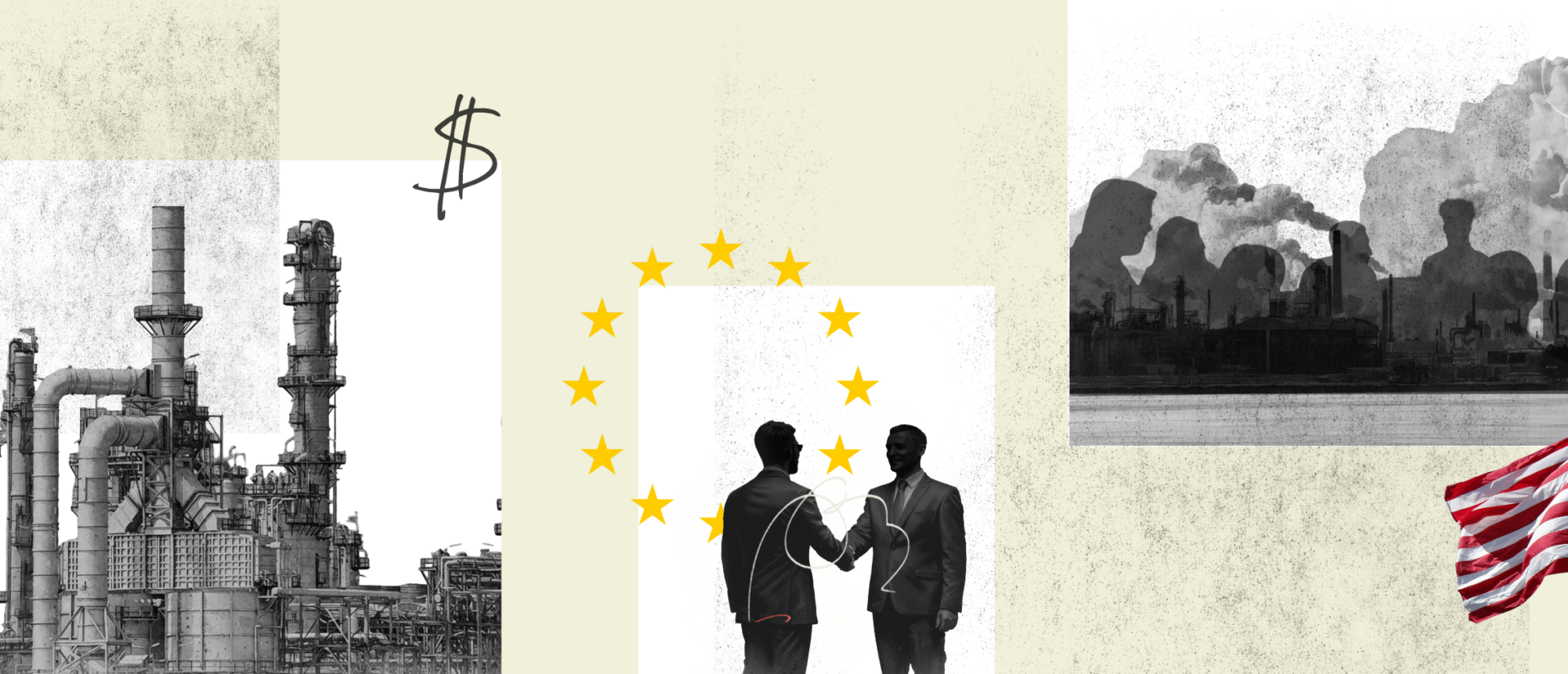
Leaked documents reveal how a secretive alliance of eleven large multinational enterprises has worked to tear down the EU’s flagship human rights and climate law, the Corporate Sustainability Due Diligence Directive (CSDDD). The mostly US-based coalition, which calls itself the Competitiveness Roundtable, has targeted all EU institutions, governments in Europe’s capitals, as well as the Trump administration and other non-EU governments to serve its own interests. With European lawmakers soon moving ahead to completely dilute the CSDDD at the expense of human rights and the climate, this research exposes the fragility of Europe’s democracy.
Key findings
- Leaked documents reveal how a secretive alliance of eleven companies, including Chevron, ExxonMobil, and Koch, Inc., has worked under the guise of a “Competitiveness Roundtable” to get the Corporate Sustainability Due Diligence Directive (CSDDD) either scrapped or massively diluted.
- The companies, most of which are headquartered in the US and operate in the fossil fuel sector, aimed to “divide and conquer in the Council”, sideline “stubborn” European Commission departments, and push the European People’s Party (EPP) in the European Parliament “to side with the right-wing parties as much as possible”.
- Chevron and ExxonMobil were in charge of mobilising pressure against the CSDDD from non-EU countries. The Roundtable companies endeavoured to get the CSDDD high on the agenda of the US-EU trade negotiations and also worked on mobilising other countries against the CSDDD, in order to disguise the US influence.
- Roundtable companies paid the TEHA Group – a think tank – to write a research report and organise an event on EU competitiveness, which echoed the Roundtable’s position and cast doubt on the European Commission’s assessment of the economic impact of the CSDDD.
While Europeans were told that their governments were negotiating a landmark law to hold corporations accountable for human rights abuses and climate damage, a secretive alliance of US fossil fuel giants was working behind the scenes to destroy it. Collaborating under the innocent-sounding name ‘Competitiveness Roundtable’, eleven multinational enterprises have worked closely to eviscerate several EU sustainability laws, including the Corporate Sustainability Due Diligence Directive (CSDDD) and the Corporate Sustainability Reporting Directive (CSRD). This Competitiveness Roundtable may be unknown, but its members are a who’s-who of polluting, mainly US, multinationals, including Chevron, ExxonMobil, and Dow. The group seems to have run rings around all branches of the EU and the Trump administration to get what they want: scrapping, or at least hugely diluting, the CSDDD.
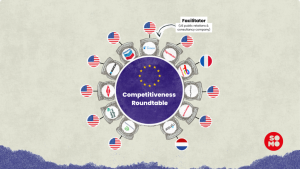
Leaked documents obtained by SOMO reveal how, under the pretext of the now-near-magical concept of ‘competitiveness’, these companies plotted to hijack democratically adopted EU laws and strip them of all meaningful provisions, including those on climate transition plans, civil liability, and the scope of supply chains. EU officials appear not to have known who they were up against. But the documents obtained by SOMO show a high level of organisation and strategising with a clear facilitator: Teneo, a US public relations and consultancy company.
The documents indicate that many of the companies involved wanted to stay hidden from view. After all, if it were widely known that a secretive group of mostly American fossil fuel companies like Chevron, ExxonMobil, and Koch, Inc. was working as a coordinated organisation to dilute an EU climate and human rights law, that might raise questions and serious concern among the public and the policymakers they were targeting. Many of the companies in the Roundtable have never publicly spoken out against the CSDDD.
Big Oil’s ‘Competitiveness Roundtable’
The Competitiveness Roundtable is dominated by fossil fuel companies, including three Big Oil companies (ExxonMobil, Chevron, TotalEnergies) and three other companies with activities in the oil and gas sector (Koch, Inc., Honeywell, and Baker Hughes). Other members are Nyrstar (minerals and metals, a subsidiary of Trafigura Group); Dow, Inc. (chemicals); Enterprise Mobility (car rentals); and JPMorgan Chase (finance).
Teneo, the Roundtable’s coordinator, has a track record(opens in new window) of working with fossil fuel companies, including Chevron, Shell, and Trafigura, and was hired by the government of Azerbaijan to handle public relations(opens in new window) when it hosted the COP29 climate conference.
In February 2025, the European Commission published the Omnibus I proposal(opens in new window), which aims to “simplify” several EU sustainability laws, including the CSDDD. The documents obtained by SOMO reveal that the Roundtable companies, which have been meeting weekly since at least March 2025, worked on deep interventions within each of the three EU institutions to get the Omnibus I package to align exactly with their views. The EU institutions are expected to reach a final agreement on Omnibus I by the end of 2025.
The documents reveal that the Roundtable companies’ activities in the Parliament are far more significant than what is visible in the EU Transparency Register(opens in new window). Eight of the Roundtable’s lobbying meetings during the Strasbourg plenary sessions of May and June 2025, listed in the Transparency Register, show Teneo as the only attendee, thereby failing to disclose the names of other Roundtable companies that participated in these meetings. Another three meetings the Roundtable held were not found in the EU Transparency Register(opens in new window) at all.
“Divide and conquer” the Council
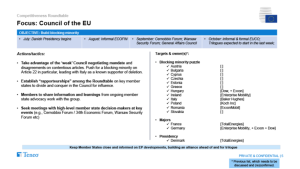
In the European Council, the Roundtable plotted to “divide and conquer” EU governments to get the climate article in the CSDDD deleted. In June 2025, during the final weeks of negotiations in the Council on the Omnibus I proposal, the Roundtable discussed lobbying EU government leaders to “intervene politically” to ensure its priorities were included in the Council’s negotiation mandate. Subsequently, German Chancellor Merz and French President Macron reportedly(opens in new window) personally intervened(opens in new window) in the Council’s political process, leading to a dramatic dilution(opens in new window) of the texts(opens in new window) negotiated in the months before the intervention. Several of the changes made to the texts strongly align with the Roundtable’s demands, including delaying and substantially weakening the climate obligations, scrapping EU civil liability provisions, and limiting the responsibility of companies to take responsibility for their supply chains (the ‘Tier 1’ restriction).

Competitiveness Roundtable meeting document, 11 July 2025.
Additionally, the documents reveal that the Roundtable is still aiming to drum up a “blocking minority” to overturn the Council’s negotiation mandate during the trilogue negotiations, which started in November 2025. By “tak[ing] advantage of the ‘weak’ Council negotiating mandate” and disagreements between EU Member States on “contentious articles”, the Competitiveness Roundtable companies hope to force the Danish Council presidency to give up on including any form of climate obligations in the CSDDD – despite EU Member States’ agreement on this in the June 2025 Council mandate(opens in new window) .
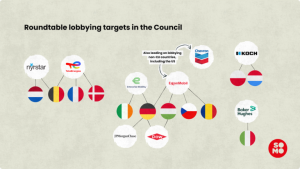
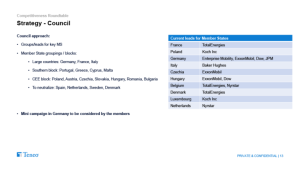
To implement the divide-and-conquer strategy, the Roundtable assigned specific companies to “establish rapporteurships” with different EU governments. TotalEnergies would target the French, Belgian, and Danish governments, and ExxonMobil would target Germany, Hungary, the Czech Republic, and Romania.
Circumventing “stubborn” European Commission departments
The Roundtable also discussed working on “circumvent[ing]” two “stubborn” European Commission departments involved in the Omnibus political process, DG JUST and DG FISMA, which, in their view, were “unlikely to be willing to see our side of the story”. According to the documents, DG JUST opposed deleting the climate article and restricting the Directive’s scope to only very large enterprises. The Roundtable aimed to diminish the role of these departments by pressuring President Von der Leyen and Commissioners McGrath (DG JUST) and Albuquerque (DG FISMA) by “organising letters from Irish and German business groups” and using an event held by the European Roundtable for Industry to “target” Von der Leyen and McGrath.
Read full report: Somo.nl
Source: Somo
Related posts:

 Victims of human rights violations in Uganda still waiting for redress
 UN Human Rights Chief urges EU leaders to approve key business and human rights legislation
 Business, UN, Govt & Civil Society urge EU to protect sustainability due diligence framework
 Development financiers fuel human rights abuses – New Report

Ten out of sixteen Rooted in Resistance activists now face charges and have been sent to Luzira Prison after standing up against Uganda’s oil development.

Civil society organizations are rallying for a robust grievance mechanism in the EAC Seed and Plant Varieties Bill.

Breaking: Sixteen Rooted in Resistance activists arrested and detained as they boldly protested Uganda’s oil ambitions.

Tanzania’s surge in conservation investments is under the UN spotlight, as allegations of indigenous land rights violations prompt an urgent call for the government to stop the evictions at once.

Minister Nabakooba wants special land title issuance halted
Breaking: Sixteen Rooted in Resistance activists arrested and detained as they boldly protested Uganda’s oil ambitions.

Rising demand for cow dung pushes prices up

Thirteen years after the Karuma Hydropower Project broke ground, countless people forced from their homes are still waiting for the compensation and resettlement they were promised.

Innovative Finance from Canada projects positive impact on local communities.

Over 5000 Indigenous Communities evicted in Kiryandongo District

Petition To Land Inquiry Commission Over Human Rights In Kiryandongo District

Invisible victims of Uganda Land Grabs
-
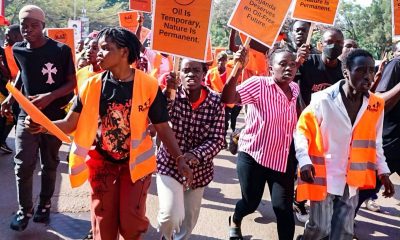 MEDIA FOR CHANGE NETWORK3 days ago
Breaking: Sixteen Rooted in Resistance activists arrested and detained as they boldly protested Uganda’s oil ambitions.
-
 MEDIA FOR CHANGE NETWORK1 week ago
Thirteen years after the Karuma Hydropower Project broke ground, countless people forced from their homes are still waiting for the compensation and resettlement they were promised.
-

 MEDIA FOR CHANGE NETWORK2 weeks ago
Civil society organizations across East Africa have revived their campaign against the EAC Seed and Plant Varieties Bill 2025, just as the regional parliament opens the floor to public consultations.
-
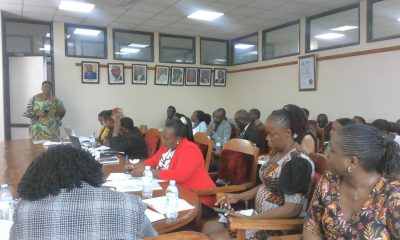
 MEDIA FOR CHANGE NETWORK6 days ago
East African Community member states launched public hearings this week for the Seed and Plant Variety Bill 2025, marking a significant step in shaping the region’s agricultural future.
-

 MEDIA FOR CHANGE NETWORK1 week ago
AGRA at 20: New report reignites debate over Africa’s farm model
-
 MEDIA FOR CHANGE NETWORK3 days ago
Tanzania’s surge in conservation investments is under the UN spotlight, as allegations of indigenous land rights violations prompt an urgent call for the government to stop the evictions at once.
-

 MEDIA FOR CHANGE NETWORK2 weeks ago
Smallholder farmers and civil society organizations have launched a dynamic media campaign for the inaugural Eastern Africa Indigenous Seed Conference, inviting more smallholder farmers to join the agroecology movement.
-
 WITNESS RADIO MILESTONES6 days ago
MPs recover hundreds of land files hidden near Mukono land office