Connect with us

SPECIAL REPORTS AND PROJECTS

Will more sovereign wealth funds mean less food sovereignty?

Published

on

In November 2022, word got out that Ferdinand Marcos Jr, the freshly minted president of the Philippines, wanted to set up a sovereign wealth fund. People scratched their heads. What wealth? The Philippines is mired in debt! It was quickly understood that this was a kind of vanity project, meant to improve the image of a man who came to power because of his family name.
Marcos’ father ruled the Philippines from the mid-1960s to the mid-1980s with an iron fist. Known more for kleptocracy and the brutality of martial law, the Marcos name needed a face-lift, local media put it. Marcos boasted that a sovereign wealth fund would boost investor confidence and attract resources to fund big projects in infrastructure or agriculture. He even dubbed it “Maharlika Fund”, a nod to the mythical warrior figure that his father claimed to personify during World War II.
Vanity aside, Marcos’ proposal raised fears of graft and corruption. After all, not long ago, Malaysia’s sovereign wealth fund (known as 1MDB) was exposed as a multi-billion dollar money laundering scheme for the personal benefit of Prime Minister Najib Razak, who now sits in jail. Yet, Marcos managed to get his proposal onto his country’s legislative agenda in a matter of weeks, and brought it to international investors in Davos and Tokyo for their approval as well.
What are these “sovereign wealth funds”? How are they being used? What link, if any, do they have with people’s struggles around food sovereignty, land grabbing and today’s deepening climate crisis?
Rise of sovereign wealth funds
The first sovereign wealth funds were set up in the 19th century, and grew slowly throughout the 20th. The idea, at first, was rather simple. If a state has excess resources – perhaps mineral wealth or a sudden boom in foreign exchange from exports – these should be tucked away for future use for the benefit of society.
Norway is the classic example. In the late 1960s, oil was discovered off its coast. Overnight, the country become unfathomably rich. After much debate, the government decided to set up a wealth fund – basically a piggy-bank belonging to all Norwegians. It is fed by a tax levied on the oil and gas extracted from Norway’s seabed, plus the revenues of Norway’s state-owned oil and gas companies.
This wealth is meant to be used “for present and future generations”. To ensure this, no one is allowed to touch the underlying pot of money itself, but the interest it earns each year goes into the national budget to pay for things like public health care, generous parental leaves, retirement pensions and public infrastructure. In concrete terms, Norway’s wealth fund contains $1.1 trillion. That money is invested in 9,000 publicly-listed companies across 70 countries around the world. The investments generate a return of about 3% a year, which is what goes into the national budget to provide everyone in Norway with those public services. It has become a source of national pride and unity across the political spectrum.
Many sovereign wealth funds were set up with a similar logic. The “wealth” may come from diamonds (Botswana) or copper (Chile), foreign currency reserves (China) or export earnings (Saudi Arabia). Even the state of Texas in the United States wrote into its constitution back in the 1850s that “available public lands” should be used to finance public schools. To do this, lands were either sold outright or were leased with the proceeds feeding a Permanent School Fund (a sovereign wealth fund) run by a trio of local civil servants. In all of these cases, the funds are created with resources that arguably belong to everyone and serve a public interest objective such as guaranteeing social rights (e.g. retirement for all in Norway) or covering national budget deficits in times of crisis (e.g. as happened with Covid-19 in Peru) or providing children with access to education (Texas).
Recently, however, governments have started diverging from this logic. Increasingly, sovereign wealth funds are being set up with no resources or wealth or sovereign character to speak of. Indonesia’s sovereign wealth fund, which was set up in 2021, is more like a “development” fund. It aims to secure foreign investment from companies, banks and funds in order to build local infrastructure and energy projects. Not much different from what the government already does. The Philippines’ proposal is more like a “public-private partnership” fund, as foreign investors will be asked to do joint ventures with the state or with local businesses. At one point, the government was proposing that the fund should be handed over to the private sector and listed on the stock market! Quite a number of small countries with no surpluses to speak of have set up sovereign wealth funds by offering citizenship to wealthy individuals (leading to corruption scandals as well).
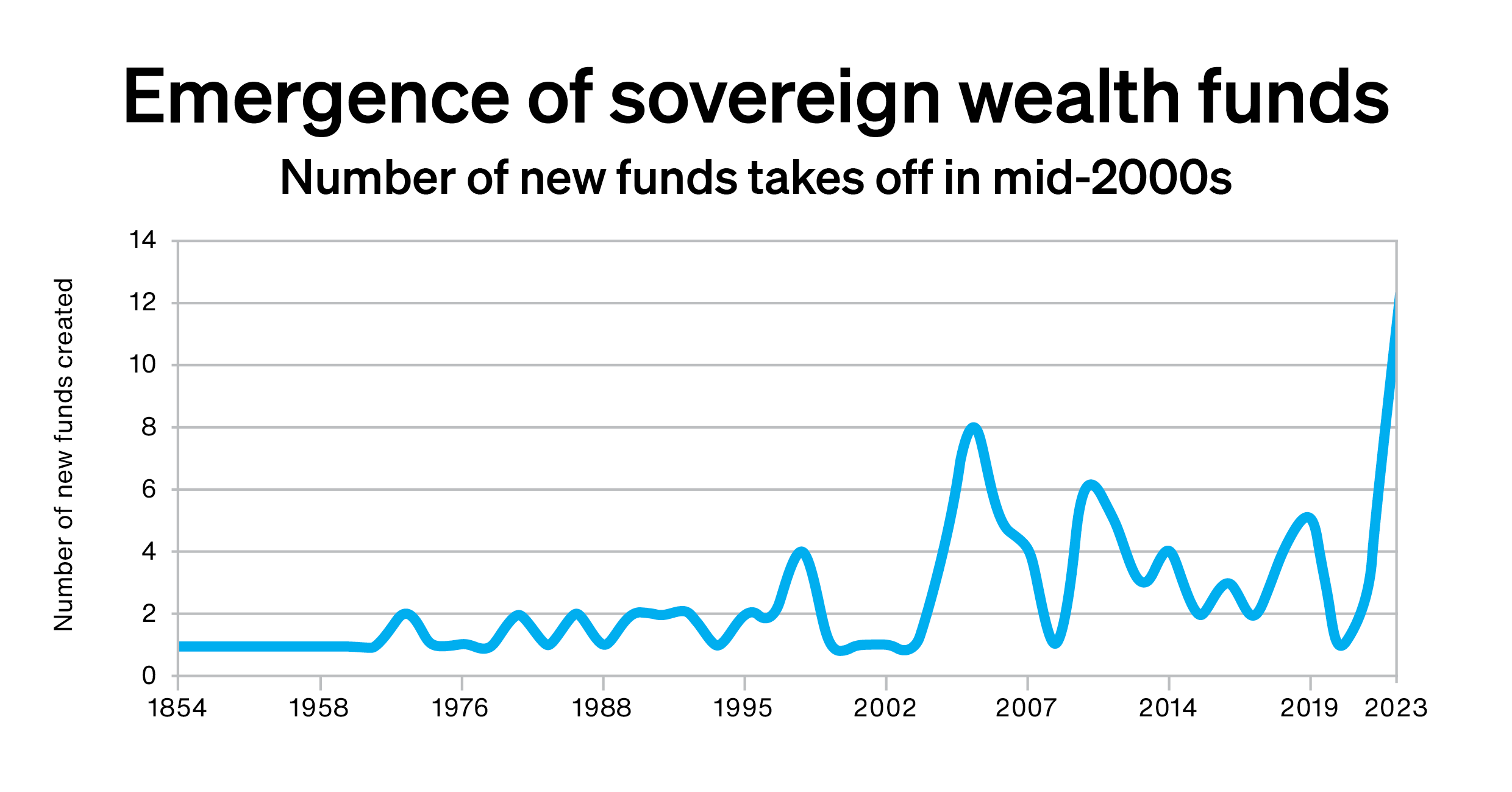
Over the past two decades, the number of sovereign wealth funds has surged (see graph) and there are now more than 100 sovereign wealth funds around the world.[1] Collectively, they hold $10 trillion – which makes them the third largest economy, after the US and China, if they were a country. That figure is expected to reach $17 trillion by 2030. While most sovereign funds are national in scope, some are sub-national. The state of Queensland, in Australia, has one. Palestine has one. Even the city of Milan has one.
Some of these funds invest only abroad, some invest only at home and some do both. Key sectors they put their money in, to capture earnings, include energy, technology, health, finance and real estate. All told, sovereign funds are so massive that most people have probably had some connection to them, as they own bits of Alibaba, Flipkart, Uber, Slack, Grab, major airports, the world’s top football teams and social media like Twitter. Anyone paying for these is actually helping sovereign wealth funds take money home.
And while it seems to be a trend among political elites these days to think that setting up such structures can bring funds into the global South, 80% of sovereign wealth fund assets is currently parked in Europe and North America. In fact, one-third is in the US alone.
Agriculture: a critical concern
In dollar terms, food and agriculture represent just 2-3% of all sovereign wealth fund investments. While that sounds small, it is a politically sensitive and strategic sector for many governments. Contributing to national food security has been a historic role for sovereign funds, and it is a vital one for those of Singapore and the Gulf states.
At least 42 sovereign funds are currently invested in food and agriculture (see table). Some are major players, but many are less visible (see box). Their investments may be in largescale farmland acquisitions and production, such as orange groves in Brazil, cattle ranches in Australia or vertical pig farms in China. Some take the form of ownership stakes in global food commodity traders that ship grains, oilseeds and coffee across our oceans, like Bunge, COFCO or Louis Dreyfus. Yet others are positions in food retail systems like supermarket chains or delivery services, and the digital technologies that these operations increasingly rely on.
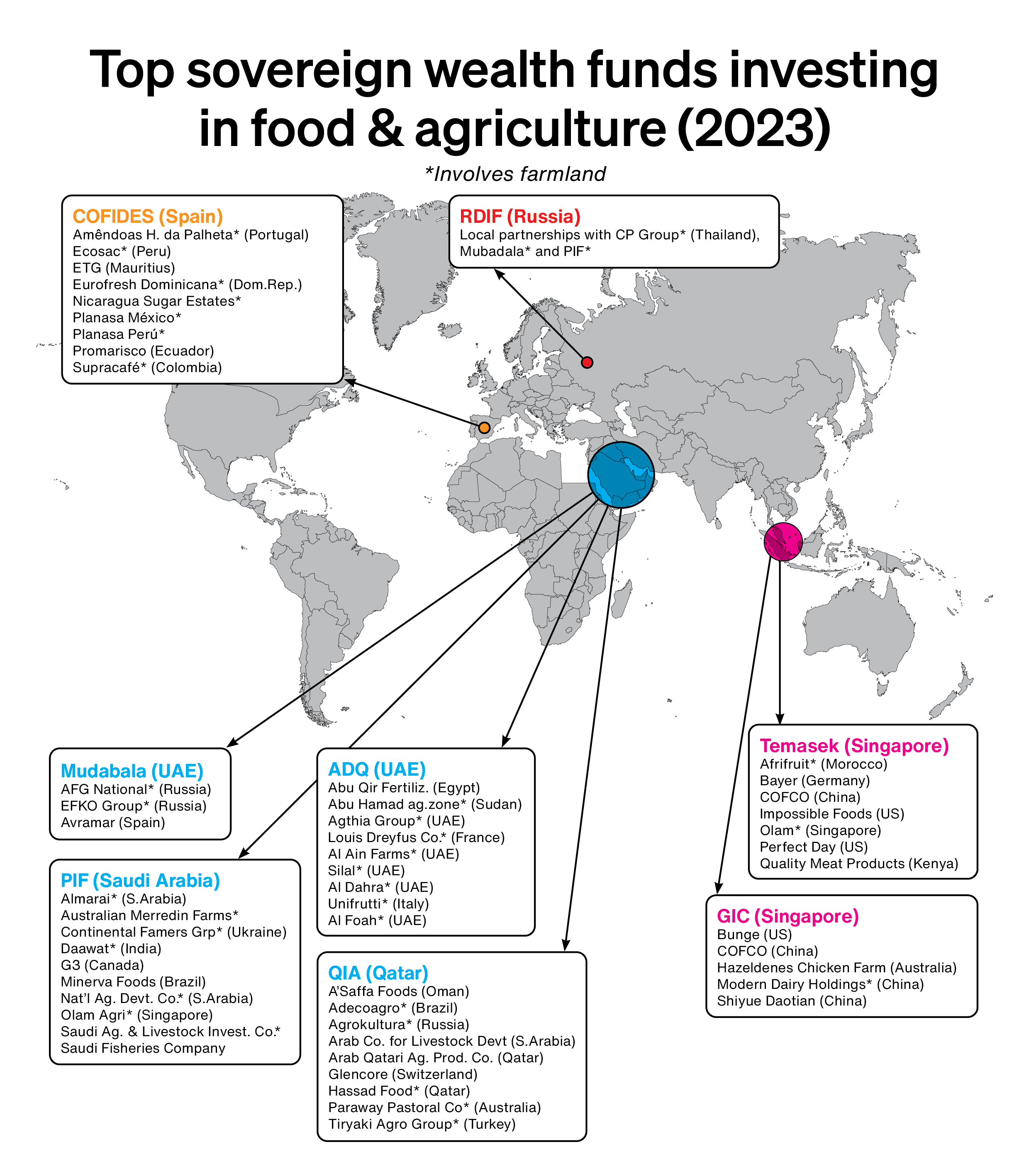
A handful of actors form the centre of gravity of global agricultural investing by sovereign funds. They are Temasek and GIC in Singapore; PIF in Saudi Arabia; Mubadala and ADQ in UAE; QIA in Qatar; RDIF in Russia; and COFIDES in Spain (see map). The Singaporeans and the Gulf states invest with their own food needs as a priority. RDIF brings big investors into Russia to help finance its export-oriented agribusiness sector. And COFIDES funds food projects around the world with one catch: a Spanish company must be directly involved in and profit from it, such as Borges with almond production in Europe or Pescanova with fish farming in Latin America. (Actually, there is a second catch: all of COFIDES’ overseas food and agriculture investments are loans.[2])
Quite a number of sovereign wealth fund ventures in agriculture are linked to concerns about land and water grabbing, whether directly and indirectly. In December 2022, Abu Dhabi’s government-owned ADQ, which has $110 billion in assets, got hold of 167,00 hectares of farmland in northeast Sudan.[3] It plans to grow sesame, wheat, cotton and alfalfa there, while it builds a massive new port nearby to ship the goods out. ADQ already owns:
  • 45% of Louis Dreyfus Company, with its massive land holdings in Latin America, growing sugarcane, citrus, rice and coffee;
  • a majority stake in Unifrutti, with 15,000 ha of fruit farms in Chile, Ecuador, Argentina, Philippines, Spain, Italy and South Africa; and
  • Al Dahra, a large agribusiness conglomerate controlling and cultivating 118,315 ha of farmland in Romania, Spain, Serbia, Morocco, Egypt, Namibia and the US.
Therefore, the concerns are quite serious. Al Dahra stands accused of draining aquifers in Arizona, just so that it can produce hay to transport back to UAE to feed local dairy herds.[4]
Saudi Arabia’s Public Investment Fund (PIF), one of the world’s top ten sovereign wealth funds in terms of assets, has $13.7 billion invested in agriculture. It owns several massive agribusiness conglomerates focused on livestock, dairy and fisheries. In 2021, it took 100% control of the Saudi Agricultural and Livestock Company (SALIC) which is engaged in meat and cereal production in Canada, Ukraine, India, Brazil, Australia and the UK.[5] The scale is enormous. In India, PIF produces its staple, basmati rice.
From Brazil, it gets its beef. In Australia, it operates 200,000 ha for sheep grazing and also buys lamb and mutton directly from producers. In Ukraine, it has 195,000 ha growing wheat, barley, maize and rice. PIF also owns 35% of Olam Agri, a major palm oil producer, and is building the largest vertical farm in the entire Middle East and North Africa region.[6] It is very strange, then, to learn that PIF’s new green financing instrument will explicitly exclude funding for any projects or expenditures associated with industrial agriculture or livestock![7] It shows the doublespeak of investors that expand intensive industrial food systems while needing to flash climate credentials.
Another very big player is Qatar. Its sovereign wealth fund has massive land holdings in Australia, through a stake in the 4.4 million ha Paraway Pastoral Company dedicated to livestock production. The fund allows Qatar to source its organic food supplies through Canada’s Sunrise Foods, which operates in Turkey, Netherlands, Russia, Ukraine and US. It owns poultry and seafood companies in Oman, and is now developing agriculture supply chains in East Africa. The Qatari wealth fund is connected to a Russian oil company which owns 50% of Agrokultura, which operates 200,000 ha of farmland in Russia. It also owns 14% of AdecoAgro with its 472,862 ha hectares under production in Argentina, Brazil and Uruguay. It is now going into Kazakhstan for the same purposes – and in direct competition with the UAE.[8]
It is important to note that many of these arrangements between sovereign wealth funds and global agribusiness involve political guarantees. Qatar is one of the biggest investors in Glencore, with whom it has a deal to ensure its access to grains and shipping services in case of need. The same is true with Qatar and Turkey’s Tiryaki Agro Group. The fund’s agricultural arm, Hassad Food, has its own agreement with Sunrise Foods which ensures that in the event of any shortage in the Qatari market, the country’s need for grain, oilseeds and wheat will be met on a priority basis.[9] Similarly, when Abu Dhabi’s ADQ bought 45% of Louis Dreyfus – the world’s third largest commodity trader – it signed a side deal giving it priority access to food shipments in times of global crisis, as the world experienced recently during both Covid-19 and the Russian invasion of Ukraine.[10]
It is fair to say that the political strategy of leveraging sovereign wealth to get access to global food supplies works. What is never mentioned is at what cost. For many of these big investment projects expand and entrench largescale corporate agribusiness, with its contingent slew of land conflicts, water pollution, indigenous rights abuses, labour violations and spiralling climate emissions. And when it comes to the Gulf states or Singapore, these are very small populations draining the resources of much bigger ones. With sovereign funds, scale is baked in. Even when they do try to reckon with social and environmental contingencies, as in the case of PIF, their attempts at making investments green or socially responsible are shallow at best. Only Norway’s stands out as making strong commitments to scrutinise and withdraw from agribusiness companies associated with social and ecological crimes, as it has done with meat packers and soy producers in Brazil (Minerva, Marfrig, SLC Agricola and JBS) as well as rubber giant Halcyon Agri.[11]
So, to answer the question: what do these funds have to do with food sovereignty? The answer is: it’s twisted. They do provide food security for a few countries. And political elites increasingly like to use the term food sovereignty to characterise these missions, as it serves their nationalist, territorial and militarist frameworks.[12] But sovereign wealth funds crush real visions of food sovereignty as they take resources away from local communities and push a capitalist, industrialist food system – be it green or not.
Putting the public interest first
Sovereign wealth funds can be a good idea if they really are sovereign (run by the people), if the resources they harness are democratically sourced and organised, and if they have a genuine public welfare mandate. We actually need more commitment to public approaches to reverse the growing inequality and privatisation that is undermining people’s rights to healthcare, housing, transportation, food, education and retirement in most countries around the world.
But there is a danger. There are increasing calls to set up sovereign wealth funds to solve government problems – from building a new capital city in Indonesia to plugging an alleged deficit in France’s pension system. But these newer funds are just tools to channel money into government coffers or private enterprises. They are not built on any collective resource or aimed at protecting a public wealth for the benefit of future generations. They seem to have little to do with traditional sovereign wealth funds, apart from the name. For that reason, they should be scrutinised and if they don’t genuinely serve the public interest they should be stopped. Similarly, those that contribute to land or water grabbing should be challenged and stopped, too.
Agriculture may not be the number one sector that these funds gravitate towards to generate wealth. But politically, geopolitically and strategically, food security is a core concern of theirs and will continue to be, requiring our critical scrutiny as well.
We need good public services that provide for public well-being. Sovereign wealth funds – despite their name – need to be put to a more scrupulous test to see if they have a role to play in that agenda.
Less visible players: Big players aside, many sovereign wealth funds participate in financing the direction of food and agriculture.[13]
• Angola’s sovereign wealth fund is investing in food and agriculture in Africa through a private equity fund that is targetting the production of maize, beans, soybeans, rice and cattle.
• Australia’s sovereign wealth fund has a Future Drought Fund since 2019. Currently holding A$4.5 billion, its sole aim is to “provide secure, continuous funding to support initiatives that enhance the drought resilience of Australian farms and communities.” Its investments must deliver returns of 2-3% above the consumer price index.
• Bolivia has a sovereign wealth fund that was set up in 2012 with state surplus funds and a loan from the central bank. It invests domestically in both public and private enterprises involved in honey production, fruit processing, aquaculture, dairy, quinoa and stevia.
• Brunei’s new sovereign wealth fund is considering investing in agriculture, in partnership with the Malaysian Investment Development Authority.
• Not much is known about how China’s sovereign wealth funds invest. The China Investment Corporation has $1.3 trillion, making it the largest in the world. It invests in agriculture overseas and reported a remarkable return of 14.27% on its overseas holdings in 2021. Equally remarkable, alternative investments, which include private equity and farmland, are said to account for 47% of its overseas portfolio. China’s National Social Security Fund is also a sovereign wealth fund and is invested domestically in agriculture through its private equity portfolio.
• France’s sovereign fund is known to be a big investor in agriculture and food, both domestically and abroad. One very controversial foreign project it is connected to is led by Arise IIP, a subsidiary of Olam, in Chad.[14]
• Gabon’s sovereign wealth fund, built from oil revenues, runs a private equity fund that invests in the food and agriculture sector. It also invests directly in agriculture and farmland projects at home.
• The National Development Fund of Iran has some $24 billion, most of it from oil and gas revenues and all of it invested domestically. According to some sources, 1% is invested in water and agriculture, including farmland ownership, a sector the fund wants to invest more in.
• Ithmar Capital, a state investment company, serves as Morocco’s sovereign wealth fund. Details are lacking but their strategy is to co-invest in Moroccan agribusiness operations with foreigners such as Spain’s COFIDES or Gulf state investors.
• Nigeria, like Abu Dabhi and Spain, has its sovereign wealth fund investing in fertiliser production. This is a very strategic concern.
• Palestine’s sovereign wealth fund is a public company that does local impact investing. Its initial funds came from the Palestinian Authority. It is invested in a 50 hectares seedless grape farm, looking into investing in animal feed production and helping set up a National Agriculture Investment Company.
• Türkiye Wealth Fund has 2% of its investments in food and agriculture, as of 2019.
• In the US, the states of Texas, New Mexico and Alaska have sovereign wealth funds that are heavily invested in farmland, whether directly or through private equity funds. The agribusiness operations they fund are in some cases domestic and in others overseas (usually in the Southern Cone of Latin America or Australia).
• Vietnam’s State Capital Investment Corporation is invested in agriculture/farmland through a joint venture with the State General Reserve Fund of Oman, showing how co-investing is a common strategy of sovereign funds.
Sovereign wealth funds invested in farmland/food/agriculture (2023)
Country
Fund
Est.
AUM (US$bn)
China
CIC
2007
1351
Norway
NBIM
1997
1145
UAE – Abu Dhabi
ADIA
1967
993
Kuwait
KIA
1953
769
Saudi Arabia
PIF
1971
620
China
NSSF
2000
474
Qatar
QIA
2005
450
UAE – Dubai
ICD
2006
300
Singapore
Temasek
1974
298
UAE – Abu Dhabi
Mubadala
2002
284
UAE – Abu Dhabi
ADQ
2018
157
Australia
Future Fund
2006
157
Iran
NDFI
2011
139
UAE
EIA
2007
91
USA – AK
Alaska PFC
1976
73
Australia – QLD
QIC
1991
67
USA – TX
UTIMCO
1876
64
USA – TX
Texas PSF
1854
56
Brunei
BIA
1983
55
France
Bpifrance
2008
50
UAE – Dubai
Dubai World
2005
42
Oman
OIA
2020
42
USA – NM
New Mexico SIC
1958
37
Malaysia
Khazanah
1993
31
Russia
RDIF
2011
28
Turkey
TVF
2017
22
Bahrain
Mumtalakat
2006
19
Ireland
ISIF
2014
16
Canada – SK
SK CIC
1947
16
Italy
CDP Equity
2011
13
China
CADF
2007
10
Indonesia
INA
2020
6
India
NIIF
2015
4
Spain
COFIDES
1988
4
Nigeria
NSIA
2011
3
Angola
FSDEA
2012
3
Egypt
TSFE
2018
2
Vietnam
SCIC
2006
2
Gabon
FGIS
2012
2
Morocco
Ithmar Capital
2011
2
Palestine
PIF
2003
1
Bolivia
FINPRO
2015
0,4
AUM (assets under management) figures from Global SWF, January 2023
Engagement in food/farmland/agriculture assessed by GRAIN
[1] Important sources used for this report include: Javier Capapé (ed), “Sovereign wealth funds 2021”, IE University, Madrid, Oct 2022, https://docs.ie.edu/cgc/SWF%202021%20IE%20SWR%20CGC%20-%20ICEX-Invest%20in%20Spain.pdf; Global SWF, “2023 Annual report”, New York, Jan 2023, https://globalswf.com/reports/2023annual; the websites of Global SWF (https://globalswf.com) and SWF Institute (https://www.swfinstitute.org/) as well as Preqin Ltd.
[3] Reuters, “Sudan to develop Red Sea port in $6-bln initial pact with Emirati group”, 13 Dec 2022, https://www.farmlandgrab.org/31347.
[4] Ella Nilsen, “Wells are running dry in drought-weary Southwest as foreign-owned farms guzzle water to feed cattle overseas“, CNN, 27 Nov 2022, https://edition.cnn.com/2022/11/05/us/arizona-water-foreign-owned-farms-climate/index.html
[5] See SALIC website: https://salic.com/
[6] AeroFarms, “PIF and AeroFarms sign joint venture agreement to build indoor vertical farms in Saudi Arabia and the wider MENA region”, 1 Feb 2023, https://www.aerofarms.com/2023/02/01/pif-and-aerofarms-sign-joint-venture-agreement-to-build-indoor-vertical-farms-in-saudi-arabia-and-the-wider-mena-region/
[7] Public Investment Fund, “Public Investment Fund Green Finance Framework”, February 2022, https://www.pif.gov.sa/Investors%20Files%20EN/PIF%20Green%20Finance%20Framework.pdf
[8] See Hassad Food, “Hassad signs MoU with Baiterek to discuss investment projects that supports food security”, 12 Oct 2022, https://www.hassad.com/2022/10/12/hassad-signs-mou-with-baiterek-to-discuss-investment-projects-that-supports-food-security/ and Global Sovereign Wealth Fund, “Gulf funds drawn into soft power battle over Kazakhstan”, 25 Aug 2021, https://globalswf.com/news/gulf-funds-drawn-into-soft-power-battle-over-kazakhstan
[9] See Hassad Food, “Strategic local and international investments along with global partnerships to satisfy the market needs from grains and wheat”, 28 Mar 2022, https://www.hassad.com/2022/03/28/strategic-local-and-international-investments-along-with-global-partnerships-to-satisfy-the-market-needs-from-grains-and-wheat/
[10] Reuters, “Commodity group Louis Dreyfus completes stake sale to ADQ”, 10 Sep 2021, https://www.reuters.com/world/middle-east/commodity-group-louis-dreyfus-completes-stake-sale-adq-2021-09-10/.
[11] See Fabiano Maisonnave, “Norway oil fund omits meatpacker JBS from deforestation watch list “, Climate Fund News, 4 Apr 2018, https://www.climatechangenews.com/2018/04/04/norway-oil-fund-omits-meatpacker-jbs-deforestation-watch-list/, Earthsight, “World’s largest pension fund dumps shares in beef firm in wake of corruption scandal”, 24 July 2018, https://www.earthsight.org.uk/news/idm/worlds-largest-pension-fund-dumps-shares-beef-firm-wake-corruption-scandal and Paulina Pielichata, “Norway sovereign wealth fund divests Halcyon over environmental concerns”, Pensions & Investments, 27 Mar 2019, https://www.pionline.com/article/20190327/ONLINE/190329915/norway-sovereign-wealth-fund-divests-halcyon-over-environmental-concerns
[12] “L’Afrique sur le chemin de l’autosuffisance alimentaire”, Seneplus, 27 Feb 2023, https://www.seneplus.com/developpement/lafrique-sur-le-chemin-de-lautosuffisance-alimentaire
[13] Main sources for this box are each fund’s respective website, news clippings and Preqin Ltd.
[14] Arise, “Bpifrance and Arise IIP establish a partnership to foster agricultural materials processing and co-industrialisation projects on a pan-African scale”, 15 February 2023, https://www.ariseiip.com/bpifrance-and-arise-iip-establish-pan-african-partnership/ , and Benjamin König, “Arise IIP, la firme qui dépouille les paysans africains”, L’Humanité, 4 April 2023, https://www.humanite.fr/monde/tchad/arise-iip-la-firme-qui-depouille-les-paysans-africains-789407
Source: Grain

Continue Reading

SPECIAL REPORTS AND PROJECTS

The secretive cabal of US polluters that is rewriting the EU’s human rights and climate law
Published

on

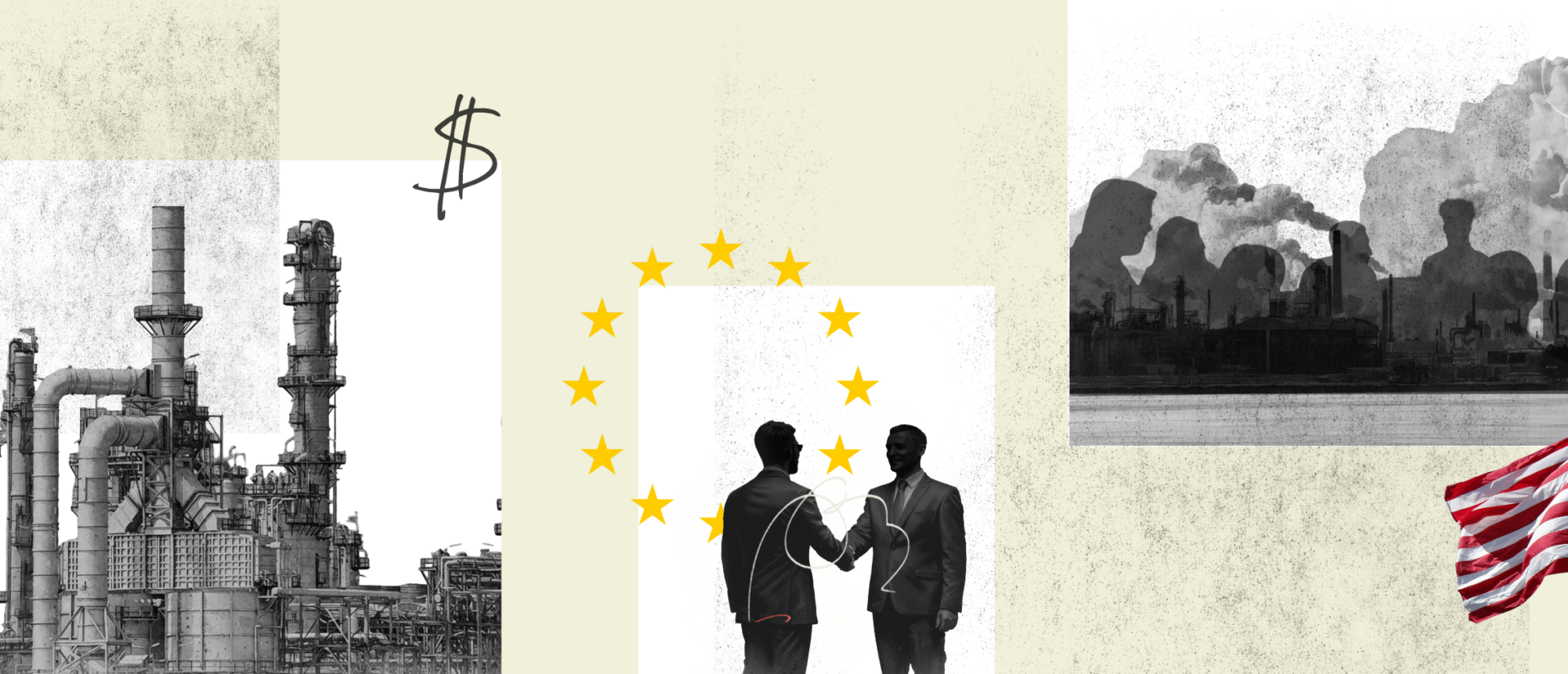
Leaked documents reveal how a secretive alliance of eleven large multinational enterprises has worked to tear down the EU’s flagship human rights and climate law, the Corporate Sustainability Due Diligence Directive (CSDDD). The mostly US-based coalition, which calls itself the Competitiveness Roundtable, has targeted all EU institutions, governments in Europe’s capitals, as well as the Trump administration and other non-EU governments to serve its own interests. With European lawmakers soon moving ahead to completely dilute the CSDDD at the expense of human rights and the climate, this research exposes the fragility of Europe’s democracy.

Key findings

  • Leaked documents reveal how a secretive alliance of eleven companies, including Chevron, ExxonMobil, and Koch, Inc., has worked under the guise of a “Competitiveness Roundtable” to get the Corporate Sustainability Due Diligence Directive (CSDDD) either scrapped or massively diluted.
  • The companies, most of which are headquartered in the US and operate in the fossil fuel sector, aimed to “divide and conquer in the Council”, sideline “stubborn” European Commission departments, and push the European People’s Party (EPP) in the European Parliament “to side with the right-wing parties as much as possible”.
  • Chevron and ExxonMobil were in charge of mobilising pressure against the CSDDD from non-EU countries. The Roundtable companies endeavoured to get the CSDDD high on the agenda of the US-EU trade negotiations and also worked on mobilising other countries against the CSDDD, in order to disguise the US influence.
  • Roundtable companies paid the TEHA Group – a think tank – to write a research report and organise an event on EU competitiveness, which echoed the Roundtable’s position and cast doubt on the European Commission’s assessment of the economic impact of the CSDDD.

While Europeans were told that their governments were negotiating a landmark law to hold corporations accountable for human rights abuses and climate damage, a secretive alliance of US fossil fuel giants was working behind the scenes to destroy it. Collaborating under the innocent-sounding name ‘Competitiveness Roundtable’, eleven multinational enterprises have worked closely to eviscerate several EU sustainability laws, including the Corporate Sustainability Due Diligence Directive (CSDDD) and the Corporate Sustainability Reporting Directive (CSRD). This Competitiveness Roundtable may be unknown, but its members are a who’s-who of polluting, mainly US, multinationals, including Chevron, ExxonMobil, and Dow. The group seems to have run rings around all branches of the EU and the Trump administration to get what they want: scrapping, or at least hugely diluting, the CSDDD.
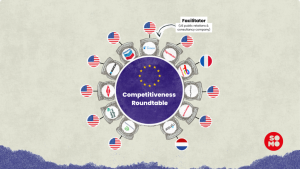
 

Leaked documents  obtained by SOMO reveal how, under the pretext of the now-near-magical concept of ‘competitiveness’, these companies plotted to hijack democratically adopted EU laws and strip them of all meaningful provisions, including those on climate transition plans, civil liability, and the scope of supply chains. EU officials appear not to have known who they were up against. But the documents obtained by SOMO show a high level of organisation and strategising with a clear facilitator: Teneo, a US public relations and consultancy company.

The documents indicate that many of the companies involved wanted to stay hidden from view. After all, if it were widely known that a secretive group of mostly American fossil fuel companies like Chevron, ExxonMobil, and Koch, Inc. was working as a coordinated organisation to dilute an EU climate and human rights law, that might raise questions and serious concern among the public and the policymakers they were targeting. Many of the companies in the Roundtable have never publicly spoken  out against the CSDDD.

Big Oil’s ‘Competitiveness Roundtable’

The Competitiveness Roundtable is dominated by fossil fuel companies, including three Big Oil companies (ExxonMobil, Chevron, TotalEnergies) and three other companies with activities in the oil and gas sector (Koch, Inc., Honeywell, and Baker Hughes). Other members are Nyrstar (minerals and metals, a subsidiary of Trafigura Group); Dow, Inc. (chemicals); Enterprise Mobility (car rentals); and JPMorgan Chase (finance).

Teneo, the Roundtable’s coordinator, has a track record(opens in new window) of working with fossil fuel companies, including Chevron, Shell, and Trafigura, and was hired by the government of Azerbaijan to handle public relations(opens in new window) when it hosted the COP29 climate conference.

In February 2025, the European Commission published the Omnibus I proposal(opens in new window), which aims to “simplify” several EU sustainability laws, including the CSDDD. The documents obtained by SOMO reveal that the Roundtable companies, which have been meeting weekly since at least March 2025, worked on deep interventions within each of the three EU institutions to get the Omnibus I package to align exactly with their views. The EU institutions are expected to reach a final agreement on Omnibus I by the end of 2025.

The documents reveal that the Roundtable companies’ activities in the Parliament are far more significant than what is visible in the EU Transparency Register(opens in new window) Eight of the Roundtable’s lobbying meetings during the Strasbourg plenary sessions of May and June 2025, listed in the Transparency Register, show Teneo as the only attendee, thereby failing  to disclose the names of other Roundtable companies that participated in these meetings. Another three meetings the Roundtable held were not found in the EU Transparency Register(opens in new window) at all.

“Divide and conquer” the Council

In the European Council, the Roundtable plotted to “divide and conquer” EU governments to get the climate article in the CSDDD deleted. In June 2025, during the final weeks of negotiations in the Council on the Omnibus I proposal, the Roundtable discussed lobbying EU government leaders to “intervene politically” to ensure its priorities were included in the Council’s negotiation mandate. Subsequently, German Chancellor Merz and French President Macron reportedly(opens in new window) personally intervened(opens in new window) in the Council’s political process, leading to a dramatic dilution(opens in new window) of the texts(opens in new window) negotiated in the months before the intervention. Several of the changes made to the texts strongly align with the Roundtable’s demands, including delaying and substantially weakening the climate obligations, scrapping EU civil liability provisions, and limiting the responsibility of companies to take responsibility for their supply chains (the ‘Tier 1’ restriction).

Competitiveness Roundtable meeting document, 11 July 2025.

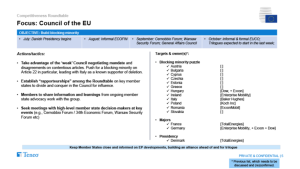
Additionally, the documents reveal that the Roundtable is still aiming to drum up a “blocking minority”  to overturn the Council’s negotiation mandate during the trilogue negotiations, which started in November 2025. By “tak[ing] advantage of the ‘weak’ Council negotiating mandate” and disagreements between EU Member States on “contentious articles”, the Competitiveness Roundtable companies hope to force the Danish Council presidency  to give up on including any form of climate obligations in the CSDDD – despite EU Member States’ agreement on this in the June 2025 Council mandate(opens in new window) .

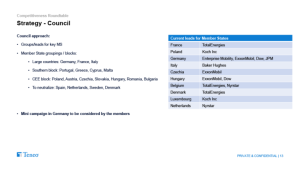
To implement the divide-and-conquer strategy, the Roundtable assigned specific companies to “establish rapporteurships” with different EU governments. TotalEnergies would target the French, Belgian, and Danish governments, and ExxonMobil would target Germany, Hungary, the Czech Republic, and Romania.
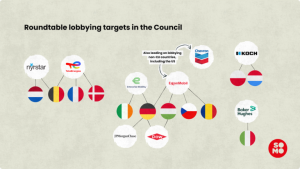
Competitiveness Roundtable meeting document, 16 May 2025.

Competitiveness Roundtable meeting document, 11 July 2025.

Circumventing “stubborn” European Commission departments

The Roundtable also discussed working on “circumvent[ing]” two “stubborn” European Commission departments involved in the Omnibus political process, DG JUST and DG FISMA,  which, in their view, were “unlikely to be willing to see our side of the story”. According to the documents, DG JUST opposed deleting the climate article and restricting the Directive’s scope to only very large enterprises. The Roundtable aimed to diminish the role of these departments by pressuring President Von der Leyen and Commissioners McGrath (DG JUST) and Albuquerque (DG FISMA) by “organising letters from Irish and German business groups” and using an event held by the European Roundtable for Industry to “target” Von der Leyen and McGrath.

Read full report: Somo.nl

Source: Somo

Continue Reading

SPECIAL REPORTS AND PROJECTS

The Carbon Mirage in Uganda: How reforestation initiatives are turning into sources of displacement and poverty?

Published

on

By Witness Radio team


Uganda’s reforestation projects are promoted as solutions to mitigate the climate crisis. But as they are implemented, there’s a deepening of inequality, destruction of lives, and a shift of environmental burdens onto the World’s poorest.


When 63-year-old Nalugo Rosemary talks about the day her life fell apart, a thousand untold tales are carried in her voice.


“In 2004,” she recalls, “Kajura and Peter, who were working for the Kikonda plantation, came with the police and arrested me. They said I was encroaching on company land. I was cultivating my own land. They beat me, threw me in detention with my two young children… for three days.”


Nalugo is one of the over thousands of people whose livelihoods were destroyed to pave the way for Kikonda’s reforestation project, raising questions about the legality and ethics of land acquisitions involved in these initiatives. Her land, her crops, her home, her livelihoods all vanished in a project that, on paper, was supposed to help save the planet and support livelihoods.


These Carbon projects are internationally celebrated for environmental protection. Still, the establishment of monoculture plantations of eucalyptus and pine trees, such as those on the Kikonda land, raises concerns about biodiversity loss and ecological imbalance, which are not addressed in the current description.


Global Woods manages the area under a 49-year lease, but systemic transparency and human rights issues remain, raising concerns about accountability in carbon projects.


More than 30 villages had already established a prosperous agricultural and cattle-keeping community before the eviction; some had been there since the 1980s, while local authorities had moved others in the 1990s. Nalugo was one of them.


“Some of us were called by leaders by then and told to farm. The leaders claimed we should not die poor, yet there was free, available land, meaning we should use the forest reserve land. The leaders said they wanted us to be better in the future.”


But in 2002–2003, the “future” arrived in the form of bulldozers, armed soldiers, and company workers harvesting residents’ crops on tractors as their owners watched helplessly.

The plantation insists it was not involved in forced evictions. Despite evictions happening over 23 years back, people living on the boundary of the plantation, like Kabangira George, who chairs a committee of the affected group, say the trauma never ended.


“People are beaten and not allowed to access the forest. They don’t allow us to access the water dams. Our cows and goats are seized, and they demand money ranging from 20,000 to 50,000 shillings to release our animals.” He added while speaking to the Witness Radio team.

A few kilometers away, the story repeats itself almost word-for-word. In Mubende, the New Forests Company (NFC), a British enterprise, displaced 901 families to establish the Namwasa Forest Reserve reforestation project.


My community was affected by the New Forest Company project. It affected 901 families, totaling over 10,000 people across seven villages in Mubende district. Crops were razed, homes burnt, animals killed. Children died while fleeing armed soldiers during the brutal evictions to give way for the plantation, Mr. Ndagize revealed.


Unfortunately, the Witness Radio team was unable to speak directly with company representatives to ask for their perspective. On its website, NFC claims extensive social benefits: schools, water points, and jobs. But to residents like Julius Ndagize, these claims feel like a cruel joke.


“They call this development,” he says bitterly. “But it brought only suffering. Poverty and backwardness. The schools they claim to have built are so expensive that poor people like us can’t afford to educate our children in them.”


His neighbor Jane (not her real name) adds that the community is not prioritized even for job opportunities and is not allowed to access their former lands.


“We request jobs from the company, but they don’t hire us. They hire people from far away,” she says. “We are not allowed to access forest lands, or even use some roads within. They are dangerous. When you are found there, you risk being attacked by company workers.”


Hoping to find a better example, our team traveled to western Uganda to investigate ECOTRUST’s Trees for Global Benefit (TGB) — a project praised globally for community-centred carbon offsetting.


ECOTRUST is a not-for-profit conservation organization established in Uganda in 1999 to conserve biological diversity and enhance social welfare by promoting innovative and sustainable environmental management. In that capacity, it receives and manages both private and public funding. In 2003, the organisation launched its leading Trees for Global Benefit (TGB) program – a carbon-offsetting scheme – that has been implemented in the Hoima and Kikuube Districts since 2013.


The programme encourages small-scale farmers to plant native regional trees on part of their land, rather than growing food as they did before, characterising it as a long-term investment.

Here, small-scale farmers were encouraged to convert farmland into tree plantations. Before its setup and implementation, people were told they would benefit from the carbon trading project and that it would bring financial stability. Mr. Rukundo Hannington Herbert of Butimba East Village, Budoma parish, was a budding farmer and businessman who claimed he was coerced into the project. He remembers being told he would “become rich.”


“I cut my bananas that fed my family and planted trees,” he says.


“After 18 years, I have been paid only 440,000, then 280,000, then 150,000. Is this the big money they promised?”


Many farmers who had joined the project are now withdrawing, saying it has pushed them back into poverty and even into extreme hunger. They have begun cutting down the trees and returning to fast-growing crops. “I have cut down these trees because they were not yielding as we were promised initially. I was dying of poverty.” He told the Witness Radio team.

Community educator Jorum Basiima says farmers were never informed about carbon buyers, pricing, or calculations.


“We don’t even know who buys carbon. We see people come and measure trees.” He reveals in an interview with Witness Radio that the project lacked transparency and only coerced people into planting, telling them they would earn a lot.


In an extensive report titled “Finance for Integrated Landscape Management: De-risking Smallholder Farmer Investments in Integrated Landscape Management,” ECOTRUST explains its specifically developed financial mechanism and outlines 12 key principles for the successful implementation of the project. Principle 8 states: “The earnings from carbon, along with the long-term carbon agreements, provide incentives and collateral for the participating households to develop multiple income streams.”


But Mr. Basiima insists, “We are only given money to do management, to manage the trees at the earlier stage. But for us, we don’t sell carbon. And we don’t even know, we don’t know any other thing, or even what carbon itself is.”


For a project meant to empower communities and restore landscapes, this absence of transparency reveals a troubling gap between promise and reality.


International Carbon expert Jonathan Crook, who works with Carbon Market Watch, a Belgium-based Non-Government Organisation, explains that Carbon credits often don’t deliver what they promise.


“A carbon credit is meant to represent one tonne of CO2 that has been avoided or reduced, or even removed from the atmosphere. But in many cases, a carbon credit cannot reliably guarantee this outcome. Many peer-reviewed scientific articles, as well as findings from NGOs, journalists, and carbon credit rating agencies, have found significant quality problems across a range of carbon credits, undermining trust that they actually deliver what’s being claimed.” He told the Witness Radio team.


Further, he states that the issue is not carbon markets alone but how companies use or misuse carbon credits. Many credits overstate or fabricate climate benefits. And global polluters buy cheap credits to avoid reducing their own emissions.


“The problem is that in many cases carbon credits are being used by companies, and increasingly by countries, to claim that they’re net-zero or carbon-neutral. The use of carbon credits can have real-world consequences, potentially delaying internal climate action for some of the world’s heaviest polluters, who need to reduce their own emissions first and foremost, he adds.


Crook insists that carbon projects must never violate human rights, yet cases like Namwasa, Kikonda, and the Hoima TGB scheme show that abuses are not exceptions; they are symptoms of a systemic failure.

Continue Reading

SPECIAL REPORTS AND PROJECTS

Global use of coal hit record high in 2024

Published

on

A coal power station in Ohio, US. Donald Trump has declared his support for coal and other fossil fuels. Photograph: Jason Whitman/NurPhoto/Shutterstock

Bleak report finds greenhouse gas emissions are still rising despite ‘exponential’ growth of renewables.

Coal use hit a record high around the world last year despite efforts to switch to clean energy, imperilling the world’s attempts to rein in global heating.

The share of coal in electricity generation dropped as renewable energy surged ahead. But the general increase in power demand meant that more coal was used overall, according to the annual State of Climate Action report, published on Wednesday.

The report painted a grim picture of the world’s chances of avoiding increasingly severe impacts from the climate crisis. Countries are falling behind the targets they have set for reducing greenhouse gas emissions, which have continued to rise, albeit at a lower rate than before.

Clea Schumer, a research associate at the World Resources Institute thinktank, which led the report, said: “There’s no doubt that we are largely doing the right things. We are just not moving fast enough. One of the most concerning findings from our assessment is that for the fifth report in our series in a row, efforts to phase out coal are well off track.”

If the world is to reach net zero carbon emissions by 2050, in order to limit global heating to 1.5C above preindustrial levels, as set out in the Paris climate agreement, then more sectors must use electricity instead of oil, gas or other fossil fuels.

But this will work only if the global electricity supply is shifted to a low-carbon footing. “The trouble is that a power system that relies on fossil fuels has huge cascading and knock-on effects,” said Schumer. “The message on this is crystal clear. We simply will not limit warming to 1.5C if coal use keeps breaking records.”

Though most governments are supposed to be aiming to “phase down” coal use after a commitment made in 2021, some are pushing ahead with the most polluting fuel. India’s prime minister, Narendra Modi, celebrated surpassing 1bn tonnes of coal production this year, and in the US Donald Trump has declared his support for coal and other fossil fuels.

Trump’s efforts to halt renewable energy projects, and remove funding and incentives for switching to low-carbon power sources, have largely not made themselves felt yet in the form of higher greenhouse gas emissions. But the report suggested these efforts would have an effect in future, though others, including China and the EU, could blunt the impact by continuing to favour renewables.

The good news is that renewable energy generation has grown “exponentially”, according to the report, which found solar to be “the fastest-growing power source in history”. This is still not enough, however: the annual growth rates of solar and wind power need to double for the world to make the emissions cuts needed by the end of this decade.

Sophie Boehm, a senior research associate at the WRI’s systems change lab and a lead author of the report, said: “There’s no question that the United States’ recent attacks on clean energy make it more challenging for the world to keep the Paris agreement goal within reach. But the broader transition is much bigger than any one country, and momentum is building across markets and emerging economies, where clean energy has become the cheapest, most reliable path to economic growth and energy security.”

The world is moving too slowly on improving energy efficiency, in particular cutting the carbon generated by heating buildings. Industrial emissions are also a concern: the steel sector has been increasing its “carbon intensity” – the carbon produced with each unit of steel manufactured – despite efforts in some countries to move to low-carbon methods.

Electrifying road transport is moving faster – more than one in five new vehicles sold last year was electric. In China, the share was closer to half.

The report also sounded a warning on the state of the world’s “carbon sinks” – forests, peatlands, wetlands, oceans and other natural features that store carbon. While nations have repeatedly pledged to protect their forests, they continue to be cut down, albeit at a slower rate in some areas. In 2024, more than 8m hectares (20m acres) of forest were permanently lost. That is lower than the high of nearly 11m hectares reached in 2017, but worse than the 7.8m hectares lost in 2021. The world needs to move nine times faster to halt deforestation than governments are managing, the report found.

World leaders and high-ranking officials will meet in Brazil next month for the Cop30 UN climate summit, to discuss how to put the world on track to stay within 1.5C of global heating in line with the 2015 Paris climate agreement. Each government is supposed to submit a detailed national plan on emissions cuts, called a “nationally determined contribution”. But it is already clear that those plans will be inadequate, so the key question will be how countries respond.

Source: theguardian.com

Continue Reading

Resource Center

Legal Framework

READ BY CATEGORY

Facebook

Newsletter

Subscribe to Witness Radio's newsletter


Trending

Subscribe to Witness Radio's newsletter