
WITNESS RADIO MILESTONES
REVEALED: The Origin Of Namuganza’s War With Minister Betty Amongi, Bigirimana Pinned For Selling Air Worth 100 Million To Government


It was a somber mood in the commission of inquiry into land matters when Albert Mugumya, the under-secretary Uganda Lands Commission (ULC) revealed the origin of the bad blood between the Cabinet Minister of Lands, Housing and Urban Development Betty Amongi and the state minister for lands Persis Namuganza.
Suuza first refused Mugumya’s request and told him to go ahead with his testimony. A tough looking Mugumya started revealing shocking details of how government officials have been putting him on pressure to release billions of cash to non-existing land. Mugumya said that in 2016, he received a letter from the lands minister Betty Amongi instructing him to make immediate payments to Agnes Bagaya (100m), Pius Bigirimana (100 million), Nasubuga Teddy (121 million), Sam Seguya (100 million), Crush Baligye (60 million), Jemba Nicholas (50 million), Patrick Bikashangiza (50 million) for their land. He said that Amongi copied her letter to her junior minister Persis Namuganza, Matia Kashaija the finance minister among others.
In her letter, Amongi informed Mugumya that she was the last person to determine who will and will not be compensated. Amongi further indicated in her letter that the president ordered her to be the final person so that she can monitor how the land fund claimants are paid.
Mugumya told the commission that he wrote back to the minister telling her that she doesn’t have powers to determine who has to be paid when. He further explained to the minister that the constitution stipulates clearly that it’s the accounting officer who is responsible for the payments.
Mugumya said that surprisingly, the auditor general had already instructed ULC to stop paying claimants because he was still investigating how they were handling the compensation money.
Mugumya said that the auditor general’s instructions came after he discovered that there were some big government officials who had applied for payments yet they didn’t have any land to sell to the commission. Mugumya gave an example of Pius Bigirimana, the
Permanent Secretary Ministry of Gender and Labour and Social Development, who the auditor general investigated and found out that he was selling air to the commission.
He said that the Uganda land fund payment committee sat and passed a resolution cautioning Amongi that she doesn’t have powers to order the undersecretary and to approve payments.
State minister Persis Namuganza also wrote to Amongi informing her that she was breaking the law to approve the persons to be compensated. Namuganza clearly told her boss Amongi that the compensation docket belongs to her office not Amongi’s. Namuganza further explained to Amongi that there was no money to pay the selected people she branded special in her letter. Namuganzi further informed Amongi that the budget which was allocated to the fund was finished after paying 6 billion shillings to the Anglican church for their land in Entebbe, the remaining money was to be paid to the people of Amuru who government was planning to relocate.
“My lord, minister Amongi took the powers of the accounting officer. She released billions of cash to Pius Bigirimana. When we warned her that we didn’t see Bigirimana’s land, which he wanted to sell to the government, she just told us that she paid 100 million shillings to Victoria Ssebagereka Bakooko, who was very sick and 650 million shillings to Ishaks Ruhana who was in hiding because banks were looking for him over debts. “My lord, I tried to stop the payments by telling the minister that there was an in-house committee chaired by minister Chris Baryomonsi which was investigating how the land fund money was administered. My lord, the minister was very angry with me and threatened to fire me for undermining her. My lord, I pray that you allow me to reveal more secrets in-camera because of the magnitude of the matter,” Mugumya pleaded.
He added that Amongi wrote back to Namuganza warning her that she was the cabinet minister so she was the one with absolute authority in the ministry.
The commission also learnt from George William Bizibu, the executive secretary Uganda Asian departed property custodian board that Amongi grabbed a lot of property belonging to departed Asians in different parts of the country. He said that Amongi used her position as the minister who sat on the custodian board to grab the said property using her company Amobet Investment Company limited.
“We have just realized that the minister was using her
company and one man called Henry Mubiru to steal Indian’s property and we are in the process of cancelling all the property titles,” Bizibu said.
Yesterday, an Indian, Patel pined Amongi before the commission for grabbing his family property on plot 29 Acacia road in Kololo. The commission of inquiry through the commission’s chairperson Catherine Bamugemereire has issued criminal summons against Amongi and she is expected to appear on Monday.


Related posts:

 Land Inquiry Commission opens investigations into the eviction of natives from former government ranches in Bunyoro sub-region
 Startling Revelations About 213 Titles Government Returned To Mengo Emerge at Land Commission of Inquiry
 2 million hectares of land grabbed, 190,000 families violently displaced in Mubende district in 2017- Witnessradio.org report.
 What Minister Nantaba told the Land Commission of Inquiry?




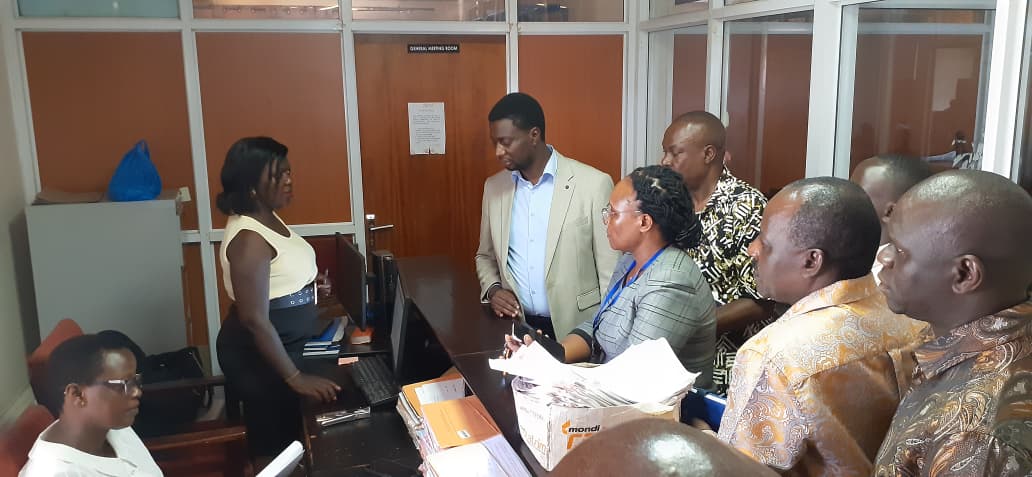
Parliament’s Committee on Lands, Housing and Urban Development has ordered a police investigation after recovering hundreds of land files allegedly hidden in shops and vehicle boots near the Mukono Zonal Land Office (MZO).
The committee, led by chairperson Edison Rugumayo, was inspecting the office as part of an inquiry into allegations of land fraud, delays in processing titles and other irregularities affecting land transactions in Mukono District.
During the inspection, legislators toured various departments and questioned staff about their work, including the handling and storage of land records.
At the office of Senior Staff Surveyor Steven Ndegeya, the committee raised concerns over alleged irregularities involving land titles reportedly created in wetlands and central forest reserves.
The legislators also questioned officials about more than 200 titles reportedly issued in Mabira Forest and demanded a list of people associated with the titles.
The committee was further alarmed after being told that more than 50 land titles had allegedly been created on the government-owned Njeru Stock Farm.
Rugumayo asked Ndegeya to provide the transaction trail, original title documents, geographical maps and details of all individuals holding titles on the land.
Ndegeya asked for more time, saying he needed to consult registrars before preparing an organised report.
He told the committee that there was no certificate of title for Njeru Stock Farm belonging to the Uganda Land Commission in the system.
However, he said the system contained records of individual Mailo landowners whose interests dated back many years, arguing that some people who obtained titles on the land had acquired them legally.
The committee later met MZO officials to establish the causes of the complaints and alleged irregularities.
Three staff members, Dan Kyalo, Hannifah Nantongo and Susan Aceru, were tasked with producing files that were allegedly being taken out of the MZO.
The three denied having moved the files.
However, accompanied by police officers, the committee recovered hundreds of titles allegedly stored in shops across the road from the land office. Other files were reportedly found in vehicle boots.

When questioned about who had instructed them to keep the files outside the office, the officials reportedly told the committee they had been directed by their supervisor, Ndegeya.
The committee also questioned the security team deployed by the Ministry of Lands in Kampala about how the files and titles had been removed from the office.
It emerged that Emma Otim, the security head, had left responsibility for keeping the office keys with a private security guard who routinely opens and closes the office.
The committee questioned why a guard whose primary responsibility was reportedly to man the gate had been entrusted with the office keys.
Principal Assistant Secretary at the MZO, Doreen Tumushabe, said she could not be held responsible for the alleged conduct of individual employees but promised to strengthen supervision.
Tumushabe also cited staff shortages, lack of vehicles and the large number of complaints involving allegedly forged land titles among the challenges affecting the office.
During the oversight visit, the committee also discovered hundreds of allegedly forged land titles at the MZO.
Officials told the committee that no related case had been opened at Mukono Police Station despite the alleged discovery of the forged titles.
The committee also heard complaints from members of the public who said they had waited for years to obtain land titles or have land disputes resolved.
A 75-year-old woman, Maria Nakitende, told the committee that she had waited for decades for authorities to resolve her title-related matter.
Hajji Musa Muliika of Katosi alleged that he was asked to pay Shs14 million after the title he had submitted was reportedly lost while in the hands of MZO officials.
Rugumayo directed police to conduct a thorough investigation into the circumstances surrounding the removal and concealment of the files and establish why they were taken outside the office, particularly ahead of the committee’s visit.
He also ordered the head of the Mukono land office to submit, within one week, a report on land titles in Mabira Forest and wetlands, as well as complaints against staff members.
Masaka legislator Joan Namutaawe criticised the quality of services at the land office and questioned whether Tumushabe was fully in control of operations at the MZO.
Namutaawe warned that the committee would pursue cases involving alleged illegal occupation and development in wetlands.
Source: nilepost.co.ug
Related posts:



MEDIA FOR CHANGE NETWORK
Uganda moves toward a Bamboo Policy to boost environmental conservation and green growth.

Related posts:

 As Uganda awaits the Energy Efficiency and Conservation law, plans to develop a five-year plan are underway.
 REC25 & EXPO Ends with a call on Uganda to balance conservation and livelihood
 Africa’s growth lies with smallholder farmers
 Green Resources’ forestry projects are negatively impacting on local communities – donor
WITNESS RADIO MILESTONES
A Global Report reveals that Development Banks’ Accountability Systems are failing communities.
Related posts:
 Banks have given almost $7tn to fossil fuel firms since Paris deal, report reveals
 Opinion: USAID needs an independent accountability office to improve development outcomes
 Communities Under Siege: New Report Reveals World Bank Failures in Safeguard Compliance and Human Rights Oversight in Tanzania
 Oxfam Report 2011: When Indigenous communities named Rwanda nationals by investor to run away from corporate accountability

Govt orders fresh valuation of land for Rubanda iron ore project

Can Agroecology Improve the Resilience of African Smallholder Farmers?

Death Of Witnesses Cited Among Causes Of Land Case Backlog

Sweeping investments are fueling widespread land grabbing and deepening rights violations across Uganda – Report.

While hunger continues to grip the world, a new report highlights forests and forest foods as a hidden treasure trove of nourishment.

Five years after Uganda’s National Action Plan on Business and Human Rights, are local communities hosting land-based investment projects seeing change?

Lango ex-combatants count losses after dry spell destroys maize harvest

Alert: Land degradation is emerging as a pressing threat to global security.

Innovative Finance from Canada projects positive impact on local communities.

Over 5000 Indigenous Communities evicted in Kiryandongo District

Petition To Land Inquiry Commission Over Human Rights In Kiryandongo District

Invisible victims of Uganda Land Grabs
-

 MEDIA FOR CHANGE NETWORK2 weeks ago
The global race for clean energy minerals is leaving communities grappling with conflicts and human rights abuses, a new report reveals.
-

 MEDIA FOR CHANGE NETWORK1 week ago
Across Africa, the push for a greener future is putting new pressure on local communities, as recent ILC case studies highlight.
-

 MEDIA FOR CHANGE NETWORK1 week ago
Who will shape the future of East Africa’s seeds? Youth and civil society are sounding the alarm over a proposed regional law.
-
 MEDIA FOR CHANGE NETWORK1 week ago
Sweeping investments are fueling widespread land grabbing and deepening rights violations across Uganda – Report.
-

 MEDIA FOR CHANGE NETWORK2 weeks ago
Uganda urged to drop charges against 11 environmental defenders after 17 months without witnesses
-
 FARM NEWS2 weeks ago
Govt pushes natural regeneration to restore 8.4 million hectares
-

 MEDIA FOR CHANGE NETWORK2 weeks ago
3 Division Commander Warns Communities Against Land Wrangles
-
 FARM NEWS6 days ago
Can Agroecology Improve the Resilience of African Smallholder Farmers?