Connect with us

WITNESS RADIO MILESTONES

Resign, judge tells Minister Amongi

Published

on

Accused of conflict of interest, Betty Amongi, the minister for Lands was nudged yesterday by a rather angry Justice Catherine Bamugemereire to resign.

Appearing before the Justice Bamugemereire-led Commission of Inquiry into Land Matters; Amongi tried hard but failed to separate herself from the questionable actions of her private company, AMOBET Investment Ltd.

According to the commission, the minister’s company forged land titles and fraudulently acquired four high-end government properties. The minister runs the company with her sister, Ketty Amongi, a Lira-based businesswoman.

During cross-examination, Justice Bamugemereire asked the minister whether she knew what conflict of interest means and the consequences it carries for a culpable senior government official such as a minister. Before she could answer, the judge asked the minister to read out loud the Leadership Code Act section 5 sub-sections 1 and section 12 sub-section 2.

In reading out loud, the minister said, “A leader cannot put himself or herself in a position in which his or her personal interests conflict with his or her duties and responsibilities. A leader shall not participate in the deliberations of a public body or board or council or commission or committee of which he or she is a member at any meetings at which any matter in which he or she has personal interest is to be discussed.”

She added, “A leader who contravenes that sub section 1 breaches the code and is liable to vacate office or be dismissed…”

“Don’t you see that this Leadership Code Act is asking you what to do?” the judge said, sending a rather tense minister and the audience gathered in the National Records Centre and Archives Building in Wandegeya into laughter.

Before she finally showed up yesterday at 9 o’clock, the minister had skipped two summonses, which prompted an angry Bamugemereire to issue the latest criminal summons.

Amongi is accused of attempting to fraudulently acquire property on Plot 29, Acacia avenue in Kololo, Kampala.

The property in dispute is under leasehold number 235 and registered in the names of Toshak Patel, an architect.

But the minister insisted that all operational functions of the company were executed by the managing director called Henry Mubiru.

Amongi denied knowing the disputed property on Plot 29, Acacia avenue. But documents in possession of the commission showed that the minister has in the past signed off many transactions as managing director of AMOBET.

It is alleged that inDecember 2017, Amongi through her company, AMOBET, acquired temporary possession of the property after it was repossessed by the Asian family in 1992.

Documents indicate that the allocation by AMOBET, Investments Limited was signed by the executive secretary of the Departed Asians Property Custodian Board (DAPCB), George William Bizibu.

Bizibu who appeared before the Commission on May 7, made some contradictory statements and was subsequently detained for further questioning.

He was also instructed to present to the Commission, documents on the alleged board meetings he held. During cross examination, the seven Commissioners found that Bizibu, without the consent of the full DAPCB board, underestimated properties owned by government and doled them out at giveaway prices.

A case in point is the above mentioned property on Plot 29 Acacia Avenue which commands rent of US$9,000 per month, but was fraudulently allocated to somebody else at a paltry US$150 per month.

While there are no exact figures, reports indicate that government has lost billions of shilling through these shoddy dealings.

Last week, the land probe questioned the Uganda Land Commission (ULC) Undersecretary, Albert Jethro Mugumya, in regard to the minister’s hand in the management of the land fund. It is alleged that in 2016, Amongi directed Mugumya to pay millions of shillings under the Land Fund contrary to her mandate.

Mugumya said Amongi directed him to make the payments to various people citing special requests.

Mugumya who declined to divulge details, said Amongi’s involvement amounted to micro management of the land fund contrary to her role of providing policy guidelines.

Documents presented before the commission confirm that on November 23, 2016, the minister directed Mugumya to make an urgent payment of land compensation of more than Shs 620 million to nine people.

In another letter dated October 31, 2016, Amongi directed Mugumya to effect payments for special consideration to two sick persons.

According to the letter, the minister directed Mugumya to advance Shs 100 million out of Shs 776,780,000 to Victoria Kakoko-Sebagereka who was very sick and due for treatment abroad, and Shs 50 million to a one Mzee Kuriash Barinda of Isingiro.

In another letter dated November 29, 2017, Amongi directed the payment of Shs 675.8 million to Yisaka Lwakana for land at Kooki, Katete.

“The payments were effected basing on special requests as indicated in the minister’s letters and the land is known to ULC as per the records,” said Mugumya adding that he complied with the minister’s directive.

Evidence presented before the land probe indicates that Amongi contravened the Public Service Standing Orders when she directed the accounting officer instead of the ULC chairman to effect the payments.

Extracted from the observer

Continue Reading
Click to comment

Leave a Reply

Your email address will not be published. Required fields are marked *

WITNESS RADIO MILESTONES

MPs recover hundreds of land files hidden near Mukono land office

Published

on

Parliament’s Lands Committee has ordered a police investigation after recovering hundreds of land files allegedly hidden in shops and vehicle boots near the Mukono Zonal Land Office.

Parliament’s Committee on Lands, Housing and Urban Development has ordered a police investigation after recovering hundreds of land files allegedly hidden in shops and vehicle boots near the Mukono Zonal Land Office (MZO).

The committee, led by chairperson Edison Rugumayo, was inspecting the office as part of an inquiry into allegations of land fraud, delays in processing titles and other irregularities affecting land transactions in Mukono District.

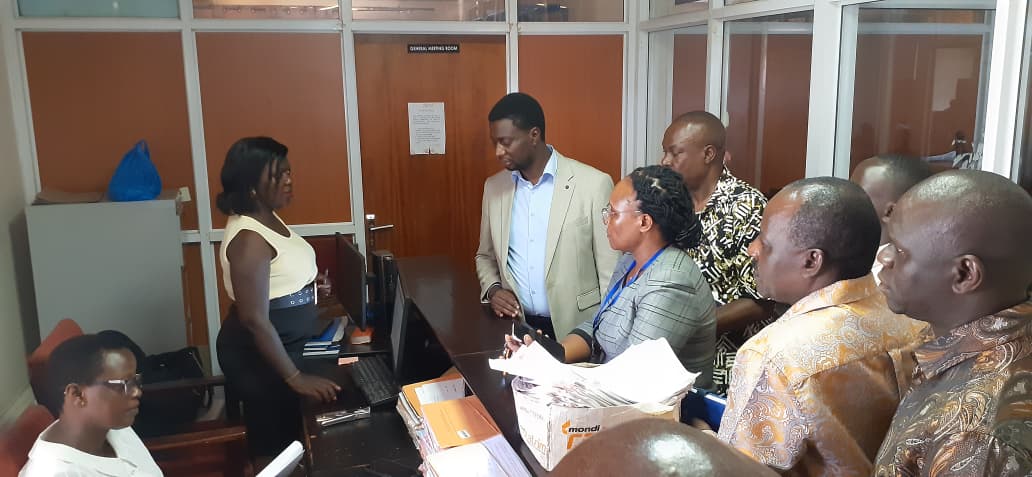
During the inspection, legislators toured various departments and questioned staff about their work, including the handling and storage of land records.

At the office of Senior Staff Surveyor Steven Ndegeya, the committee raised concerns over alleged irregularities involving land titles reportedly created in wetlands and central forest reserves.

The legislators also questioned officials about more than 200 titles reportedly issued in Mabira Forest and demanded a list of people associated with the titles.

The committee was further alarmed after being told that more than 50 land titles had allegedly been created on the government-owned Njeru Stock Farm.

Rugumayo asked Ndegeya to provide the transaction trail, original title documents, geographical maps and details of all individuals holding titles on the land.

Ndegeya asked for more time, saying he needed to consult registrars before preparing an organised report.

He told the committee that there was no certificate of title for Njeru Stock Farm belonging to the Uganda Land Commission in the system.

However, he said the system contained records of individual Mailo landowners whose interests dated back many years, arguing that some people who obtained titles on the land had acquired them legally.

The committee later met MZO officials to establish the causes of the complaints and alleged irregularities.

Three staff members, Dan Kyalo, Hannifah Nantongo and Susan Aceru, were tasked with producing files that were allegedly being taken out of the MZO.

The three denied having moved the files.

However, accompanied by police officers, the committee recovered hundreds of titles allegedly stored in shops across the road from the land office. Other files were reportedly found in vehicle boots.

When questioned about who had instructed them to keep the files outside the office, the officials reportedly told the committee they had been directed by their supervisor, Ndegeya.

The committee also questioned the security team deployed by the Ministry of Lands in Kampala about how the files and titles had been removed from the office.

It emerged that Emma Otim, the security head, had left responsibility for keeping the office keys with a private security guard who routinely opens and closes the office.

The committee questioned why a guard whose primary responsibility was reportedly to man the gate had been entrusted with the office keys.

Principal Assistant Secretary at the MZO, Doreen Tumushabe, said she could not be held responsible for the alleged conduct of individual employees but promised to strengthen supervision.

Tumushabe also cited staff shortages, lack of vehicles and the large number of complaints involving allegedly forged land titles among the challenges affecting the office.

During the oversight visit, the committee also discovered hundreds of allegedly forged land titles at the MZO.

Officials told the committee that no related case had been opened at Mukono Police Station despite the alleged discovery of the forged titles.

The committee also heard complaints from members of the public who said they had waited for years to obtain land titles or have land disputes resolved.

A 75-year-old woman, Maria Nakitende, told the committee that she had waited for decades for authorities to resolve her title-related matter.

Hajji Musa Muliika of Katosi alleged that he was asked to pay Shs14 million after the title he had submitted was reportedly lost while in the hands of MZO officials.

Rugumayo directed police to conduct a thorough investigation into the circumstances surrounding the removal and concealment of the files and establish why they were taken outside the office, particularly ahead of the committee’s visit.

He also ordered the head of the Mukono land office to submit, within one week, a report on land titles in Mabira Forest and wetlands, as well as complaints against staff members.

Masaka legislator Joan Namutaawe criticised the quality of services at the land office and questioned whether Tumushabe was fully in control of operations at the MZO.

Namutaawe warned that the committee would pursue cases involving alleged illegal occupation and development in wetlands.

Source: nilepost.co.ug

Continue Reading

MEDIA FOR CHANGE NETWORK

Uganda moves toward a Bamboo Policy to boost environmental conservation and green growth.

Published

on

By Witness Radio team.


Uganda’s move to develop a national bamboo policy aims to boost environmental conservation and create green jobs, addressing the country’s urgent unemployment issues among the working class.


Bamboo is a critical tool in fighting climate change due to its rapid growth, high carbon sequestration capacity, and ability to produce 35% more oxygen than equivalent trees. As a fast-growing, renewable resource, it restores degraded land, provides sustainable materials that replace emission-intensive products like concrete, and offers a resilient, low-carbon bioenergy source. 


Bamboo’s potential is outlined in the existing National Bamboo Strategy. Still, stakeholders stress that a formal policy involving entrepreneurs, farmers, and processors is essential to remove regulatory uncertainty and foster sector growth.


“The strategy is a good document, but it was developed largely through desk research. It did not fully involve entrepreneurs, farmers, and processors who are already working in the bamboo industry,” said Sjaak de Blois, chairman of Bamboo Uganda, encouraging stakeholders to see their role as vital.


The bamboo policy is currently at an early consultative stage, with no draft yet submitted to the cabinet or parliament. Recent consultations brought together representatives from eight government ministries, private-sector bamboo actors, and development partners to begin aligning the strategy with practical regulatory needs.


“What we have now is the starting point,” De Blois mentioned. “The next step is to take the strategy and make it more practical, more market-driven, and more Ugandan. The next step is to move from having a plan to adopting a policy.


Bamboo currently falls under several regulatory frameworks, with no single authority overseeing the sector. The policy push is being driven in part by Bamboo Uganda, a membership-based organization bringing together bamboo farmers and processors, among others. The organization aims to play a coordinating role similar to that historically played by the Uganda Coffee Development Authority in the coffee sector.


“If you want to make a sector meaningful for a country, you need coordination. Coffee became what it is because of an institution that aligned farmers, traders, exporters, and regulators. Bamboo needs the same kind of coordination.” He said.


The policy process is supported by the Belgian development agency, which is funding consultations and facilitating dialogue between the government and the private sector.

Industry players say the absence of clear regulations has constrained investment despite growing demand.

“At the moment, bamboo is everywhere and nowhere at the same time. As a farmer, you talk to forestry, as a charcoal producer, you talk to energy, as a builder, you talk to works. There is no single framework that enables the industry to function.” De Blois added.


Supporters of the policy argue that bamboo could play a significant role in environmental conservation. Bamboo grows rapidly, regenerates after harvesting, and can be harvested annually for decades, reducing pressure on natural forests.


According to Global Forest Watch (GFW), Uganda lost 1.2 million hectares of tree cover between 2001 and 2024, representing a 15% decline from the 2000 baseline. Bamboo has been identified as a key species for restoration.


“One acre of bamboo that is harvested sustainably can prevent the destruction of hundreds of acres of natural forest,” De Blois said. “If we get this right, bamboo can help reverse deforestation rather than contribute to it.”


Ms. Susan Kaikara, from the Ministry of Water and Environment, emphasized bamboo’s potential to drive Uganda’s green-growth agenda.


“Establishing a coherent national policy framework will strengthen coordination, inspire investment, and unlock bamboo’s full potential as a pillar of Uganda’s green economy,” she said.


Uganda’s charcoal market alone is estimated to be worth hundreds of millions of dollars annually, much of it supplied through unsustainable wood harvesting. Industry actors say certified bamboo charcoal plantations could offer a cleaner alternative.


“If they allow us to certify bamboo charcoal plantations, then we can get a trade license to compete or to work together with the existing market. We will reverse deforestation. We would enter an industry of about 500,000 hectares, creating smart, green jobs. We can digitalize them to make them attractive through bamboo agroforestry. So again, those things need a policy.” He adds.


Bamboo is also viewed as a climate-friendly crop due to its high capacity for carbon sequestration. Its rapid growth enables it to absorb large amounts of carbon dioxide, while its extensive root system improves soil structure and increases long-term carbon storage.


“When you look at carbon sequestration, bamboo offers several advantages. Residues from harvested bamboo can be converted into biochar, locking carbon into the soil for long periods. When you also see the sequestration per acre compared to many other trees, it is five or six times higher. So, we sequester a lot,” De Blois said


Stakeholders say that if the policy process progresses as planned, bamboo could emerge as one of Uganda’s key green growth sectors within the next decade.


“Policy making takes time. But what is important is that we have started the conversation with all the right ministries in the room. From here, it is about taking steady, practical steps.” He concluded.

Continue Reading

WITNESS RADIO MILESTONES

A Global Report reveals that Development Banks’ Accountability Systems are failing communities.
Published

on

By Witness Radio team.

For decades, development projects have been funded to address some of the World’s most pressing problems, including poverty, wildlife conservation, and climate change. However, what unfolds on the ground is sometimes the opposite of development. Instead of benefits, these projects have often harmed the very people they are supposed to support.

The effort to address such harm has led to the establishment of Independent Accountability Mechanisms (IAMs) by various development banks. Yet, communities affected by these projects often face betrayal by national court systems, leaving them feeling overlooked and vulnerable, emotions that underscore the urgent need for effective justice.

According to experts in development financing, since the early 1990s, development banks have sought to address and mitigate harm through IAMs—non-judicial grievance mechanisms that provide a direct avenue for impacted communities to raise concerns, engage with project implementers, and obtain remedies for the harm they have experienced.

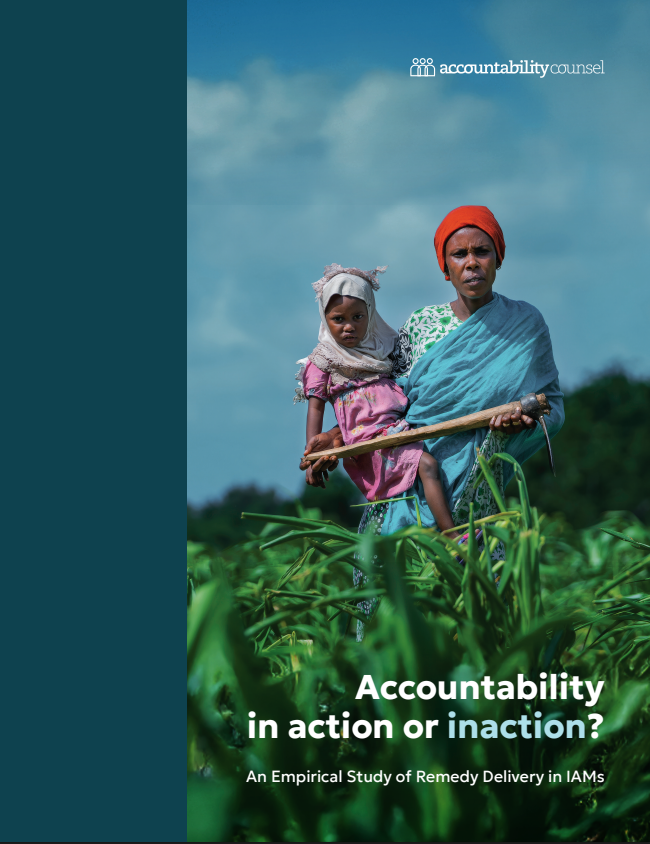
The study, conducted by Accountability Counsel and titled Accountability in Action or Inaction? An Empirical Study of Remedy Delivery in Independent Accountability Mechanisms shows that while IAMs exist, their relevance has fallen short, underscoring the urgent need for reform to restore community trust and hope.

In compiling the report, researchers reviewed 2,270 complaints across 16 IAMs and conducted 45 interviews covering 25 cases globally.

The report reveals a persistent gap between the promise of remedies and their realization, highlighting that only 15% of closed complaints led to commitments, and just 10% achieved full completion, underscoring the urgent need for effective remedies for communities.

The findings highlight ongoing challenges, including inadequate implementation, limited monitoring, and persistent power imbalances, which continue to block communities from accessing meaningful remedies and demand immediate reform.

“The consequences of these institutional gaps are severe. As these cases show, institutional silence can exacerbate risk, while meaningful intervention can help de-escalate it.” The Report adds.

Uganda is among the countries where communities have sought justice using these accountability mechanisms. Between 2006 and 2010, communities in one of the districts of Uganda were brutally evicted by the UK-based Company, which was growing trees in the area.

The company was formerly an investee of the Agri-Vie Agribusiness Fund, a private equity fund supported by the International Finance Corporation (IFC), the private sector arm of the World Bank Group. The community filed a Complaint with the IFC’s accountability mechanism, the Compliance Advisor Ombudsman (CAO).

“We complained to this body in 2011, hoping for justice, but over 15 years later our people are still struggling, living miserably, some without homes,” a community land and environmental defender told the Witness Radio team.

According to the affected residents, the CAO process did not lead to success or meaningful compensation, as they had hoped.

Between 2013 and 2014, the communities, with support from the CAO, signed a final agreement with the Company to address the harm. Among other commitments, this included resettlement of the affected communities.

In its 28-page report published in 2015 titled: A Story of Community-Company Dispute Resolution in Uganda, the CAO wrote,” With the agreements concluded, implementation is gathering pace. As agreed, the company has begun extending development assistance to both cooperatives, and the process of restoring and enhancing livelihoods has commenced.

The first step taken by both cooperatives was to acquire land. In late 2013, the Mubende Cooperative bought 500 acres of ‘fertile agricultural land’ in the Mubende district. Their vision was to allocate a certain percentage of the land for resettlement, with the remainder utilized for farming projects.

Reports from the ground indicate that communities remain dissatisfied with the process, claiming it failed to address their concerns fully and highlighting the urgent need for more effective remedy systems.

“When you say that people are well, it is really a total lie. Many people were never compensated or resettled. Even those who got a portion of land say they have never seen a fertile land—I have never seen it, because people are living or cultivating on rocky, infertile lands,” the defender further revealed.

The struggle faced by the Ugandan community is not unique. Their experience mirrors what the Accountability Counsel report identifies worldwide. Despite registering more than 2000 complaints by communities harmed by bank-financed projects globally, there has been no comprehensive system-wide analysis of whether and how often these mechanisms deliver meaningful remedies, defined as tangible, material outcomes that repair harm and improve lives.

In addition to the slow success of such IAMs, the report notes that, across interviews covering 25 complaints, 84% referenced retaliation, violence, or threats of violence-an alarming indicator of the risks faced by communities seeking justice, demanding immediate attention and action.

“Government officials and company representatives were frequently implicated in efforts to suppress dissent. This not only reduces the likelihood of achieving a substantial remedy, but also suppresses the willingness of community members to speak honestly and openly about Complaint outcomes.” The report further adds,

Further, it reveals that communities described a range of retaliatory tactics, including physical clashes, arrests, detentions, fatalities, intimidation and harassment, death threats, and anonymous warning letters, among others.

“Remedy must be reimagined not as a peripheral concern but as a core responsibility of development institutions. It must be adequately resourced, independently monitored, and centered around the needs and voices of affected people,” the report adds.

The report recommends that development banks and IAMs establish a Remedy Framework with clear standards to ensure remedies are timely, adequate, and community-centered, and to encourage stakeholders to prioritize systemic reform for better justice outcomes.

The report also urges development banks and their accountability mechanisms to make remedies a foundational element of responsible finance. Adopting institutional frameworks that prioritize redress, empowering IAMs to oversee and enforce commitments, and incorporating the outcomes of IAM processes into project evaluations and institutional learning.

Continue Reading

Resource Center

Legal Framework

READ BY CATEGORY

Facebook

Newsletter

Subscribe to Witness Radio's news and report updates


Trending

Subscribe to Witness Radio's news and report updates