Co-authored by: ADAPPE-Guinée, Bread for All (Switzerland), CDHD (Congo-Brazzaville), COPACO (DRC), Culture Radio (Sierra Leone), GRAIN, Joegbahn Land Protection Organization (Liberia), JVE Côte d’Ivoire, MALOA (Sierra Leone), Muyissi Environnement (Gabon), NRWP (Liberia), RADD (Cameroon), REFEB (Côte d’Ivoire), RIAO-RDC (DRC), SEFE (Cameroon), SiLNoRF (Sierra Leone), Synaparcam (Cameroon), UVD (Côte d’Ivoire), WRM, YETIHO (Côte d’Ivoire) and YVE Ghana.
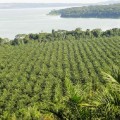
Over the past decade, agribusiness companies have been increasing their production of palm oil to meet a growing global demand for cheap vegetable oil that gets used in the production of processed foods, biofuels and cosmetics. Community lands in many African countries are a main target for the expansion of their plantations.
In 2016, GRAIN reported that over 65 large-scale land deals for oil palm plantations in Africa had been signed between 2000-2015, covering over 4.7 million hectares.1 Multinational companies, in collaboration with local elites and development banks, had launched a full-scale attack against communities from Sierra Leone in West Africa to the DR Congo in Central Africa to take their lands for oil palm plantations.
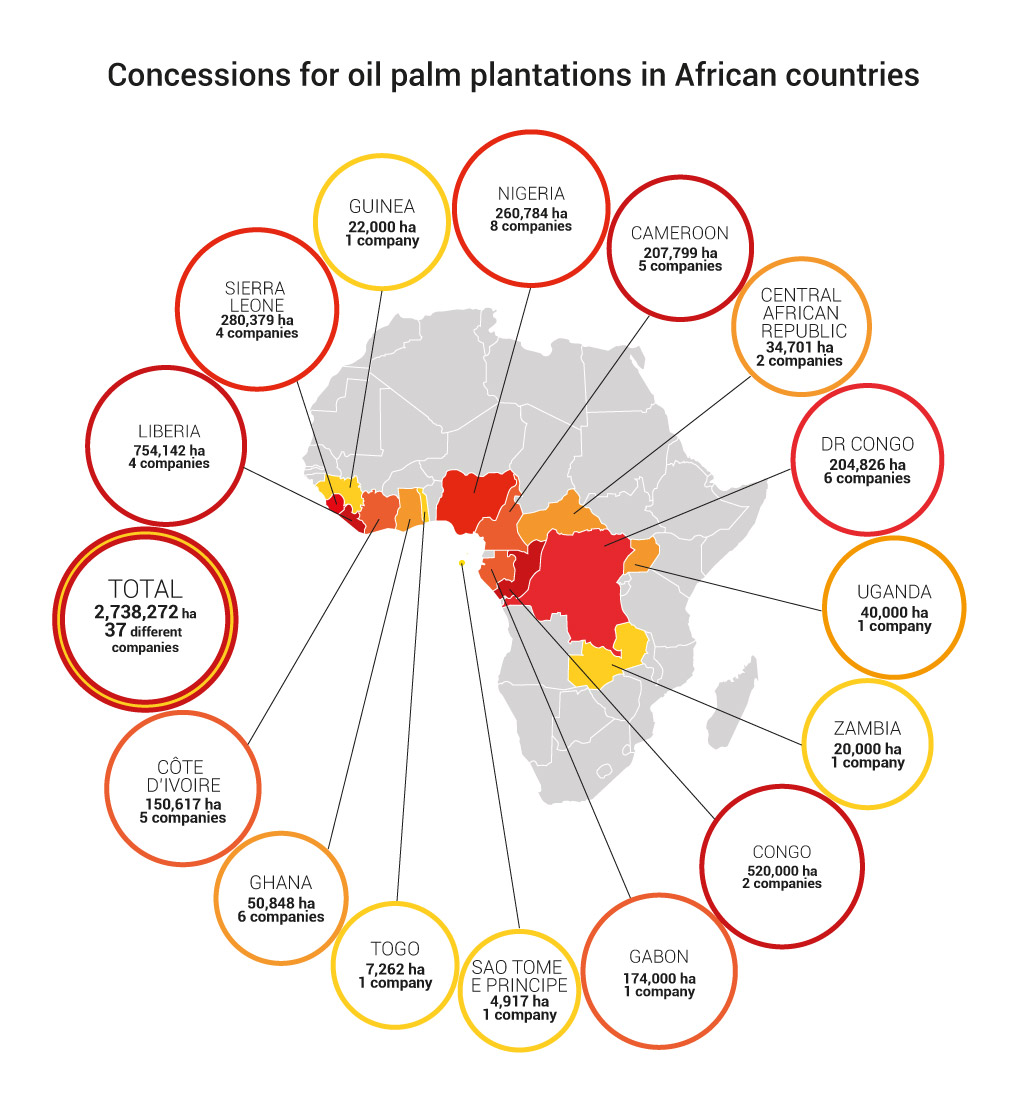
Things have not, however, worked out entirely as the companies had hoped. Our updated accounting shows a significant decline in the number and total area of land deals for industrial oil palm plantations in Africa over the past five years, from 4.7 million hectares to a little over 2.7 million hectares. And only a small fraction of this area, 220,608 hectares, has been converted to oil palm plantations or replanted with new palms. We believe that strong resistance by communities has been key to slowing this expansion of industrial oil palm plantations in the region.
Communities in Africa have, by now, had more than enough experience with large-scale oil palm plantations to know that they are not needed nor wanted. Their traditional systems of oil palm cultivation and palm oil production are far more dynamic and far more capable of meeting the continent’s needs. It is time to completely stop the expansion of industrial oil palm plantations, and return the lands occupied by oil palm plantation companies to the affected communities.
The state of oil palm plantations in Africa
According to our updated data set, there are currently 49 large-scale concessions for oil palm plantations in Africa, covering 2.74 million hectares (see Annex I).
Many of the oil palm plantation projects that were announced over the past decade have failed or have been abandoned, as can be seen in the accompanying table (see Annex II). Other projects have been scaled back. And, while there have been some new projects and expansions since 2014, the pace has certainly slowed, with no announcements for new, large-scale oil palm plantation projects during the past two years.2
The geographic focus has narrowed as well. Nearly all the corporate oil palm plantation projects for Africa that were outside of Central and West Africa have been abandoned. The focus is now on a handful of countries, with the priorities being Cameroon, the DR Congo, Congo-Brazaville, Côte d’Ivoire, Gabon, Ghana, Liberia, Nigeria and Sierra Leone. There is also activity, but to a lesser extent, in the Central African Republic, Guinée, Sao Tome e Principe, Togo and Uganda.
Another central point that emerges from the updated data set is the massive discrepancy between the area that corporations have acquired under concessions and the area that they have converted to industrial oil palm plantations. Only 463,000 hectares or 17% of the total area acquired under concessions (2.74 million hectares) is planted with oil palms, with another 55,000 ha planted for rubber and other crops within these concessions. Moreover, the majority of these corporate plantations are old plantations that date back to the parastatal projects of the 1970s and 1980s or even further back into the colonial era. We estimate that only 220,608 hectares have been developed into industrial oil palm plantations or replanted over the past decade.3
The most clear case is in Congo-Brazzaville. Of the 520,000 ha in concessions that the government awarded to palm oil companies, less than 1,000 ha or 0.2% has been developed into plantations. It seems likely that these concessions were merely fronts to facilitate illegal logging operations by converting forested areas to agricultural lands.4 Liberia provides another example. During the administration of President Sirleaf, the first elected government following the country’s horrific civil war, 755,000 ha were handed out to oil palm plantation companies in concessions. But today, less than 54,000 ha (7% of the total concession areas) have been developed into industrial plantations, even though some of the largest oil palm plantation companies in the world have acquired these concessions.
The big companies driving the expansion
The 2016 data set identified a long list of companies, some big, many of them small and with little experience in agriculture, that were acquiring lands for industrial oil palm plantations in Africa. But the updated data set shows that many of these small and inexperienced operators have disappeared. Today, the expansion of industrial oil palm plantations in Africa is dominated by a handful of large, multinational companies. Just five companies control about three-quarters of the planted, industrial oil palm plantation area on the continent (see Table 1).
Some of these companies are big Southeast Asian oil palm plantation companies, such as Sime Darby, Golden Agri, KLK, Salim Group, and Olam. Each of these companies have one major oil palm plantation project in Africa. Wilmar, which is based in Singapore, is the most active of the Southeast Asian oil palm plantation companies. It has oil palm plantation operations in five African countries (Côte d’Ivoire, Ghana, Liberia, Nigeria, Uganda), with 83,714 ha planted.
The other key companies operating oil palm plantations in Africa are the old European colonial agribusiness companies. The two most important are SOCFIN of Luxembourg and SIAT of Belgium. Both of these companies have built their plantation empires upon the ruins of a World Bank programme to construct oil palm and rubber plantations across several countries in West and Central Africa in the 1970s and 1980s. That programme was carried out in close collaboration with SOCFIN’s consulting firm, SOCFINCO. SIAT’s founder and co-owner was a member of the SOCFINCO team at the time.
Under this World Bank programme, SOCFINCO oversaw the development of blueprints for national oil palm and rubber plantation programmes, helped identify the lands for conversions to industrial plantations, and was paid to manage the plantations and, in some cases, oversee the sales of the rubber and palm oil by the state plantation companies established through the programme (see box: The World Bank and SOCFIN/SIAT’s plantation projects in Nigeria). The World Bank provided loans to the African governments for these projects, and then, in the 1990s, with the state plantation companies deep in debt, it pushed for privatisation. SOCFIN and SIAT ended up with several of the most prized plantations.5
Today SOCFIN and SIAT have a combined total of 123,336 hectares planted to oil palm plantations in Africa (91,081 ha for SOCFIN and 32,255 for SIAT). These two companies therefore control a quarter of all the large oil palm plantations on the continent.
Table 1. Top five oil palm plantations companies in Africa
|
Company
|
Area under oil palm plantations (ha)
|
Countries
|
|
SOCFIN (Luxembourg)
|
93,764*
|
Cameroon, Côte d’Ivoire, DRC, Ghana, Guinea, Nigeria, Sao Tome e Principe, Sierra Leone
|
|
Wilmar (Singapore)
|
83,714**
|
Côte d’Ivoire, Ghana, Liberia, Nigeria, Uganda
|
|
Olam (Singapore)
|
71,500
|
Gabon
|
|
SIAT (Belgium)
|
32,415
|
Ghana, Nigeria
|
|
Feronia (Canada)
|
23,500
|
DRC
|
* Includes plantations owned by SOGUIPAH in Guinea.
**Includes plantations owned by SIFCA in Liberia. Wilmar owns 27% of SIFCA.
The World Bank remains an important actor in driving the expansion of industrial oil palm plantations in Africa, particularly through its International Finance Corporation. But it is not the only development bank active in this area. There are numerous development finance institutions (DFIs) that are involved in corporate oil palm plantations in Africa. Most of them are from European countries, but there are also DFIs from the US and China that are involved, as well as several African-based development banks, such as the African Development Bank and the West African Development Bank. Often the DFIs channel their money into plantation companies through private equity funds that are based in offshore tax havens, such as the African Agricultural Fund in Mauritius, which has shares in Goldtree (Sierra Leone) and Feronia (DR Congo).
Typically these DFIs provide loans to oil palm plantation companies on favourable terms. In some cases, they have provided support at the outset of the project, while in other cases they have stepped in to enable a company to expand its plantations or to keep it from going bankrupt. In certain cases, DFIs have even acquired shares in plantation companies and have taken seats on their boards of directors, such as with Feronia Inc in the DR Congo and Goldtree in Sierra Leone, in which DFIs now constitute the companies’ majority owners.
It is likely that without the current and historical involvement of the World Bank and other DFIs, many of the industrial oil palm plantations that exist in Africa today would never have gotten off the ground. For those of us working to stop palm oil companies from grabbing lands, it is thus important to keep pressuring DFIs to stop funding these industrial plantations.
Resisting the land grab
There are at least 27 large scale oil palm plantation projects reported or announced over the past decade that were abandoned or have failed. Numerous other projects have been scaled back or have stalled. These projects were supposed to transform over 3.1 million ha of land into industrial plantations, but they have not come near to this figure.
One reason for this failure is that many of the projects were led by companies with little or no previous experience with large scale agriculture. Some of these companies simply wanted to profit on the rush for farmland in Africa, and most were interested in securing leases or concessions over large areas of land that they could then sell to another company after making minor investments in operations or no investments at all. Other companies, such as China’s ZTE in the DR Congo, the Singapore-based Siva Group in Cameroon and Sierra Leone or India’s Karuturi in Ethiopia, lacked the capacity to carry out the projects they had embarked upon.
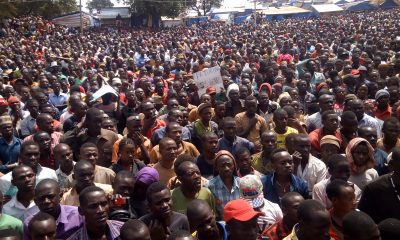
But a more important explanation for the difficulties that companies have had in pushing through on their projects is the resistance that they encountered from affected communities and groups supporting these communities. Protests by villagers in the Rufiji District of Tanzania killed a 20,000 ha industrial oil palm plantation project by the British company African Green Oil Ltd.6 An intense struggle by communities in southwestern Cameroon, supported by community organisations and national and international groups, forced the government to scale back the concession it granted to US firm Herakles Farms from 73,000 ha to less than 20,000 ha. Ultimately the US company backing the venture pulled out, and the new investors have been unable to move ahead with the project.7
Other villagers in Cameroon have stopped the expansion of Pamol’s plantations or are fighting protracted battles to get their lands back and stop the expansion of SOCFIN’s subsidiary Socapalm.8
In Liberia, the Joegbahn clan stopped the UK company Equatorial Palm Oil, now owned by one of the largest oil palm plantation companies in the world, from taking their lands for plantations, despite the government having provided these lands to the company under a concession agreement.9 The other major palm oil companies operating in Liberia are also coming up against fierce resistance from villagers and their partner organisations, as they try to carry out their industrial plantation plans.10
Land conflicts are costly for companies. The fact that so many industrial oil palm plantation projects in Africa are embroiled in land conflicts has the effect of discouraging companies from pursuing investments. The resistance to Herakles Farms, for instance, surely influenced the decisions of the international food corporations Cargill and Sime Darby to pull back from pursuing oil palm plantations in Cameroon. The international criticism of development banks for their funding of Feronia’s plantations in the DR Congo has likely caused them to refuse funding for other industrial oil palm plantation projects in Africa. While there is no way for us to say for sure which projects or how many projects were shelved because of risks of land conflicts or local resistance, we do know from our experience in different struggles that resistance is having a big impact on their decisions and capacity to move industrial plantation projects forward.
The final chapter for industrial oil palm plantations in Africa
West and Central Africa are the origins of the oil palm. It is deeply embedded in the culture and history of most countries in the region– providing not only an important source of cooking oil to many, many generations of communities, but also beverages, animal feed, textiles, building materials, medicines and all kinds of spiritual and ceremonial uses.11 The local production of palm oil was thriving until it was brutally interrupted by a colonial occupation in which much of the region’s oil palm forest groves were put at the service of foreign companies and huge areas of lands were violently taken over to make way for the world’s first large-scale oil palm plantations.
The European colonial rulers selected from the diverse African palms and, with the same brutal force, established massive oil palm plantations in Southeast Asia. The cheap palm oil produced on these plantations, with virtual slave labour, would eventually be shipped back to Africa, turning a region that once had no problem to produce surpluses of palm oil, into a major importer.
The post-colonial period was not much better for communities in the region. Through the cover of the World Bank’s African plantation programmes of the 1970s and 1980s, the old colonial plantation companies were able to re-establish their presence in the region (see box: The World Bank and SOCFIN/SIAT’s plantation projects in Nigeria). In fact, because the oil palm plantation expansion during these years was led by parastatal companies claiming to act in the national interest, the companies could rely on governments to use Presidential decrees and the brute force of the army to displace people from the best lands for oil palm cultivation. The African governments also used public money to pay for this expansion, by way of loans from the World Bank, and then handed the plantations over to foreign companies in the 1990s and 2000s, through the privatisation processes forced upon them by the World Bank, as part of so-called structural adjustment programmes.
Box: The World Bank and SOCFIN/SIAT’s plantation projects in Nigeria
The World Bank pursued a programme to develop large-scale palm oil production in Nigeria in the 1970s and 1980s with the Nigerian government. This programme, financed by multi-million dollar loans from the World Bank and other development banks and ultimately paid for by the Nigerian public, was drawn up and executed by SOCFINCO, a consultancy firm created by the Belgian colonial plantation company SOCFIN, in association with the Dutch company HVA. The person leading SOCFINCO’s operations in Nigeria was the founder of SIAT, Pierre Vandebeeck. From 1974 to the end of the 1980s, SOCFINCO crafted master plans for at least 7 World Bank-backed oil palm projects in 5 different states. Each project involved the creation of a parastatal company that would both take over the state’s existing plantations and develop new plantations and palm oil mills as well as large-scale outgrower schemes.
SOCFINCO was then hired, with lucrative management fees, to handle the project management. All of the projects generated enduring land conflicts with local communities, such as with the Oghareki community in Delta State or the villagers of Egbeda in Rivers State. After dispossessing numerous communities from their lands and incurring huge losses for the Nigerian government, the parastatal companies were then privatised, with the more valuable of the plantation assets ending up in the hands of SOCFIN or SIAT, which Vandebeeck formed in 1991 to take over the plantations of the Oil Palm Company Ltd of Bendel State (now divided into Edo State and Delta State). These plantations are now operated by SIAT’s Nigerian subsidiary Presco. In 2011, another SIAT subsidiary in Nigeria, SIAT Nigeria Limited, acquired the 16,000 ha of plantations of the Rivers State palm oil company, Risonpalm, which Vandebeek, as staff of SOCFINCO, had overseen as plantation manager during the World Bank programme from 1978-1983.
SOCFIN, for its part, took over the oil palm plantations in the Okomu area that were developed under the World Bank programme. It was SOCFINCO that first identified this area for plantation development as part of the appraisal study it was hired to undertake in 1974. The Okomu Oil Palm Company Plc. (OOPC) was subsequently established as a parastatal company in 1976 and 15,580 ha of land within the Okomu Forest Reserve of Edo State was de-reserved and taken from the local communities to make way for oil palm plantations. The company hired SOCFINCO as the managing agent to oversee its activities from 1976-1990. Reports vary, but at some point between 1986 and 1990, OOPC was then divested to SOCFIIN’s subsidiary Indufina Luxembourg.12
The new wave of industrial oil palm plantations that has taken place in Africa over the past 15 years is built, quite literally, on the back of this brutal history. The majority of recent industrial oil palm projects that are being implemented involve old concessions, abandoned plantations and long simmering land conflicts.
For communities across African countries, today’s industrial oil palm plantation projects are experienced as another round of colonial occupation.13 Their lands are being taken from them, often by force, without consultation or consent. The industrial plantations destroy their forests and local biodiversity and pollute their water sources. They lose access to lands to grow food as well as their traditional palm groves, and they are forbidden from producing their own palm oil. The companies are only able to produce palm oil for cheap because the labour conditions on their plantations are so bad, often even worse than they were in colonial times, with wages, when they are paid, not covering basic living expenses and the vast majority of jobs being for daily labourers, with no job security. There are barely any social investments, such as schools, clinics and infrastructures, that might provide some compensation– and villagers rarely see any of the rental payments that companies claim to make.
Much like under the colonial period, villagers living in and around the concession areas are constantly harassed and beaten by company security guards who accuse them of stealing palm fruits from the company plantations. Opponents of the company are also routinely beaten, arrested and intimidated, and sometimes even killed. But it is women who suffer the most, and almost always in silence. The level of sexual violence faced by women living around the plantations or working at the plantations is generally horrific.14
Yet today’s agrocolonialism is nevertheless cloaked in the story of a mission to help Africa, just as it was during the colonial period. All of the companies claim to be “responsible investors”, with several adhering to the principles of the Roundtable for Sustainable Palm Oil (RSPO) and making ‘zero deforestation’ pledges. Although the RSPO certification criteria cannot be considered sustainable, since it promotes industrial plantations, it is interesting to see how few of these companies have achieved RSPO certification for their industrial plantations in African countries. Only 9 of the 52 large scale oil palm plantations in operation in Africa have RSPO certification.
Most of the corporate plantation projects include outgrower schemes, where the companies organise local smallholders to supply them with oil palm fruits. Sometimes, companies lure farmers into these programmes by providing seedlings and promising that such schemes are a way for villagers to ‘get rich quickly’. These programmes are sometimes written into the concession agreements with the government and companies often receive funding from African governments, UN institutions, donors or development banks for these outgrower or smallholder programmes. In several cases, the schemes are carried out with the collaboration of NGOs. Some outgrower schemes have existed for decades, and were established through the World Bank funded industrial oil palm programmes of the 1970s and 1980s. This is the case in Ghana, where the area under outgrower schemes is larger than the area under industrial plantations.15 In most recent cases, however, these outgrower schemes are not the priority for the companies, and the companies channel far more of their resources into their own company plantations, for which they can maintain stricter control over production.
Olam, for example, established a joint venture company with the Gabon government to develop ‘outgrower’ programmes in nine provinces to allegedly support the country’s food security. The programme, called GRAINE, is supposed to develop smallholder plantations of oil palms and other crops covering 200,000 ha and involving 1,600 villages by 2020. Yet, by the end of 2017, the joint venture had invested $40 million in the GRAINE programme, in contrast with the $643 million that Olam’s plantation company spent on its own industrial plantations. Moreover, rather than increase food production, the GRAINE programme had instead devoted the funding it received from the African Development Bank to the development of a large oil palm plantation on a 30,000 ha concession in the savannah zone at Ndendé in Ngounié province.16 A recent report indicated that this GRAINE oil palm plantation may now be handed over to Olam’s plantation company!17
Where companies are actually implementing outgrower programmes or maintaining the smallholder schemes initiated by the previous plantation owners, the results are not much better. The villagers participating in these programmes have to cultivate industrial oil palms exclusively on part or on all of their lands and must produce exclusively for the company. The company sets the terms of the contract and determines the prices that are paid. Experience shows that the companies typically fix the contracts to guarantee their profits, while the villagers end up in debt at the end of each year. The villagers also sacrifice lands that they could have used to produce food for their families and communities.
Corporate oil palm projects are clearly a disaster for the local communities where they are based. The number of failed projects and the losses incurred by many active plantation companies at their operations in Africa seem to indicate that the companies are not profiting much either. But this does not mean that the main people behind these companies do not profit. The executives and directors of loss making oil palm plantation companies always ensure that they are paid handsomely, through salaries, bonuses, share options and all kinds of “service fees” or exaggerated expenses that they charge to the companies. While a company like Feronia Inc, which is heavily financed by development banks, complains of not being able to pay its workers even the legal minimum wage or to build decent health clinics within its concession in the DR Congo, its top executives received over $2 million in salaries and share options in 2017.18 Moreover, when there are (declared) profits, such as with some of the SOCFIN owned plantation companies in Africa, most of the profits are distributed to the shareholders, and are not used to improve the wages of its workers or to construct the social projects that were promised to communities.19
Turning the page
The experience with this latest wave of industrial oil palm plantations in Africa makes it clear that this model of corporate agriculture is totally inappropriate and ineffective for the continent. Villagers in many parts of the region have a long history of cultivating oil palms and producing palm oil without the involvement of big companies, and women are usually the main actors in these small scale systems. Today, smallholders in African countries, supplying small-scale mills, account for the vast majority of palm oil that is produced on the continent, and they are far more capable of expanding production to meet the growing local demand, if they have access to lands and markets.20 They also produce a palm oil that is of higher quality and more suited to local food cultures, whereas the industrial plantations produce a highly-refined palm oil designed for industrial uses, including unhealthy, ultra-processed foods and biofuels.
Despite all the support they get from governments, banks and donors, the plantations of the big palm oil companies still account for only 10% of the total harvested area of oil palms in Africa.21 Most of the palm oil that the big companies sell in Africa is imported from Malaysia and Indonesia and this cheap, low quality palm oil undercuts the local markets for the higher-quality traditional palm oil supplied by small-scale producers.
It is the history of diverse small scale production that needs to be the foundation for the future of palm oil production on the continent. Communities do not need companies to manage their lands and to produce palm oil. As we have seen over the past decades, companies only drain the profits to far away places and their model of production leaves nothing but misery and pollution for local people.
For all of these reasons, there needs to be an immediate ban on all future, large-scale oil palm plantation projects and a halt to those currently being implemented. Where large-scale plantations already exist, the lands must be returned to the control of the local communities, who can then develop a vision for how they want to utilise and organise these lands, now and into the future. The concession agreements governments have signed with companies, most of which are in violation of the law and the rights of the local communities, must be scrapped.
It is time to turn the page on colonial plantations in Africa, and put oil palms back into the hands of communities!
1 GRAIN, “The global farmland grab in 2016: how big, how bad?”, June 2016: https://www.grain.org/e/5492
2 The exception is the company Africa Palm Corp which claims to have secured agreements with Guinea-Bissau, Republic of the Congo, Togo and Ghana covering 5 million hectares. There is little evidence, however, to indicate that this company will be able to move forward with these projects.
3 This comprises the plantation areas developed/replanted by Pamol, Nana Bouba Group, Palme d’Or, Agro Panorama, DekelOil, Feronia, Blattner, Volta Red, Olam, Golden Agri, KLK, SIFCA (Liberia), Sime Darby, Goldtree, Kalyan Agrovet and IDC, as well as the expanded/replanted areas by SOCFIN (27,980 ha), Wilmar (27,231 ha), SIAT (8,605 ha).
4 Earthsight, “The Coming Storm,” March 2018: https://docs.wixstatic.com/ugd/624187_3b22354dff0843789fc440cb4674caaf.pdf
5 SOCFIN and SIAT acquired plantations that were developed and or privatised by way of World Bank programmes in Cameroon (Socapalm), Côte d’Ivoire (SOGB), Gabon (Agrogabon, now owned by Olam), Ghana (GOPDC and SIPL) and Nigeria (Presco, SIAT Nigeria, and Okomu).
6 Kizito Makoye, “Tanzanian Farmers Crack the Code for Fighting Land Grabs” MSN, November 2018: https://www.msn.com/en-xl/africa/life-arts/tanzanian-farmers-crack-the-code-for-fighting-land-grabs/ar-BBPDXXv
7 WRM, “Palm oil concessions for logging: the case of Herakles Farms in Cameroon,” September 2015: https://wrm.org.uy/articles-from-the-wrm-bulletin/section1/palm-oil-concessions-for-logging-the-case-of-herakles-farms-in-cameroon/
8 Fern, .Speaking truth to power: the village women taking on the palm oil giant,” September 2018: https://www.fern.org/news-resources/speaking-truth-to-power-the-village-women-taking-on-the-palm-oil-giant-45/
9 Silas Kpanan’Ayoung Siakor and Jacinta Fay, “When our land is free, we’re all free,” Synchronicity Earth, https://www.synchronicityearth.org/when-our-land-is-free-were-all-free/
10 Ashoka Mukpo, “‘We come from the earth’: Q&A with Goldman Prize winner Alfred Brownell”, Mongabay, June 2019: https://news.mongabay.com/2019/06/we-come-from-the-earth-qa-with-goldman-prize-winner-alfred-brownell/
11 GRAIN, “Planet palm oil: peasants pay the price for cheap vegetable oil”, September 2014: https://grain.org/e/5031
12 Much of the information from the period of the World Bank programme is derived from the World Bank archives (http://documents.worldbank.org/curated/en/506921468098056629/pdf/multi-page.pdf; http://documents.worldbank.org/curated/en/735641468915257440/text/multi0page.txt; http://documents.worldbank.org/curated/en/328231468082133313/text/multi-page.txt; http://documents.worldbank.org/curated/en/735641468915257440/text/multi0page.txt; http://documents.worldbank.org/curated/en/477341468075533881/pdf/multi-page.pdf). See also Emmanuel Okachukwu A. Omah, “Public Enterprises and Community Development in Rivers State: A case study of Risonpalm Limited,” June 2002: https://oer.unn.edu.ng/download/public-enterprises-and-community-development-in-rivers-state-a-case-study-of-risonpalm-limited; Nwizugbe Obiageri Ezenwa, “Corporate Community Crisis in Nigeria; Case Study of Presco Industries Ltd and Oghareki Community,” IOSR Journal Of Humanities And Social Science, March 2014: http://www.iosrjournals.org/iosr-jhss/papers/Vol19-issue3/Version-7/J019378289.pdf; and documentation from the evaluations of Okomu’s extension plans from 2016 conducted by Proforest and Foremost Development Services Limited.
13 World Rainforest Movement, GRAIN and an Alliance of community and local organisations united against industrial oil palm plantations in West and Central Africa, “Booklet: 12 tactics palm oil companies use to grab community land’ April 2019: https://grain.org/e/6171
14 RADD, Muyissi Environnment, Natural Resource Women Platform, Culture Radio, GRAIN, WRM, “Breaking the Silence: Violence against women in and around industrial oil palm and rubber plantations,” https://wrm.org.uy/all-campaigns/breaking-the-silence-violence-against-women-in-and-around-industrial-oil-palm-and-rubber-plantations/
15 Kwabena Ofosu-BUDU and Daniel Bruce SARPONG, “Oil palm industry growth in Africa: A value chain and smallholders’ study for Ghana,” Chapter 11, FAO: http://www.fao.org/3/i3222e/i3222e11.pdf
16 RADD, SEFE, YETHIO, SYNAPARCAM, GRAIN and WRM, “The seed of despair: communities lose their land and water sources due to OLAM’s agribusiness in Gabon,” 11 July 2017, https://grain.org/e/5755
17 “Gabon: la gestion du projet Graine cédée à la CDC,” Gabon Media Time, Novembre 2018: https://pmepmimagazine.info/gabon-la-gestion-du-projet-graine-cedee-a-la-cdc/
18 According to Feronia Inc’s annual report for 2017, available here: https://www.sedar.com
19 See Socfinaf’s 2018 annual report: https://www.socfin.com/sites/default/files/2019-04/Rapport%20annuel%20-%20Socfinaf%282018%29.pdf
20 Ordway, Elsa M et al. “Oil palm expansion and deforestation in Southwest Cameroon associated with proliferation of informal mills.” Nature communications vol. 10,1 114. 10 January 2019: https://www.ncbi.nlm.nih.gov/pmc/articles/PMC6328567/
21 According to FAOSTAT, the total harvested area in Africa in 2017 is 4,578,074 ha.