Connect with us

MEDIA FOR CHANGE NETWORK

World Bank Changes: The office of the Accountability Mechanism Secretary is to be disbanded as the Inspection Panel, and the Dispute Resolution Service will operate independently.

Published

on

By Witness Radio team.

The World Bank’s Board of Executive Directors has approved changes to its Accountability Mechanism (AM) structure to enhance its independence and overall effectiveness, efficiency, and functioning.

The World Bank Accountability Mechanism is an independent complaints mechanism for people and communities that believe a World Bank-funded project has harmed them or is likely to be abused by one. It also houses the Inspection Panel and the Dispute Resolution Service.

This milestone, a response to the overwhelming complaints from cases handled by the World Bank’s Accountability Mechanism, including the failure to fully address concerns submitted by communities negatively impacted by World Bank-funded projects, brings hope for a more effective and responsive system.

The approved changes follow a comprehensive report by an external review team appointed by the World Bank Board last year. This thorough review explored options to improve the World Bank’s accountability process, instilling confidence in the changes made.

The report provided assessments and recommendations on issues related to accessibility to the compliance and DR functions; how the IPN can independently perform its compliance function under the present structure; options for structural changes; redundancies and efficiencies in the present AM system; and interactions between the DR and the compliance review functions, among others offering options that range from moderate to significant changes.

Based on the recommendations from the External Review Team report, the Inspection Panel (IP) and the Dispute Resolution Service (DRS) will operate as two parallel units, each independently reporting to the Board, and the Accountability Mechanism Secretary will be closed.

Additionally, a new position of Executive Secretary will be created to support both units and work under the direct supervision of the IP Chair and the Head of the DRS.

Initially, as per its founding mandate, the Inspection Panel responds to complaints from individuals affected by World Bank projects. If a Request for Inspection is deemed eligible and the Panel recommends an investigation, the Board approves. Within 30 business days of the investigation’s approval, the Accountability Mechanism Secretary will offer the Requesters and borrower the option of voluntary, independent dispute resolution. If both parties accept this offer, the Dispute Resolution Service will assist them in reaching an agreement to resolve the issues raised in the Request.

If either party declines dispute resolution or an agreement is not reached within the specified time frame, the case is transferred to the Inspection Panel. The Panel, a cornerstone of the World Bank’s accountability process since 1993, investigates to assess whether the Bank has adhered to its operational policies and procedures and to identify any harm caused.

The new Executive Secretary position will provide administrative, communication, and coordination services to the IP and the DRS. This role will ensure smooth operations and effective communication between the two units, the Board, and other stakeholders.

The World Bank has also stated that these changes will not impact current cases, and the Board will continue to explore further reforms to enhance overall accountability. The changes will be implemented following the Board’s adoption of amendments to the governing resolutions in the coming weeks.

The AM and DRS were created by the Board in 2020 to provide project-affected communities with the option of dispute resolution to address their concerns. Creating these units was a significant step towards enhancing the World Bank’s accountability and ensuring that affected communities have a voice in the project implementation process. The Inspection Panel, which carries out compliance reviews in response to complaints by affected people, was established in 1993 as the first independent accountability mechanism at an international financial institution.

Continue Reading

MEDIA FOR CHANGE NETWORK

Nabakooba Urges Judicial Integrity in Land Cases Amid Rising Evictions

Published

on

The Minister of Lands, Housing and Urban Development, Judith Nabakooba, has urged judicial officers to exercise greater diligence and uphold the law when handling land-related cases, amid growing concern over unlawful evictions.

Nabakooba emphasized that the judiciary plays a central role in safeguarding citizens’ land rights and must ensure that justice is administered fairly, without bias or external influence.

“Judicial officers must carefully handle land disputes in line with the law, without fear or favour, so that we can put an end to the continued eviction of people from their land,” she said.

She warned that in some cases, the court system is being exploited by individuals seeking to dispossess vulnerable people who lack the resources or legal knowledge to defend themselves effectively.

“There are cases where the courts are used to intimidate those who cannot adequately represent themselves, and in the end, they lose their land unfairly,” she added.

Her remarks come against the backdrop of increasing land disputes across Uganda, many of which have resulted in forced evictions and prolonged legal battles.

Nabakooba stressed the need for a justice system that protects all citizens—particularly the vulnerable—by ensuring transparency, accountability, and strict adherence to the law in land adjudication processes.

She called on judicial officers to remain vigilant and committed to upholding the rights of Ugandans, noting that restoring public trust in the system is essential to addressing the country’s persistent land conflicts.

Source: nilepost.co.ug

Continue Reading

MEDIA FOR CHANGE NETWORK

Breaking: Ugandan Court jails eight Anti-EACOP activists as crackdown on dissent deepens.

Published

on

By the Witness Radio team.

KAMPALA, Uganda—The Buganda Road Chief Magistrate’s Court sentenced eight environmental activists to 11 months in prison for “public nuisance.” The court ruled that their protest against the East African Crude Oil Pipeline unlawfully disrupted traffic in central Kampala.

The group includes Akram Katende, Ismail Zziwa, Teopista Nakyambadde, Shammy Nalwadda, Dorothy Asio, Shafik Kalyango, Noah Kafiiti, and Keisha Ali. They were sentenced on Friday, April 17, 2026, by a Grade One Magistrate. The court convicted them of nuisance on the road, contrary to section 65(e) of the Road Act Cap. 346.

In a judgment delivered by Chief Magistrate H/W Achayo Rophine, the court found that the activists had “placed themselves on the road in a manner that caused danger or inconvenience to traffic.

The activists, operating under the umbrella of Rooted in Resistance, formerly Students Against EACOP Uganda, were arrested on August 1, 2025, while marching toward Stanbic Bank Uganda’s headquarters. They were protesting the bank’s alleged role in financing the controversial East African Crude Oil Pipeline (EACOP).

They have been on remand for more than eight months after being repeatedly denied bail.

In her ruling, Magistrate Achayo relied heavily on police testimony and video evidence, which she said showed the activists standing and sitting in the middle of Hannington Road, holding

placards reading “Stop EACOP” and refusing orders to disperse.

The court concluded that the protest constituted an unlawful assembly, noting that the group had not notified authorities in advance and had failed to comply with police instructions to clear the road.

Citing Article 43 of the Constitution, she ruled that the activists’ actions prejudiced the rights of other road users and the public interest, particularly by causing a traffic jam in a busy section of Kampala.

“The accused persons… caused inconvenience on the road with their unlawful assembly,” the judgment reads.

Despite the relatively minor nature of the offense, which carries a maximum sentence of one year, the activists had already spent most of that time in detention before conviction.

Their prolonged remand has drawn criticism from legal observers and human rights advocates, who argue that the case reflects a broader pattern of punitive pre-trial detention.

Defense lawyer Kato Tumusiime condemned the ruling and announced plans to appeal to the High Court, describing the decision as an attack on fundamental freedoms.

He argued that the conviction is “intended to silence freedom of expression and speech in Uganda.”

“The judgment is unfair, and we intend to appeal it,” lawyer Kato Tumusiime said.

The case is part of a growing number of arrests linked to opposition to the East African Crude Oil Pipeline, a major regional infrastructure project.

In April 2025, another group of activists, commonly known as KCB 11, protesting against KCB Bank Uganda’s involvement in the project, were detained for three months under similar circumstances.

Campaigners say these cases point to a systematic use of the justice system to deter protest against powerful economic interests.

The East African Crude Oil Pipeline (EACOP) is a 1,443-kilometer heated crude oil pipeline designed to transport crude oil from western Uganda’s Lake Albert region to the port of Tanga in Tanzania. The project is being developed by a consortium led by TotalEnergies and China National Offshore Oil Company, alongside the governments of Uganda and Tanzania.

Supporters of the project say it is central to Uganda’s economic ambitions, expected to generate revenue, create jobs, and enable the country to become an oil exporter.

However, environmental groups and civil society organizations have raised concerns about its impact. Critics point to the displacement of communities during land acquisition, potential risks to ecosystems, and the project’s contribution to global carbon emissions.

Despite opposition, the project has already entered the implementation phase. Construction activities are ongoing in both Uganda and Tanzania, and land acquisition processes have largely progressed, although some disputes remain. Uganda continues to target its first oil production within the next few years.

These concerns have fueled a wave of protests, targeting financial institutions seen as backing the pipeline.

Campaigners have also criticized companies and financiers linked to the project for failing to speak out. StopEACOP Campaign Coordinator Zaki Mamdoo has argued that corporate silence in the face of arrests is not neutral, pointing to evidence of communication between project developers and Ugandan authorities.

“At COP28, when I confronted TotalEnergies CEO Patrick Pouyanné over the arrest of yet another group of anti-EACOP activists, he confirmed to me that the company was in direct communication with Ugandan authorities over the detention of those activists. That demonstrates that the companies behind EACOP are not passive observers of the repression meted out by the authorities”, said StopEACOP Campaign Coordinator, Zaki Mamdoo.

Continue Reading

MEDIA FOR CHANGE NETWORK

Govt launches war on land fraud, illegal evictions

Published

on

The government has warned that the growing wave of land-related crimes across the country, caused by unscrupulous land agents, fraudulent transactions, and family inheritance disputes, is increasingly undermining investment confidence and tenure security.

Lands Minister Judith Nabakooba said the persistent rise in land offences is eroding public trust in the land administration system and slowing down wealth creation efforts, especially in both urban and peri-urban areas.

“The trend is mainly being contributed to by unscrupulous land agents, overzealous administrators of estates, forgeries of land transaction documents, absentee landlords and tenants who disregard their obligations, and this has hurt investment and wealth creation, necessitating immediate coordinated intervention,” Ms Nabakooba said.

She explained that many of the disputes occur in high-risk settings such as unregistered customary land, contested ownership, inheritance wrangles, and large-scale land transactions where verification systems are weak, bypassed, or manipulated by actors familiar with legal loopholes.

Despite Uganda’s existing legal safeguards, including Article 237 of the Constitution, the Land Act, the Succession Act, and the Mortgage Act, officials say enforcement gaps continue to be exploited.  Data from the ministry’s Sustainable Urbanization and Housing Programme report shows that the level of digitised land services has increased from 45 percent to 82 percent, significantly improving efficiency and reducing delays in service delivery.

 The same report indicates that the time taken to conduct a land search has reduced from five days to one day at physical offices, and to as little as five minutes through online platforms. Processing times for land transactions such as transfers and mortgages have also dropped from 15 days to about 11 days, marking progress in service delivery reform.

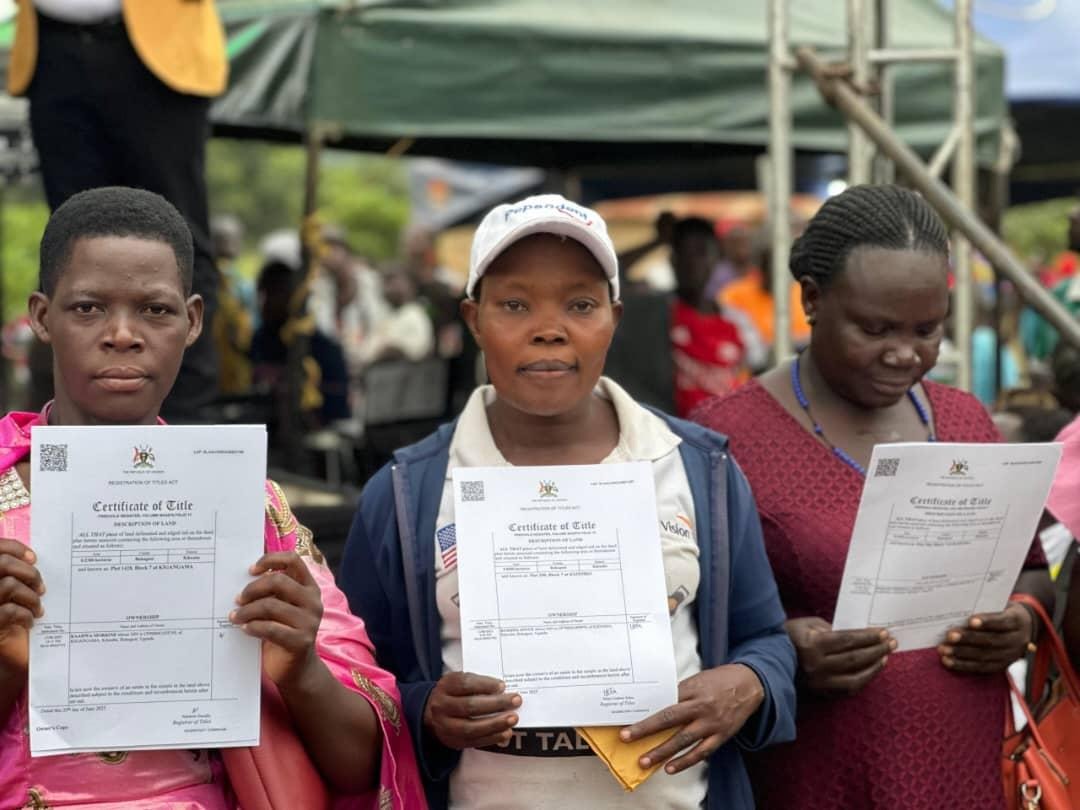
In addition, systematic land demarcation and certification efforts have expanded, with surveyed land parcels increasing from 66,148 to 469,656. Certificates of Customary Ownership have also risen significantly from 9,325 to 80,898, reflecting government efforts to formalise tenure systems and reduce disputes in customary land areas.

 To curb illegal evictions and related abuses, government introduced Administrative Circular No. 1 of 2025, which tightened procedures governing evictions nationwide. The directive requires that no eviction be carried out without the involvement of District Security Committees in consultation with the Ministry of Lands.

“Eviction or demolition shall only be carried out between 8am and 6pm, and no eviction or demolition shall be carried out during weekends or public holidays. Each demolition shall be carried out in a manner that respects and upholds human rights and dignity,” Ms Nabakooba said.

 Beyond enforcement measures, the ministry says it is pushing broader reforms aimed at strengthening governance and reducing fraud.  These include allowing tenants to deposit nominal ground rent (busuulu) with the Uganda Revenue Authority in cases where landlords are absent or refuse payment, alongside plans to deploy blockchain technology and artificial intelligence in land transactions.

Also mass land titling to resolve boundary disputes is being undertaken.  “Government remains committed to ensuring social justice and harmony in land ownership, and all stakeholders must comply with established legal procedures. All Resident District Commissioners should remain vigilant in maintaining law and order,” Ms Nabakooba added.

 However, concerns remain about enforcement at district level, particularly in high-conflict areas where vulnerable groups continue to face intimidation and forced evictions.  Mr Twaha Ssembalirwa, a legal expert from Atlas Advocates, said the rise in land-related crimes reflects weak enforcement rather than a lack of legislation.

“Uganda has a fairly robust legal framework on land, but the challenge lies in enforcement. Corruption in land transactions is mostly among the big wigs in most of the cases we handle, plus low public awareness, especially among people dealing with customary and unregistered land,” he said.

Original Source: monitor.co.ug

Continue Reading

Resource Center

Legal Framework

READ BY CATEGORY

Facebook

Newsletter

Subscribe to Witness Radio's newsletter


Trending

Subscribe to Witness Radio's newsletter