
MEDIA FOR CHANGE NETWORK
80-year-old widow evicted from her land, detained for five months on trespass charges

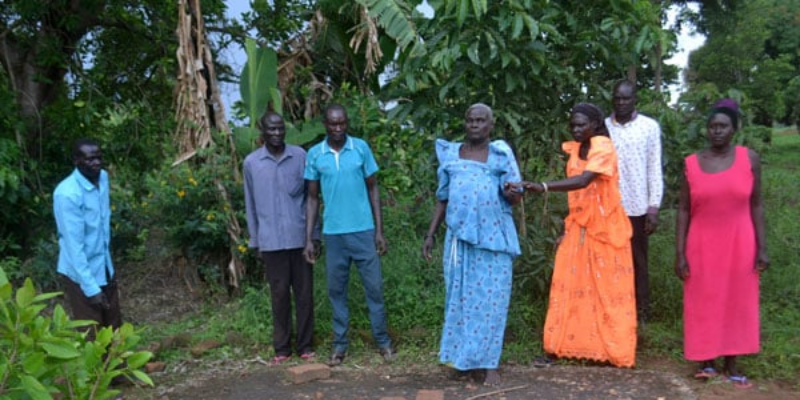
Ms Elivaida Mugala (C) and her children pose next to the grave of her husband on disputed piece of land in Nawaka village, Ikumbya Sub-county in Luuka District. PHOTO/DENIS EDEMA.
Ms Elivaida Mugala, a resident of Nawaka village, Ikumbya Sub-county in Luuka District, Eastern Uganda, is fighting to reclaim her 36-acre piece of land allegedly stolen by a grabber who accused her of trespass, yet she has lived on it for five decades.
Armed with what Ms Mugala believes are forged documents and backed by some local authorities, the alleged land grabber, Mr Fred Bahati, has left the 80-year-old widow and her family frustrated and helpless.
Her neighbours and other community members are also outraged and now worried that their land could be targeted next.
Neighbours who witnessed her eviction described the scene as chaotic and traumatising to watch after the suspected grabber allegedly hired police and suspected goons to eject the elderly Ms Mugala from the peoperty she inherited from her late husband, Yowasi Kintu who died in 2022.
“Mr Bahati took advantage of our vulnerability after my husband’s death. He used his power and influence to forge documents to claim ownership of my land. But I won’t back down. I’ll fight for justice, no matter what it takes,’’ Ms Mugala vowed.
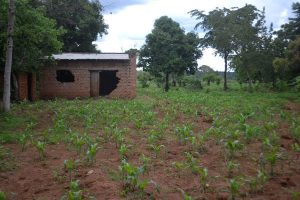
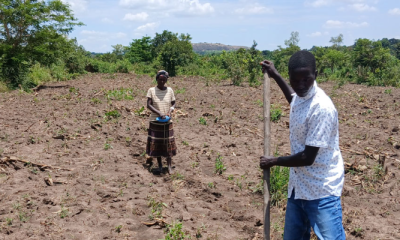
A maize garden in front of one of the houses that belonged to Ms Elivaida Mugala
Ms Mugala recounted eviction experience, saying: “When I resisted the forceful eviction from the land we’ve occupied since the 1970s, I was accused of trespassing on my own land and home. I was arrested along with my grandchildren and daughter, and we were imprisoned in Iganga for five months without clear charges or legal representation.’’
“He came with an army of security personnel, threatening us with firearms and intimidating our entire community. His hired thugs destroyed my home and crops, then accused me and my grandchildren of causing the damage. At my age, what energy do I have to inflict such harm?” Ms Mugala recounted.
“It’s a grave injustice, and I demand accountability. It’s clear that some local leaders are colluding with the grabber. They’re taking advantage of the family’s vulnerability, but the community won’t stand for it. We’re calling on district leaders to intervene and bring justice to this elderly woman,” Defence Secretary of Nawaka B Village, Mr Francis Balwaine said.
According to Mr Balwaine no leader has visited to investigate, nor police picked interest in investing this case.
“It’s clear that the lack of action is due to the family’s inability to bribe their way to justice. This injustice will have consequences, and it will likely cost the ruling party votes,’’ he added.
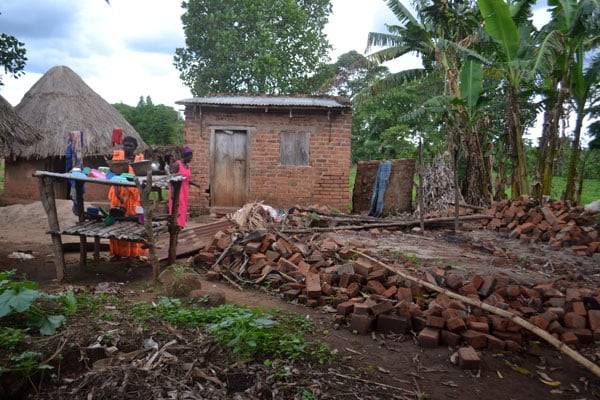
When this reporter visited the scene, Ms Mugala’s two-roomed house was found damaged, with windows shattered and doors plucked out.
The trees she had planted around the home were also cut down.
Ms Mugala showed us a maize garden prepared by the suspected land grabber during the five months she was reportedly detained by police no clear charge.
Mr Christopher Matindo, a 76-year-old retired teacher and current information secretary of Nawaka Parish, who shares a boundary with Ms Mugala, said he was worried he could be the next target for the land grabbers.
“Mr Bahati hasn’t lived around here since he was a child. What basis does he have for claiming ownership of this land?’’ Mr Matindo wondered.
Mr Matindo revealed that his land is adjacent to the disputed piece of land, making him a concerned neighbor.
“I’m worried that if they succeed in grabbing Ms Mugala’s land, mine could be next. What’s more troubling is the silence from local leaders. Why are they quiet on this matter?’’ he wondered.
One of Ms Mugala’s sons, Mr Moses Nsandha, 37, said they have sought help from various offices, including the police, but they have not been helped.
“It’s like the land grabber has bought off the entire Luuka district leadership, leaving us with nowhere to turn,’’ he alleged.
“We’ve been loyal NRM voters for decades, but this incident has opened our eyes to see the reality. If this is how they repay us – by enabling grabbers to steal from the vulnerable – then they shouldn’t expect our votes again if there is no justice for the old woman,’’ said Mr Godfrey Mulwa, Councilor for Nawaka Parish.
When contacted, Mr Bahati said the case was in court and denied any involvement in destroying the elderly woman’s property.
He claimed that he purchased the land through the rightful channels, arguing that the house he demolished was his workers’ quarters on his property.
Mr Bahati claimed he’s in possession of genuine documents proving his ownership of the land, which he said spans between 8-10 acres.
He dismissed Ms Mugala’s claim that the disputed land measures 36 acres, arguing that she exaggerated it.
According to the district Police Commander, Mr Moses Akena, land fights are increasingly becoming a challenge in Luuka.

A house belonging to the daughter of Ms Mugala, which was destroyed by a suspected land grabber in Luuka district.PHOTO/ ENIS EDEMA.
“A common scenario is when family members, particularly brothers, grab property from widows or orphans after the death of the family head,’’ he said.
Mr Akena acknowledged a high level of moral decay in the community, contributing to the rise in land disputes.
However, he noted that the police are collaborating with Redeem International, an NGO that advocates for widows’ and orphans’ rights. Through this partnership, they’re working to restore grabbed property to its rightful owners through court proceedings.
Police have over time been accused of enabling land grabbing through corruption.
Mr Hassan Ssembarirwa, Deputy Resident Commissioner of Luuka, said Ms Mugala, whose land is allegedly being grabbed by Mr Bahati, is currently before the RDC’s office.
He noted that Mr Bahati has filed five cases against Ms Mugala in different courts.
Ironically, Mr Ssembarirwa revealed that Redeem International, an organisation dedicated to protecting the property rights of widows and orphans, is handling Ms Mugala’s case in court with the support of the RDC’s office. Their goal is to ensure the elderly woman regains her land.
“The police forensic investigations indicated that he had forged agreement documents and the matter is before the court, being followed up by Redeem International and the office of the RDC to ensure the old woman gets justice,’’ Mr Ssembarirwa said seemingly affirming that the responsible government officials have folded their hands instead of helping Ms Ms Mugala who also claim to be a longtime supporter of the ruling National Resistance Movement (NRM) which has been I power for nearly four decades.
Ms Damalie Nyafwono, a lawyer with the NGO, said her team had successfully secured bail for three individuals accused in a land dispute case filed by Mr Bahati at Kiyunga Magistrate Court in Luuka.
“Mr Bahati has filed multiple cases against Ms Magala in different courts in Iganga. It’s clear he’s trying to harass and intimidate her. But we’re prepared to fight her case in every forum until she gets justice,’’ the lawyer said.
Corruption among public servants and land grabbing have become a common and permanent feature in almost every part of the country, with the most vulnerable being women and ordinary/ poor Ugandans who cannot bribe their way to get justice.
Police said in their latest annual crime report that a total of 397 cases of land-related crimes were reported in 2024, compared to 271 cases reported in 2023, giving a 46.5 per cent increase in the crimes reported under this category.
Source: monitor.co.ug
Related posts:

 SDA church is dispossessing a helpless 76-year-old widow, grand children
 A dead body recovered in a resident’s garden is causing sleepless nights to community members in fear of arrests and false charges.
 Hearing of a case against a 72-year-old woman for disobeying NEMA orders is kicking off today..
 Breaking: over 350,000 acres of land were grabbed during Witness Radio – Uganda’s seven months ban.




Related posts:

 EACOP PAPs have started a private criminal proceeding against Army General, Hoima Police Commander and others over their criminal acts during illegal land evictions.
 UPDF General on the spot over fresh evictions in Hoima
 Breaking: The army general, police chief, presidential representative, and others are appearing before the Hoima Chief Magistrate court today.
 Court issues fresh criminal summonses against army general, police chief and presidential representative and others in a private criminal case.
MEDIA FOR CHANGE NETWORK
Five years after Uganda’s National Action Plan on Business and Human Rights, are local communities hosting land-based investment projects seeing change?

Related posts:

 Breaking Alert: Uganda passes the National Action Plan (NAP) on Business and Human Rights
 Africa’s responsible business agenda is facing challenges as more land is taken from local communities for investment, and landowners struggle to secure justice.
 The 4th African Forum on Business and Human Rights: The rapidly escalating investment in Africa is urgently eroding environmental conservation and disregarding the dignity, the land, and human rights of the African people.
 Land and environmental rights defenders, CSOs, scholars, and government to meet in Kampala to assess Uganda’s performance on the implementation of the UN Guiding principles on Business and Human Rights in Uganda.

Related posts:

 African women push for reparations and environmental accountability after landmark Climate Justice Day.
 African women are rising for climate justice and reparations on the inaugural continental day of action.
 Breaking: West and Central African women meet in Senegal over the climate crisis.
 African women unite on the frontlines of the Climate Crisis

The pain and anguish in the Albertine Part II

Lango ex-combatants count losses after dry spell destroys maize harvest

Five years after Uganda’s National Action Plan on Business and Human Rights, are local communities hosting land-based investment projects seeing change?

The Fight for Climate Justice: African Women at the Forefront

Breaking: Sixteen Rooted in Resistance activists arrested and detained as they boldly protested Uganda’s oil ambitions.

Tanzania’s surge in conservation investments is under the UN spotlight, as allegations of indigenous land rights violations prompt an urgent call for the government to stop the evictions at once.

Ten out of sixteen Rooted in Resistance activists now face charges and have been sent to Luzira Prison after standing up against Uganda’s oil development.

New revelations: TotalEnergies is investing in countries facing political and economic risks, raising fresh questions about the company’s investment strategy.

Innovative Finance from Canada projects positive impact on local communities.

Over 5000 Indigenous Communities evicted in Kiryandongo District

Petition To Land Inquiry Commission Over Human Rights In Kiryandongo District

Invisible victims of Uganda Land Grabs
-

 MEDIA FOR CHANGE NETWORK2 weeks ago
While hunger continues to grip the world, a new report highlights forests and forest foods as a hidden treasure trove of nourishment.
-

 MEDIA FOR CHANGE NETWORK7 days ago
Alert: Land degradation is emerging as a pressing threat to global security.
-

 MEDIA FOR CHANGE NETWORK7 days ago
Young people and agriculture: Step into the world of Ugandan NGO ESAFF, where a new generation in schools is being inspired to reimagine farming, celebrate wholesome food, and become passionate advocates for food sovereignty.
-
 MEDIA FOR CHANGE NETWORK4 days ago
Five years after Uganda’s National Action Plan on Business and Human Rights, are local communities hosting land-based investment projects seeing change?
-

 MEDIA FOR CHANGE NETWORK2 weeks ago
In Kasanda District, a grandmother faces eviction as her own grandchildren join forces against her.
-
 FARM NEWS2 days ago
Lango ex-combatants count losses after dry spell destroys maize harvest
-
 MEDIA FOR CHANGE NETWORK2 weeks ago
Lira siblings reclaim father’s land after bitter family dispute
-
 MEDIA FOR CHANGE NETWORK2 weeks ago
After weeks behind bars, six anti-oil activists have been granted cash bail by the LDC Court.