Seated is former President of Finland and UNCCD Land Ambassador Tarja Halonen. Standing from left are BSSS President Prof. Paul Hallett, BSSS Executive Director Andrew Morris, and UNCCD CSO Panel Representative Sopiko Babalashvili.
By Witness Radio and British Society of Soil Science (BSSS) teams.
As land degradation spreads globally, its impacts reach beyond the environment, affecting food security, livelihoods, water access, migration, and political stability. The health of our land is becoming a central pillar of global security.
For decades, international security has been framed by borders, military power, and political conflict. Beneath these visible forces lies a quieter foundation: the land itself, which grows our food, supports livelihoods, stores water, and sustains communities.
As land suffers from unsustainable use, drought, and climate pressures, the fallout spreads beyond environmental harm into the economic and social fabric that determines whether communities remain safe and stable.
This connection was brought into sharp focus at the 17th Conference of the Parties to the United Nations Convention to Combat Desertification, UNCCD COP17, held in Ulaanbaatar, Mongolia. Governments, scientists, Indigenous peoples, pastoralists, civil society organizations, and young people gathered under the theme “Restoring Land, Restoring Hope.”
Though the spotlight was on desertification, drought, and land degradation, participants voiced concerns about a broader crisis involving food systems, water resources, livelihoods, migration, and community stability.
For Rico Rau, Global Focal Point of the UNCCD Youth Caucus, the conventional understanding of security does not capture these realities because access to food and water is fundamental to human survival.
“Security is often defined as war, weapons and conflict,” Rau says, arguing that the ability of societies to provide food and water should be considered part of the same conversation.
His perspective includes land degradation in a broader definition of security, showing how the slow unraveling of natural systems erodes the economic and social bedrock supporting stability.
The consequences are already unfolding in regions where environmental decline collides with poverty, climate stress, and fierce competition for natural resources.
Hindou Oumarou Ibrahim, a Chadian environmental activist, geographer, and advocate for Indigenous peoples, points to the Lake Chad region as an example of how ecosystem changes can affect communities whose livelihoods depend directly on land and water.
Lake Chad, which covered roughly 25,000 square kilometers around 1960, has dramatically shrunk. However, the lake fluctuates significantly with rainfall and seasonal hydrological conditions.
Ibrahim says pressure on water and other natural resources has increased competition between communities and countries sharing the basin. At the same time, landscape degradation represents a deeper loss for Indigenous communities whose cultures and livelihoods are tied to the ecosystem.
“Desertification is not only about the land,” Ibrahim says, describing it as a threat to people and the places they call home. “When ecosystems deteriorate, communities can lose access to farming areas, grazing land, water and other resources, creating economic pressures that can eventually contribute to competition, displacement and conflict.” Ibrahim adds.
The link between environmental decline and insecurity does not mean every drought or drop in soil fertility sparks conflict. Instead, ongoing degradation strips away economic and ecological shields that help communities weather storms, leaving them exposed when drought, hunger, poverty, or political turmoil strike together.
This reality hits hardest where farming and livestock underpin family incomes and food supplies. As fertile land dwindles, farmers face shrinking harvests and incomes, while pastoralists must travel farther for pasture and water, increasing pressure on neighboring communities and traditional grazing paths.
The world’s reliance on productive land cannot be overstated, especially as swelling populations and climate change heap even more strain on fragile food systems.
Dr. Karen Daly, a soil scientist and environmental soils and land-use researcher, says the role of soil is increasingly being understood as extending far beyond supporting crop production. She says scientists are paying greater attention to its ability to regulate water, support biodiversity, store carbon, and sustain essential ecosystem functions.
“Land is where food is grown. Healthy soils retain and filter water, support vegetation, and contribute to agricultural resilience. In contrast, degraded soils become less capable of these functions when communities face more frequent climate stresses,” she says.
Figures from COP17 showed that more than 95 percent of food depends on productive land and over a third of the world’s land is degraded. Another estimate cited about 3.2 billion people affected by land degradation.
These numbers reveal why land degradation is not just an environmental issue, but a challenge that reaches deep into the economic and social well-being of entire populations.
A degraded landscape may start as an environmental concern, then become an agricultural crisis, a threat to livelihoods, and finally a social or political emergency when communities can no longer survive on dwindling resources.
Tarja Halonen, former President of Finland and a UNCCD Land Ambassador, connects these environmental pressures to the wider issue of migration and human security.
She acknowledges movement has always been part of human history. Still, she argues people should not be forced from their homes when degraded environmental conditions make it impossible to maintain livelihoods.
Her view expands land restoration beyond environmental protection. Reviving degraded land helps communities keep food on the table, safeguard natural resources, and hold onto places their families have called home for generations.
The link between land and migration is crucial where environmental stress meets poverty, conflict, and limited economic prospects. Land degradation may not be the only reason people leave, but it can tip the balance and drive vulnerable communities to move.
Restoring degraded land also means asking who holds control and whether those who rely on it feel secure enough to invest in its future.
Juliane Wiesenhütter, Team Leader at GIZ, argues that land rights are fundamental to sustainable land management because farmers and communities are less likely to invest long-term in conservation when they are uncertain about future land access.
“If we want people to invest also in land and care for the land they depend on, they need secure rights. So, this is also a very cross-cutting aspect in our work. And also, here at the conference, we have a land tenure decision. Land rights are therefore not a side issue. They are a fundamental part of sustainable land and natural resource management,” she said.
Her perspective puts land governance on equal footing with soil science and environmental policy, making it a cornerstone of true restoration.
These global challenges hit home in Uganda, where land is the heartbeat of agriculture, rural life, investment, and food security. Restoration efforts that focus only on technical fixes and ignore tenure security, land access, and community voices risk missing the realities of those who care for these landscapes.
Land rights can determine whether restoration becomes a long-term investment or a short-lived project. “Where communities have secure rights and control over their resources, they have greater incentive to protect soils, manage vegetation, invest in sustainable agriculture, and maintain ecological functions their livelihoods depend on.”
The discussions at COP17 challenged the idea that solutions to land degradation must come mainly from governments and scientists. Indigenous peoples and local communities carry generations of wisdom about soils, plants, water, seasons, and ecosystems. Many participants insisted modern restoration must include this knowledge.
Ibrahim described traditional ecological knowledge within her own community, including the importance of particular trees and plants in maintaining ecosystems and restoring degraded lands. She contends that true restoration is about more than counting trees; the choice of species, the state of the land, and the intricate ties among ecosystem elements all shape whether restoration will last.
“We should involve the local communities because we are the guardians of the land. You cannot talk about our home without us. We are the ones who know how to protect it, how to restore it.” She added.
For communities whose lives, cultures, and identities are rooted in specific landscapes, participation goes beyond a seat at international conferences. It is about whether those most affected by environmental choices have a real voice in shaping solutions. “So, if you want a full solution, our voices must be at the tables,” she added.
This principle also applies to pastoralists, whose stewardship of rangelands drew new attention at COP17. Rangelands cover vast areas and sustain hundreds of millions. Pastoralists’ mobility lets livestock adapt to shifting conditions and allows the land time to recover.
Mariana Kapowich-Solomon, a soil scientist and land-degradation expert who has worked with FAO and UNDP, argues scientific knowledge has little value if it remains distant from people experiencing land degradation.
“Science has to touch the ground,” she says, emphasizing the need for research to reach farmers and communities and respond to each country’s conditions and priorities.
In her view, science should point to practical solutions people can use, not drift from the gritty realities of degraded landscapes.
Andrew Morris, Executive Director of the BSSS and the Western European Civil Society Organization (CSO) panel representative of the UNCCD, says COP17 marked growing recognition of soils and land restoration as strategic priorities, rather than issues confined to the environmental agenda, adding that one of the most important developments was the stronger integration of scientific evidence into policy discussions.
“This is essential, if we’re going to get sensible policies and create lasting change.” Morris said, describing the development “as a sign that the global conversation around land is becoming more mature, more ambitious and more action-oriented.”
“The community that came together at COP was amazing,” he says. “It was a real mix of cultures, religions, and ethnicities that, in the main, put aside domestic politics, ideals of nationhood and memories of previous disagreements to unite and deliver a clear and sober voice that resonates globally. We are in this together; we have the solutions, we need to unite and be given the vehicle and opportunity to enact lasting change,” he says.
As land degradation collides with climate stress, poverty, hunger, and migration, the health of our planet’s land is taking center stage in the global security conversation.
This article was produced through a partnership between Witness Radio and the British Society of Soil Science (BSSS), based on voices and recordings from the BSSS Soil Matters podcast recorded during the UNCCD COP17 in Ulaanbaatar, Mongolia.
Learn more about the British Society of Soil Science: soils.org.uk


 Uganda: StopEACOP Campaign Condemns Standard Bank’s Decision to Fund EACOP
 Govt sues 41 people for shunning sh711m EACOP compensation
 Govt resurrects emotive Land Acquisition Bill.
 Activists demand to know govt position on land amendment Bill


 UNCCD COP17 kicks off in Mongolia, drawing nations together to tackle urgent issues of land, drought, and food security.
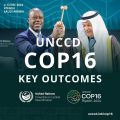 COP16 in Riyadh: World Leaders Commit $12.15B to Combat Land Degradation and Drought
 UNCCD COP16: NGOs issue a stark warning and call for urgent actions to deal with the escalating threats of desertification, land degradation, and drought.
 Civil society groups at UNCCD COP17 are calling for urgent action on land rights, drought, and vital funding.

 Kasese district land bosses ordered to cancel land titles of gov’t land grabbers
 Gov’t cancels three titles on Makerere university land
 Urban Poor Extinction: City Market Land Titles Vanish With No Trace!
 The district security committee continues to defy gov’t’s directive to return locals to their land 48 days later.

 One killed, another injured as residents resist arrest over disputed Wakiso land
 394,000 Land Titles Affected By Closure Of Ministry Of Lands Offices In Wakiso
 NEMA hindering environment restoration in Wakiso – leaders
 About 41 million people food insecure in E. Africa amid COVID-19 pandemic: UN






 MEDIA FOR CHANGE NETWORK2 weeks ago
 MEDIA FOR CHANGE NETWORK2 weeks ago
 MEDIA FOR CHANGE NETWORK5 days ago
 MEDIA FOR CHANGE NETWORK2 weeks ago
 MEDIA FOR CHANGE NETWORK2 weeks ago
 MEDIA FOR CHANGE NETWORK1 week ago
 MEDIA FOR CHANGE NETWORK4 days ago
 MEDIA FOR CHANGE NETWORK5 days ago