Connect with us

MEDIA FOR CHANGE NETWORK

Sembabule district suspends land title issuance over rampant disputes

Published

on

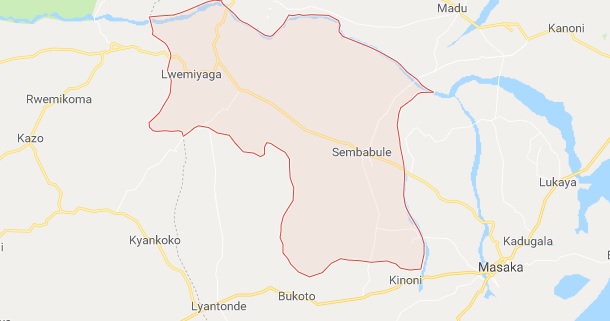
Sembabule, Uganda. Sembabule district local government has halted the issuance of land titles in a move to address the widespread land disputes in the area.

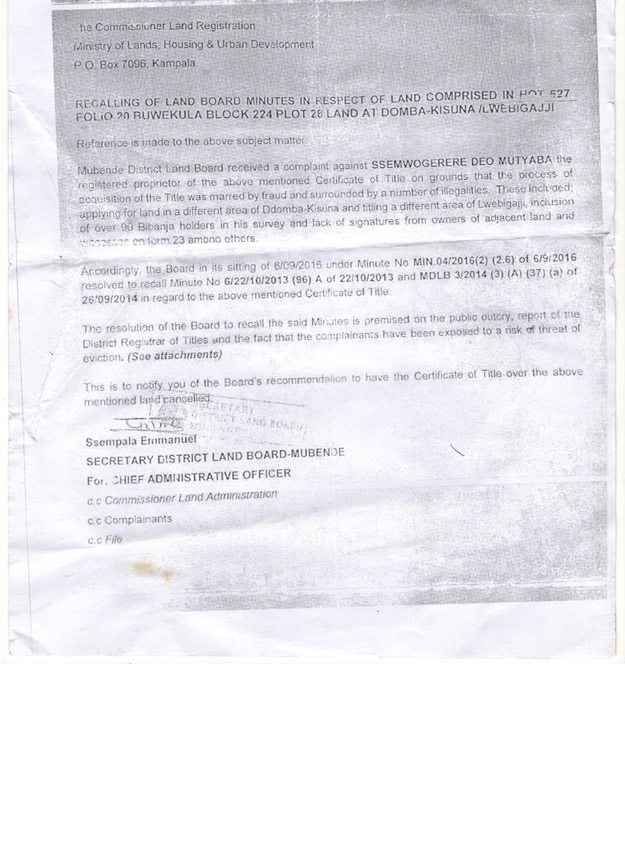
The decision was based on the district production sectoral committee report, which highlighted the widespread land disputes as one of the factors affecting agricultural production in the area. Records indicate the district is currently stressed with land wrangles that are largely arising from irregular allocations facilitated by unscrupulous area land committees at sub-county levels.

Julius Ssebugwawo, the Secretary of the District Production Committee says that hundreds of residents in the area are living in fear of eviction by people who irregularly acquired land titles over big chunks of land and that as a result, the disputes are frustrating agriculture.

According to him, they established that notable wealthy persons in and outside Sembabule are using manipulative tactics to connive with area land committees to facilitate irregular allocations of public land, at the expense of hundreds of residents who also depend on the same land for survival.

Ssebugwawo explains that the tenure of the majority of the area land committees expired but they have continued to transact business, messing up processes of land allocations in the district. The report also indicates that the local committees have facilitated the issuance of free-hold and overlapping titles over community social amenities such as valley dams and gazetted forest reserves, wetlands and in the precious Bigobyamugenyi Archeological site in Ntuusi sub-county.

Wahab Kabaliisa and Grace Nahaabwe, the councillors representing Mateete and Bulongo sub-counties respectively explained that the rampant land wrangles have repeatedly resulted in violence as residents resist evictions by often highhanded claimants.

Nahaabwe adds that on top of threatening the settlements and economic agricultural activities, the wrangles are also casting the district in bad light which calls for serious intervention by the current district administration. Accordingly, the councillors unanimously resolved to suspend operations of all sub-county area land committees and recommended halting further issuance of land titles in the area until an audit is done on the operations of the District Land Board.

Olivia Nakayiwa the Sembabule district Deputy Speaker who presides over the council session accordingly asked Malik Mahabba; the Chief Administrative Officer to write to all sub-county chiefs and Chairpersons instructing them to implement the resolution. Mahabba said n his response that he had also noted the concern on land disputes in the area, saying this could be one of the approaches towards fixing the challenge.

Nayebare Kyamuzigita, the outgoing Sembabule Resident District Commissioner also confirms that her office has been overwhelmed by cases of land disputes, many of them threatening hundreds of people with eviction.

Original Source: URN Via The Independent 

Continue Reading

MEDIA FOR CHANGE NETWORK

African countries forced to extract fossil fuels to service external debt: Report

Published

on

These countries are trapped in an “economic architecture” designed to drain wealth and resources from the continent, shows report
  • African governments are expanding fossil fuel production to service mounting external debt.
  • This leads to compromising public services like health and education.
  • The debt-driven extraction exacerbates gender injustices and environmental degradation, with women bearing the brunt.
  • The report calls for a Fossil Fuel Treaty to support a just transition to renewable energy and alleviate the debt burden.

African governments are being forced to expand fossil fuel production at the expense of critical public services, including health and education, and with far-reaching consequences on food security, health and water. The governments are spending revenues earned from the fossil fuel on servicing debts, with external borrowing doubling since 2020 to over $1 trillion and interest on debt more than doubling over the last 15 years to an estimated $163 billion.

Due to the debt burden, the countries are also unable to invest in public goods such as infrastructure and social protection systems, all of which could benefit women and the marginalised enhance general wellbeing of the people.

The lack of expenditure on improving basic social services, makes the international community accomplices in violating the human rights of African people particularly women, “who subsidise social services through their unpaid labour”, according to a report by campaign groups-African Forum and Network on Debt and Development (AFRODAD) and the Fossil Fuel Treaty.

In part to blame for the crisis is the international infrastructure, including structural adjustment programmes, trade liberalisation and International Monetary Fund (IMF)-imposed austerity measures, that have forced African governments to prioritise debt repayments.

The report showed that the countries are trapped in an “economic architecture” designed to drain wealth and resources from the continent to the Global North, and are finding themselves adopting austerity measures and resource extraction.

“Climate change’s biggest drivers — fossil fuels — continue to enjoy investment under a narrative that they are necessary for Africa’s energy security and development. Yet, the evidence is emerging that coal, oil and gas extraction are not only contributing to the debt-based structural entrapment of Africa,” it warned.

Africa, the report noted, is paying for a climate crisis it did not create — first by being on the ‘frontlines’ of the devastating impacts of extreme weather, displacement, loss and damage, and secondly, through solutions to climate change that drive more debt, extract more than they restore and weakening countries’ economic resilience.

“For countries with the least historical responsibility and the greatest structural constraints, the proposed Fossil Fuel Treaty offers a pathway to pursue a planned and just transition away from fossil fuels in ways that strengthen economic sovereignty, public legitimacy, and socio-economic and environmental justice, it added.

The report Gender, Debt and Fossil Fuels: A Mapping of Key Insights from the African Continent asserted that climate change, fossil fuel extraction and debt all reinforce gender injustices on their own. As a result, Africa is at the frontlines of the global climate, fossil fuels and debt ‘polycrisis’ that is largely based on unjust systems perpetuating extraction of resources to the Global North.

The crisis, according to the authors of the report, was particularly disadvantageous to women and girls, wth the gender experiencing the worst impacts.

“Africa is being pushed to drill its way out of debt under a global economic model that treats debt service as sacrosanct. When governments cut health, education and social protection to reassure creditors, the strain does not disappear; it is displaced into women’s unpaid labour, dispossession and the violence through which fossil fuel extraction is enforced,” according to a statement by authors Bemnet Agata and Amiera Sawas on behalf of the organisations.

The document asserted that fossil fuel extraction imposes a “spectrum of violence” against communities, and women and girls are the most vulnerable.

“Whether in Mozambique, Nigeria, Uganda or Tanzania, women and girls are more at risk to the impacts of land dispossession and displacement by oil and gas projects. Militarisation aimed at securing extraction projects drive repression, persecution and sexual violence by corporate and state security forces,” the researchers wrote in the report.

“Africa is being pushed to drill its way out of debt under a global economic model that treats debt service as sacrosanct. When governments cut health, education and social protection to reassure creditors, the strain does not disappear; it is displaced — into women’s unpaid labour, dispossession and the violence through which fossil fuel extraction is enforced,” it noted.

Fossil fuels also cause environmental destruction that is linked to health and social crises due to pollution, food insecurity, land degradation and water contamination, all of which disproportionately peril women. This compels movements of women and Indigenous civil society to come to the frontlines of environmental defense, inevitably exposing them to state violence.

It is critical to explore how fossil fuels are intricately tied in with gendered identities and patriarchy and its expressions of violence through what it calls ‘petromasculinity’.

Scientists define petromasculinity as the fusion of authoritarian masculine identities with militarism, corporate fossil fuel interests, underpinning state violence, where “fossil fuel use can function as a violent compensatory practice in reaction to gender and climate trouble”.

The concept escalates gender-based violence and the social, economic and political exclusion of women, girls and gender minorities. “Despite the risk, women and Indigenous leaders have been at the forefront of calling for a just energy and economic transition rooted in feminist and principles of fairness, where all people, societies and nations have equal opportunities to lead and benefit,” said Amiera Sawas, co-author of the report and director of research for the Fossil Fuel Treaty Initiative.

“African feminists have long been calling our attention to the myriad ways that debt, fossil fuel extraction and climate change are impacting women’s and girls’ rights. It’s time the international community listened,” he added.
He called for international cooperation and solidarity via a Fossil Fuel Treaty to support nations to cancel and renegotiate debt repayments and to access fairer finance for renewable energy systems.

For the reason, any serious conversation about a just transition must begin by recognising the reality of the fossil industry in Africa, and its consequences on the wellbeing of the people.

It recommends that African countries can benefit from participating in an international treaty that supports a fair phase-out of fossil fuels, one in which the wealthiest and most responsible nations act first. and fastest, while enabling a financed, justice-based transition to a renewable energy future.

Nations participating in such a treaty could create a platform for renegotiating and cancelling some external debt to create space for an equitable transition.

Such a transition should move communities away from fossil fuels towards decentralised, accessible renewable energy for all, and phase out of oil, gas and coal while building diverse, resilient and “gender-just” economies.
Overall, the paper calls for new approaches to tackling the triple challenge of debt crises, fossil fuelled entrapment and gendered violence, warning that past proposals have failed to address the root of the problem.

Source: downtoearth.org.in

Continue Reading

MEDIA FOR CHANGE NETWORK

StopEACOP Campaign challenges TotalEnergies assessment of Uganda land acquisition programme

Published

on

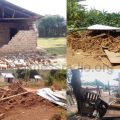
An elderly PAP in front of the Resettlement house in Buliisa (Inset: the house that was affected by the Tilenga project). Image credit: PAU

Civil society organisations under the StopEACOP Campaign have criticised an assessment commissioned by TotalEnergies on its land acquisition programme for the Tilenga oil project in Uganda, describing the report as lacking independence and credibility.

The Tilenga development will supply crude to the East African Crude Oil Pipeline which is designed to transport oil from western Uganda to international markets. The project has been widely contested by environmental groups and community advocates.

TotalEnergies commissioned Canadian consultancy Land and People Planning Ltd to conduct the assessment in the districts of Buliisa, Hoima and Kikuube. The report concluded that the company had addressed the core elements of the land acquisition programme and demonstrated commitment to transparency and continuous improvement.

However, the StopEACOP Campaign argues that the independence of the study is questionable. The coalition noted that TotalEnergies stated that an original assessor withdrew due to health reasons and that the Canadian firm was appointed as a replacement, without publicly explaining how key stakeholders were involved in the selection process.

Campaign coordinator Zaki Mamdoo said the report appeared to be designed to improve the company’s public image rather than provide a rigorous independent review. He added that the company’s suggestion that the Tilenga land process was ready for closure was difficult to reconcile with ongoing court cases filed by project affected people disputing compensation.

Activists also argue that the assessment does not address allegations of coercion, intimidation and pressure faced by communities asked to release land for the Tilenga project. Civil society groups have cited documented cases including the eviction of 42 families in Buliisa district following a court order issued before compensation payments were completed.

Diana Nabiruma of the Africa Institute for Energy Governance said communities have reported being warned that refusal to accept compensation offers could lead to court cases where they have little chance of success. She added that organisations supporting affected residents often observe bias and limited willingness by courts to address land disputes linked to oil developments.

In February 2026, the institute published research examining compliance with livelihood restoration commitments linked to the East African Crude Oil Pipeline. The report identified significant gaps in implementation and warned that many affected households risk failing to return to their pre displacement socio economic conditions if corrective action is not taken.

Campaigners also questioned the timing of the TotalEnergies assessment as the company faces an ongoing case in a civil court in Paris. The court recently ordered the company to release documents that had previously been withheld, including market studies on compensation rates prepared by subcontractors, minutes from a human rights steering committee and a report examining flooding linked to the Tilenga project.

According to Camille Grandperrin, legal officer at the Friends of the Earth France, analysis of the disclosed documents suggests multiple areas where the project may not comply with international standards, including the IFC Performance Standard 5.

The StopEACOP Campaign also highlighted discrepancies in the number of people included in the assessment. The action plan referenced 4954 project affected people, while civil society estimates suggest that more than 100000 people could be impacted across both the Tilenga project and the wider pipeline development.

Critics argue that evaluating Tilenga in isolation from the broader pipeline infrastructure creates a misleading picture of the scale of social impacts. They also note that the report does not address flooding allegedly linked to the construction of the Tilenga Central Processing Facility.

Campaign groups say the testimonies of affected communities, including claims of restricted land use prior to compensation and pressure faced by activists and land defenders, raise serious concerns that require independent scrutiny. They argue that a broader and fully independent review of Uganda’s oil sector impacts is needed to provide credible information to investors, lenders and insurers.

Author: Bryan Groenendaal

Source: greenbuildingafrica.co.za

Continue Reading

MEDIA FOR CHANGE NETWORK

More than 1.1 billion people worldwide face a risk of land eviction – Global report

Published

on

By Witness Radio team.

A global report released by the Food and Agriculture Organisation of the United Nations (FAO) in collaboration with other organizations has reported that more than 1.1 billion people worldwide— about 23 percent of the global adult population—live under the constant fear of losing their land or homes within the next five years, threatening their livelihoods, food security, and resilience to climate change. 

“Too many people still live with the fear of losing their land and homes, with women and young people remaining among the most excluded—a reality that undermines food security, climate action, and biodiversity protection, and shows why secure land rights are foundational to achieving all three,” says Marcy Vigoda, Director of the International Land Coalition. 

The report, titled “Status of Land Tenure and Governance” (SLTG), was authored by the Food and Agriculture Organization of the United Nations, the International Land Coalition (ILC), and the French Agricultural Research Organization CIRAD. The report states that, despite progress over the past two decades, only 35 percent of the world’s land has formally documented ownership, tenure, or use rights. 

The report notes that commercial interests constitute a major driver of land insecurity. In addition to large-scale land acquisitions, corporate investments, and financialized shareholding, the report identifies factors such as weak land governance, inadequate recognition of customary tenure systems, and increasing demands for agricultural commodities as contributing to intensified land concentration. These dynamics, particularly evident in the aftermath of the 2008–2009 food and financial crises, have accelerated the transfer of land from smallholders and local communities, exacerbating vulnerabilities among populations lacking secure tenure. 

Lands once considered marginal investment opportunities are now highly sought after for industrial farming, conservation, carbon storage, and other climate-related projects. In some cases, climate mitigation projects such as renewable energy, carbon offset schemes, and biofuel plantations are also increasing pressure on these lands, especially where tenure rights are not legally recognized.

The new report is the first comprehensive global stock take designed to track how land is owned, used, and governed. It complements decades of guidance on implementing the Voluntary Guidelines on the Responsible Governance of Tenure of Land, Fisheries, and Forests (VGGT). It responds to the growing demand to integrate land rights with climate action, gender equality, biodiversity protection, and more.

While international and national policies on land tenure have expanded, the report highlights that implementation remains slow and uneven. Although global frameworks have been widely adopted, the uptake and application of responsible land governance principles remain limited.

Worldwide, governments legally own more than 64 percent of land, including areas under customary systems that often lack formal documentation. A little over a quarter of land is privately owned, while about 10 percent of global land has an unknown tenure status.

The findings also reveal that the top 10 percent of the largest landholders operate about 89 percent of all agricultural land, showing the high concentration of land ownership globally. Secure land tenure enables people to invest in land, improve productivity, protect ecosystems, and strengthen food security.

“Land insecurity is one of the most damaging forms of inequality, paid for in lower productivity, weaker resilience, and poorer nutrition. Secure land tenure enables sustainable investment and is the difference between short-term survival and long-term food security,” FAO Chief Economist Maximo Torero Cullen reveals.

The report highlights persistent gender inequality in land ownership. Globally, women are significantly less likely than men to own or hold secure land rights. In 2024, across 108 countries, 48 percent of men reported owning homes individually or jointly, compared to 40 percent of women. “While rural residents are more likely than urban residents to report ownership, women remain consistently disadvantaged in both settings,” the report notes.

In agriculture, the gender gap is even more pronounced. In 43 out of 49 countries with available data, men in agricultural households are more likely to own or control land. In nearly half of these countries, the gap exceeds 20 percentage points. Evidence from several countries also shows that the gap is particularly large in sole land ownership, while joint ownership arrangements often improve women’s access to land.

Despite growing global attention to land governance, data on land tenure remains limited and politically sensitive. Methodological challenges, capacity limitations, and political sensitivities often reduce the availability and transparency of land tenure data.

According to Sélim Louafi, Deputy Director for Research and Strategy at CIRAD, stronger data systems are essential for better policy decisions. “When we generate evidence with and for all stakeholders, we create the foundation for stronger, more transparent, and more equitable public policies, both nationally and internationally.”

Experts say stronger policies and political commitment are needed to secure land rights for all. The report concludes: “Progress on land tenure and governance requires a stronger, more comprehensive, and better-coordinated approach to change, both within the land sector and in conjunction with global efforts on economic recovery, climate action, biodiversity conservation, and open societies.”

Continue Reading

Resource Center

Legal Framework

READ BY CATEGORY

Facebook

Newsletter

Subscribe to Witness Radio's newsletter


Trending

Subscribe to Witness Radio's newsletter