MEDIA FOR CHANGE NETWORK
One killed, plantations destroyed in land row
Published
6 years agoon

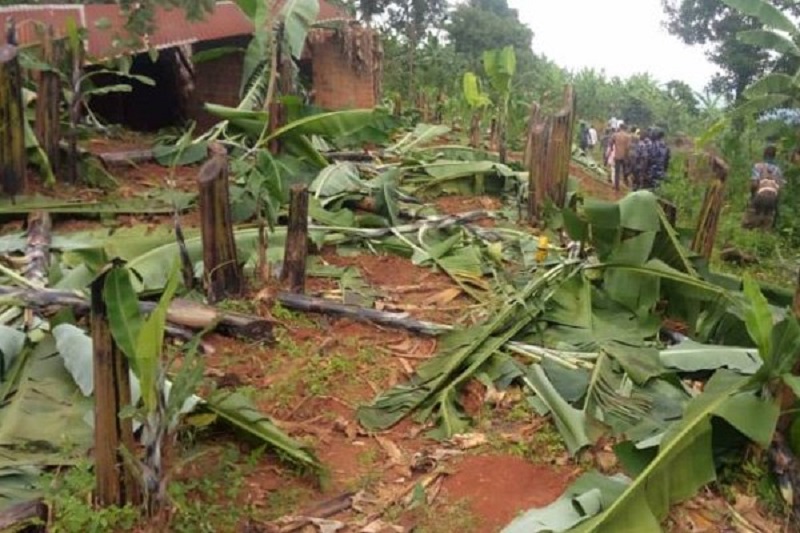
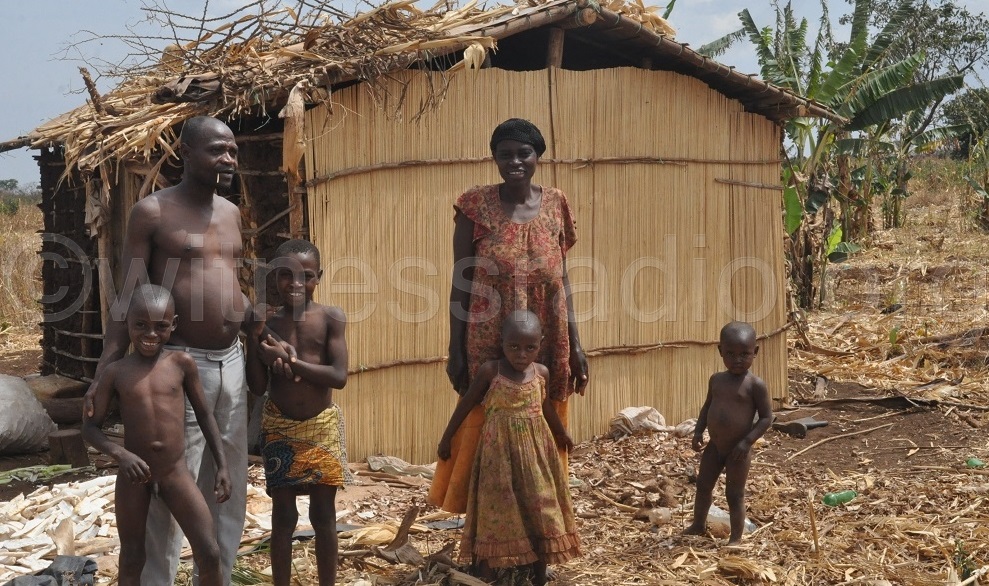
Banana plantations were destroyed following a fight over family land in Bwikhonje Village, Busano Sub County Mbale District. Photo by Yahudu Kitunzi
One person has been killed and five houses torched after a fight broke out among family members in Bwikhonje village, Busano Sub County in Mbale District over ownership of the land on Tuesday.
Four acres of banana plantations were also allegedly destroyed.
Police have already arrested two of the family members (brothers) in connection to the incident that resulted into the death of a 52-year-old woman identified as Atonina Kakai.
According to eyewitnesses, the scuffle started after the deceased tried to stop the suspects from selling off the disputed land amounting to two acres.
The Elgon region Police Spokesperson, Mr Rogers Taitika confirmed the incident, saying so far two suspects have already been arrested for killing their aunt. The suspects allegedly kicked the deceased in the stomach.
“We got information from local leaders in the area that two brothers have killed their aunt over land. We rushed at the scene and managed to arrest the suspects and we are hunting for others to help us in investigations,” Mr Taitika said.
“They tried to rush her to Busano Health Centre III for medication but she was pronounced dead on the arrival,” he said.
As a result of this, the angry residents, according to Mr Taitika, torched five houses, destroying acres of banana plantations that belong to the suspects.
“We have information that the ring leader (Sam Wanale) one of the suspect was given a piece of land sometime back and sold. He (Suspect) wanted again to sell another piece of land which the deceased declined, “he said.
Police called upon residents to remain calm as investigations go on and cautioned them against taking the law into their hands.
A family Member who preferred anonymity said the suspects wanted to sell the land to buy motorcycles.
The deceased’s body was taken to Mbale Municipal Mortuary for postmortem.
Land has become an epicentre of disharmony among communities in the country.
Source: Daily Monitor
Related posts:

15 houses burnt in protracted land dispute in Zombo
How land grabs are causing food insecurity: A case of a community land rights defender in Mubende district forced to buy food for a family of 13 people for the last five years.
The African Development Bank and the Tree Plantations Industry
‘A shame for the world’: Uganda’s fragile forest ecosystem destroyed for sugar

You may like
-
The global farmland grab goes green
-
A new pattern of senior UPDF officers’ involvement in the land grab
-
Fresh violence in Kiryandongo as a project affected family head narrowly survived death
-
What next for Uganda‘s agricultural surplus?
-
Dwindling number of Africans own land.
-
Renewing demand for justice; the 28 land rights defenders have applied for bail
MEDIA FOR CHANGE NETWORK
Big Tech’s digital trade agenda is a danger for farmers and food systems
Published
3 hours agoon
May 26, 2026
Criticism against Big Tech’s digital crusade is growing, along with demands for greater regulation. Yet, through underhand tactics such as trade deals, tech companies are blocking reform. Their recent focus on agriculture threatens our food systems. In order to rein in their growing power over them, it is crucial to expose what is happening behind the scenes and build movements to stop it.
It is not easy to evade the power and influence of Big Tech companies in everyday life, even for those living in rural communities in the global South where internet access is often limited.
Anyone searching for information on the internet, whether in Brazil, India or Kenya, will most likely use Google’s search engine.1 If they are in China, they will probably use Baidu’s. If they need to connect with their family or friends, they will probably use one of Meta’s social media or messaging platforms, like Facebook, which controls 75% of the global social media market, and 83% in Africa.2 When ordering food delivery in Brazil, they will most likely turn to the iFood platform (which holds 80% of the market), and if in Southeast Asia, they will almost certainly use Grab.3
Such digital monopolies enable tech companies to gather huge amounts of data from billions of people. This power is in turn being used to expand their control over developments in artificial intelligence (AI). Today, eight of the ten largest corporations in the world are tech companies. Each of them has a market value greater than the GDP of 93% of all countries.4
People around the world are waking up to the dangers of this corporate power. The Big Tech companies and their billionaire owners are taking over the media, backing far-right political parties, providing support to militaries committing war crimes, and collaborating with governments to curtail human rights.5 And they have an agenda for the food system too. Big Tech companies are converging with the largest agribusiness corporations, vacuuming up the data of small-scale food producers, workers and consumers with barely any oversight or limitations and then using that data against their interests.
Mass data grabbing across the food system
The world’s largest seed, pesticide and fertiliser companies have access to a constant stream of data from farms stretching across tens of millions of hectares– from Brazil to China– by way of digital apps installed on the smart phones and tractors of farmers. The information is stored on the clouds of Big Tech companies, like Microsoft’s Azure and Amazon’s AWS.
The clouds also store data from a growing number of government programmes collected to develop national digital databases and services for farmers. The Indian government’s new digital database, Agri Stack, for example, was developed with Microsoft and gives the company detailed information on 80 million Indian farmers, from land records to health histories.6 Agri Stack is the blueprint for other national digital farm registries that the Gates Foundation and the World Bank are pushing forward in several countries, beginning with Ethiopia and Kenya.7 Farmers increasingly have little choice but to hand over their data to corporations in order to access extension services, get loans and subsidies, or purchase inputs and machinery.
The UN Special Rapporteur on the Right to Food and others have been raising concerns about how this corporate control over data can harm farmers.8 Agribusiness companies, for example, can use their chatbots and digital apps to push farmers into buying their seeds, pesticides and fertilisers. When the chatbot advice fails, there is little farmers can do to get compensation, and even just switching to another platform can be difficult. The clear overall trend is that corporations are using their digital platforms to entrench a top-down flow of information that gives farmers less and less autonomy over how they farm.
Companies can also sell data they collect on farmers to third-parties who may use that information in ways that harms the interests of farmers. This is what happened with the Bayer-Microsoft collaboration in India, where farmer data was sold to food companies who then used the data to squeeze farmers on prices.9
And it is not just on the farm. Mass data harvesting is happening at all points of the food system, with ever more integration. China’s largest online retailer, Alibaba, for instance, connects its newly created digital agriculture division with its e-commerce and food delivery platforms that generate data on the preferences and behaviour of over 800 million consumers.10 Retailers can use online and in-store sales data to build profiles of their consumers and then encourage them to buy certain products or adjust prices to what they determine each customer will be willing to pay– a practice called surveillance pricing.11 Online food delivery platforms are also notorious for using their access and control over data on their drivers to coerce them into working long hours for low pay.12
There is growing criticism and resistance to these and other tactics used by tech companies. So, to fight back against any measures that might restrain their ambitions, tech companies are investing big time in influencing politicians. In 2025 alone, they spent US$170 million on lobbying in the European Union and US$109 million in the US.13 They also rely on another less visible but equally important tool to entrench their agendas and shield themselves from public accountability: digital trade deals.
Unpacking Big Tech’s digital trade agenda
Digital trade gets addressed in the e-commerce or digital chapters included in free trade agreements (FTA), or directly in bilateral or regional digital trade agreements. These texts are heavily influenced by tech corporations, especially where it comes to ensuring their control over data, restricting the access of others to their source codes and algorithms, and limiting the ability of governments to tax digital services.
The corporate agenda is heavily backed by the US government, which is home to the majority of Big Tech companies. The industry’s demands are included in the US-Mexico-Canada Agreement (USMCA) and all other agreements negotiated by the US. But they are also included in the Comprehensive and Progressive Agreement for Trans-Pacific Partnership (CPTPP) and the negotiations for the African Continental Free Trade Area (AfCFTA), in which the US is not a party. With some nuances, the Regional Comprehensive Economic Partnership (RCEP) and the European Union follow a similar path (see Box).
The tech company agenda embedded in these trade deals has important consequences for food systems. For instance, in order for governments to ensure farmers, consumers and food workers have rights and control over their data, it is necessary for that data to be stored in locations under their jurisdiction. This is key not only in terms of personal privacy, but also to prevent it from falling into the hands of those who could harm them. There have been some limited movements in this direction, such as laws to protect people’s privacy in the European Union, Argentina, Brazil, and Kenya.14 Unfortunately, data generated on farms (on land, seeds, plant and animal genetics, weather) is considered non-personal and not covered by the laws, even though personal information can be gathered when data on yields is combined with location, for example.
Such government initiatives, no matter how limited, are all being fiercely opposed by the industry, which wants to be able to exploit and sell data to third parties without restriction. Not having a local, physical presence in the countries where data is extracted is also a way for tech companies to evade liabilities for their workers, especially when it comes to delivery workers, where risks of work place injuries are high. These are some of the main reasons why tech companies are pushing for data to be able to move freely across borders. In digital trade jargon, this is known as “freedom for cross-border data flows” and aims to prevent “forced data localisation”.
Access to source codes (the lines of code written by programmers to instruct machines to perform a specific task) and algorithms (pieces of code that include the steps needed to solve a problem) is also an issue for food systems. Farmers around the world have always repaired their own tools. It is a traditional part of farming. But this has become much more difficult with the adoption of digital tools, such as agricultural drones and connected tractors. Repairing these requires access to the manufacturers’ source codes, which is strictly protected by intellectual property rights. In the US, farmers lose US$3 billion a year to tractor downtime and pay US$1.2 billion more in excess repair costs because of these restrictions.15 Food delivery workers also suffer because they are unable to access the opaque algorithms that decide how much they are paid or even if they’ve been terminated.16 Consumers also find algorithms that manipulate consumption to be a black box.
There are many important reasons why companies should have to make public their source codes and algorithms but digital trade agreements can pre-empt measures aimed at doing so. Most digital trade agreements restrict public or government access to company source codes and algorithms, and the few that include exceptions, tend to be weak and vague.17
Food systems are also impacted by Big Tech’s use of digital trade deals to avoid paying taxes.18 These corporations have long benefitted from a temporary moratorium on customs duties on electronic transmissions established in 1998 by the WTO. Under the moratorium, states are allowed to collect domestic taxes, but cannot use tariffs to tax products entering their territory. A study found that between 2017 and 2020 Global South countries, most of which are net importers of digital services, lost US$56 billion in tax they could not apply to those imports.19 It means governments have fewer resources with which to implement food and agriculture policies for the benefit of their populations and other essential services.
To reinforce tax avoidance, all digital trade deals signed to date have systematically prohibited taxes on electronic transmissions. Those pushed by the US with El Salvador and Guatemala have, more recently, included a commitment from both Central American countries to support the US’s push to make the WTO moratorium permanent. However, at the WTO, Brazil led an effort that succeeded in getting the moratorium dropped in March 2026.20 The big question now is whether governments will seize on this development to implement border taxes or bind themselves to similar restrictions under bilateral digital trade deals.
The need for a convergence of struggles
Fortunately, movements challenging the power of tech corporations are mushrooming around the world and starting to work together towards common objectives.
Some efforts are focused on digital justice and digital rights, such as the Just Net Coalition, the European network defending rights and freedoms online and the Global Digital Justice Forum, which includes digital rights networks, feminist groups, corporate watchdogs, communication rights campaigners, trade unions, and cooperatives.21 Groups such as Citizen Lab and AlgoRace are tackling digital surveillance and the impacts of AI on migrant and racialised communities. The People vs Big Tech movement aims to challenge the power of tech corporations on issues like digital policy, consumers’ rights, climate change, LGBTQ+ rights, and feminism.22
They are also many worker-led efforts to stop corporations from using digital platforms to exploit workers and violate their rights. These include actions by workers at Amazon warehouses in the US and India and food delivery drivers working for Ele.me (Ali Baba) in China.23 In both the European Union and the UK, 12 food delivery workers organisations have been speaking out against serious abuses on platforms such as Deliveroo, Just Eat and Uber Eats, and have called for a public register of the algorithms used.24 Facebook (Meta) content moderators in Colombia and Ghana have also been mobilising.25 And there is a growing movement fighting against the expansion of data centres because of their impacts on local communities and voracity for energy, water and critical minerals, which is causing an increasing number of social and environmental conflicts worldwide.26
People in the food sovereignty movement are also active on digital issues. For example, African farmers are speaking out against the privatisation and corporate capture of their data, arguing that data cannot be separated from its relationship to territories and communities.27 The European Coordination Via Campesina recently published a critique of corporate led digitalisation that calls for inclusive research and innovation to support the transition to agroecology.28 A growing farmers’ movement is also claiming the right to repair machinery and the right to build their own tools and share the information freely.29 During the pandemic, small farmers and vendors from Indonesia to Brazil showed their capacity to coordinate efforts with driver’s cooperatives and used their own digital tools to ensure people had access to food.
In order for the movements fighting Big Tech to challenge digital trade agreements, alliances are needed with those that have long been fighting against free trade agreements.
From their side, peasant movements such as La Via Campesina have been fighting free trade agreements across different regions.30 They have increasingly joined forces with other groups, including trade unions, environmentalists, women’s groups and indigenous peoples. A recent example of this is the broad coalition of sectors that fought intensely against the EU-Mercosur agreement. During the 3rd Nyeleni Forum, which brought together movements from a wide range of sectors (farmers, migrants, trade unions, healthcare workers, environmentalists and women), the digitalisation of food systems was identified as a new colonial frontier. Building on this, there could be greater convergence with groups to denounce the impacts of corporate digitalisation and to stop digital trade agreements that advance the interests of corporations.
The global advance of digital trade agreements
Academic and activist Jane Kelsey says the standard corporate demands in most digital trade negotiations can be traced back to the “Digital 2 Dozen” principles published by the US Trade Representative in 2014.31 These shaped the e-commerce chapters of the Trans-Pacific Partnership (later the Comprehensive and Progressive Agreement for Trans-Pacific Partnership -CPTPP), and became a model for later agreements.32 Even after leaving the CPTPP in 2017, the US pursued even stronger Big Tech protections in the US-Mexico-Canada Agreement (USMCA) in 2020.
The US Chamber of Commerce, whose members include large agribusiness and tech corporations, systematically promotes ‘high-standard’ digital trade agreements, particularly among the “Digital Dozen” countries (Australia, Canada, Chile, Colombia, Japan, South Korea, Mexico, New Zealand, Peru, Taiwan, the UK and ASEAN members).33 Several major deals have followed, including agreements involving the US, Japan, Singapore, Australia, Chile, the UK- and the EU.34 China, the UAE and India, are also advancing digital trade negotiations, but with different priorities.
The USMCA guarantees cross-border data flows, including personal information, and bans data localisation. Its provisions have influenced other agreements, even those without US participation such as the CPTPP and African Continental Free Trade Area (AfCFTA) negotiations, sometimes conflicting with national laws, including those in Kenya and Nigeria.35
The European Union also supports free data flows and bans data localisation but insists on protections for personal data. Its legislation is actually regarded as one of the strongest data privacy laws in the world, which has put it in the crosshairs of Big Tech and the Trump administration.36 But implementation has been tortuous, and safeguards in international deals are often unclear.37 The EU’s data privacy body has acknowledged this in reference to the EU-Singapore deal, where there are no regulations on what corporations can do with people’s data.38
The Regional Comprehensive Economic Partnership (RCEP), which includes ten ASEAN member states, as well as Australia, China, Japan, New Zealand and South Korea, includes similar provisions to CPTPP’s. 39 Its rules are not legally binding though, and allow more restrictions for national security interests. This is particularly relevant for China, who supports the freedom of cross-border trade in goods enabled by the internet rather than the freedom of all data flows. Some say this is a reflection of the interests of Chinese e-commerce platforms, like Alibaba.40
The USMCA, CPTPP and digital trade deals pushed by the European Union ban forced transfer of source codes and algorithms, while RCEP doesn’t include specific protection. Public-interest exceptions in these deals tend to be weak.41
In regards to taxes on electronic transmissions: the US continues pushing to make the WTO moratorium on custom duties on electronic transmissions permanent, while the EU, AfCFTA and RCEP allow room for internal taxation.42 Yet RCEP’s signatories are committed to adjusting their practices in line with any future changes at the WTO level.
Related posts:

Happening shortly! Kenya’s upcoming court ruling on the Seed Law could have a significant impact on farmers’ rights, food sovereignty, and the country’s food system.
New digital tool to empower farmers to access extension services
The United Nations Food Systems Summit is a corporate food summit —not a “people’s” food summit
Food systems in conflict areas: Architectures of armed conflict are turning food and hunger into weapons of war.
MEDIA FOR CHANGE NETWORK
Food systems in conflict areas: Architectures of armed conflict are turning food and hunger into weapons of war.
Published
5 days agoon
May 21, 2026
By the Witness Radio team.
War now extends beyond guns and bombs, with food systems becoming strategic tools in modern conflict, a crucial factor for understanding global security and the deliberate targeting of food as a weapon.
Fields are burned before harvest. Irrigation systems are destroyed. Fishing zones are blocked. Grain silos are bombed. Seeds are contaminated or confiscated. Entire communities are cut off from their ability to grow or buy food for months or years, deliberately harming people’s access to food.
The result is not only displacement or destruction, but a slower, more deliberate outcome: hunger. In many cases, it functions not as a side effect of war but as a method of weakening populations and reshaping control over land, resources, and survival itself.
A new position paper by La Via Campesina, representing over 200 million peasants, Indigenous peoples, farmers, and rural workers, argues that controlling land and food is a deliberate political act, and that defending these resources is vital to life itself. This underscores the critical need for collective action to safeguard food security.
The report frames war and hunger as interconnected forces within a global political order, highlighting the widespread implications of targeting food systems.
The document states that “war and hunger are two faces of the same system,” and adds that defending land and food systems is inseparable from defending life itself.
La Via Campesina describes the current global moment as one defined by overlapping conflicts across Gaza, Sudan, Ukraine, Yemen, the Sahel, Myanmar, the Democratic Republic of Congo, and other regions. Rather than isolated crises, the report suggests these wars reflect a broader global system shaped by intensifying geopolitical competition, expanding military industries, weakening international governance, and growing pressure on land, water, and food systems.
“Rare earth elements, fossil fuels, water, and agricultural land are the true stakes of most contemporary conflicts. The targeting of Ukrainian grain exports, the scramble for Congolese cobalt, and the siege of Gaza’s fishing grounds all reflect this logic,” the paper reveals.
The rural poor, who produce most of the World’s food, are bearing the heaviest burden. They face poverty, hunger, displacement, and vulnerability.
Modern conflicts target food infrastructure-irrigation, grain reserves, and seed banks-highlighting how warfare deliberately undermines food security and calls for increased vigilance.
“The use of starvation as a weapon of war is strategic. Throughout history, empires understood that destroying a people’s capacity to feed themselves is among the most effective tools of subjugation.” La Via Campesina describes.
Across the cases examined in the report, La Via Campesina argues that controlling food has long been a way of controlling populations. What is different today, it suggests, is the scale, coordination, and technological sophistication through which food systems are disrupted in modern warfare.
In Gaza, the report cites widespread destruction of agricultural land and severe restrictions on fishing areas, alongside repeated disruptions of food supply corridors. Humanitarian assessments referenced in the paper indicate that more than 80% of farmland has been damaged or rendered unusable, deepening already severe food insecurity and famine risk warnings.
In Yemen, years of restrictions on key ports, particularly Hudaydah, through which most food imports enter, have significantly limited access to essential supplies. Combined with ongoing conflict, this has contributed to one of the most severe and prolonged hunger crises in the world.
In eastern Democratic Republic of Congo, cycles of armed violence have repeatedly destroyed crops and forced farming communities from their land. In many areas, agricultural production has collapsed entirely due to insecurity and the presence of armed groups controlling rural territory. The result has been persistent and widespread food insecurity affecting millions of people.
In Sudan, the conflict has similarly disrupted food systems through the looting of grain stores, destruction of farms, and mass displacement of rural populations. Entire agricultural regions have been emptied, turning once-productive farmland into zones of acute hunger.
The environmental degradation in war zones, including soil contamination and deforestation, is linked directly to global climate and resource crises, calling for a heightened awareness of these interconnected issues.
The report also links these local environmental impacts to global ecological pressures. It argues that as climate instability, water scarcity, soil degradation, and biodiversity loss intensify, competition over natural resources is increasing. In this context, land, water, and fertile agricultural regions become strategic assets in broader geopolitical struggles.
What emerges from both the data and case studies is a picture of hunger that is not only humanitarian but deeply political. It is shaped by conflict, resource control, and global systems that determine who can produce food, who can access it, and who is excluded from both.
In this sense, the report suggests, war is no longer confined to battlefields. It extends into wheat fields, fishing waters, seed banks, and supply routes. Hunger becomes not just a consequence of war, but one of its most powerful instruments.
Related posts:

African Food Systems Summit 2024: Do not use it to promote failed agricultural models – African Faith Leaders.
Agroecological farming: EAC Bill moves to Parliament to establish a regional legal framework to protect and promote sustainable farming and food systems.
The United Nations Food Systems Summit is a corporate food summit —not a “people’s” food summit
OPINION: Land rights for small producers: a critical solution to the world’s food systems
MEDIA FOR CHANGE NETWORK
Experts warn that without Africa’s control over resources and climate financing, the continent faces the risk of entering a new era of “green colonialism”.
Published
6 days agoon
May 20, 2026
By Witness Radio Team
As the global push for clean energy accelerates, African governments are under mounting pressure to move away from fossil fuels and embrace renewable energy. But economists, political leaders, and climate justice advocates are warning that Africa’s transition could reproduce the same unequal economic structures established during colonialism unless the continent gains greater control over its resources, industries, and financing systems, inspiring a sense of agency and possibility.
Although Africa contributes less than 4 percent of global greenhouse gas emissions, it is among the regions most vulnerable to climate change. The continent continues to suffer disproportionately from a crisis largely caused by industrialized nations, including prolonged droughts and devastating floods, which greatly affect its people.
Governments across Africa are increasingly adopting renewable energy policies promoted as pathways toward sustainable development. Despite being promoted, a growing number of experts argue that the transition risks becoming another extractive project in which African resources fuel foreign industries while local communities remain impoverished.
The global transition to clean energy has sharply increased demand for minerals such as cobalt, lithium, graphite, manganese, and copper, which are abundant across Africa and critical for batteries, electric vehicles, and renewable energy technologies.
At the same time, the continent possesses vast renewable energy potential. According to the International Renewable Energy Agency (IRENA), Africa could generate significantly more renewable energy than it currently consumes.
In an interview with Witness Radio, Tunisian economist and President of the Global Institute for Sustainable Prosperity, Fadhel Kaboub, said Africa’s role in the global transition should go beyond merely supplying raw materials to industrialized countries.
“We cannot decarbonize a system that hasn’t been structurally economically decolonized yet. Africa has the potential to become an energy powerhouse globally, an industrial powerhouse, and as a result, an economic and geopolitical powerhouse.” Kaboub reveals.
Kaboub argued that the current global economic system continues to place African countries at the bottom of supply chains, echoing colonial patterns. This pattern is vital for economists and global citizens to understand.
“Africa was assigned the role of supplying cheap raw materials while importing finished products and technologies. The danger is that the green transition is reinforcing the same model instead of transforming it,” he added.
Across the continent, activists and researchers are increasingly raising concerns about what they describe as “green colonialism,” where climate and environmental projects dispossess communities while benefiting foreign governments and corporations.
In several African countries, including Uganda, large-scale carbon offset projects have been linked to land conflicts and forced displacement. Critics say some carbon markets allow polluting corporations in the Global North to continue emitting greenhouse gases while using African land and forests to offset their emissions.
Environmental advocates warn that unless African governments ensure local ownership and value addition in mining linked to renewable energy, the continent risks repeating the history of raw material extraction, which is key for informed policy decisions.
Africa’s green transition discussions also focused on climate financing as a key point of debate. African leaders have repeatedly criticized rich countries for not sufficiently financing adaptation and renewable energy projects, despite their historic role in spewing the bulk of the World’s carbon emissions.
At the COP29 climate Summit in November 2024 in Azerbaijan, His Excellency Bola Ahmed Tinubu, the president of the Federal Republic of Nigeria, warned that many African countries are trapped between debt repayment obligations and climate adaptation needs.
“Africa did little to cause the climate crisis, yet the debt climate trap has saddled many of its nations with a tragic choice: Eschew repayments to fund adaptation to climate shocks and risk default- a financial purgatory where development indicators plummet; or honor obligations and compromise on resilience, thus entrenching vulnerability to development-shuttering climate events,” he added.
Speaking during the Africa Climate Summit 2025, former Ethiopian Prime Minister Hailemariam Desalegn said debt restructuring must become part of global climate discussions.
“Unless we confront the debt crisis head-on, efforts to finance Africa’s climate ambitions will continue to fall short,” Desalegn said.
Kaboub believes the financing crisis reflects a broader historical injustice. “The industrialized world has consumed most of the global carbon budget that creates a climate debt owed to Africa and the Global South.” He revealed.
Some African economists and climate justice groups are calling for climate reparations, not more loans that deepen dependency, to address historical injustices and support equitable development.
“The future of Africa’s green transition depends on who controls it. If Africa controls its resources, industries, and development path, the transition could become a tool for liberation. If not, it risks becoming another phase of exploitation under a green banner.” Kaboub concluded.
Related posts:

Africa adopts the Africa Climate Innovation Compact (ACIC) Declaration to drive the continent towards innovative climate solutions.
Financial Institutions from Africa have made a monumental commitment of $100 billion to Africa’s green industrialization, a decision of immense significance that has the potential to shape Africa’s future.
African Women forge bold actions for climate justice at the 2024 Women’s Climate Assembly in Senegal.
Experts push for a National Bamboo Policy to strengthen climate mitigation efforts.
Big Tech’s digital trade agenda is a danger for farmers and food systems
Food systems in conflict areas: Architectures of armed conflict are turning food and hunger into weapons of war.
Experts warn that without Africa’s control over resources and climate financing, the continent faces the risk of entering a new era of “green colonialism”.
Rising fertilizer dependence sparks debate over Africa’s agricultural future; experts call for urgent critical review process.
“We are facing increased violent land dispossessions and climate injustices” – African women.
East African women unite and meet in Nairobi to develop strategies to protect communal tenure systems and collectively resist false climate solutions.
Kassanda businessmen accused of a second attempt to grab an 86-year-old farmer’s land despite court orders.
A Ugandan minister is in the hot seat over the grabbing of land from a peasant in Kiryandongo district.
Innovative Finance from Canada projects positive impact on local communities.
Over 5000 Indigenous Communities evicted in Kiryandongo District
Petition To Land Inquiry Commission Over Human Rights In Kiryandongo District
Invisible victims of Uganda Land Grabs
Resource Center
- CAN AFRICAN FOOD SYSTEMS THRIVE WITHOUT CHEMICAL FERTILISERS
- Land And Environment Rights In Uganda Experiences From Karamoja And Mid Western Sub Regions
- REPARATORY AND CLIMATE JUSTICE MUST BE AT THE CORE OF COP30, SAY GLOBAL LEADERS AND MOVEMENTS
- LAND GRABS AT GUNPOINT REPORT IN KIRYANDONGO DISTRICT
- THOSE OIL LIARS! THEY DESTROYED MY BUSINESS!
- RESEARCH BRIEF -TOURISM POTENTIAL OF GREATER MASAKA -MARCH 2025
- The Mouila Declaration of the Informal Alliance against the Expansion of Industrial Monocultures
- FORCED LAND EVICTIONS IN UGANDA TRENDS RIGHTS OF DEFENDERS IMPACT AND CALL FOR ACTION
Legal Framework
READ BY CATEGORY
Newsletter
Trending
-
MEDIA FOR CHANGE NETWORK2 weeks agoA Ugandan minister is in the hot seat over the grabbing of land from a peasant in Kiryandongo district.
-
MEDIA FOR CHANGE NETWORK2 weeks agoA community in Yumbe district has raised serious concerns about allegations of land-grabbing involving an aspirant for Uganda’s Parliamentary Speakership, affecting over 50 families.
-
MEDIA FOR CHANGE NETWORK1 week agoRising fertilizer dependence sparks debate over Africa’s agricultural future; experts call for urgent critical review process.
-
MEDIA FOR CHANGE NETWORK6 days agoExperts warn that without Africa’s control over resources and climate financing, the continent faces the risk of entering a new era of “green colonialism”.
-
MEDIA FOR CHANGE NETWORK5 days agoFood systems in conflict areas: Architectures of armed conflict are turning food and hunger into weapons of war.
-
MEDIA FOR CHANGE NETWORK3 hours agoBig Tech’s digital trade agenda is a danger for farmers and food systems