
WITNESS RADIO MILESTONES
More than 40 families are facing a constructive eviction from a quarry company

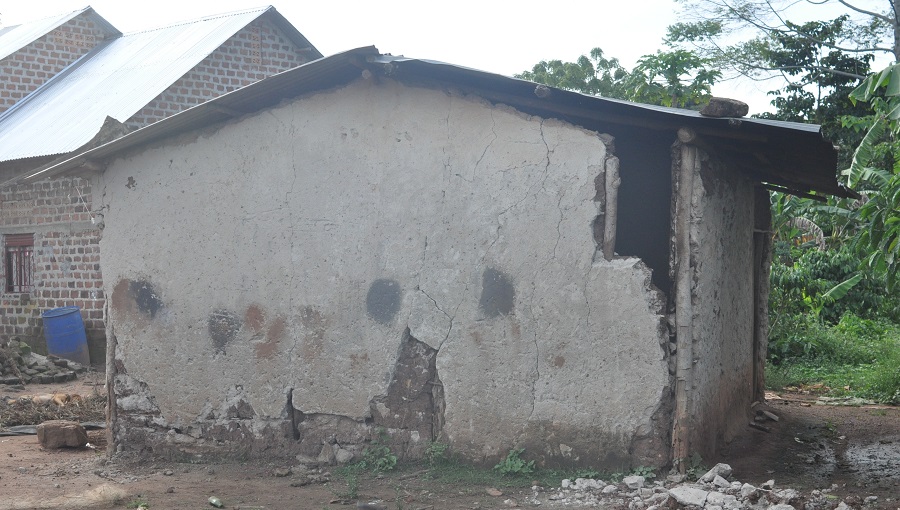
One of the houses affected by the vibration
By witnessradio.org Team
Buikwe/Uganda – a quarry company, Famous 2009 limited is constructively evicting more than 40 families off their ancestral land, witnessradio.org has learned. Famous 2009 Limited, a general works contractor was founded and registered in 2010 in Uganda.
According to the company site, Famous 2009 limited is hired to build apartments and runs a number of stone quarries. The company further boosts of being ‘known for its keen sense of corporate social responsibility and commitment to sustainability and community welfare. “We have been involved in giving back to its community through many charity donations and construction of different police posts to ensure the safety and security of its community and the members” according to the company.
However, victims of rock quarry site based at Kikube-Buleega, Ngogwe Sub-county, Buikwe district, accuse the company of failing to protect them from flying debris, quarry-dust, noise pollution and vibration, whose effects have caused illness and disabilities among the population, and caused abnormalities among animals and domestic birds among other challenges.
Some victims say, well as the company did not carry out consultations and/or awareness before blasting the rock, complaints about the effects of rock quarrying from communities are overlooked by Famous 2009 Limited. Instead, offer peanuts for families to vacate their land.

One of the company sites
Mirembe Desita, not real name due to fear of retaliation said is one of the many victims of rock quarrying. She revealed that
she has been in and out of the hospital as a result of rock quarrying. “Ever since they started carrying out blasting, I have been disturbed by the blasting. My family members…carry me away from my home when the company blasts the rock and this has been happening since September, 2020” said Mirembe.
Ragil Rajeev, an operations manager for Famous 2009 limited denied the claims saying that they take care of communities while carrying out the stone blasting.
When he was asked what exactly does his company do while carrying out the stone blasting, he replied by saying, we shall call you back for a better explanations.
Mirembe Desita, not real name due to fear of retaliation said is one of the many victims of rock quarrying. She revealed that she has been in and out of the hospital as a result of rock quarrying. “Ever since they started carrying out blasting, I have been disturbed by the blasting. My family members…carry me away from my home when the company blasts the rock and this has been happening since September 2020” said Mirembe.
Ragil Rajeev, an operations manager for Famous 2009 limited denied the claims saying that they take care of communities while carrying out the stone blasting.
When he was asked what exactly his company do while carrying out the stone blasting, he replied by saying, we shall call you back for a better explanation.
Related posts:

 Outspoken natives are facing persecution for resisting land eviction in Kiryandongo district
 More than a dozen of community land rights defenders are facing persecution for resisting illegal land eviction in Kiryandongo district
 Another Coffee Company is disposing hundreds of native families in Kiryandongo
 Masindi court declines to halt a forceful and violent eviction of 2300 families off their land













Parliament’s Committee on Lands, Housing and Urban Development has ordered a police investigation after recovering hundreds of land files allegedly hidden in shops and vehicle boots near the Mukono Zonal Land Office (MZO).
The committee, led by chairperson Edison Rugumayo, was inspecting the office as part of an inquiry into allegations of land fraud, delays in processing titles and other irregularities affecting land transactions in Mukono District.
During the inspection, legislators toured various departments and questioned staff about their work, including the handling and storage of land records.
At the office of Senior Staff Surveyor Steven Ndegeya, the committee raised concerns over alleged irregularities involving land titles reportedly created in wetlands and central forest reserves.
The legislators also questioned officials about more than 200 titles reportedly issued in Mabira Forest and demanded a list of people associated with the titles.
The committee was further alarmed after being told that more than 50 land titles had allegedly been created on the government-owned Njeru Stock Farm.
Rugumayo asked Ndegeya to provide the transaction trail, original title documents, geographical maps and details of all individuals holding titles on the land.
Ndegeya asked for more time, saying he needed to consult registrars before preparing an organised report.
He told the committee that there was no certificate of title for Njeru Stock Farm belonging to the Uganda Land Commission in the system.
However, he said the system contained records of individual Mailo landowners whose interests dated back many years, arguing that some people who obtained titles on the land had acquired them legally.
The committee later met MZO officials to establish the causes of the complaints and alleged irregularities.
Three staff members, Dan Kyalo, Hannifah Nantongo and Susan Aceru, were tasked with producing files that were allegedly being taken out of the MZO.
The three denied having moved the files.
However, accompanied by police officers, the committee recovered hundreds of titles allegedly stored in shops across the road from the land office. Other files were reportedly found in vehicle boots.

When questioned about who had instructed them to keep the files outside the office, the officials reportedly told the committee they had been directed by their supervisor, Ndegeya.
The committee also questioned the security team deployed by the Ministry of Lands in Kampala about how the files and titles had been removed from the office.
It emerged that Emma Otim, the security head, had left responsibility for keeping the office keys with a private security guard who routinely opens and closes the office.
The committee questioned why a guard whose primary responsibility was reportedly to man the gate had been entrusted with the office keys.
Principal Assistant Secretary at the MZO, Doreen Tumushabe, said she could not be held responsible for the alleged conduct of individual employees but promised to strengthen supervision.
Tumushabe also cited staff shortages, lack of vehicles and the large number of complaints involving allegedly forged land titles among the challenges affecting the office.
During the oversight visit, the committee also discovered hundreds of allegedly forged land titles at the MZO.
Officials told the committee that no related case had been opened at Mukono Police Station despite the alleged discovery of the forged titles.
The committee also heard complaints from members of the public who said they had waited for years to obtain land titles or have land disputes resolved.
A 75-year-old woman, Maria Nakitende, told the committee that she had waited for decades for authorities to resolve her title-related matter.
Hajji Musa Muliika of Katosi alleged that he was asked to pay Shs14 million after the title he had submitted was reportedly lost while in the hands of MZO officials.
Rugumayo directed police to conduct a thorough investigation into the circumstances surrounding the removal and concealment of the files and establish why they were taken outside the office, particularly ahead of the committee’s visit.
He also ordered the head of the Mukono land office to submit, within one week, a report on land titles in Mabira Forest and wetlands, as well as complaints against staff members.
Masaka legislator Joan Namutaawe criticised the quality of services at the land office and questioned whether Tumushabe was fully in control of operations at the MZO.
Namutaawe warned that the committee would pursue cases involving alleged illegal occupation and development in wetlands.
Source: nilepost.co.ug
Related posts:




MEDIA FOR CHANGE NETWORK
Uganda moves toward a Bamboo Policy to boost environmental conservation and green growth.


Related posts:

 As Uganda awaits the Energy Efficiency and Conservation law, plans to develop a five-year plan are underway.
 REC25 & EXPO Ends with a call on Uganda to balance conservation and livelihood
 Africa’s growth lies with smallholder farmers
 Green Resources’ forestry projects are negatively impacting on local communities – donor
WITNESS RADIO MILESTONES
A Global Report reveals that Development Banks’ Accountability Systems are failing communities.

Related posts:

 Banks have given almost $7tn to fossil fuel firms since Paris deal, report reveals
 Opinion: USAID needs an independent accountability office to improve development outcomes
 Communities Under Siege: New Report Reveals World Bank Failures in Safeguard Compliance and Human Rights Oversight in Tanzania
 Oxfam Report 2011: When Indigenous communities named Rwanda nationals by investor to run away from corporate accountability

Govt orders fresh valuation of land for Rubanda iron ore project

Can Agroecology Improve the Resilience of African Smallholder Farmers?

Death Of Witnesses Cited Among Causes Of Land Case Backlog

Sweeping investments are fueling widespread land grabbing and deepening rights violations across Uganda – Report.

While hunger continues to grip the world, a new report highlights forests and forest foods as a hidden treasure trove of nourishment.

Five years after Uganda’s National Action Plan on Business and Human Rights, are local communities hosting land-based investment projects seeing change?

Lango ex-combatants count losses after dry spell destroys maize harvest

Alert: Land degradation is emerging as a pressing threat to global security.

Innovative Finance from Canada projects positive impact on local communities.

Over 5000 Indigenous Communities evicted in Kiryandongo District

Petition To Land Inquiry Commission Over Human Rights In Kiryandongo District

Invisible victims of Uganda Land Grabs
-

 MEDIA FOR CHANGE NETWORK2 weeks ago
The global race for clean energy minerals is leaving communities grappling with conflicts and human rights abuses, a new report reveals.
-

 MEDIA FOR CHANGE NETWORK1 week ago
Across Africa, the push for a greener future is putting new pressure on local communities, as recent ILC case studies highlight.
-

 MEDIA FOR CHANGE NETWORK1 week ago
Who will shape the future of East Africa’s seeds? Youth and civil society are sounding the alarm over a proposed regional law.
-
 MEDIA FOR CHANGE NETWORK1 week ago
Sweeping investments are fueling widespread land grabbing and deepening rights violations across Uganda – Report.
-

 MEDIA FOR CHANGE NETWORK2 weeks ago
Uganda urged to drop charges against 11 environmental defenders after 17 months without witnesses
-
 FARM NEWS2 weeks ago
Govt pushes natural regeneration to restore 8.4 million hectares
-

 MEDIA FOR CHANGE NETWORK2 weeks ago
3 Division Commander Warns Communities Against Land Wrangles
-
 FARM NEWS6 days ago
Can Agroecology Improve the Resilience of African Smallholder Farmers?