Connect with us

MEDIA FOR CHANGE NETWORK

DR Congo crisis: Washington’s brokered peace agreement is rendered useless as fighting, forced land displacement, and mineral exploitation persist…

Published

on

By the Witness Radio team.

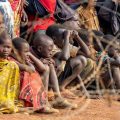
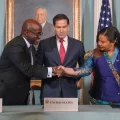
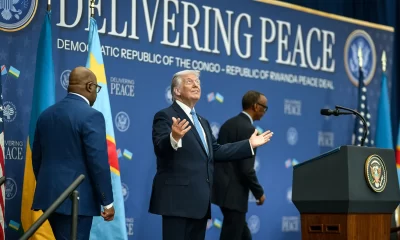
After the signing of the Washington Accords, a peace and prosperity deal between the Democratic Republic of the Congo and Rwanda brokered by the United States, many Congolese hoped the agreement would finally bring stability to the country’s long-troubled eastern region.

Instead, persistent violence has continued, raising questions among civil society groups and citizens about whether the agreements can truly deliver peace.

According to the US State Department, the Washington Accords were intended to reaffirm both countries’ commitment to implementing the peace agreement signed in Washington, D.C., on June 27, 2025. The deal was also intended to advance a vision of regional cooperation through a Regional Economic Integration Framework (REIF), which aims to promote peace, security, and economic growth in the Great Lakes region.

Fighting continues in eastern Congo, involving the March 23 Movement (M23) and Congolese government forces (FARDC), with Rwanda and the DRC government each accusing the other of supporting violations of existing agreements.

Authorities in the Democratic Republic of Congo (DRC) have long accused Rwanda of backing the March 23 Movement (M23) rebel group, allegations that Rwanda initially denied for decades. However, according to a January 24 article by The Rwandan, an online news platform based in Rwanda, a high-ranking Rwandan official later acknowledged security coordination with M23/AFC rebels.

Now, Congolese civil society organizations reveal that the Washington Accords are failing to address issues of justice or Rwanda’s responsibility in the war of aggression, invasion, and occupation of eastern DRC.

The Mobilization to Safeguard Congolese Sovereignty and Autonomy (MOSSAC), an ad hoc coalition of 81 Congolese civil society groups, formed to voice concerns about the occupation and to demand a lasting peace grounded in security, accountability, sovereignty, and justice in the DRC revealed in an interview with Witness Radio that these accords are taking Congolese back to the days of King Leopold, where a colonial resource grab is imposed, and might makes right.

“These agreements, pushed on the DRC by the Trump administration during the ongoing violent incursion, represent the results of a negotiation at gunpoint. It’s all about how they’re going to take the minerals and have all these business deals. There’s nothing in there that gives any detail on what they’re going to do to create peace.” MOSSAC International outreach coordinator, Dr. Deborah S. Rogers, told Witness Radio.

The Washington Accords consist of three separate agreements. The first is a peace agreement signed by both Congo and Rwanda, calling for a ceasefire and improved relations. The second establishes the Regional Economic Integration Framework, which promotes joint economic cooperation and allows for collaboration in exploiting regional resources. The third agreement, the Strategic Partnership Agreement, was signed by the Congolese government and the United States to strengthen cooperation on economic development and resource security.

But critics argue that, taken together, these agreements resemble what some observers have described as a “peace for minerals” arrangement, as both the United States and Rwanda see the DRC as a key hub for strategic minerals.

“Each of these three agreements has its own challenges. When viewed together, however, they are often framed as part of what is called the “Peace for Minerals” agreement. They are only targeting DRC’s resources, including land and minerals,” Dr. Deborah added.

Conflict in eastern Congo has persisted for decades and is deeply intertwined with regional politics and competition for natural resources.

The conflict dates back to the aftermath of the 1994 genocide in Rwanda, when nearly two million Hutu refugees fled into eastern Congo. Some extremist groups formed armed militias there, leading to escalating tensions with Tutsi groups and drawing neighboring countries into the conflict.

The resulting violence sparked the First Congo War (1996–1997) and subsequent conflicts that have devastated the region. Since 1996, the wars in eastern Congo are estimated to have contributed to the deaths of roughly six million people and the displacement of people.

Civil society groups say the violence has destroyed infrastructure, displaced millions, and caused widespread human rights abuses, including rape, targeting them to drive them off resource-rich land.

Eastern Congo is rich in natural resources, including gold, copper, diamonds, and coltan, minerals essential for global industries ranging from electronics to renewable energy.

Observers say the region’s mineral wealth has long fueled both local and international interests.

“We view this as a reward for Rwanda for having invaded and occupied these lands and seized the mine sites. They are being granted through an agreement what they initially took by force, effectively legalizing and normalizing the ongoing plundering of DRC’s minerals and their transfer to Rwanda. Rwanda seeks land because it is a small country with a growing population, and in the territories,  it controls, it uses terror to drive people out,” she added.

Shockingly, civil society officials say that lands belonging to displaced Congolese are being taken over by Rwandan settlers. Families returning to their homes after temporary lulls in the violence often find their land and houses already occupied.

“Meanwhile, the people from Rwanda are coming in and settling on those farms and in those homes. So, when people come back, they discover that their lands and their homes have been taken over.” Dr. Deborah further revealed

These deals have drawn a lot of criticism from both international and National organizations, including civil societies. The Oakland Institute described the deals as ‘the latest US maneuver to control Congolese critical minerals” in its report, shafted: The Scramble for Critical Minerals in the DRC, published last year.

“US involvement in Congolese affairs has always been unequivocally tied to the goal of securing access to critical minerals. “The ‘peace’ deal comes after decades of US training, advising, and sponsoring foreign armies and rebel movements, and at a time when Rwanda and its proxy M23 have expanded territorial control in eastern DRC. This is a win-lose deal that serves US mining interests and rewards Rwanda for decades of pillaging Congolese resources,” Mr. Frédéric Mousseau, report co-author and Policy Director at the Oakland Institute, revealed.

MOSSAC also observes that the agreements do not address issues of justice or the culpability of Rwanda in the war of aggression, invasion, and occupation of eastern DRC, but instead reward Rwanda by presenting it a pathway to normalize and make legal its pillaging of Congolese land and resources.

“How can this be a proper agreement when people are being killed during the negotiation process? There’s no justice, no accountability for decades of invasion and resource theft. Lasting peace cannot happen without justice first.” Another Mossac representative told Witness Radio.

Despite the promises of peace and economic integration, violence continues in eastern Congo.

Civil society groups say M23 forces have expanded their territorial control in several provinces, including North Kivu, South Kivu, Ituri, and Maniema. They argue that ongoing attacks undermine the credibility of the agreements. “Every day since the accords were signed, there have been violations,” Dr. Deborah maintained

Efforts by Witness Radio to obtain a comment from the Congolese government were unsuccessful. Officials from the Ministry responsible for internal affairs did not respond to our calls/emails.

Continue Reading

MEDIA FOR CHANGE NETWORK

Oil-affected residents and civil society organizations reject TotalEnergies’ Tilenga Progress Report, citing unfairness in their operations.

Published

on

By the Witness Radio team.

Residents affected by the Tilenga oil project, along with civil society organisations, have rejected a progress report by TotalEnergies, arguing that the compensation and resettlement processes are unfair and inadequate.

In 2023, Jealous Mugisha Mulimba and 41 other families were sued by the Government of Uganda for refusing the compensation offered for their land and property, which were required for the Tilenga Resettlement Action Plan 5 (RAP 5), part of the broader Tilenga Project.

Mugisha is a smallholder farmer who had been deriving his livelihood from 2.5 acres of land, which he lost to the project.

“That land, however small you may see it, was my only source of income. I didn’t go to school to have a formal job. I squeezed every single bit of money I got from my land, and without it, life is a real struggle,” Mugisha told Witness Radio, visibly heartbroken.

In December 2023, Mugisha’s life and that of his family were thrown into disarray when the government acquired his land for the oil project. He and other affected community members rejected the government’s valuation and compensation offer, arguing it was far too low to sustain their livelihoods.

“For me personally, they wanted to give 5 million shillings per acre, yet land is more valuable in our area, and I had property on it, which I rejected. Many others who refused went through the same,” he said.

As a result, the government, through the Ministry of Energy and Mineral Development (MEMD), sued the project-affected families, requesting the High Court of Hoima to allow it to deposit the compensation into court accounts and to issue demolition orders for the project. The court ruled in favor of the government within just four days of filing the case, a process Mugisha described as rushed and unfair.

“We witnessed one of the quickest court rulings, with the court offering only a single hearing. In fact, the court informed some of our lawyers and community members only two days before the hearing. There was no time to prepare a defense, which caused the community to lose the case.” Mugisha added.

The discovery of oil in Uganda was initially welcomed by host communities and expected to boost local livelihoods and national economic growth. Critics now say the benefits are uneven, with large-scale profits going to the government and multinational companies, while affected residents suffer losses.

“The oil projects have caused a lot of suffering to people; there have been setbacks in their livelihoods because of inadequate compensation accompanied by gross violation of human rights to project critics.” Mugisha adds.

The Tilenga Project is operated by TotalEnergies (56.67%), in partnership with China National Offshore Oil Corporation (CNOOC) (28.33%) and the Uganda National Oil Company (UNOC) (15%). According to TotalEnergies’ report, the project acquired approximately 2,108 acres of land, affecting 4,954 Project-Affected Persons (PAPs). Of these, 205 (4%) experienced physical displacement requiring housing, while 4,749 (96%) experienced economic displacement, primarily due to the loss of livelihoods.

The report, prepared by Land and People Planning Ltd. and Interface Consulting Ltd., assesses RAPs 2–5 and benchmarks them against the project’s Land Acquisition and Resettlement Framework (LARF). It claims 99% compliance with compensation and resettlement, and 100% adherence to responsible resettlement principles.

While TotalEnergies claims 99% compliance with compensation and resettlement, residents like Mugisha highlight that on the ground, significant disparities persist, with many unable to sustain their livelihoods despite official reports.

Victims of the project say these exist only on paper, while the reality on the ground is very different.

“Sometimes they write good reports, but when you go to the ground, that’s when you realize their falseness. If the processes were fair, why did the government have to sue families instead of settling this matter in a way that benefits both sides?” Mugisha, who currently lives on clan land after the eviction, told a Witness Radio journalist, adding, “I wouldn’t be struggling at my age to find a place to live and food for my family.”

Efforts to get a comment from Total Energies on these grievances went unanswered. However, the Ministry of Energy states that the government and project developers are actively monitoring RAP implementation to ensure compliance.

“The latest social performance updates on land compensation under RAPs 2–5 indicate that the overwhelming majority of Project Affected Persons (PAPs) have successfully received their entitlements and, where applicable, have been resettled.” Dr. Patricia Litho, the Assistant Commissioner for Communication at the Ministry of Energy, wrote to Witness Radio.

Dr. Litho added that the remaining 1% of cases involve disputes such as ownership disagreements, ongoing succession processes, or refusal to accept the compensation.

About groups like Mugisha’s who refused compensation, Dr. Litho added that, “On the matter of individuals who challenged the valuation of their assets and chose not to accept the compensation offered—including the example you referenced in Buliisa District—the law provides a clear mechanism for resolving such disputes. Where communities cannot reach an agreement, the government may deposit the assessed compensation amount with the courts, allowing the project to proceed while preserving the rights of affected persons to pursue legal redress. The individuals in such circumstances remain fully entitled to challenge the valuation through the courts, and the judiciary ultimately determines the appropriate outcome.”

However, Margret Kemigisa, Legal Officer working with the Africa Institute for Energy Governance (AFIEGO), highlights that many families affected by oil projects such as Tilenga continue to struggle to access justice, a claim disputed by Dr. Litho, who asserts that multiple grievance redress mechanisms are in place to address concerns raised by PAPs:

“Before any matter reaches court, the resettlement process under the Tilenga Project provides several engagement and grievance resolution mechanisms for PAPs established under the Resettlement Action Plans. Through these mechanisms, PAPs can raise concerns about asset valuation, compensation amounts, or any other resettlement-related issues. However, some PAPs may still choose not to accept the compensation offered even after the grievance mechanisms have been exhausted. In such circumstances, the government must balance two important considerations: respecting the rights of the affected persons while also ensuring that nationally significant projects proceed in accordance with the law.” Dr. Litho revealed.

But Civil society groups are raising concerns about the independence of Ugandan courts, arguing that justice for people experiencing poverty is often delayed or denied. After what was described as a “quick ruling” against Mugisha and the 41 other households, the residents and their lawyers filed an appeal on December 22, 2023, at the Court of Appeal. However, the case has not yet been scheduled for a hearing.

“We have written three letters requesting that the appeal be fixed for a hearing. However, none of these letters has received a response so far. Generally, the hearing of appeals, especially time-sensitive cases such as this, has been very slow and frustrating for PAPs. Meanwhile, the cases filed by the government seeking to evict PAPs are heard expeditiously.” Adds Margret Kemigisa of AFIEGO, which is supporting the legal action of the affected families.

When asked about the status of the case involving the 42 households, the Judiciary spokesperson, His Worship Mawanda James, declined to comment, saying the matter is still before the court. “The matter is still in court. I can’t comment,” he said in a reply to Witness Radio.

AFIEGO also criticized the resettlement process for relying on intimidation, division of families, and coercion, which forced some families to accept inadequate compensation.

“The Tilenga project’s compulsory land acquisition processes have been marked by delayed, inadequate, and unfair compensation, as well as the use of threats, division of families, intimidation, and other tactics to coerce many low-income families to accept inadequate and unfair compensation.

As a result, many affected households are unhappy with the project, and call it a curse,” a May 17, 2024, statement by AFIEGO titled,” Last Man Fighting: Statement on Eviction Mr. Fred Balikenda and His Family for Total’s Tilenga Oil Project stated.

Now, as Total celebrates what it calls a milestone in involuntary resettlement, the fate of those who were supposed to benefit from the project remains uncertain. For Jealous Mugisha and others, it is now clear that both the government and multinational corporations are primarily profit-oriented

Continue Reading

MEDIA FOR CHANGE NETWORK

African countries forced to extract fossil fuels to service external debt: Report

Published

on

These countries are trapped in an “economic architecture” designed to drain wealth and resources from the continent, shows report
  • African governments are expanding fossil fuel production to service mounting external debt.
  • This leads to compromising public services like health and education.
  • The debt-driven extraction exacerbates gender injustices and environmental degradation, with women bearing the brunt.
  • The report calls for a Fossil Fuel Treaty to support a just transition to renewable energy and alleviate the debt burden.

African governments are being forced to expand fossil fuel production at the expense of critical public services, including health and education, and with far-reaching consequences on food security, health and water. The governments are spending revenues earned from the fossil fuel on servicing debts, with external borrowing doubling since 2020 to over $1 trillion and interest on debt more than doubling over the last 15 years to an estimated $163 billion.

Due to the debt burden, the countries are also unable to invest in public goods such as infrastructure and social protection systems, all of which could benefit women and the marginalised enhance general wellbeing of the people.

The lack of expenditure on improving basic social services, makes the international community accomplices in violating the human rights of African people particularly women, “who subsidise social services through their unpaid labour”, according to a report by campaign groups-African Forum and Network on Debt and Development (AFRODAD) and the Fossil Fuel Treaty.

In part to blame for the crisis is the international infrastructure, including structural adjustment programmes, trade liberalisation and International Monetary Fund (IMF)-imposed austerity measures, that have forced African governments to prioritise debt repayments.

The report showed that the countries are trapped in an “economic architecture” designed to drain wealth and resources from the continent to the Global North, and are finding themselves adopting austerity measures and resource extraction.

“Climate change’s biggest drivers — fossil fuels — continue to enjoy investment under a narrative that they are necessary for Africa’s energy security and development. Yet, the evidence is emerging that coal, oil and gas extraction are not only contributing to the debt-based structural entrapment of Africa,” it warned.

Africa, the report noted, is paying for a climate crisis it did not create — first by being on the ‘frontlines’ of the devastating impacts of extreme weather, displacement, loss and damage, and secondly, through solutions to climate change that drive more debt, extract more than they restore and weakening countries’ economic resilience.

“For countries with the least historical responsibility and the greatest structural constraints, the proposed Fossil Fuel Treaty offers a pathway to pursue a planned and just transition away from fossil fuels in ways that strengthen economic sovereignty, public legitimacy, and socio-economic and environmental justice, it added.

The report Gender, Debt and Fossil Fuels: A Mapping of Key Insights from the African Continent asserted that climate change, fossil fuel extraction and debt all reinforce gender injustices on their own. As a result, Africa is at the frontlines of the global climate, fossil fuels and debt ‘polycrisis’ that is largely based on unjust systems perpetuating extraction of resources to the Global North.

The crisis, according to the authors of the report, was particularly disadvantageous to women and girls, wth the gender experiencing the worst impacts.

“Africa is being pushed to drill its way out of debt under a global economic model that treats debt service as sacrosanct. When governments cut health, education and social protection to reassure creditors, the strain does not disappear; it is displaced into women’s unpaid labour, dispossession and the violence through which fossil fuel extraction is enforced,” according to a statement by authors Bemnet Agata and Amiera Sawas on behalf of the organisations.

The document asserted that fossil fuel extraction imposes a “spectrum of violence” against communities, and women and girls are the most vulnerable.

“Whether in Mozambique, Nigeria, Uganda or Tanzania, women and girls are more at risk to the impacts of land dispossession and displacement by oil and gas projects. Militarisation aimed at securing extraction projects drive repression, persecution and sexual violence by corporate and state security forces,” the researchers wrote in the report.

“Africa is being pushed to drill its way out of debt under a global economic model that treats debt service as sacrosanct. When governments cut health, education and social protection to reassure creditors, the strain does not disappear; it is displaced — into women’s unpaid labour, dispossession and the violence through which fossil fuel extraction is enforced,” it noted.

Fossil fuels also cause environmental destruction that is linked to health and social crises due to pollution, food insecurity, land degradation and water contamination, all of which disproportionately peril women. This compels movements of women and Indigenous civil society to come to the frontlines of environmental defense, inevitably exposing them to state violence.

It is critical to explore how fossil fuels are intricately tied in with gendered identities and patriarchy and its expressions of violence through what it calls ‘petromasculinity’.

Scientists define petromasculinity as the fusion of authoritarian masculine identities with militarism, corporate fossil fuel interests, underpinning state violence, where “fossil fuel use can function as a violent compensatory practice in reaction to gender and climate trouble”.

The concept escalates gender-based violence and the social, economic and political exclusion of women, girls and gender minorities. “Despite the risk, women and Indigenous leaders have been at the forefront of calling for a just energy and economic transition rooted in feminist and principles of fairness, where all people, societies and nations have equal opportunities to lead and benefit,” said Amiera Sawas, co-author of the report and director of research for the Fossil Fuel Treaty Initiative.

“African feminists have long been calling our attention to the myriad ways that debt, fossil fuel extraction and climate change are impacting women’s and girls’ rights. It’s time the international community listened,” he added.
He called for international cooperation and solidarity via a Fossil Fuel Treaty to support nations to cancel and renegotiate debt repayments and to access fairer finance for renewable energy systems.

For the reason, any serious conversation about a just transition must begin by recognising the reality of the fossil industry in Africa, and its consequences on the wellbeing of the people.

It recommends that African countries can benefit from participating in an international treaty that supports a fair phase-out of fossil fuels, one in which the wealthiest and most responsible nations act first. and fastest, while enabling a financed, justice-based transition to a renewable energy future.

Nations participating in such a treaty could create a platform for renegotiating and cancelling some external debt to create space for an equitable transition.

Such a transition should move communities away from fossil fuels towards decentralised, accessible renewable energy for all, and phase out of oil, gas and coal while building diverse, resilient and “gender-just” economies.
Overall, the paper calls for new approaches to tackling the triple challenge of debt crises, fossil fuelled entrapment and gendered violence, warning that past proposals have failed to address the root of the problem.

Source: downtoearth.org.in

Continue Reading

MEDIA FOR CHANGE NETWORK

StopEACOP Campaign challenges TotalEnergies assessment of Uganda land acquisition programme

Published

on

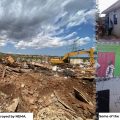
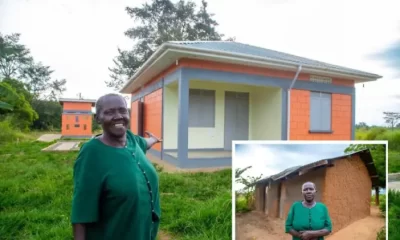
An elderly PAP in front of the Resettlement house in Buliisa (Inset: the house that was affected by the Tilenga project). Image credit: PAU

Civil society organisations under the StopEACOP Campaign have criticised an assessment commissioned by TotalEnergies on its land acquisition programme for the Tilenga oil project in Uganda, describing the report as lacking independence and credibility.

The Tilenga development will supply crude to the East African Crude Oil Pipeline which is designed to transport oil from western Uganda to international markets. The project has been widely contested by environmental groups and community advocates.

TotalEnergies commissioned Canadian consultancy Land and People Planning Ltd to conduct the assessment in the districts of Buliisa, Hoima and Kikuube. The report concluded that the company had addressed the core elements of the land acquisition programme and demonstrated commitment to transparency and continuous improvement.

However, the StopEACOP Campaign argues that the independence of the study is questionable. The coalition noted that TotalEnergies stated that an original assessor withdrew due to health reasons and that the Canadian firm was appointed as a replacement, without publicly explaining how key stakeholders were involved in the selection process.

Campaign coordinator Zaki Mamdoo said the report appeared to be designed to improve the company’s public image rather than provide a rigorous independent review. He added that the company’s suggestion that the Tilenga land process was ready for closure was difficult to reconcile with ongoing court cases filed by project affected people disputing compensation.

Activists also argue that the assessment does not address allegations of coercion, intimidation and pressure faced by communities asked to release land for the Tilenga project. Civil society groups have cited documented cases including the eviction of 42 families in Buliisa district following a court order issued before compensation payments were completed.

Diana Nabiruma of the Africa Institute for Energy Governance said communities have reported being warned that refusal to accept compensation offers could lead to court cases where they have little chance of success. She added that organisations supporting affected residents often observe bias and limited willingness by courts to address land disputes linked to oil developments.

In February 2026, the institute published research examining compliance with livelihood restoration commitments linked to the East African Crude Oil Pipeline. The report identified significant gaps in implementation and warned that many affected households risk failing to return to their pre displacement socio economic conditions if corrective action is not taken.

Campaigners also questioned the timing of the TotalEnergies assessment as the company faces an ongoing case in a civil court in Paris. The court recently ordered the company to release documents that had previously been withheld, including market studies on compensation rates prepared by subcontractors, minutes from a human rights steering committee and a report examining flooding linked to the Tilenga project.

According to Camille Grandperrin, legal officer at the Friends of the Earth France, analysis of the disclosed documents suggests multiple areas where the project may not comply with international standards, including the IFC Performance Standard 5.

The StopEACOP Campaign also highlighted discrepancies in the number of people included in the assessment. The action plan referenced 4954 project affected people, while civil society estimates suggest that more than 100000 people could be impacted across both the Tilenga project and the wider pipeline development.

Critics argue that evaluating Tilenga in isolation from the broader pipeline infrastructure creates a misleading picture of the scale of social impacts. They also note that the report does not address flooding allegedly linked to the construction of the Tilenga Central Processing Facility.

Campaign groups say the testimonies of affected communities, including claims of restricted land use prior to compensation and pressure faced by activists and land defenders, raise serious concerns that require independent scrutiny. They argue that a broader and fully independent review of Uganda’s oil sector impacts is needed to provide credible information to investors, lenders and insurers.

Author: Bryan Groenendaal

Source: greenbuildingafrica.co.za

Continue Reading

Resource Center

Legal Framework

READ BY CATEGORY

Facebook

Newsletter

Subscribe to Witness Radio's newsletter


Trending

Subscribe to Witness Radio's newsletter