Connect with us

WITNESS RADIO MILESTONES

Why matooke farming is losing ground in Bukedi

Published

on

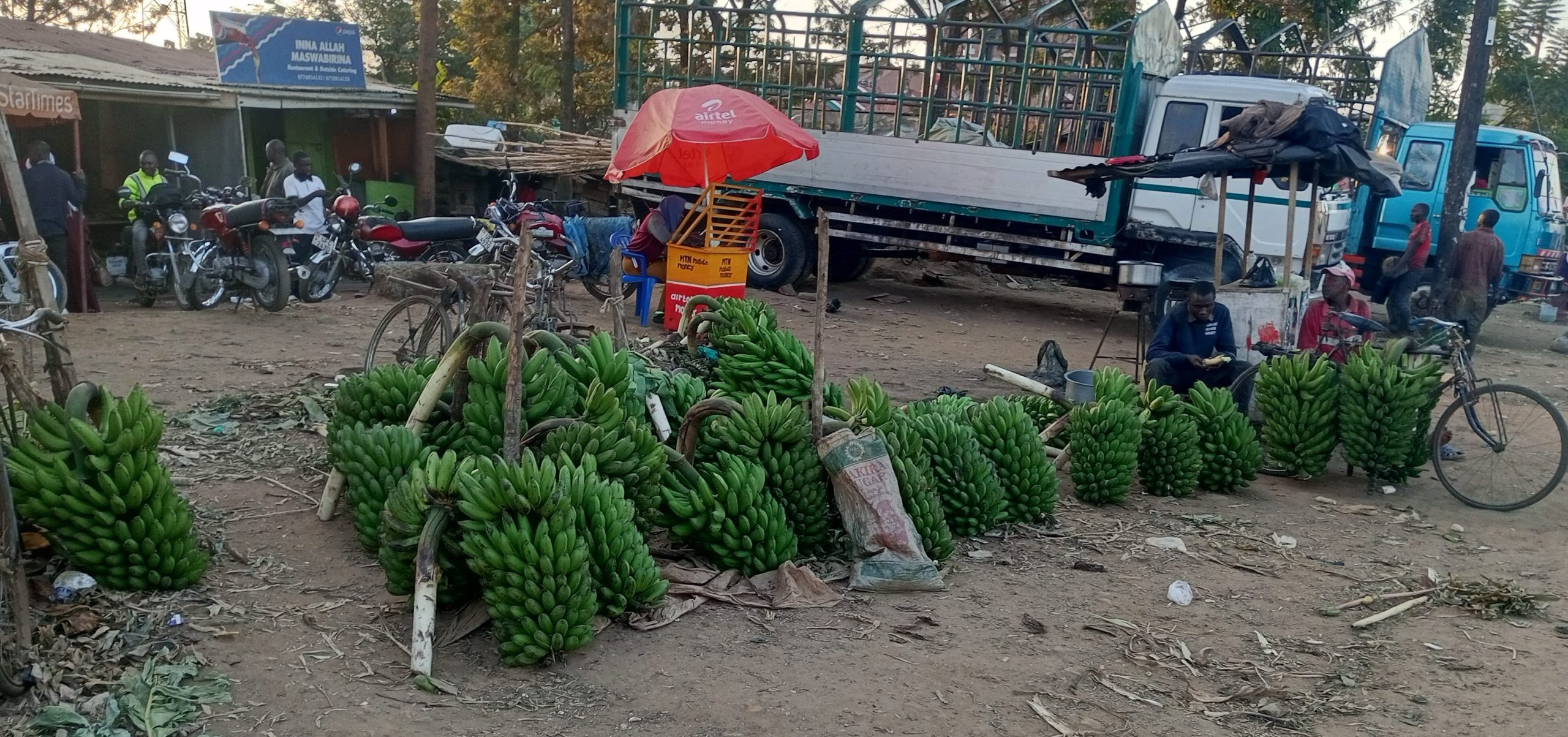
On a humid morning in Namusango Village, Kamonkoli South Ward, Kamonkoli Town Council in Budaka District, 58-year-old farmer James Kainja walks at the edge of what used to be his flourishing matooke garden.  For generations, the green banana plant—matooke—stood tall in Uganda’s farmlands, its broad leaves swaying in the wind and its heavy bunches promising a warm, hearty meal. But in Bukedi Sub-region today, that story is fading. Between the tired banana stools, spear grass has taken over. A few bunches hang small and low quality. “We used to harvest every week,” Mr Kainja says, dusting his palms.

“Now, it is once in a while and the money is not worth the struggle,” he adds. Across Bukedi, particularly in Pallisa, Budaka, Butebo, and Kibuku, the banana plants are shrinking back, replaced by maize, cassava, rice, and other faster-growing crops.  The sub-region that once sent truckloads of matooke to nearby districts now measures its banana harvest in small piles under tarpaulin. Where the green canopy of banana leaves once dominated, the landscape has changed. For many farmers, the decision is not about abandoning tradition but about survival.

Matooke as culture

In many Bukedi households, matooke still holds cultural value, especially during weddings, funerals, and community gatherings.  But with fewer plantations, sourcing enough bunches has become harder and more expensive. Matooke is now imported into Bukedi from Mbale and Mbarara. Mr Abubakar Nanghejje, an elder in Kibuku, warns: “If this trend continues, our children may only know matooke from stories. We are losing more than a crop—we are losing a piece of who we are.”

He adds that matooke, once abundant, is now a luxury: “People only access matooke during ceremonies because the cost of a bunch has turned expensive,” he explains. Within Kibuku Town Council, women sell matooke in pieces: three or four fingers for Shs1,000, while a complete bunch costs between Shs30,000 and Shs35,000. This contrasts sharply with central and western Uganda, where matooke is more than a crop—it is an identity, a culture, and a livelihood.  Yet across the country, banana plantations are thinning out, replaced by maize, beans, or simply abandoned.

Farmers’ voices

Mr Peter Mwigala, a 73-year-old farmer from Bubulanga Village, recalls with nostalgia: “I grew matooke for 30 years. But now my plantation is less than half what it used to be. The pests are too many, the prices are too low, and the rains are no longer reliable.” His story echoes across villages, evidence of a slow, steady decline in matooke production.  This decline has unfolded over two to three decades, rather than as a sudden collapse. Agricultural researchers point to several reasons. Among them, banana bacterial wilt (BBW), banana weevils, and nematodes that have devastated plantations in major banana-growing areas. These pests cause premature ripening, rotting, and eventual uprooting of infected plants.

 “When wilt enters your plantation, you can lose everything in one season,” says Mr Abner Botiri, an agriculture officer in Budaka. He further explains that erratic rainfall and prolonged dry spells also take a toll.  Matooke thrives in consistent moisture, but under drought stress it yields smaller bunches.  Repeated losses have led some farmers to abandon the crop entirely. Continuous cultivation without soil management has also depleted many banana-growing soils. Beyond agronomic challenges, the economics of matooke farming have shifted dramatically.  Local market prices fluctuate widely depending on supply, while transport costs have risen sharply.

Mr John Gwanyi, a 71-year-old farmer, recalls: “In the 1980s and 1990s, matooke farmers could educate children through primary, secondary, and tertiary levels, and still cover basic needs. Today, a whole plantation might not pay for one term’s school fees.” Urbanisation has worsened the trend. Younger generations moving to towns now eat rice, spaghetti, and bread more frequently.

The once sacred matooke meal is no longer the undisputed centrepiece of Ugandan dining tables. Meanwhile, land fragmentation leaves families with smaller plots, unable to sustain large banana plantations.  In some areas, higher-value or quicker-return crops like coffee, passion fruit, or maize dominate.  As one agricultural economist notes: “A bunch of matooke takes nine months to mature, but maize can be ready in three months. For cash-strapped farmers, that difference matters.

Government interventions

Government and research institutions have made several attempts to address the situation.  The National Agricultural Research Organisation (NARO) has introduced resistant banana varieties and promoted good agronomic practices. NGOs are training farmers in mulching, proper spacing, and integrated pest management. Still, the decline carries a cultural weight. In Buganda, for instance, matooke is central to marriage ceremonies, community gatherings, and daily life.

“When you serve matooke at a function, it shows respect,” explains Mr Badiru Kirya, a cultural leader in Obwa Ikumbania bwa Bugwere. Yet, Mr Kirya attributes part of the decline to newer banana varieties introduced by research agencies. “The old varieties planted by our grandparents could withstand weather changes better. These new varieties are weaker against climate volatility,” he says. He also notes that soil infertility and population pressure have accelerated the decline, as families squeeze more onto smaller pieces of land.

National standing

Uganda remains one of the world’s largest banana consumers, with per capita consumption estimated at 250–300 kg annually in some regions. Yet, national banana production has generally declined. According to the Uganda Bureau of Statistics (UBOS) 2024 census, only 27.1 percent of households participate in banana cultivation.  Dr Sadik Kassim, the NARO deputy director general in-charge of agricultural promotion, highlights several factors. “Soil fertility has gone low, while pests and disease build-up have grossly affected matooke gardens. Erratic rainfall and climate change further reduce yields.

Poor agricultural practices have made the decline worse,” he says. However, Dr Kassim dismisses the claim that new technologies are to blame. Similarly, Dr Rabooni Tumuhimbise, the director of research at Rwebitaba Zonal Agricultural Research and Development Institute, said: “As of now, I am not aware that Bukedi has registered a decline in banana production. This needs verification before conclusions.” But farmers and local leaders insist the reality is clear: matooke is disappearing from Bukedi. Mr Arthur Wako Mboizi, a seasoned politician and opinion leader, argues: “Bukedi has drastically registered a total decline in banana production due to various factors, including soil infertility, diseases, and erratic rainfall.”

Efforts are underway to add value. Under the Presidential Initiative on Banana, NARO and Kilimo Trust have developed matooke-based products such as flour, bread, and cakes. More than 13 million Ugandans consume bananas as their staple, and 75 percent of farmers grow them, contributing nearly $440 million annually to the economy. Yet, for Bukedi, the reality is sobering. The once proud producer of matooke is a shadow of its former self. As Mr Nanghejje, the Kibuku elder, put it: “We are losing more than a crop. We are losing a piece of who we are.”

Background 

In 2024, national banana production was estimated at 6 million tonnes annually, 70 percent of which was consumed at household level and 30 percent sold.

The Banana Merchandise Trade Statistics Bulletin (2024) shows export earnings rose from $2.1 million in June 2023 to $2.4 million in June 2024. Still, yields remain below potential—currently 5–30 tonnes per hectare compared to an attainable 60–70 tonnes.  Uganda’s banana losses to wilt disease are massive, with officials estimating a 71.4 percent loss of potential harvest annually, worth nearly $300 million.

Source: Monitor

Continue Reading

WITNESS RADIO MILESTONES

MPs recover hundreds of land files hidden near Mukono land office

Published

on

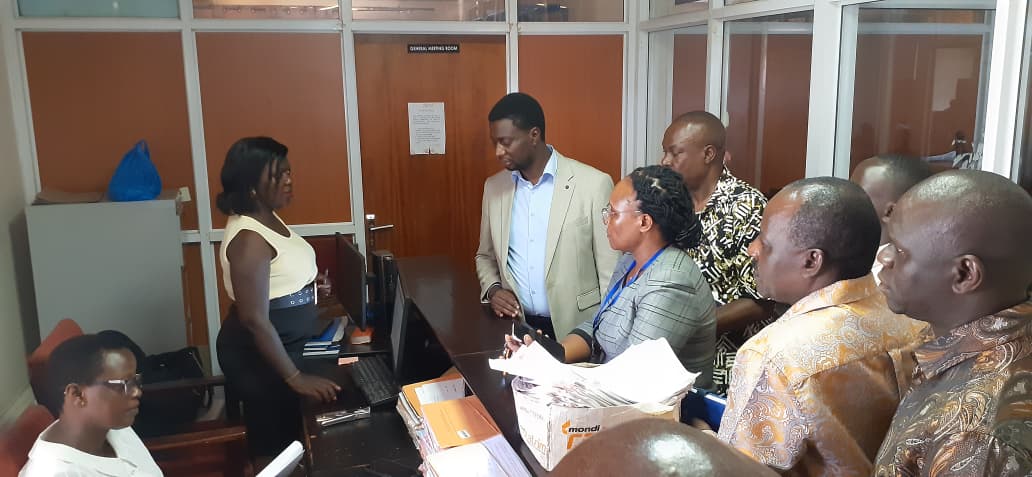
Parliament’s Lands Committee has ordered a police investigation after recovering hundreds of land files allegedly hidden in shops and vehicle boots near the Mukono Zonal Land Office.

Parliament’s Committee on Lands, Housing and Urban Development has ordered a police investigation after recovering hundreds of land files allegedly hidden in shops and vehicle boots near the Mukono Zonal Land Office (MZO).

The committee, led by chairperson Edison Rugumayo, was inspecting the office as part of an inquiry into allegations of land fraud, delays in processing titles and other irregularities affecting land transactions in Mukono District.

During the inspection, legislators toured various departments and questioned staff about their work, including the handling and storage of land records.

At the office of Senior Staff Surveyor Steven Ndegeya, the committee raised concerns over alleged irregularities involving land titles reportedly created in wetlands and central forest reserves.

The legislators also questioned officials about more than 200 titles reportedly issued in Mabira Forest and demanded a list of people associated with the titles.

The committee was further alarmed after being told that more than 50 land titles had allegedly been created on the government-owned Njeru Stock Farm.

Rugumayo asked Ndegeya to provide the transaction trail, original title documents, geographical maps and details of all individuals holding titles on the land.

Ndegeya asked for more time, saying he needed to consult registrars before preparing an organised report.

He told the committee that there was no certificate of title for Njeru Stock Farm belonging to the Uganda Land Commission in the system.

However, he said the system contained records of individual Mailo landowners whose interests dated back many years, arguing that some people who obtained titles on the land had acquired them legally.

The committee later met MZO officials to establish the causes of the complaints and alleged irregularities.

Three staff members, Dan Kyalo, Hannifah Nantongo and Susan Aceru, were tasked with producing files that were allegedly being taken out of the MZO.

The three denied having moved the files.

However, accompanied by police officers, the committee recovered hundreds of titles allegedly stored in shops across the road from the land office. Other files were reportedly found in vehicle boots.

When questioned about who had instructed them to keep the files outside the office, the officials reportedly told the committee they had been directed by their supervisor, Ndegeya.

The committee also questioned the security team deployed by the Ministry of Lands in Kampala about how the files and titles had been removed from the office.

It emerged that Emma Otim, the security head, had left responsibility for keeping the office keys with a private security guard who routinely opens and closes the office.

The committee questioned why a guard whose primary responsibility was reportedly to man the gate had been entrusted with the office keys.

Principal Assistant Secretary at the MZO, Doreen Tumushabe, said she could not be held responsible for the alleged conduct of individual employees but promised to strengthen supervision.

Tumushabe also cited staff shortages, lack of vehicles and the large number of complaints involving allegedly forged land titles among the challenges affecting the office.

During the oversight visit, the committee also discovered hundreds of allegedly forged land titles at the MZO.

Officials told the committee that no related case had been opened at Mukono Police Station despite the alleged discovery of the forged titles.

The committee also heard complaints from members of the public who said they had waited for years to obtain land titles or have land disputes resolved.

A 75-year-old woman, Maria Nakitende, told the committee that she had waited for decades for authorities to resolve her title-related matter.

Hajji Musa Muliika of Katosi alleged that he was asked to pay Shs14 million after the title he had submitted was reportedly lost while in the hands of MZO officials.

Rugumayo directed police to conduct a thorough investigation into the circumstances surrounding the removal and concealment of the files and establish why they were taken outside the office, particularly ahead of the committee’s visit.

He also ordered the head of the Mukono land office to submit, within one week, a report on land titles in Mabira Forest and wetlands, as well as complaints against staff members.

Masaka legislator Joan Namutaawe criticised the quality of services at the land office and questioned whether Tumushabe was fully in control of operations at the MZO.

Namutaawe warned that the committee would pursue cases involving alleged illegal occupation and development in wetlands.

Source: nilepost.co.ug

Continue Reading

MEDIA FOR CHANGE NETWORK

Uganda moves toward a Bamboo Policy to boost environmental conservation and green growth.
Published

on

By Witness Radio team.


Uganda’s move to develop a national bamboo policy aims to boost environmental conservation and create green jobs, addressing the country’s urgent unemployment issues among the working class.


Bamboo is a critical tool in fighting climate change due to its rapid growth, high carbon sequestration capacity, and ability to produce 35% more oxygen than equivalent trees. As a fast-growing, renewable resource, it restores degraded land, provides sustainable materials that replace emission-intensive products like concrete, and offers a resilient, low-carbon bioenergy source. 


Bamboo’s potential is outlined in the existing National Bamboo Strategy. Still, stakeholders stress that a formal policy involving entrepreneurs, farmers, and processors is essential to remove regulatory uncertainty and foster sector growth.


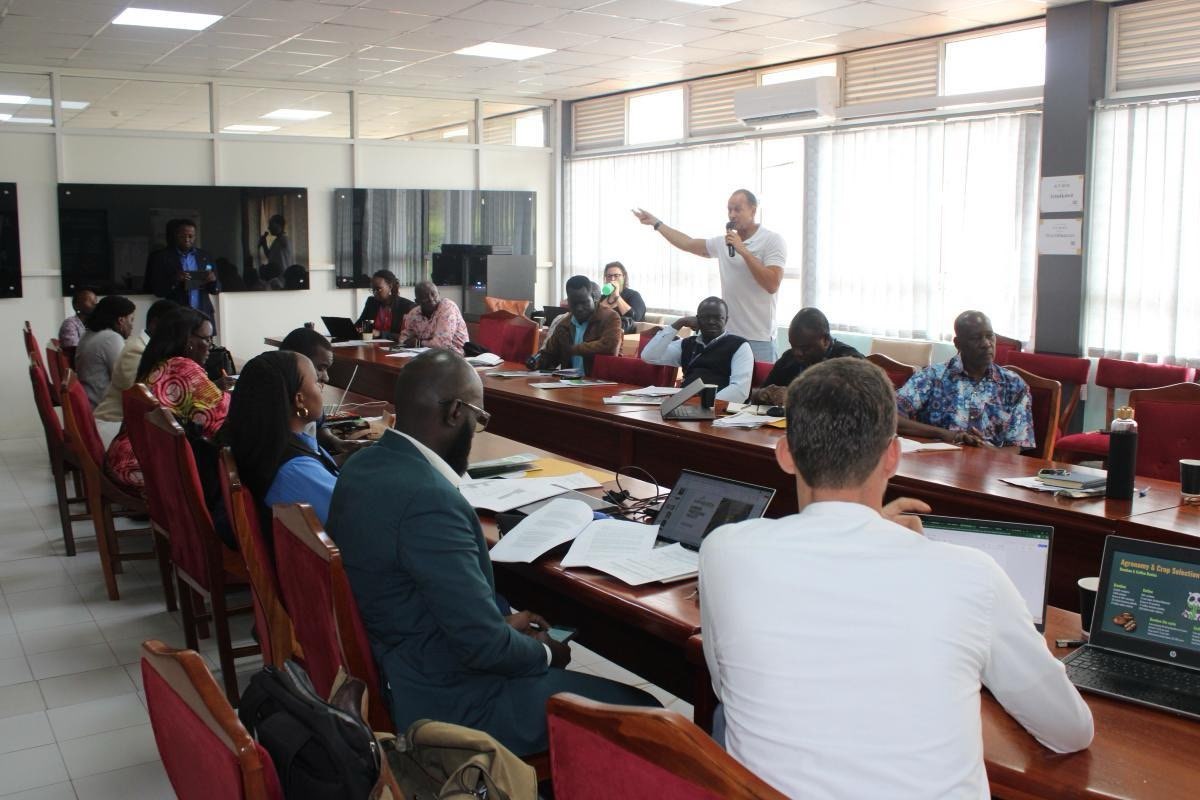
“The strategy is a good document, but it was developed largely through desk research. It did not fully involve entrepreneurs, farmers, and processors who are already working in the bamboo industry,” said Sjaak de Blois, chairman of Bamboo Uganda, encouraging stakeholders to see their role as vital.


The bamboo policy is currently at an early consultative stage, with no draft yet submitted to the cabinet or parliament. Recent consultations brought together representatives from eight government ministries, private-sector bamboo actors, and development partners to begin aligning the strategy with practical regulatory needs.


“What we have now is the starting point,” De Blois mentioned. “The next step is to take the strategy and make it more practical, more market-driven, and more Ugandan. The next step is to move from having a plan to adopting a policy.


Bamboo currently falls under several regulatory frameworks, with no single authority overseeing the sector. The policy push is being driven in part by Bamboo Uganda, a membership-based organization bringing together bamboo farmers and processors, among others. The organization aims to play a coordinating role similar to that historically played by the Uganda Coffee Development Authority in the coffee sector.


“If you want to make a sector meaningful for a country, you need coordination. Coffee became what it is because of an institution that aligned farmers, traders, exporters, and regulators. Bamboo needs the same kind of coordination.” He said.


The policy process is supported by the Belgian development agency, which is funding consultations and facilitating dialogue between the government and the private sector.

Industry players say the absence of clear regulations has constrained investment despite growing demand.

“At the moment, bamboo is everywhere and nowhere at the same time. As a farmer, you talk to forestry, as a charcoal producer, you talk to energy, as a builder, you talk to works. There is no single framework that enables the industry to function.” De Blois added.


Supporters of the policy argue that bamboo could play a significant role in environmental conservation. Bamboo grows rapidly, regenerates after harvesting, and can be harvested annually for decades, reducing pressure on natural forests.


According to Global Forest Watch (GFW), Uganda lost 1.2 million hectares of tree cover between 2001 and 2024, representing a 15% decline from the 2000 baseline. Bamboo has been identified as a key species for restoration.


“One acre of bamboo that is harvested sustainably can prevent the destruction of hundreds of acres of natural forest,” De Blois said. “If we get this right, bamboo can help reverse deforestation rather than contribute to it.”


Ms. Susan Kaikara, from the Ministry of Water and Environment, emphasized bamboo’s potential to drive Uganda’s green-growth agenda.


“Establishing a coherent national policy framework will strengthen coordination, inspire investment, and unlock bamboo’s full potential as a pillar of Uganda’s green economy,” she said.


Uganda’s charcoal market alone is estimated to be worth hundreds of millions of dollars annually, much of it supplied through unsustainable wood harvesting. Industry actors say certified bamboo charcoal plantations could offer a cleaner alternative.


“If they allow us to certify bamboo charcoal plantations, then we can get a trade license to compete or to work together with the existing market. We will reverse deforestation. We would enter an industry of about 500,000 hectares, creating smart, green jobs. We can digitalize them to make them attractive through bamboo agroforestry. So again, those things need a policy.” He adds.


Bamboo is also viewed as a climate-friendly crop due to its high capacity for carbon sequestration. Its rapid growth enables it to absorb large amounts of carbon dioxide, while its extensive root system improves soil structure and increases long-term carbon storage.


“When you look at carbon sequestration, bamboo offers several advantages. Residues from harvested bamboo can be converted into biochar, locking carbon into the soil for long periods. When you also see the sequestration per acre compared to many other trees, it is five or six times higher. So, we sequester a lot,” De Blois said


Stakeholders say that if the policy process progresses as planned, bamboo could emerge as one of Uganda’s key green growth sectors within the next decade.


“Policy making takes time. But what is important is that we have started the conversation with all the right ministries in the room. From here, it is about taking steady, practical steps.” He concluded.

Continue Reading

WITNESS RADIO MILESTONES

A Global Report reveals that Development Banks’ Accountability Systems are failing communities.
Published

on

By Witness Radio team.

For decades, development projects have been funded to address some of the World’s most pressing problems, including poverty, wildlife conservation, and climate change. However, what unfolds on the ground is sometimes the opposite of development. Instead of benefits, these projects have often harmed the very people they are supposed to support.

The effort to address such harm has led to the establishment of Independent Accountability Mechanisms (IAMs) by various development banks. Yet, communities affected by these projects often face betrayal by national court systems, leaving them feeling overlooked and vulnerable, emotions that underscore the urgent need for effective justice.

According to experts in development financing, since the early 1990s, development banks have sought to address and mitigate harm through IAMs—non-judicial grievance mechanisms that provide a direct avenue for impacted communities to raise concerns, engage with project implementers, and obtain remedies for the harm they have experienced.

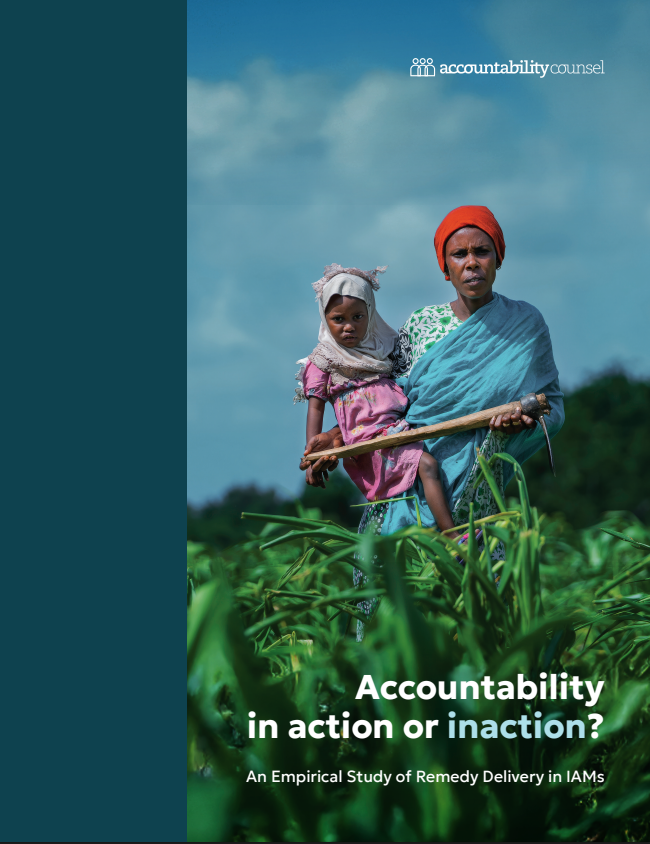
The study, conducted by Accountability Counsel and titled Accountability in Action or Inaction? An Empirical Study of Remedy Delivery in Independent Accountability Mechanisms shows that while IAMs exist, their relevance has fallen short, underscoring the urgent need for reform to restore community trust and hope.

In compiling the report, researchers reviewed 2,270 complaints across 16 IAMs and conducted 45 interviews covering 25 cases globally.

The report reveals a persistent gap between the promise of remedies and their realization, highlighting that only 15% of closed complaints led to commitments, and just 10% achieved full completion, underscoring the urgent need for effective remedies for communities.

The findings highlight ongoing challenges, including inadequate implementation, limited monitoring, and persistent power imbalances, which continue to block communities from accessing meaningful remedies and demand immediate reform.

“The consequences of these institutional gaps are severe. As these cases show, institutional silence can exacerbate risk, while meaningful intervention can help de-escalate it.” The Report adds.

Uganda is among the countries where communities have sought justice using these accountability mechanisms. Between 2006 and 2010, communities in one of the districts of Uganda were brutally evicted by the UK-based Company, which was growing trees in the area.

The company was formerly an investee of the Agri-Vie Agribusiness Fund, a private equity fund supported by the International Finance Corporation (IFC), the private sector arm of the World Bank Group. The community filed a Complaint with the IFC’s accountability mechanism, the Compliance Advisor Ombudsman (CAO).

“We complained to this body in 2011, hoping for justice, but over 15 years later our people are still struggling, living miserably, some without homes,” a community land and environmental defender told the Witness Radio team.

According to the affected residents, the CAO process did not lead to success or meaningful compensation, as they had hoped.

Between 2013 and 2014, the communities, with support from the CAO, signed a final agreement with the Company to address the harm. Among other commitments, this included resettlement of the affected communities.

In its 28-page report published in 2015 titled: A Story of Community-Company Dispute Resolution in Uganda, the CAO wrote,” With the agreements concluded, implementation is gathering pace. As agreed, the company has begun extending development assistance to both cooperatives, and the process of restoring and enhancing livelihoods has commenced.

The first step taken by both cooperatives was to acquire land. In late 2013, the Mubende Cooperative bought 500 acres of ‘fertile agricultural land’ in the Mubende district. Their vision was to allocate a certain percentage of the land for resettlement, with the remainder utilized for farming projects.

Reports from the ground indicate that communities remain dissatisfied with the process, claiming it failed to address their concerns fully and highlighting the urgent need for more effective remedy systems.

“When you say that people are well, it is really a total lie. Many people were never compensated or resettled. Even those who got a portion of land say they have never seen a fertile land—I have never seen it, because people are living or cultivating on rocky, infertile lands,” the defender further revealed.

The struggle faced by the Ugandan community is not unique. Their experience mirrors what the Accountability Counsel report identifies worldwide. Despite registering more than 2000 complaints by communities harmed by bank-financed projects globally, there has been no comprehensive system-wide analysis of whether and how often these mechanisms deliver meaningful remedies, defined as tangible, material outcomes that repair harm and improve lives.

In addition to the slow success of such IAMs, the report notes that, across interviews covering 25 complaints, 84% referenced retaliation, violence, or threats of violence-an alarming indicator of the risks faced by communities seeking justice, demanding immediate attention and action.

“Government officials and company representatives were frequently implicated in efforts to suppress dissent. This not only reduces the likelihood of achieving a substantial remedy, but also suppresses the willingness of community members to speak honestly and openly about Complaint outcomes.” The report further adds,

Further, it reveals that communities described a range of retaliatory tactics, including physical clashes, arrests, detentions, fatalities, intimidation and harassment, death threats, and anonymous warning letters, among others.

“Remedy must be reimagined not as a peripheral concern but as a core responsibility of development institutions. It must be adequately resourced, independently monitored, and centered around the needs and voices of affected people,” the report adds.

The report recommends that development banks and IAMs establish a Remedy Framework with clear standards to ensure remedies are timely, adequate, and community-centered, and to encourage stakeholders to prioritize systemic reform for better justice outcomes.

The report also urges development banks and their accountability mechanisms to make remedies a foundational element of responsible finance. Adopting institutional frameworks that prioritize redress, empowering IAMs to oversee and enforce commitments, and incorporating the outcomes of IAM processes into project evaluations and institutional learning.

Continue Reading

Resource Center

Legal Framework

READ BY CATEGORY

Facebook

Newsletter

Subscribe to Witness Radio's news and report updates


Trending

Subscribe to Witness Radio's news and report updates