By the Witness Radio Team
Oil may not yet flow from Uganda’s wells, but for people near the oil fields in midwestern Uganda and along the pipeline corridor, the oil saga has been shaping their lives for years.
They have felt its impact through land they claim is no longer theirs, homes uprooted, roads and infrastructure cutting through fields they once cultivated, and lingering uncertainty after the announcement that their land was needed for a project promising to reshape Uganda’s future.
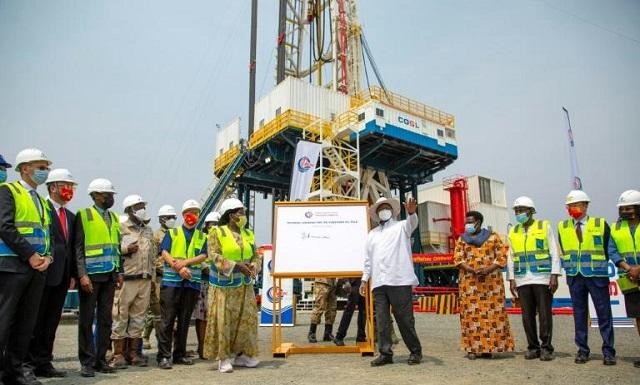
Uganda stands on the brink of a moment waited for nearly twenty years. The nation is set to produce its first commercial oil this September, and the government touts’ oil as a gateway to new revenue, jobs, infrastructure, and a path toward middle-income status.
Yet as Uganda readies itself for its first barrels, new findings about the French oil giant at the industry’s heart raise a broader question: beyond profits, what is at stake?
These revelations also shed light on TotalEnergies’ broader investment strategy and its growing presence in countries marked by deep political, economic, and human-rights challenges.
TotalEnergies is the operator of the Tilenga oil project in western Uganda and a major shareholder in the East African Crude Oil Pipeline (EACOP), which is intended to transport crude from Uganda’s oil fields to the Tanzanian coast.
A 2026 analysis by German environmental organization Urgewald, based on its Global Oil & Gas Exit List (GOGEL), found that more than half of TotalEnergies’ planned short-term oil and gas development is located in countries classified as autocracies or hybrid regimes.
Of the 7,829 million barrels of oil equivalent identified by Urgewald as part of the company’s planned short-term development, 4,178 million barrels are in those countries. More than 3,700 million barrels are also in countries classified as having high or extreme political and economic risks.
Uganda is among the countries listed in the analysis. Together, Uganda and Mozambique account for about 40 percent of TotalEnergies’ planned short-term upstream expansion. When Iraq is included, the three countries account for more than half of the company’s planned expansion.
The findings do not suggest that Uganda, Mozambique and Iraq share the same political systems or social circumstances. Instead, the three countries stand out in Urgewald’s analysis because of the scale of TotalEnergies’ planned upstream expansion there.
In Uganda, the company is involved in the Tilenga oil project and EACOP. In Mozambique, TotalEnergies is involved in the Mozambique LNG project, while Iraq is another major destination for the company’s planned upstream expansion.
Taken together, these findings position Uganda’s inaugural oil production as a key piece in TotalEnergies’ sweeping global ambitions.
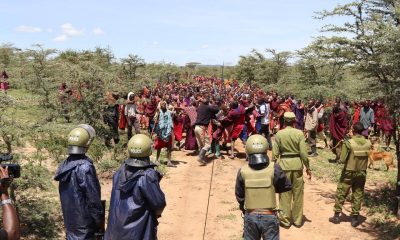
For communities touched by Uganda’s oil ventures, the promise of economic transformation has often arrived as land disputes, compensation battles, and resettlement struggles—realities woven into the fabric of these projects.
The EACOP pipeline carves its way through ten Ugandan districts, demanding land for its path and the infrastructure that follows.
While officials insist that land acquisition and compensation have been handled justly, many in affected communities voice grievances over what they see as insufficient payment for their land, homes, crops, and possessions.
Among them is Bwowe Ismail, a resident of Bethlehem village in Kyotera District. Bwowe told Witness Radio that his land was taken for the project after he demanded compensation he believed matched the value of his land and property.
He says that instead of receiving the compensation he sought, authorities intimidated him and later arrested him.
“Instead of compensating me fairly as I wanted, state authorities intimidated [me], enabled my arrest and accused [me] of sabotaging a government initiative,” Bwowe said.
Bwowe says that on one occasion he was arrested and accused of stealing money from a wealthy man in his village, an allegation he denies.
“They arrested me [and said] that I stole money from someone. I am a respected man in the society and could not do this. They just did it to shame me,” he said.
According to Bwowe, TotalEnergies offered to support his legal representation if he agreed to sit with the company and accept the compensation, but he refused.
He says that after he continued to reject the compensation and resisted what he described as intimidation, the government sued him and others who refused compensation. It asked the court to allow the money to be deposited into court accounts. The court ruled for the government.
Bwowe’s ordeal mirrors a broader struggle over land acquisition and compensation faced by communities in Uganda’s oil regions. More broadly, his story reveals how these conflicts can spiral far beyond the loss of land itself.
In its report, Our Trust is Broken: Loss of Land and Livelihoods for Oil Development in Uganda, Human Rights Watch reported that EACOP and other oil developments have affected more than 100,000 people in Uganda and Tanzania. The report also raised concerns about compensation, resettlement, and the effects of oil development on communities and biodiversity.
For many affected communities, seeking justice remains an uphill battle. Their worries about Uganda’s oil projects extend well beyond land.
Environmental activists and organizations challenging Uganda’s oil expansion have found themselves facing arrests and criminal charges.
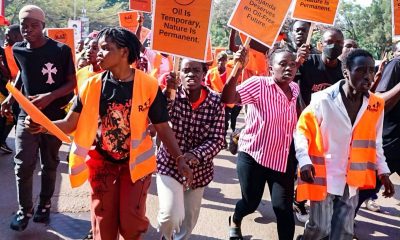
In August, 20 youth activists associated with Rooted in Resistance were arrested while delivering petitions to TotalEnergies and Parliament calling for an end to fossil-fuel expansion.
These arrests are part of a growing pattern of detentions and prosecutions targeting activists who oppose EACOP and other oil projects.
Brighton Aryampa, team lead at Youth for Green Communities, an organization that provides legal representation to environmental activists, says the treatment of protesters raises questions about Uganda’s civic space.
“The government is deliberately using legal action against Stop EACOP activists to suppress dissent, free speech, the right to peaceful protest, and public participation. This taints Uganda as a country that undermines democratic principles of free expression and open discourse, as hundreds of Stop EACOP activists have been arrested and charged,” Aryampa said. Concerns about civic space arise as Uganda faces mounting criticism for its record on political freedoms, free expression, treatment of human-rights defenders, and access to justice.
The country ranks 125th out of 142 countries in the World Justice Project’s Rule of Law Index. Freedom House classifies Uganda as “Not Free”, while CIVICUS gives the country a “Repressed” civic-space rating of 28 out of 100.
All these conditions shape the complex landscape in which Uganda’s oil projects are taking root.
Urgewald describes TotalEnergies as one of the world’s most aggressive oil and gas expanders.
Its 2026 analysis found that TotalEnergies has the largest short-term expansion plans among its major oil and gas peers in authoritarian states and countries classified as high-risk for business.
Sonja Meister, an energy campaigner at Urgewald and author of the analysis, says the company is taking significant risks through its expansion strategy.
“TotalEnergies is taking a huge risk with its fossil fuel expansion and disregarding the repercussions for communities on the ground. This game of roulette has serious consequences for civil society, ecosystems, and the climate alike,” Meister said in an email exchange with Witness Radio.
For Uganda, the significance of the findings lies not just in the amount of oil expected to be produced but in where the country’s projects sit within TotalEnergies’ wider portfolio and what that suggests about the company’s approach. This matter because Uganda is one of several countries where the company pursues major upstream investments despite political, economic, and governance risks identified by organizations such as Urgewald.
Uganda is one of several countries where the company is pursuing major upstream investments despite political, economic, and governance risks identified by organizations such as Urgewald.
This does not mean TotalEnergies’ investments will have identical impacts everywhere or that Uganda’s oil sector will mirror outcomes seen in other countries. Still, it raises pressing questions about how the company weighs political and economic risks, safeguards communities, and responds to human-rights issues as they emerge.
It also sparks important questions about how the company evaluates political and economic risks, shields communities during major developments, and handles human-rights concerns as they surface.
TotalEnergies’ expansion also depends on access to financial markets and investors. According to Urgewald’s analysis, bonds have become an increasingly important source of financing for TotalEnergies compared with loans.
Among the company’s major investors are French financial institutions including Crédit Agricole and Amundi. Deutsche Bank, primarily through DWS, is also a major investor, while German DZ Bank, primarily through Union Investment, is another significant investor.
Urgewald notes that these investors have yet to pledge to stop buying new TotalEnergies bonds, urging financial institutions to rethink their ties to the company and its fossil-fuel ambitions. This financing dilemma is pivotal because TotalEnergies’ expansion hinges on continued access to capital and investors.
Meister says continued expansion depends heavily on access to finance. “TotalEnergies relies on the financial industry’s continuous support. Without new bonds, it would be much harder for the group to finance its destructive expansion projects such as ‘Mozambique LNG’ or ‘EACOP’,” she said.
She said banks and investors financing the company should reconsider their role.
“The banks and investors involved must recognize their responsibility and not sink further funds into these risky endeavors,” Meister said.
The government has hailed Uganda’s first oil production as a landmark economic achievement.
For communities living in the shadow of oil developments, however, the road to first oil has already meant land seizures, compensation wrangles, forced relocations, and at times, direct clashes with authorities and oil firms.
Meanwhile, Urgewald’s research situates Uganda within a sweeping trend of TotalEnergies’ global fossil-fuel expansion, especially in countries flagged for serious political, economic, or governance risks.
Witness Radio sought a response from TotalEnergies Uganda to the concerns raised in this story, including issues relating to land acquisition, compensation, treatment of protesters and the company’s wider expansion strategy. We contacted the company’s Corporate Affairs Manager, Anita Kayongo, by email and telephone but had not received a response by the time of publication.