Connect with us

MEDIA FOR CHANGE NETWORK

A dead body recovered in a resident’s garden is causing sleepless nights to community members in fear of arrests and false charges.


Published

on

By Witness Radio team

The Mubende Police on Wednesday last week recovered the body of a yet-to-be-identified male person who committed suicide in one of the resident’s gardens in Kirwanyi, Kitule parish in Butoloogo Sub- County in Mubende district. The incident has caused shock and fear to the community who believe this is a plot to criminalize land grab in their area.

The police have not yet established the identity of the deceased calling, on the public who may have lost any of their beloved ones to approach them

“We have neither identified the personal information or relatives for this person nor the cause of his death ever since we received his body. He was found hanged in a resident’s garden and is also unknown to the community. We call upon anyone who lost a relative to approach us.” Racheal Kawaala, the Wamala Region Police spokesperson told Witness Radio on Saturday last week.

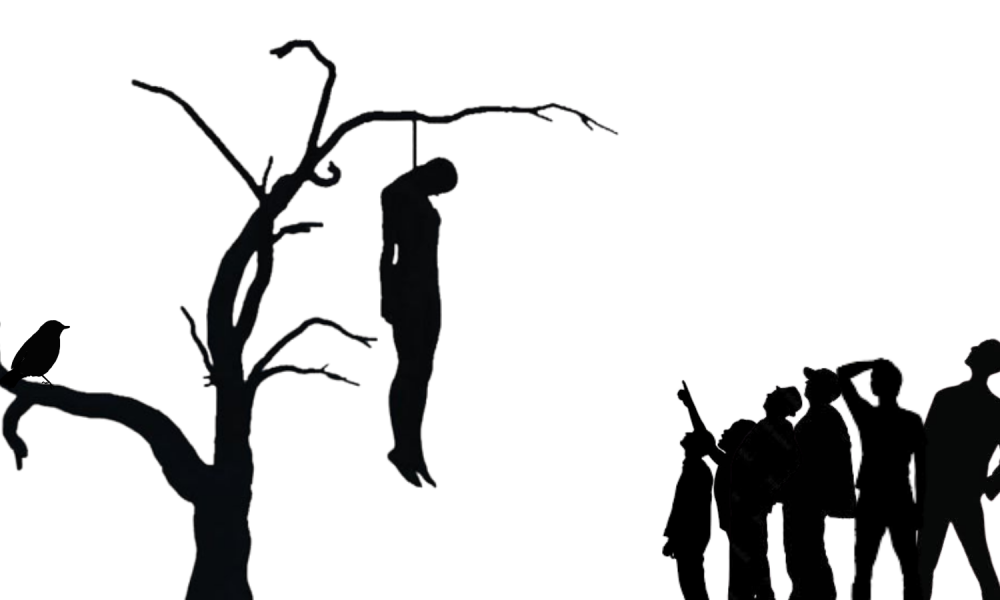
He was found dead and hanging on a tree at around 3 pm on Tuesday by a resident who had gone to tend to his maize plantation. The resident whose attention was attracted by an awful stench alerted the village leaders, residents, and the police.

The next day, police swung into action at 3 pm and picked up the body of the deceased, and took it to Mubende hospital.

Ms. Kawala added that senior officers joined the probe into the cause of the death. She added that the body is, however, still kept in Mubende Hospital Mortuary.

However, the news of the dead body left the community shocked and in fear of arrests for allegedly being behind the cause of the murder. They believe this is a plot by their evictor, a renowned land grabber, Naava Milly Namutebi to frame them with murder charges so that she can continue grabbing their land.

According to the community, the discovery of the body happened just a few days after the return of the self-claimed landlord and her intensified violent land grab.

In December, Naava returned to the community land guarded by (four) 4 armed men and started harvesting community members’ crops. They allege she might be behind the dead body that they believe was dumped to further the land grab.

At least 30 houses and hundreds of hectares of crops especially maize have been destroyed in the recent violent evictions according to a community land rights defender, Mr. Ssesazi Christopher.

Since 2012, Naava with support from a senior government army officer Major Eric Kigamboha, and the Mubende police have displaced over 4000 people from their land without a court order and continue to perpetrate violence against families that are still staying on the land.

Over 3.5 square miles belonging to residents have all been taken by the wealthy investor without consent from the owners.

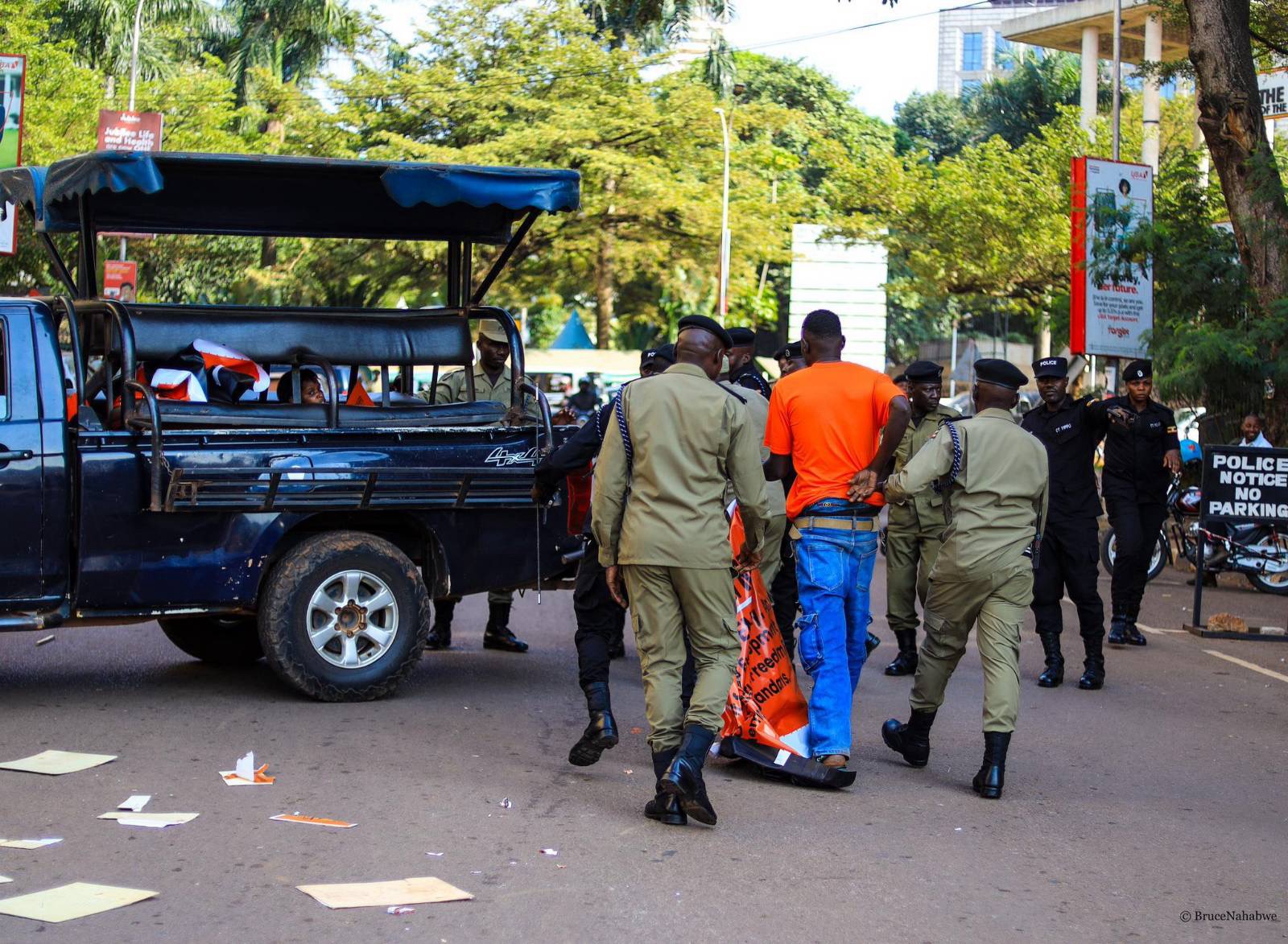
This took them aback, in 2019, a similar incident happened, seven community members were framed for having killed one Mbabazi Samuel who worked as a casual laborer for a self-claimed landlord Naava and was imprisoned for three years in jail without trial.

The casual worker had been murdered in cold blood. The residents were later accused of being behind the murder in a bid to eliminate some of the powerful and vocal land rights defenders to ease her land grab process.

According to locals, the two workers of Naava lynched their colleague at one of the resident’s gardens. Later, this incident was used against vocal rights defenders who were resisting her land grab.

“Eventually, some information leaked from some of the workers that the residents will be punished and charged for the murder. Some villagers went on the run while others who remained were arrested by the police.” One of the defenders revealed this information in an interview with Witness Radio.

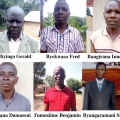
Tumusiime Benjamin, Bagirana Innocent, Habana Damaseni Miyingo Gerald, Byangaramani Charles, and Byekwaso Fred were arrested by armed policemen attached to Mubende police on orders of one Naava Milly Namutebi. But luckily their charges were later dropped by the Director of Public Prosecution (DPP) in June last year

Naava’s continued land grab and perpetuation of violence defy the recent orders of both the Prime Minister of Uganda Rt. Hon. Nabbanja Robinah and the Minister of Land, Housing, and Urban Development Hon. Judith Nabakooba. . Last year, Nabakooba visited the affected communities and directed no further evictions.

However, when Naava defied and continued the violent evictions, over 60 residents pitched camp at the Prime minister’s home in Kakumiro district in December protesting the continued destruction of their property.

Sources told Witness Radio that the Prime Minister ordered the arrest of the renowned land grabber and the withdrawal of policemen that have been guarding and facilitating the land grab.

Continue Reading

MEDIA FOR CHANGE NETWORK

“No Land, No Life” – Women at the East Africa Convergence Refuse to Move out Quietly

Published

on

They came from forests, coastlines, grazing territories, and farmlands. In total, 45 women from Kenya, Uganda, Tanzania and communities across DRC, South Africa, and Zimbabwe gathered in Limuru, Kenya, for the East Africa Land and Climate Justice Convergence. Through plenaries and group discussions, storytelling, drawings and celebrations, they shared stories of trauma, injustice and despair. But they also told stories of resilience, movement building and leadership in the fight against land dispossession and big extractive projects. Each discussion reinforced that protecting the commons through collective stewardship is a powerful alternative to the current development model that encloses, destroys and dispossesses people and the environment.

(Day One Women’s Land and Climate Convergence 2026 graphic documentation. Image: WoMin)

A central theme throughout the convergence was the role of indigenous knowledge systems in the protection and care of communal land. The women participants shared various examples of governance practices that enable balance between human and non-human life, resolving conflicts, and sustained territories across generations.

Identifying the patterns across struggles

The women were very clear about the struggles they faced and could name the forces behind them. Across all the countries represented, women identified the same patterns: government gazette communal land and other resources, corporations move in, laws are poorly enforced, and Indigenous voices are pushed out. In this process, women suffer the most. They suffer twice — they lose land, and they carry the burden of survival when food, water, and dignity disappear.

Participants pointed to problems within their communal governance, which often grants women little to no control of the communal resources even though women are the primary users and the most consistent stewards of these resources. Alongside privatisation, male dominating structures in the governing systems of the commons continue to undermine women’s rights, agency and leadership.

Despite enclosure and violence, communities keep holding each other. In Namakwaland, South Africa, women organise protests against mining related dispossession. In Loliondo, Tanzania, a union of 50 women is taking land cases to the African Court in Arusha. In Kenya, the Ogiek fought 17 years through domestic courts until the African Court ordered reparations in 2022. In each of these iconic struggles, and many others across the continent, women are at the centre of the evidence, the advocacy, and the resistance.

(Day Two Women’s Land and Climate Convergence 2026 graphic documentation. Image: WoMin)

“Protecting land means protecting life”

The convergence was not an end. It was a vessel to bring women together to deepen analysis and understanding of the struggles of the commons as well as to identify collective action. And the women planned – they spoke of the need for cross-country radical solidarity, mental health support programs for the women in the frontline of the resistance, political and leadership development trainings, and support for strategic litigation as tools to enhance the struggle.

While the convergence is over, the struggle is not. As one participant said: “Maybe the biggest thing we found here is each other. We are not just fighting for land. We are fighting for a way of living where no one is left behind.”

Because as women from Turkana reminded us: “No land, no life. Protecting land means protecting life.”

(Day Three Women’s Land and Climate Convergence 2026 graphic documentation. Image: WoMin)

The graphic documentation shown throughout this article was developed in collaboration with Kenyan artist, MariaStella Kamuti. Each piece offers visual representation of the daily critical conversations and knowledge-sharing that took place throughout the convergence. They also serve as important popular education tools as we cultivate and expland the Land Commons and Care thematic area of work in East Africa and across the continent.

Source: Womin.africa

Continue Reading

MEDIA FOR CHANGE NETWORK

Climate Change and Conflict : The Agony of Kasese Farmers.

Published

on

As climate change impacts various parts of the globe, Kasese District in South-Western Uganda serves as a stark example of environmental vulnerability. Global warming has accelerated the melting of glaciers in the Rwenzori Mountains. Satellite data from scientific monitoring groups reveals a striking 30% reduction in ice surface area between 2020 and 2024.

For the farming communities of Munkunyu Sub-county, this environmental challenge has created a complex crisis. The altered landscape has heightened resource competition between local Bakonzo crop farmers and Basongora cattle keepers from neighbouring Nyakatonzi Sub-county, as both communities navigate severe strains put on nature and land.

Why the land crisis is growing

Before diving deeper into the unfolding situation on the ground, it is critical to understand the primary triggers forcing these communities into confrontation:

The Glacial Melt: A 30% loss of Rwenzori ice cover in just four years is drastically altering local river volumes and weather predictability.

The Climate Double-Whammy: Farmers and pastoralists are trapped in a punishing cycle of back-to-back disasters, first catastrophic flash floods, immediately followed by extreme dry spells that leave no grass for livestock or food for households.

How floods and hungry cattle sparked a quiet war

Just eight months ago, Munkunyu’s farming families faced severe flash floods that wiped out their entire agricultural investments. In the wake of these disasters, herdsmen seeking surviving pastures moved their cattle directly into the cultivation zones. Farmers report that on 30 May 2026, livestock grazed across 217 hectares of food crops. This created immense economic and psychological strain for hundreds of households already struggling with food insecurity and school fee obligations.

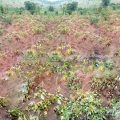
Wide acres of local farmland left bare and ruined after hungry cows moved into cultivation zones to eat growing food crops. (Photo Credit: KYL)

Matsiko Loyce, a local councillor and farmer, outlines the collective weight of losing both crops and land resources:

“In October last year, we lost our crops to floods. As we began to recover with hopes of feeding our families, livestock grazed on our remaining income. It is a deeply distressing situation.”

Local herds of cattle walk through agricultural fields, destroying the remaining green crops. (Photo Credit: KYL)

The escalating pressure soon led to physical friction. When local youths attempted to block cattle from entering the remaining fields, a violent altercation broke out. Matsiko emphasises the critical need for peaceful intervention:

“Two young men trying to protect the crops were injured during the confrontation. The matter has been formally reported to the police to ensure a peaceful, lawful resolution.”

The broken 15 million shilling compensation deal

Following local mediation efforts, the pastoralists initially agreed to a compensation package of 15 million Ugandan Shillings (approx. $4,110 USD) for the 150 hectares of ruined crops.

However, the agreement faced a major setback when the June 12 deadline arrived. The pastoralists shifted their position, offering to pay only 5 million shillings (approx. $1,370 USD) with no clear assurance of whether or when the remaining 10 million shilling balance (approx. $2,740 USD) would be paid. The farmers reportedly refused this reduced offer, demanding the full fulfillment of the original 15 million shilling agreement. According to human rights defenders monitoring the situation, this delay has severely fractured community trust.

A history of lost grazing land

This resource competition is deeply linked to historical migration patterns. The Basongora are an ancient pastoralist community whose traditional lifestyle was disrupted between 1925 and 1954. During this time, colonial administrations gazetted over 90% of their ancestral grazing lands to establish Queen Elizabeth National Park.

Displaced and hit by a devastating rinderpest epidemic in 1931, many Basongora crossed into the Democratic Republic of Congo (DRC) before returning to Kasese in subsequent decades. Concurrently, the Bakonzo have long cultivated food and cash crops in lowlands like Nyakatonzi and Munkunyu. While these groups have maintained a delicate coexistence for decades, accelerating climate change has disrupted that balance, renewing historical anxieties over land access.

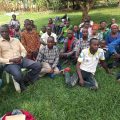
Bakonzo and Basongora elders convene near the boundary of Queen Elizabeth National Park to initiate a collaborative resource-sharing framework aimed at preventing future land disputes. (Photo Credit: KYL)

Choosing to survive together over fighting

Kato Ronald, the Executive Director of Kasese Youth Link and a human rights defender, appeals for structured mediation over conflict:

“Both the livestock and the human populations require sustenance. There is an urgent need to resolve this climate-induced conflict through a framework that ensures human security.”

Local leaders call for dialogue

As the conflict drags on, local leaders are calling for restorative justice rather than increased criminalisation to prevent further escalation. Mr. Ndyoka Isaac Kabunzu, the LCIII Chairperson for Munkunyu Sub-county, noted that recent arrests

have only heightened anxieties.

“These developments have increased community tension. Any individuals held without sufficient evidence should be released. Sustainable peace requires structural intervention over criminalisation.”

Kabunzu strongly advocated for a transparent judicial review, urging district leaders, security agencies, cultural institutions, and all stakeholders to immediately convene a dialogue aimed at addressing the root causes.

While the air in Munkunyu remains tense as communities await a resolution to the compensation agreement, the path forward relies on restoring mutual trust, establishing green compensation frameworks, and choosing joint survival over resource division.

Source: Peace Journalism Foundation East Africa

Continue Reading

MEDIA FOR CHANGE NETWORK

Rights experts call for an inclusive transition as the East Africa region attracts renewable energy investments.

Published

on

By the Witness Radio team.

NAIROBI, Kenya: As governments across East and the Horn of Africa accelerate efforts to transition from fossil fuels to renewable energy, experts have warned that the shift could deepen inequality and further trigger human rights violations if affected communities are excluded from decision-making processes.

The warning came at the 5th East and Horn of Africa Business and Human Rights Conference in Nairobi, organized by Danchurch Aid and its partners. Climate justice advocates, business leaders, and human rights experts met to discuss how the increasing investments could better align with human rights standards and responsible business conduct.

Just transition was among the key issues discussed during the two-day conference held last week, with experts emphasizing the need for inclusive approaches as East Africa attracts growing investments in renewable energy.

While there is a need and an urgency to address climate change, experts argue that the global race toward clean energy is already producing unintended consequences elsewhere, offering important lessons for Africa.

“The transition to renewable energy is inevitable, whereas justice isn’t,” Mr. Andrew Byaruhanga, the Executive Director of Resource Rights Africa, said during a panel discussion on just transition pathways.

Byaruhanga said governments and investors risk prioritizing energy targets and financial returns over the rights and welfare of communities whose land and livelihoods are affected by transition-related projects.

“The finance sector must be mobilized, not just for returns, but also for impact. Public and private sectors must align their efforts, share risks, and invest in long-term partnerships. The success of this transition, therefore, depends on empowering those most affected. Governments have a role to play in making sure that the financing architecture takes cognizance of these realities,” he added.

His remarks reflected growing concerns that renewable energy projects, despite their climate benefits, can reproduce the same patterns of exclusion and dispossession that have historically accompanied large-scale development projects.

Across the world, communities are increasingly raising concerns about land acquisition, displacement, inadequate compensation, and restrictions on civic space linked to renewable energy infrastructure and critical mineral extraction.

A recent report by the Coalition for Human Rights in Development, Financing the Transition, Silencing Defenders, documented cases across Asia where communities and environmental defenders faced intimidation, arrests, displacement, and violence while opposing energy transition projects.

Among the cases highlighted was the Jalaur River Multipurpose Project in the Philippines, where Indigenous Tumandok communities reportedly faced inadequate consultations and displacement threats linked to the construction of a hydropower dam. In India’s Assam state, local communities opposed a major solar project over concerns that it would displace more than 20,000 Indigenous residents and threaten traditional livelihoods.

Although the cases occurred outside Africa, experts in Nairobi said similar risks are emerging across the continent as governments pursue investments in renewable energy, carbon markets, and climate-related infrastructure.

Florence Shako, Executive Director of the Center for Education Policy and Climate Justice, said the transition must not come at the expense of vulnerable communities.

“We can talk about decarbonization and the fact that it’s important to transition, but we must really think about what inclusivity means for the youth, for persons with disabilities, and for people in the Global South,” she said.

Shako noted that many affected communities lack access to information, legal representation, and affordable mechanisms for seeking justice when their rights are violated. She also warned that transition projects often fail to provide alternatives for people who lose land, jobs, or sources of income.

“We need to think about replacement livelihoods and access to remedies. Otherwise, communities will continue bearing the costs while others reap the benefits.” She added.

The conference also highlighted concerns about youth exclusion from transition discussions.

According to Eric Baeni, Coordinator of the Pan African Youth Alliance on Business and Human Rights (PAYA-BHR), unemployment remains one of the biggest barriers preventing young people from engaging with climate and transition agendas.

“We are the workforce of the continent, but we are unemployed. Unemployment is the key challenge that prevents many young people from understanding and participating in the just transition.” He said.

He called for deliberate efforts to involve young people in policy discussions and ensure they benefit from employment opportunities created by emerging green industries.

The concerns raised in Nairobi come at a time when African governments are under increasing pressure to pursue low-carbon development pathways while tackling poverty, unemployment, and climate vulnerability. African countries emit only a small fraction of global greenhouse gas emissions, but are among the most vulnerable to climate-related disasters such as droughts, floods, and food insecurity.

Experts further argued that this reality requires transition strategies that prioritize local development needs rather than simply replicating models designed elsewhere.

As the conference concluded, experts called for stronger protections for human rights defenders, meaningful community participation, accessible grievance mechanisms, and investment frameworks that place affected communities at the center of decision-making.

They also urged governments to strengthen safeguards around land rights, free, prior, and informed consent, and benefit-sharing arrangements before approving major transition-related projects.

Continue Reading

Resource Center

Legal Framework

READ BY CATEGORY

Facebook

Newsletter

Subscribe to Witness Radio's news and report updates


Trending

Subscribe to Witness Radio's news and report updates