
MEDIA FOR CHANGE NETWORK
Family seeks to reclaim 49 acres from Lyantonde district

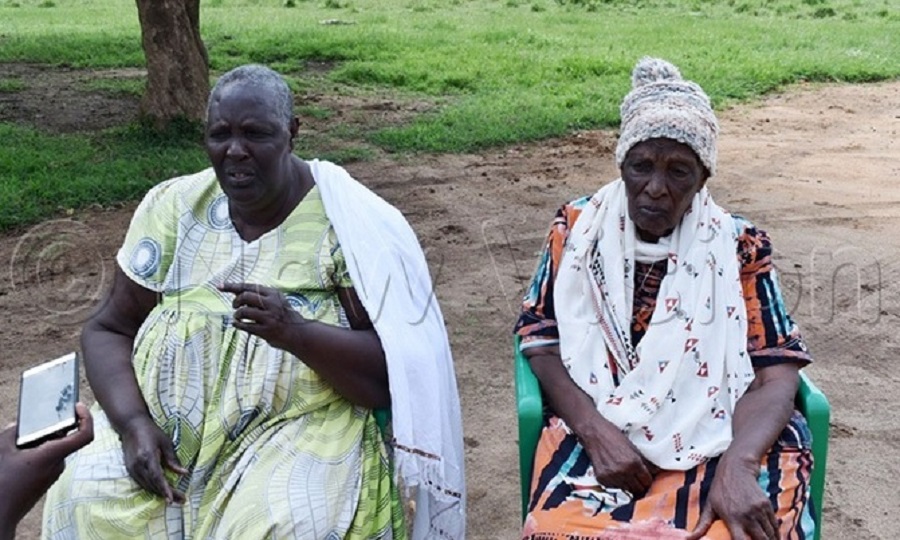
Byehondozo and her daughter Kakako. Photos by Davis Buyondo
LYANTONDE -A family in Lyantonde is seeking to repossess its 49.05 acres of land said to be illegally occupied by the district local government for 14 years.
The contested land is located on Block 76, plot 50, Kaliiro ward ‘A’ in Kabula county. It currently houses the district administration block and other departmental offices plus other portions subdivided and allocated to different developers.
It is currently becoming a major land row since the claimant wants the district to vacate her land and compensate her for the period the have occupied it illegally.
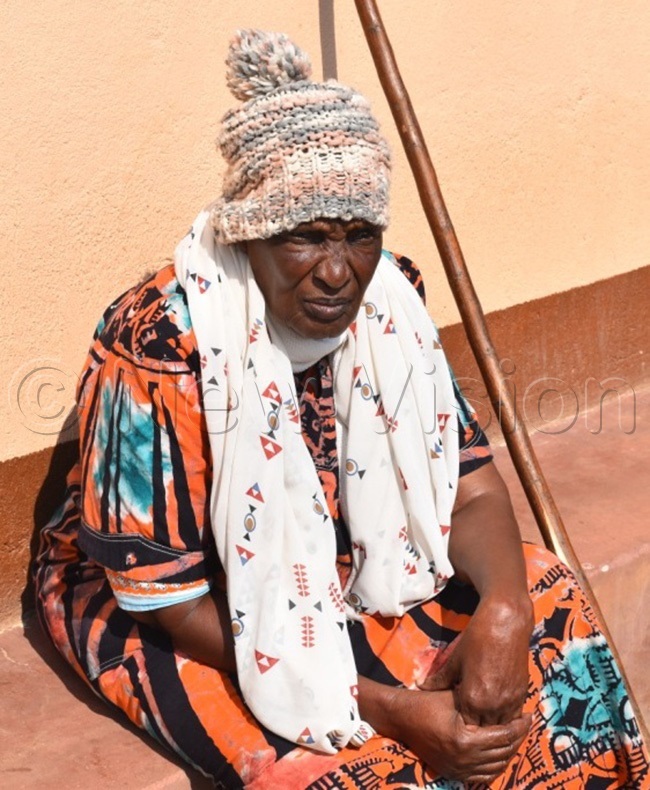
Copies of relevant documents obtained by the New Vision indicate Joyce Byehondozo, 81, a resident of Kaliiro ‘A’ in Lyantonde town council, is the rightful owner of the land who originally possessed a title.
She was born on this land in 1939 and inherited it from her father __late Kinanigira who also inherited it from his father.
She explained that former President Apollo Milton Obote’s government took a small portion of land and put structures including a sub-county block, the house of the sub-county chief and a toilet.
Her woes date back to 1993 when Lyantonde was still under Rakai district administration. It is said that Rakai district bought the land from Byehondozo in 1993 which land it transferred to Lyantonde when it became an independent district in 2006.
But Byehondozo disputed the claim saying she did not sell her land to Rakai district or anyone as it is claimed.
She explained that after claiming her right over the disputed land, some unscrupulous district officials asked her to avail to them the duplication certificate of the title for verification.
This was done on an understanding that after the verification process the duplicate certificate of the title would be returned back to her.
However, Byehondozo did not receive her duplicate certificate of the title for her land from Rakai District as it had been agreed.
Her daughter Florence Kakako (67) and grandchildren are following up on the matter given the fact that the old lady is weak and can hardly move.
They later learnt that the then Rakai Administration registered itself at the lands office as the actual proprietor of the land without her knowledge and consent or any payment for consideration.
“Rakai district authorities fraudulently obtained the title of the land and we are treated as illegal occupants,” Kakako recounted.
In a letter dated July 17, 2018 addressed to the land commission secretariat, Muhanga and Associates, who represent the ill-fated family, it is indicated that in 2010, Lyantonde district had been entered on to the certificate of the title as the proprietor of the land.
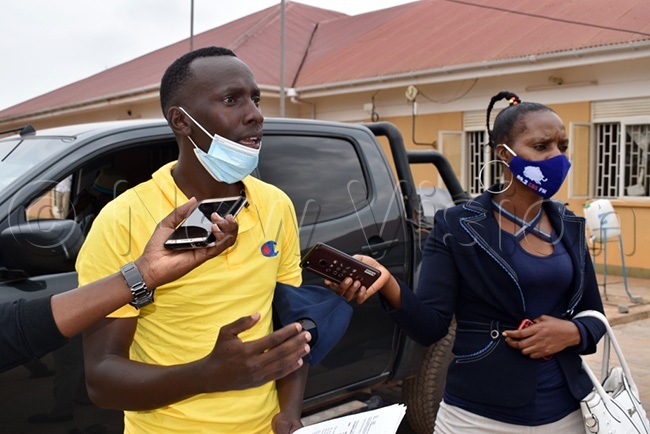
And to their shock, Byehondozo and her family were served with a notice to vacate the land from Christopher Okumu, the Chief Administrative Officer dated June 15, 2015.
“Some claimed we were illegal occupants and they wanted us to vacate the land to pave a way for their development projects including a subdivision of plots to allocate them to different developers,” she said.
The family further holds the Lyantonde district and the Attorney General jointly liable for the continued trespass on their land and the eventual fraud in procuring the registration of the same land in their names as well as developing it illegally.
In May 2017, Byehondozo filed a claim in the High Court at Masaka intending for eviction orders against the district and the compensation.
Nevertheless, on June 30, 2017, the district and attorney general of Uganda entered their respective defence in the main suit.
Statehouse intervenes
The matter came to the attention of President Yoweri Museveni. In a letter to the Lyantonde CAO, dated February 1, 2016, Flora Kiconco,
the Principal Private Secretary to President Yoweri Museveni, the matter was brought to the attention of the president who directed that the district should not interfere in Byehodozo’s occupation of land.
However, Kiconco added, this office continued to receive complaints from the complainant that the district officials had continued trespassing on her land, cultivating on it, and in the process of fencing it to deny her use.
“The purpose of this letter is to once again inform you about H.E the president’s directive and request you to ensure that Byehondozo enjoys a quiet possession of that land without any interference,” she noted. She further requested the CAO to prevail over the district officials who interfere with Byehondozo’s occupation on the said land until when the president intervenes.
Temporary injunction
On February 14, 2018, Byehondozo entered a temporary injunction restraining- both parties, their agents, assignees, and others, from leasing, alienating, selling, or harassing or in any way interfering with each other’s’ occupation until the main suit is determined.
The matter was before her Worship-Beatrice Stella Atingu, the Assistant Registrar of the High Court of Uganda at Masaka.
Although the injunction was issued, the district did not halt its operations on the land. Different people were allocated portions of land for cultivation.
Last year, people who were allocated portions of land sprayed chemicals to dry the grass but Byehondozo’s family lost two cows after eating the sprayed grass.
In another letter dated February 19, 2018, Kiconco requests the Lyatonde RDC to ensure that both parties (complainant and the defendants) abide by the court order.
And last week, according to Arnold Agira, one of Byehondozo’s children, another district staff sprayed with chemicals a portion of land measuring half an acre.
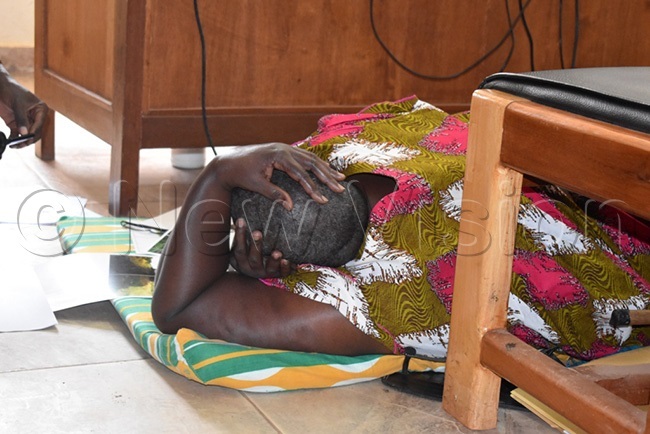
He argued that they were provoked to storm the CAO’s office due to the increasing violation of the injunction.
“We honored the injunction but the district is still allocating people land. We have reached the RDC’s office, CAO, Police but no one has bothered assisting us,” he said.
However, Byehondozo’s family has appealed to Col. Edith Nakalema, the head of the Anti-Corruption Unit of State House, to investigate the corruption and increasing theft of land in Lyantonde especially their 49.05 acres which the district took.
District intervenes
A delegation of top district officials toured the land on Tuesday.
They include Catherine Kamwiine, the Resident District Commissioner, David Lubuuka, the Chief Administrative Officer, Jamal Kanyesigye, the District Police Commander, DISO- and Fred Muhangi, the Lyantonde LC5 chairperson.
Led by Kamwiine, the officials first held a closed meeting with the family members to dialogue over the longstanding grievances.
They later toured the land and halted several activities mainly farming as well as warning people who were cultivating the land illegally.
Former RDC speaks
Sulaiman Tuguragara Matojo, the former Lyantonde RDC, said that the matter came to his office and statehouse intervened and built her a new house on the land as they wait for the court decision on the matter.
He explained that his office had earlier advised the two parties to sit and agree on the compensation plan but the family wanted eviction of the district headquarters which has cost over a billion shillings to build.
He explained that the family was only paid sh11m as compensated for the portion of land measuring about half an acre which Obote’s government has occupied.
Related posts:

 Lyantonde, Sembabule lose over 700 heads of cattle in two months
 How land grabs are causing food insecurity: A case of a community land rights defender in Mubende district forced to buy food for a family of 13 people for the last five years.
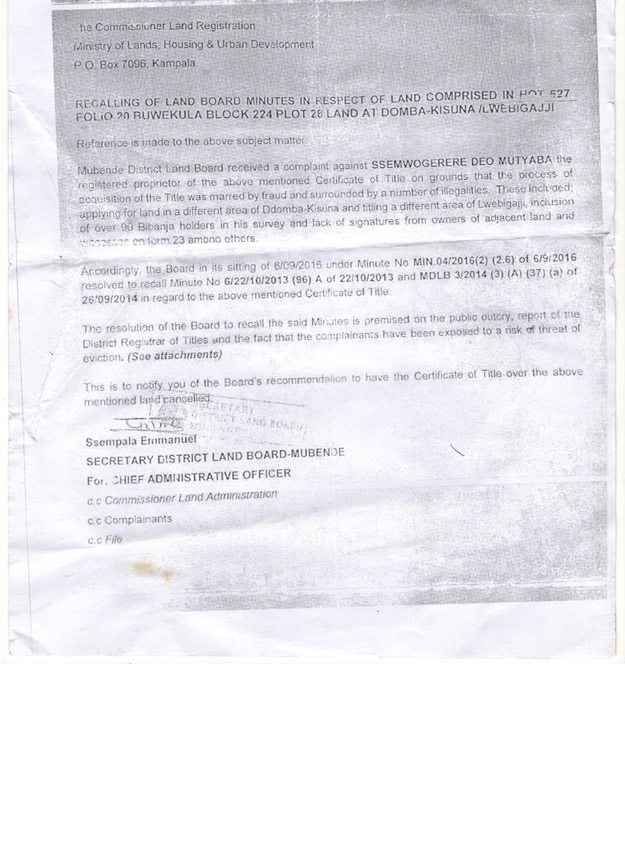 Mubende district land board to cancel land title over fraud
 Family Farming organizations request to accelerate the efforts to implement the decade of family farming
MEDIA FOR CHANGE NETWORK
World Food Day 2026: Building healthy diets means reimagining how we grow, share, and enjoy our food.

Related posts:

 Global hunger falls, but millions in Africa still go without food, says UN
 While hunger continues to grip the world, a new report highlights forests and forest foods as a hidden treasure trove of nourishment.
 Agroecological Entrepreneurship: African farmers are redefining agriculture by building agroecological businesses that challenge industrial models.
 Wars are disrupting food systems, and ending world hunger requires urgent global action, experts say.
MEDIA FOR CHANGE NETWORK
International Day of Rural Women : Rural women farmers deserve not only equal rights and access to resources, but also the strength and voice to safeguard Mother Nature.
Related posts:

 How unequal access to land by women endangers Uganda’s food security
 Women’s groups demand equality in land tenure security to boost food production.
 Rights and Resources Initiative (RRI) launched a new report looking at 80 legal frameworks
 Smallholder Farmers Can Now Access Agricultural Credit Facility Without Collateral
MEDIA FOR CHANGE NETWORK
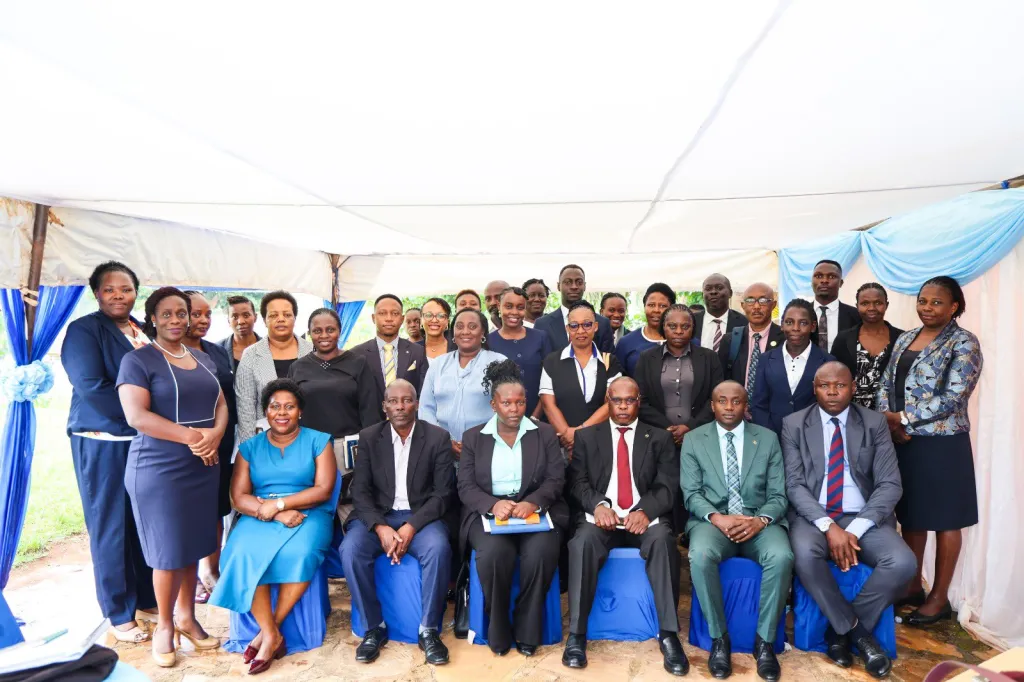
ODPP Staff Equipped With New Skills on Land Crimes, Witness Protection and Victims Rights
Related posts:

 Witness Radio Petitions ODPP urgently to review and withdraw criminal charges against Buvuma Community Land Defenders.
 Witness Radio petitions chief prosecutor: Want 34 community land rights defenders and activists released from prison.
 Mubende district police are aiding land grabbing and committing crimes against locals they are obliged to protect.
 Uganda: the number of community environmental and land rights defenders targeted for challenging irresponsible business practices has reached more than 1500 victims as of June 31st, 2023.

World Food Day 2026: Building healthy diets means reimagining how we grow, share, and enjoy our food.

International Day of Rural Women : Rural women farmers deserve not only equal rights and access to resources, but also the strength and voice to safeguard Mother Nature.

ODPP Staff Equipped With New Skills on Land Crimes, Witness Protection and Victims Rights

As World Bank Holds Annual Meetings, 84,000 Tanzanians Call for Justice

Lango ex-combatants count losses after dry spell destroys maize harvest

Five years after Uganda’s National Action Plan on Business and Human Rights, are local communities hosting land-based investment projects seeing change?

The global race for clean energy minerals is leaving communities grappling with conflicts and human rights abuses, a new report reveals.

Alert: Land degradation is emerging as a pressing threat to global security.

Innovative Finance from Canada projects positive impact on local communities.

Over 5000 Indigenous Communities evicted in Kiryandongo District

Petition To Land Inquiry Commission Over Human Rights In Kiryandongo District

Invisible victims of Uganda Land Grabs
-

 MEDIA FOR CHANGE NETWORK2 weeks ago
Sweeping investments are fueling widespread land grabbing and deepening rights violations across Uganda – Report.
-
 NGO WORK5 days ago
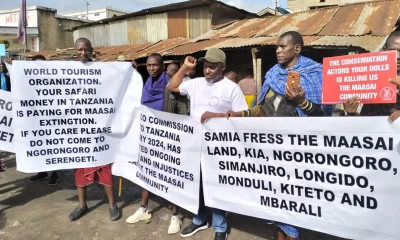
Tanzanian Government Abducts Maasai Villagers in an Unconscionable Attack on Indigenous Land Defenders
-

 MEDIA FOR CHANGE NETWORK2 weeks ago
Across Africa, the push for a greener future is putting new pressure on local communities, as recent ILC case studies highlight.
-
 MEDIA FOR CHANGE NETWORK5 days ago
Court remands 10 anti-oil activists as suspect collapses in dock
-
 MEDIA FOR CHANGE NETWORK2 weeks ago
Who will shape the future of East Africa’s seeds? Youth and civil society are sounding the alarm over a proposed regional law.
-
 MEDIA FOR CHANGE NETWORK2 days ago
World Food Day 2026: Building healthy diets means reimagining how we grow, share, and enjoy our food.
-
 FARM NEWS2 weeks ago
Can Agroecology Improve the Resilience of African Smallholder Farmers?
-
 MEDIA FOR CHANGE NETWORK4 days ago
As waves of investment sweep across Uganda, countless women rise to defend their land, safeguard their traditions, and claim their right to be heard.