Connect with us

NGO WORK

Two dead as Siaya protests against gold mining firm turn tragic

Published

on

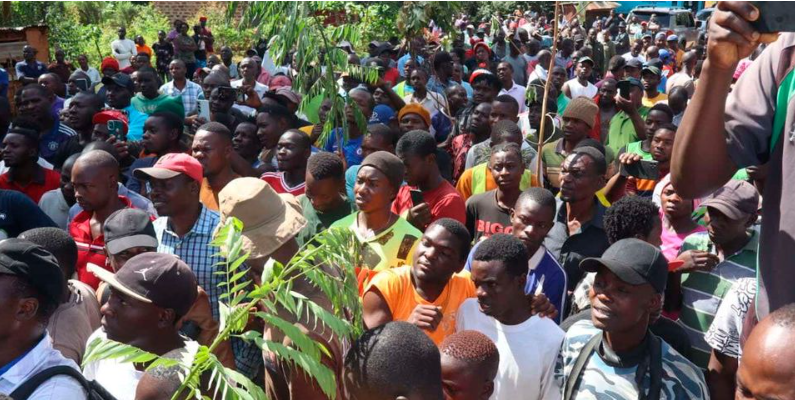
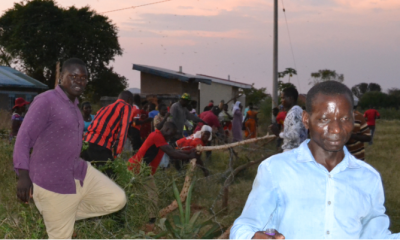
Ikolomani residents protesting against eviction plan to pave space for British mining company Shanta Gold on November 12, 2025. Two people died in similar protests in Gem, Siaya County.  Isaac Wale | Nation Media Group

Two people were shot dead on Monday in Gem–Ramula, Siaya County, after villagers staged a protest over an alleged eviction they linked to Shanta Gold Kenya Limited.

Area police boss Charles Wafula confirmed the incident, stating that the victims were among a group alleged to have attacked a police post after the officers moved in to disperse the demonstrators.

According to Mr Wafula, the demonstrators, angered by what they described as an illegal resettlement by the company, stormed the station during the protest, prompting officers to intervene.

“The individuals had organised a demonstration but they did not notify the police. Our officers moved in to contain the situation, but the group began attacking both officers and Ramula Police Post, damaging several items, including vehicles,” Mr Wafula said.

However, a local rights organisation has sharply contested the police account, portraying the killings as unlawful and unprovoked.

In a statement, the Community Initiative Action Group Kenya said the two victims identified as Henry Otieno and Jack Omenda were part of a peaceful protest against what they termed a forced eviction from their ancestral land.

“The community had gathered peacefully to demonstrate against Shanta Gold Limited’s attempt to relocate them without their consent,” said the lobby’s Executive Director Chris Owalla.

The group further alleged that police officers opened fire without warning following a confrontation with residents at Ramula Market.

“Witnesses state there was an exchange between the community and police after which officers opened fire, killing Henry and Jack on the spot,” Mr Owalla said.

The rights group also accused senior police officers including Mr Wafula and Charles Emodo of Directorate of Criminal Investigation, of disregarding a court order that had halted evictions and mining operations in the area.

According to Mr Owalla, the Environment and Land Court in Siaya had, on February 5, 2026, issued conservatory orders barring any involuntary resettlement of residents in Ramula and its environs, pending the hearing of a petition.

The organisation is now calling for investigations by the Independent Policing Oversight Authority and the the Director of Public Prosecutions, alongside an independent autopsy on the victims.

Fear of evictions

The unrest is rooted in long-standing tensions over planned gold mining operations by Shanta Gold in the region. The company is seeking to establish a large-scale extraction project – one that residents fear could uproot communities and erode livelihoods carefully built over generations.

Similar scenes of unrest were reported in November 2025 in Ikolomani, where locals protested against possible relocations linked to the same company.

Shanta Gold has previously signalled its intention to invest in a multi-billion-shilling project in western Kenya, targeting high-grade gold deposits expected to yield significant output over several years.

Source: nation.africa

Continue Reading

NGO WORK

Tanzania: Commissions call for mass eviction of Indigenous Maasai from world-famous tourist destinations.
Published

on

Two presidential commissions have recommended the mass eviction of Maasai people from some of East Africa’s most iconic conservation areas and tourist destinations.

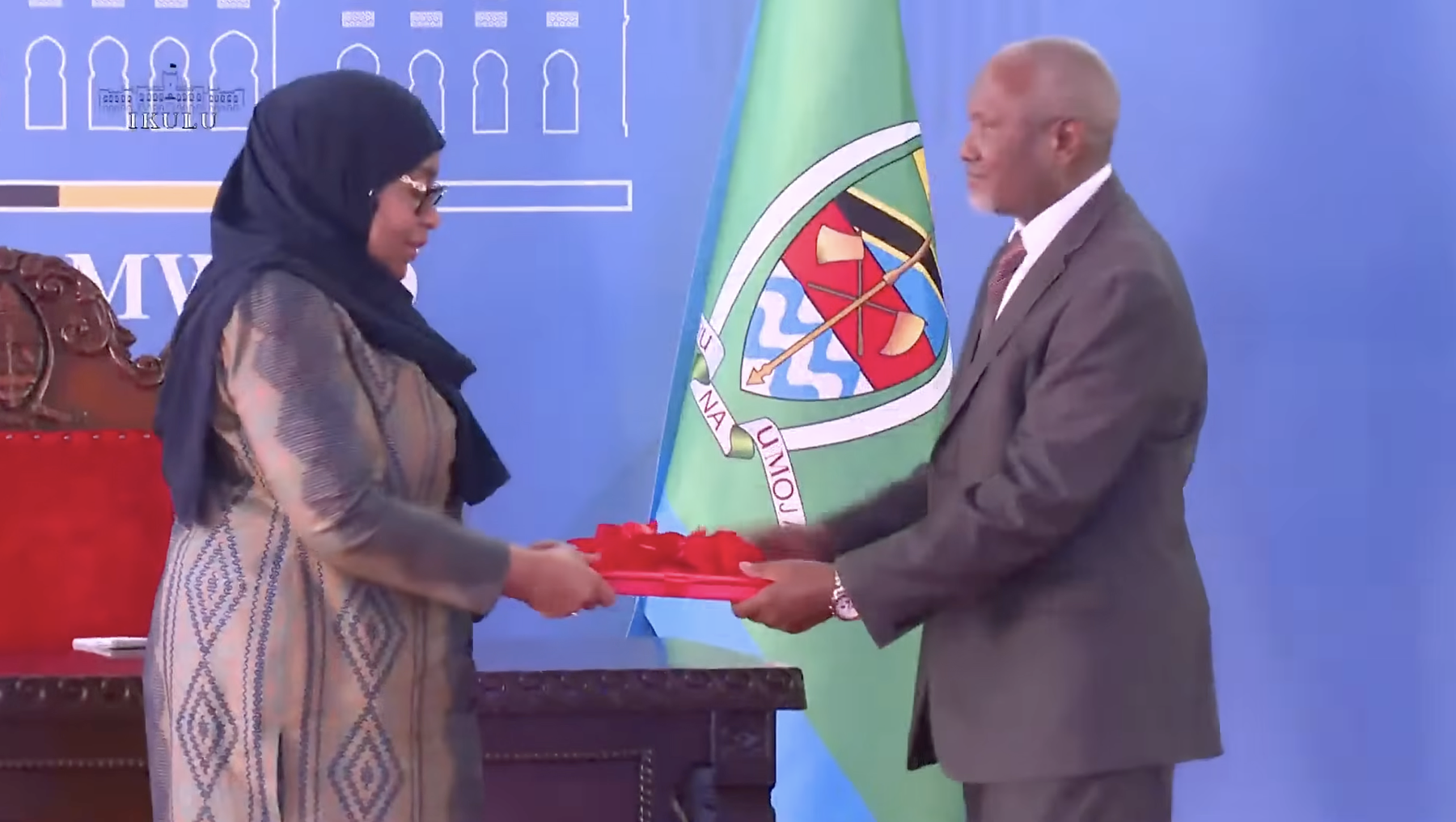
The commissions were established by Tanzania’s President Samia Suluhu Hassan following previous evictions of Maasai pastoralists from parts of the world-famous Serengeti ecosystem, and large-scale protests in the Ngorongoro Conservation Area in 2024.

Now, despite a global outcry at the earlier evictions, the two Commissions have:

  • Backed the previous evictions and called for them to continue, including in the UNESCO World Heritage Sites of Ngorongoro and neighboring Lake Natron.
  • Described the long-standing Maasai presence in the area as an “environmental pressure” that needs to be reduced.
  • Threatened local NGOs that support the Maasai, accusing them of “spreading misinformation or propaganda” because they “conflict with government interests.”
  • Called for the “relocation” of all “non-conservation activities” [in other words, Maasai occupancy of the land] outside the conservation areas.
  • Called for existing recognition of the Maasai people’s right to live in the Ngorongoro area to be removed.

An anonymous Maasai spokesperson said today: “We are blamed for environmental degradation while the unchecked expansion of tourism is ignored. Forced relocation, disguised as policy, has deprived our people of basic rights and dignity. We reject any continuation of these measures and condemn the Commission’s failure to reflect the voices, realities, and rights of our people.”
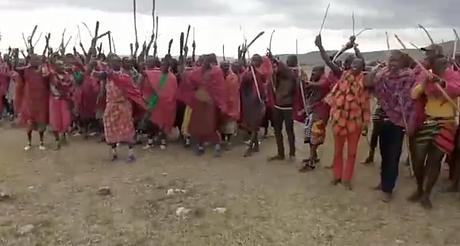
Still from a video showing the Maasai protesting the violent evictions from their ancestral lands, 2022.

The authorities maintain that these are “voluntary relocations.” However, the Maasai have overwhelmingly rejected being moved.

The Ngorongoro Conservation Area is a UNESCO World Heritage Site. When it was established, the ancestral right of the Maasai to live there with their cattle was explicitly acknowledged. But UNESCO’s World Heritage Committee has backed the so-called “voluntary relocations”, and UNESCO endorses the “fortress conservation” model that underpins Tanzania’s approach.

Survival International Director Caroline Pearce said today, “These commissions were a sham, a gimmick designed to give Tanzania’s violent persecution of the Maasai a veneer of respectability. It was widely predicted that they’d back further evictions: the whole saga just confirms that colonial-style fortress conservation is alive and well in Tanzania today, and enthusiastically endorsed by UNESCO.

“These recommendations give the green light to more evictions, in Ngorongoro and beyond. And while the Maasai are robbed of their lands and livelihood, the government, tour operators and so-called conservationists will enrich themselves from a landscape emptied of its original owners.”

Source: survivalinternational.org

Continue Reading

NGO WORK

Sham Presidential Commissions Rubber Stamp Tanzanian Government’s Efforts to Evict Indigenous Maasai from Ngorongoro Conservation Area
Published

on

  • March 12, 2026, Presidential commissions’ reports recommend dismantling longstanding Maasai rights in the Ngorongoro Conservation Area (NCA) – rubber-stamping the Tanzanian government’s plans for widespread evictions to expand tourism.
  • President Hassan pursues a so-called “voluntary” relocation program, despite extensive evidence that communities are being forced to leave through the withdrawal of essential services and livelihood restrictions.
  • The government announced a crackdown on civil society groups critical of its plans, raising concerns of further repression of land defenders and NGOs speaking out against forced displacement.
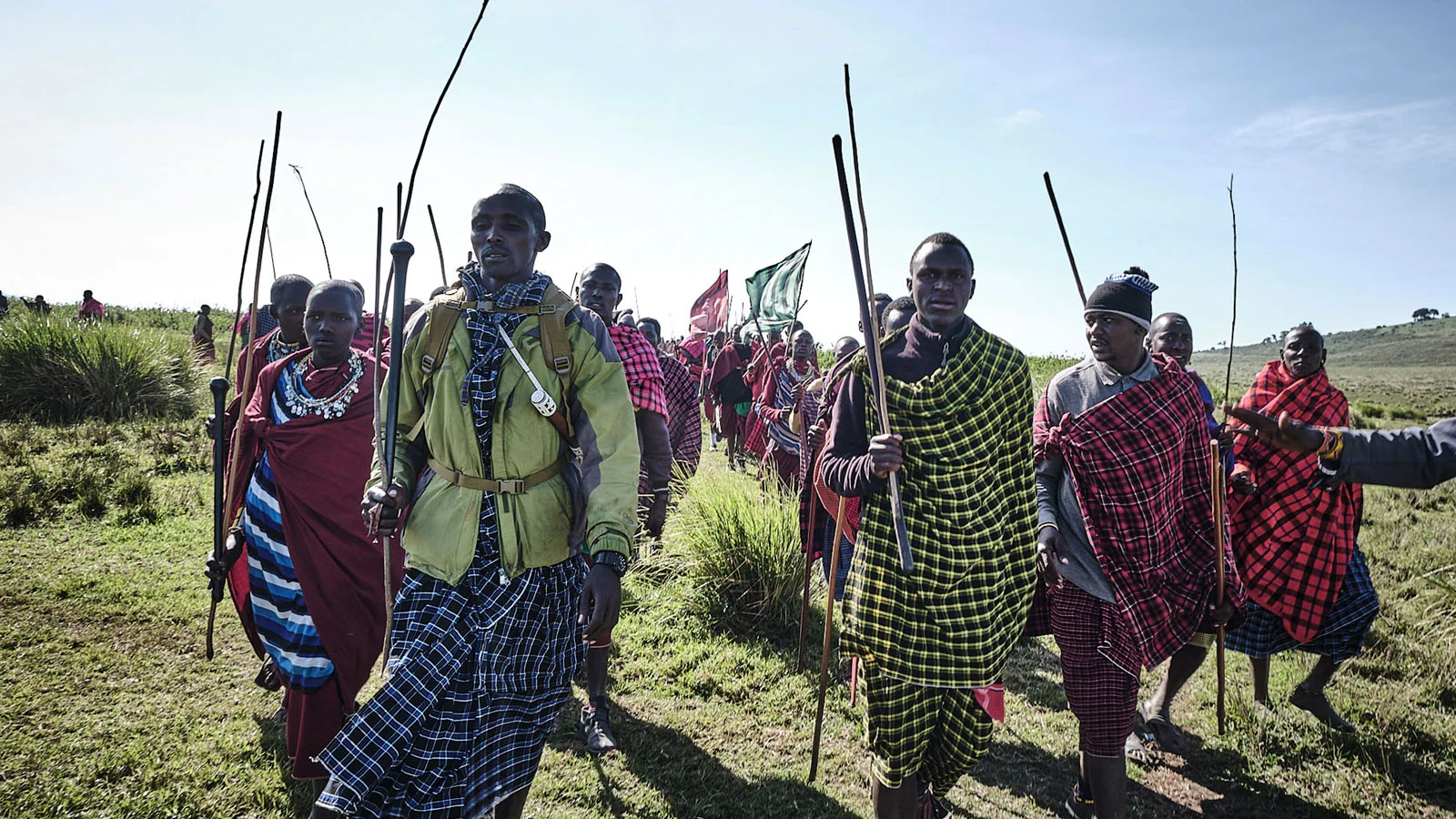
  • Maasai communities remain steadfast in the defense of their land, livelihoods, and way of life, vowing to continue resistance against attempts to force them from their ancestral territories.

Oakland, CA – In reports submitted on March 12, 2026 to Tanzanian President Samia Suluhu Hassan, commissions tasked to assess land disputes in the Ngorongoro Conservation Area (NCA) and review resettlement plans, dismissed rights of the Indigenous Maasai to their ancestral lands. They instead advance recommendations that further marginalize their rights in order to expand safari tourism.

“The commissions’ recommendations are based on outright lies about the environmental impacts of the Maasai, while completely ignoring the real damage caused by rapid tourism expansion,” said a Maasai elder. 1 “If these extremely biased and reckless recommendations are implemented, it will be the end of our people in Ngorongoro.”

Immediately after the reports were submitted, park rangers started harassment of residents in the grazing areas of Ndutu with the intent to force them to leave for tourism expansion. Three community members were reportedly beaten and arrested while others received notices to vacate.

Recommendations are a crafty attempt at changing 1959 legislation that created the NCA as a multiple land use area – explicitly enshrining the right of the Maasai to live and graze cattle in the area. The Maasai were promised that “should there be any conflict between the interests of the game [animals] and the human inhabitants, those of the latter must take precedence.”

The President has accepted the recommendations and stated she “will act on them” – a decision that will have a catastrophic impact on Maasai communities. The government has signaled its intention to drastically reduce Maasai presence in the NCA and relocate what it calls “non-conservation activities” outside the area. Towards this goal, the President has indicated an expansion of the “voluntary” relocation program.

For years, the Oakland Institute has shattered government myths about “voluntary” resettlement –exposing serious flaws with relocation plans that are being forced upon communities. To pressure residents to leave, the government has stopped basic medical, education, and water services while restricting access to grazing land for pastoralists. Massive mobilizations by the Maasai against this forced resettlement expose the government’s lie that people are leaving willingly.

Beyond the NCA, the commissions also recommend further restrictions on livelihoods, threatening the future eviction of Maasai communities living near Lake Natron and Loliondo. “These sham findings are the latest attempt by the government to rapidly expand its brutal fortress conservation model across the country, threatening hundreds of thousands of Indigenous lives in blind pursuit of tourism dollars that have failed to trickle down to improve the lives of the poor Tanzanians and the local communities,” said Anuradha Mittal, Executive Director of the Oakland Institute.

In another alarming development, the government is attempting to silence local NGOs by reviewing their registration status and monitoring their activities to force them to operate “in alignment with national conservation objectives.” The move reflects the regime’s ongoing persecution of civil society and broader crackdown on dissent, carried out through state violence and arbitrary detention. Major opposition parties remain outlawed in Tanzania, while government critics have routinely disappeared. Following the rigged October 2025 national elections, the government violently suppressed pro-democracy protests and state security forces killed thousands of civilians.

As previously warned by the Oakland Institute, both commissions lacked independence given they were dominated by government personnel and had very limited Maasai representation. The commissions’ reports – which have not been made public – were orally presented to the government nearly one year after they were due to provide findings.

“These commissions have no credibility. From the start, they were tasked with rubber stamping the government’s plans to evict the Indigenous Maasai so their land can be a safari and hunting playground for the rich foreign tourists. One cannot be fooled by their “findings” and international solidarity must be mobilized to uphold Maasai’s rights to their ancestral land,” warned Mittal.

Source: oaklandinstitute.org

Continue Reading

NGO WORK

Peace in DRC Requires More than Symbolic US Sanctions on Rwanda

Published

on

  • On March 2, 2026, the US Treasury imposed sanctions on the Rwanda Defence Force (RDF) and four of its senior officials following their “blatant violations of the Washington Peace Accords.”
  • The step remains symbolic and unlikely to meaningfully deter the actors exploiting Congolese minerals who are fueling the war.
  • The sanctions neither affect the deals made by the US with critical mineral companies tied to the Rwandan government nor does it impact American foreign assistance to the country.
  • As long as the US continues to support Rwanda as a business hub for refinery and reexport of smuggled Congolese minerals, there will be no incentive for RDF/M23 to return valuable mines and lands to the Congolese and end the conflict.

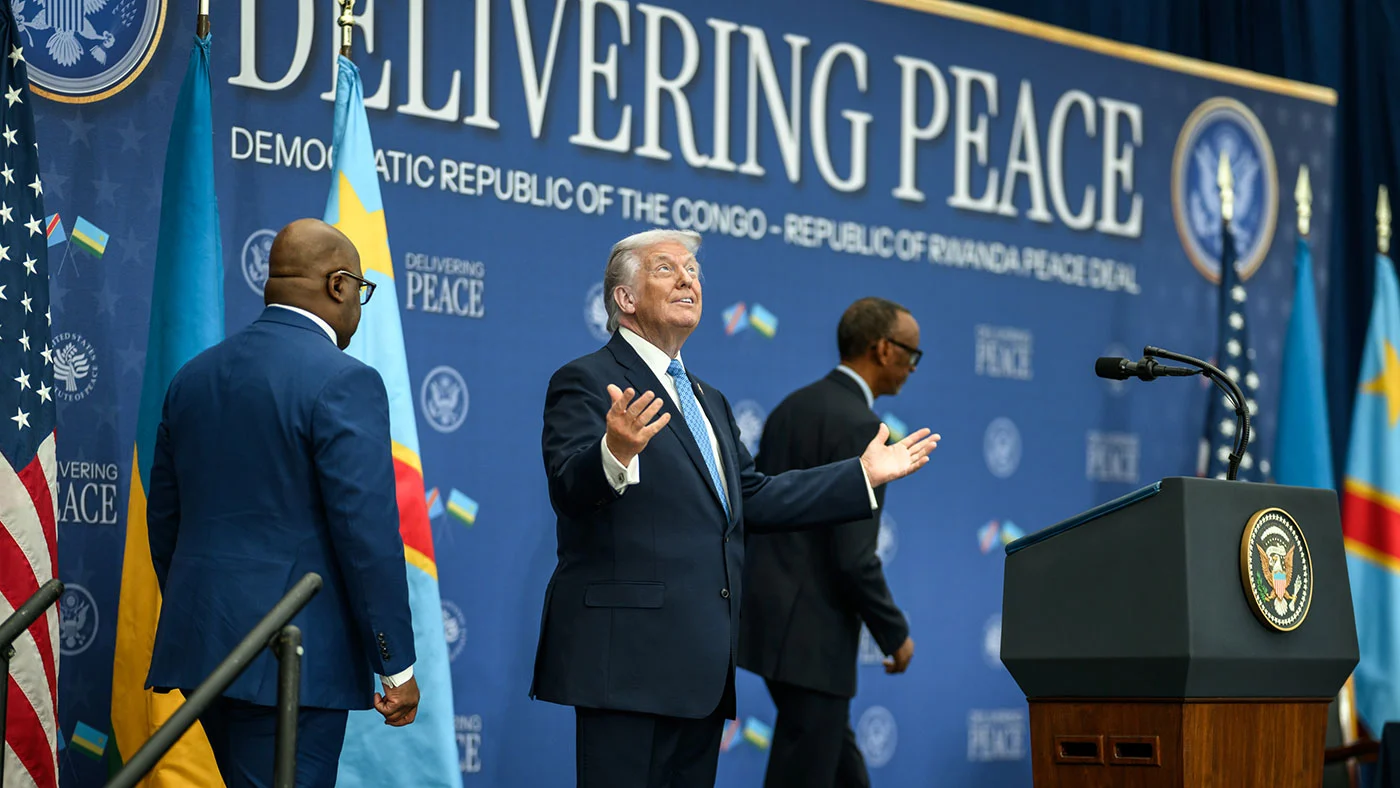
Oakland, CA – On March 2, 2026, the US Treasury imposed sanctions on the Rwanda Defence Force (RDF) and four of its senior officials following their “blatant violations of the Washington Peace Accords” signed between Rwanda and the DRC in December 2025.

The RDF has been actively supporting, training, and fighting alongside its proxy, the March 23 Movement (M23), waging a war that has led to countless deaths, mass atrocities and displacement in eastern DRC. Together, they have seized the provincial capitals of Goma and Bukavu and strategic mining sites in South and North Kivu.

“Sanctioning the RDF is an important step but is unlikely to meaningfully deter the actors exploiting Congolese minerals that are fueling the war,” said Frédéric Mousseau, Policy Director of the Oakland Institute. “As long as the US continues to support Rwanda as a business hub for refinery and reexport of smuggled Congolese minerals, there is no incentive for RDF/M23 to return valuable mines and lands and end the conflict that has been decimating the Congolese people for over three decades.”

While applying sanctions, the US continues to make deals with critical mineral companies tied to the Rwandan government. In May 2025, Rwanda’s Trinity Metals signed a letter of intent with the US Department of State to establish a new supply chain of tin from Rwanda to the US. In October 2025, Rwanda exported tungsten to the US for the first time through a partnership involving Trinity Metals, Pennsylvania-based Global Tungsten & Powders, and the international commodities trading firm Traxys. Under this ongoing deal, between four and seven containers of tungsten concentrate will be shipped every quarter to the US for two years, offering a strategic alternative source for a mineral largely produced by China.

According to the most recently available ownership information, Ngali Holdings holds 5 percent of Trinity Metals and 25 percent of the company’s Rutongo tin mines. State-owned with reported ties to the RDF, Ngali Holdings was established in 2015 to undertake the “exploration, extraction/exploitation and commercialization of strategic mineral resources.” While the RDF’s minority stake in Trinity Metals does not make the company eligible for sanctions, it shows the limitations of the sanctions’ overall impact. Rwanda’s role in the US plan to seize control of Congolese minerals remains intact.

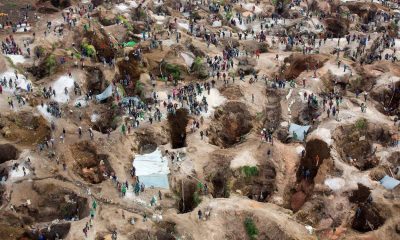
The US sanctions also fail to confront the massive financial benefits Rwanda/M23 gain from occupying eastern DRC. Since M23 seized the Rubaya mine in eastern DRC in 2024, the group has ensured a monopoly on the export of coltan to Rwanda to collect an estimated US$800,000 monthly from the taxation of coltan production and trade. Rebels have also funneled gold into Rwanda, driving a record US$2 billion in exports in 2025.

Moreover, Rwanda still receives substantial foreign assistance from the US, its largest bilateral donor,  with just under US$200 million in 2024 and US$174 million for 2025 – a partial, not fully reported, estimate. With a US$3.37 billion World Bank portfolio for a country of just 14 million people, Rwanda is also among the highest per-capita recipients of World Bank financing –  receiving almost four times more per capita than DRC. Horizon Construction, a consortium with links to the RDF, has reportedly been awarded several contracts as part of the Bank’s multi-million dollar road improvement project that is active today.

In October 2025, the Oakland Institute released Shafted: The Scramble for Critical Minerals in the DRC, warning that US diplomatic initiatives, including the Rwanda-DRC peace deal – were being used to advance mineral extraction interests under the guise of bringing peace to the region. The Institute further documented how the RDF Commander in chief, President Paul Kagame has been a champion of impunity despite repeatedly violating peace and ceasefire agreements over the years.

“Rwanda’s violations of the Washington Accord and continued occupation of DRC point to the inherent contradictions of the US-brokered “peace deal” added Mousseau. “The deal granted Rwanda privileged access to Congolese resources and a key role in their refining and reexport – a reward for an aggressor who has made hundreds of millions of dollars from the plundering of Congolese minerals. This impunity and injustice can’t bring peace to Congo,” he concluded.

Source: www.oaklandinstitute.org/

Continue Reading

Resource Center

Legal Framework

READ BY CATEGORY

Facebook

Newsletter

Subscribe to Witness Radio's newsletter


Trending

Subscribe to Witness Radio's newsletter