
MEDIA FOR CHANGE NETWORK
Climate Change and Conflict : The Agony of Kasese Farmers.

As climate change impacts various parts of the globe, Kasese District in South-Western Uganda serves as a stark example of environmental vulnerability. Global warming has accelerated the melting of glaciers in the Rwenzori Mountains. Satellite data from scientific monitoring groups reveals a striking 30% reduction in ice surface area between 2020 and 2024.
For the farming communities of Munkunyu Sub-county, this environmental challenge has created a complex crisis. The altered landscape has heightened resource competition between local Bakonzo crop farmers and Basongora cattle keepers from neighbouring Nyakatonzi Sub-county, as both communities navigate severe strains put on nature and land.
Why the land crisis is growing
Before diving deeper into the unfolding situation on the ground, it is critical to understand the primary triggers forcing these communities into confrontation:
The Glacial Melt: A 30% loss of Rwenzori ice cover in just four years is drastically altering local river volumes and weather predictability.
The Climate Double-Whammy: Farmers and pastoralists are trapped in a punishing cycle of back-to-back disasters, first catastrophic flash floods, immediately followed by extreme dry spells that leave no grass for livestock or food for households.
How floods and hungry cattle sparked a quiet war
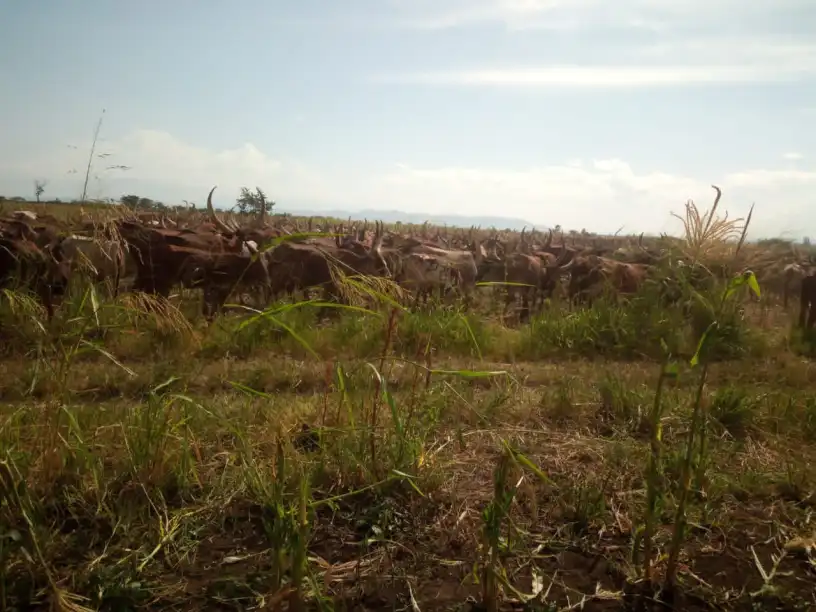
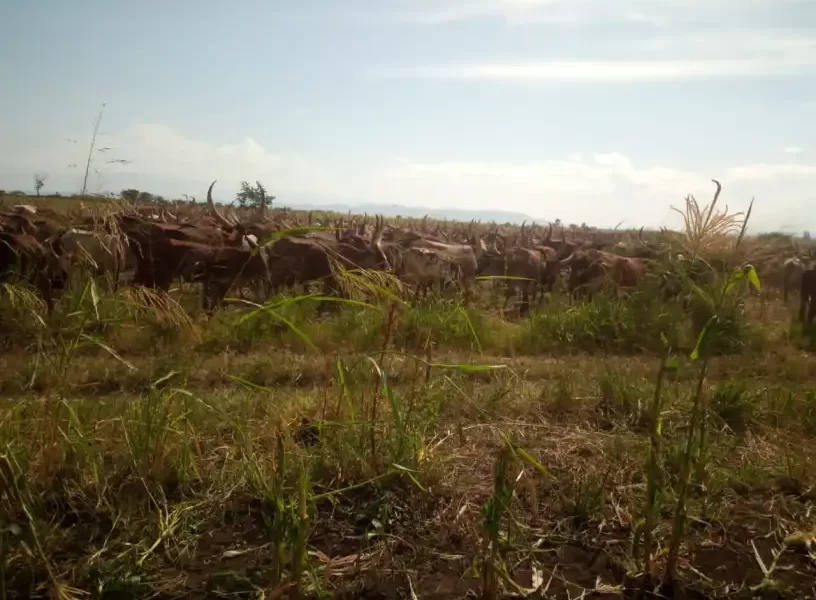
Just eight months ago, Munkunyu’s farming families faced severe flash floods that wiped out their entire agricultural investments. In the wake of these disasters, herdsmen seeking surviving pastures moved their cattle directly into the cultivation zones. Farmers report that on 30 May 2026, livestock grazed across 217 hectares of food crops. This created immense economic and psychological strain for hundreds of households already struggling with food insecurity and school fee obligations.

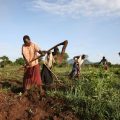
Wide acres of local farmland left bare and ruined after hungry cows moved into cultivation zones to eat growing food crops. (Photo Credit: KYL)
Matsiko Loyce, a local councillor and farmer, outlines the collective weight of losing both crops and land resources:
“In October last year, we lost our crops to floods. As we began to recover with hopes of feeding our families, livestock grazed on our remaining income. It is a deeply distressing situation.”

Local herds of cattle walk through agricultural fields, destroying the remaining green crops. (Photo Credit: KYL)
The escalating pressure soon led to physical friction. When local youths attempted to block cattle from entering the remaining fields, a violent altercation broke out. Matsiko emphasises the critical need for peaceful intervention:
“Two young men trying to protect the crops were injured during the confrontation. The matter has been formally reported to the police to ensure a peaceful, lawful resolution.”
The broken 15 million shilling compensation deal
Following local mediation efforts, the pastoralists initially agreed to a compensation package of 15 million Ugandan Shillings (approx. $4,110 USD) for the 150 hectares of ruined crops.
However, the agreement faced a major setback when the June 12 deadline arrived. The pastoralists shifted their position, offering to pay only 5 million shillings (approx. $1,370 USD) with no clear assurance of whether or when the remaining 10 million shilling balance (approx. $2,740 USD) would be paid. The farmers reportedly refused this reduced offer, demanding the full fulfillment of the original 15 million shilling agreement. According to human rights defenders monitoring the situation, this delay has severely fractured community trust.
A history of lost grazing land
This resource competition is deeply linked to historical migration patterns. The Basongora are an ancient pastoralist community whose traditional lifestyle was disrupted between 1925 and 1954. During this time, colonial administrations gazetted over 90% of their ancestral grazing lands to establish Queen Elizabeth National Park.
Displaced and hit by a devastating rinderpest epidemic in 1931, many Basongora crossed into the Democratic Republic of Congo (DRC) before returning to Kasese in subsequent decades. Concurrently, the Bakonzo have long cultivated food and cash crops in lowlands like Nyakatonzi and Munkunyu. While these groups have maintained a delicate coexistence for decades, accelerating climate change has disrupted that balance, renewing historical anxieties over land access.

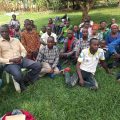
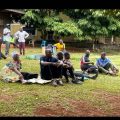
Bakonzo and Basongora elders convene near the boundary of Queen Elizabeth National Park to initiate a collaborative resource-sharing framework aimed at preventing future land disputes. (Photo Credit: KYL)
Choosing to survive together over fighting
Kato Ronald, the Executive Director of Kasese Youth Link and a human rights defender, appeals for structured mediation over conflict:
“Both the livestock and the human populations require sustenance. There is an urgent need to resolve this climate-induced conflict through a framework that ensures human security.”
Local leaders call for dialogue
As the conflict drags on, local leaders are calling for restorative justice rather than increased criminalisation to prevent further escalation. Mr. Ndyoka Isaac Kabunzu, the LCIII Chairperson for Munkunyu Sub-county, noted that recent arrests
have only heightened anxieties.
“These developments have increased community tension. Any individuals held without sufficient evidence should be released. Sustainable peace requires structural intervention over criminalisation.”
Kabunzu strongly advocated for a transparent judicial review, urging district leaders, security agencies, cultural institutions, and all stakeholders to immediately convene a dialogue aimed at addressing the root causes.
While the air in Munkunyu remains tense as communities await a resolution to the compensation agreement, the path forward relies on restoring mutual trust, establishing green compensation frameworks, and choosing joint survival over resource division.
Related posts:
 Climate change has reduced agricultural productivity by 34 percent in Africa
 Food systems in conflict areas: Architectures of armed conflict are turning food and hunger into weapons of war.
 East African lawmakers and CSO leaders are meeting in Uganda to draw up plans to promote Agroecology as an alternative to climate change mitigation.
 Farmers in Eastern Uganda receive small grants to tackle climate change


Related posts:
 Breaking Alert: Barely a year after signing the remedy agreement, World Bank Project-Affected Persons (PAPs) receive fresh land eviction threats
 Nile city project affected persons in fresh demand for compensation
 Tension as Project-Affected Persons demand to meet Uganda’s President over Oil Palm growing on their grabbed land.
 Govt reopens talks over Shs70b irrigation project

Related posts:

 Uganda’s Judiciary resorts to mediation to curb the escalating backlog of land cases
 Retrial of the Kaweeri forced land eviction case begins at Mubende High court.
 More than 50 witnesses to testify in the trial of 28 land rights defenders
 Nabakooba Urges Judicial Integrity in Land Cases Amid Rising Evictions
MEDIA FOR CHANGE NETWORK
Sweeping investments are fueling widespread land grabbing and deepening rights violations across Uganda – Report.
Related posts:

 Tanzania’s surge in conservation investments is under the UN spotlight, as allegations of indigenous land rights violations prompt an urgent call for the government to stop the evictions at once.
 Witness Radio Statement on the International Human Rights Day 2024: A call to the government of Uganda to protect Land and Environmental Rights Defenders and Communities affected by irresponsible land-based investments in Uganda.
 Kaweeri Coffee land grabbing case re-trial resumes as evictees continue to suffer gross human rights violations.
 Rights experts call for an inclusive transition as the East Africa region attracts renewable energy investments.

Govt orders fresh valuation of land for Rubanda iron ore project

Can Agroecology Improve the Resilience of African Smallholder Farmers?

Death Of Witnesses Cited Among Causes Of Land Case Backlog

Sweeping investments are fueling widespread land grabbing and deepening rights violations across Uganda – Report.

While hunger continues to grip the world, a new report highlights forests and forest foods as a hidden treasure trove of nourishment.

Five years after Uganda’s National Action Plan on Business and Human Rights, are local communities hosting land-based investment projects seeing change?

Alert: Land degradation is emerging as a pressing threat to global security.

Lango ex-combatants count losses after dry spell destroys maize harvest

Innovative Finance from Canada projects positive impact on local communities.
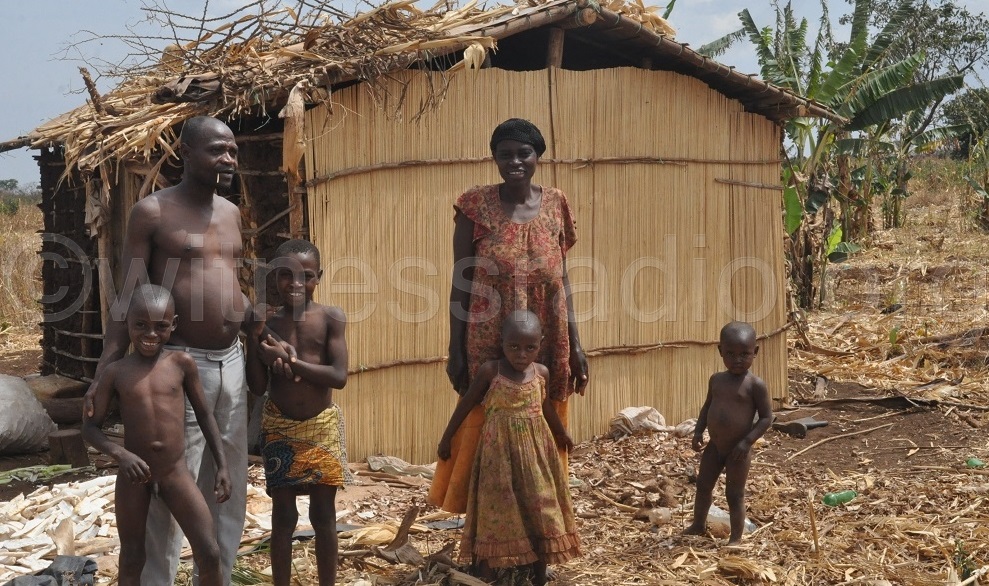
Over 5000 Indigenous Communities evicted in Kiryandongo District

Petition To Land Inquiry Commission Over Human Rights In Kiryandongo District

Invisible victims of Uganda Land Grabs
-
 FARM NEWS2 weeks ago
Lango ex-combatants count losses after dry spell destroys maize harvest
-
 MEDIA FOR CHANGE NETWORK1 week ago
The global race for clean energy minerals is leaving communities grappling with conflicts and human rights abuses, a new report reveals.
-
 MEDIA FOR CHANGE NETWORK2 weeks ago
Uganda urged to drop charges against 11 environmental defenders after 17 months without witnesses
-
 FARM NEWS1 week ago
Govt pushes natural regeneration to restore 8.4 million hectares
-
 MEDIA FOR CHANGE NETWORK5 days ago
Who will shape the future of East Africa’s seeds? Youth and civil society are sounding the alarm over a proposed regional law.
-
 MEDIA FOR CHANGE NETWORK5 days ago
Across Africa, the push for a greener future is putting new pressure on local communities, as recent ILC case studies highlight.
-
 MEDIA FOR CHANGE NETWORK5 days ago
Sweeping investments are fueling widespread land grabbing and deepening rights violations across Uganda – Report.
-
 MEDIA FOR CHANGE NETWORK2 weeks ago
The pain and anguish in the Albertine Part II