Connect with us

MEDIA FOR CHANGE NETWORK

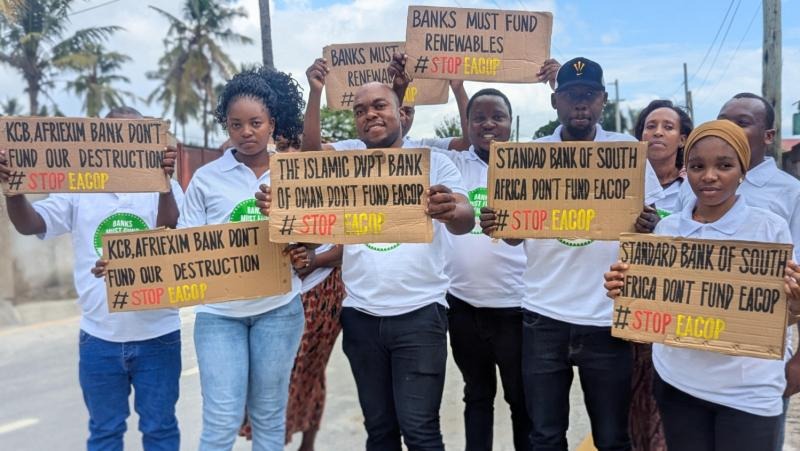
A reference filed by CSOs against the planned construction of the East African Crude Oil Pipeline (EACOP) is set for hearing.

Published

on

By Witness Radio Team

Four East African Civil Society Organizations (CSOs) have petitioned the regional court of justice, seeking both temporary and permanent injunctions against the planned construction of the East African Crude Oil Pipeline (EACOP)

The reference submitted by the Center for Food and Adequate Living Rights (CEFROHT), Africa Institute for Energy Governance (AFIEGO), Natural Justice-Kenya, and Center for Strategic Litigation in Tanzania highlights significant issues including threatening local livelihoods, food security, public health, biodiversity and the global climate that have failed to be addressed by both the governments of Uganda and Tanzania.

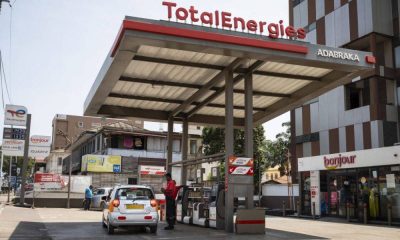
According to the reference filed on the 6th of November 2022, the governments of Uganda, and Tanzania and the Secretary General of the East African Community have violated environmental laws, human rights obligations, and regional agreements, in authorizing French oil giant, Total, to build a massive oil pipeline from Hoima, Uganda to Tanga, Tanzania.

For years, communities and civil societies have echoed concerns over the impacts of the East Africa Crude Oil Pipeline (EACOP) project which has affected thousands in Uganda and Tanzania. Human rights organizations claim French energy giant Total and its partner China National Offshore Oil Corporation involved in the $3.5 billion EACOP have failed to fully address concerns raised by the project to host communities.

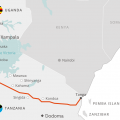
The 1,443km people crude oil export pipeline which is expected to impact over 118000 people will transport Uganda’s crude oil from Hoima in Uganda to Tanga port in Tanzania.

The project will cross through 10 districts in Uganda, a distance of 296 kilometers, and 25 districts in Tanzania, covering eight regions, and 25 districts is estimated to be the longest electrically heated pipeline in the world.

Its impact has largely been witnessed by the PAPs, leaders, and human rights activists opposing the project including land grabbing, harassment, and arrests of community leaders and rights activists.

“Construction of the pipeline will destroy farmland, disrupt livelihoods and exacerbate food insecurity. Thousands of people are to be displaced and have already been told not to set up or plant any long-term structures or crops and yet they have not been given any compensation yet. These impacts are set to cause major social disruption and erode social cohesion, leading to increased poverty in areas affected by the EACOP in Uganda and Tanzania.” The reference reveals in part.

The reference further adds that the pipeline will traverse protected forests, such as the Wambabya and Bugoma reserves, and endanger numerous water sources of great importance to millions of people in East Africa, including Lake Victoria. The pipeline passes along the Lake Victoria basin which is a major water source for millions in not only East Africa but the whole of the African region. This risks and exposes Lake Victoria and River Nile to danger through oil spills and pollution. The EACOP will also significantly impact biodiversity and put numerously vulnerable and endangered species native to Uganda and Tanzania at risk, including elephants, lions, and giraffes.

The EACOP has been widely criticized by civil societies and other actors advocating for the rights of affected people expressing the unaddressed concerns the project is likely to expose to the host communities.

On the 14th of September 2022, the European Union Parliament passed an advisory resolution to suspend the oil pipeline for a year citing disastrous human and environmental rights violations associated with the project.

According to the resolutions by the European Parliament legislators, the oil pipeline has caused the displacement of people from their land without fair compensation, caused harassment, criminalization, intimidation, and arrests of human rights defenders, and closure of NGOs, and is likely to endanger the nature reserves and habitats.

The case is scheduled to be heard in Kampala on the 11th of November 2022.

MEDIA FOR CHANGE NETWORK

East African Community member states launched public hearings this week for the Seed and Plant Variety Bill 2025, marking a significant step in shaping the region’s agricultural future.

Published

on

By the Witness Radio team

Starting August 24th, the East African member states opened a five-day window for researchers, policymakers, civil society organizations, and small-scale farmers to share their insights and concerns on the Seed and Plant Variety Bill as it moves toward its second reading in the East African Legislative Assembly.

The Bill completed the formal introduction and first-reading stages in the regional parliament in mid-2025.

Countries including Uganda, Kenya, Tanzania, Rwanda, and Burundi have been actively consulting citizens, inviting people from all walks of life to share their experiences and perspectives openly.

This follows the bill’s introduction in 2025 and its passage through legislative procedures, including tabling and the first reading in EALA.

According to EALA, the public hearings provide a critical opportunity for stakeholders to examine the Bill from multiple perspectives and contribute practical recommendations before the Assembly’s final consideration.

From farmers and seed companies to researchers, civil society, regulators, parliamentarians, women and youth in agribusiness, development partners, and private sector leaders, every voice brings experience that can shape stronger legislation and pave the way for successful implementation.

Following the high-level openings, partner states are rolling out national and regional consultations. Uganda began its hearings on the 26th, while Rwanda and Kenya launched theirs on August 27, 2026. The East African Legislative Assembly Committee on Agriculture, Tourism and Natural Resources is guiding the process.

During the launch in Uganda, the Director of the Committee on Agriculture, Tourism and Natural Resources, Sankoko Ole David, urged participants at every level to champion inclusivity and help craft agricultural regulations grounded in real evidence.

Civil society organizations (CSOs), Center for Food and Adequate Living Rights (CEFROHT), Participatory Ecological Land Use Management (PELUM), Eastern and Southern Africa Small Scale Farmers’ Forum (ESAFF), smallholder farmer groups, and regional trade stakeholders presented divergent positions on seed sovereignty versus commercial seed harmonization through discussions and position papers on the bill.

The Executive Director for CEFROHT, Dr. David Kabanda, who also led CSOs in Uganda in the consultation process, called for improved, further considered, and scrutinized provisions.

Kabanda notes that the bill’s memorandum is silent on farmer-managed seed systems, which supply 70% to 80% of all seed planted by smallholder farmers in East Africa. The CSOs propose amending the memorandum clause so that alongside coordinating variety evaluation, seed certification, and private sector seed multiplication, the Act recognizes protection of farmers’ rights, farmer-managed seed systems (FMSS) as complementary to the formal seed sector, and conservation of agro-biodiversity, biosafety, food security, and food sovereignty.

The committee emphasized that these hearings are designed as an inclusive platform, empowering stakeholders to shape the legislative process and drive evidence-based recommendations to strengthen agricultural regulation across East Africa.

In Kenya, the East African Legislative Assembly (EALA) parliamentary committee on Agriculture, Tourism and Natural Resources has held key consultative meetings with bodies such as the Kenya Plant Health Inspectorate Service (KEPHIS) and the Ministry of Agriculture on the regional seed variety framework.

Debates now focus on finding common ground between formal commercial seed certification and the rights to share and save indigenous seeds. This follows a landmark Kenyan High Court decision that overturned harsh penalties on informal seed exchanges.

These hearings are collecting vital feedback on a unified regional approach to plant variety evaluation, seed certification, testing, marketing, and plant breeders’ rights. The committee will weave these insights into a formal report, shaping recommendations before the Bill’s second reading in the East African Legislative Assembly.

Continue Reading

MEDIA FOR CHANGE NETWORK

EAC Seed Bill: Uganda launches public consultations as debates spark over safeguarding smallholder and indigenous seed rights.

Published

on

By the Witness Radio team.

Uganda has begun public consultations on the proposed East African Community Seeds and Plant Varieties Bill, 2025, bringing together farmers, researchers, regulators, policymakers, and other stakeholders to explore how this regional law could reshape access to seed, farmers’ rights, and seed systems throughout East Africa.

The consultations are part of wider public hearings across EAC Partner States before the Bill is considered by the East African Legislative Assembly (EALA).

The proposed legislation seeks to harmonize seed regulation across the region by establishing common procedures for plant variety evaluation and release, seed certification and plant variety protection.

Its proponents say harmonizing the rules would make it easier for quality seed to move across borders, reduce duplication of regulatory requirements, and encourage investment in the regional seed sector.

Yet these consultations have sparked questions about whether the regional framework can truly safeguard indigenous seed systems, farmers’ rights, biodiversity, and food sovereignty while welcoming commercial seed companies.

East African Legislative Assembly Member of Parliament Rose Akol chaired the first hearing in Uganda. She and her team examined provisions of the Bill that participants said required clarification or modification, including issues around seed certification and the movement of seed between Partner States.

Akol said the Bill aims to ease access to seed across the region by reducing barriers from differing national requirements.

“The preamble of the Bill is meant to ease access to plant and seed varieties by farmers in the community, so as not to make it difficult for them to access seeds because of non-tariff barriers where countries have their own standards and requirements in terms of registration, certification and laboratory testing,” Akol said.

One concern was how a harmonized certification system would operate across countries with different laws, standards, registration requirements, laboratory-testing procedures, and regulatory systems.

She said harmonizing standards across Partner States would make it easier for farmers to obtain seed from other countries within the region.

“Once the member states have a harmonized law applying the same standards, it will be easier for farmers to access seeds from across borders,” she added.

The East African Community Seeds and Plant Varieties Bill, 2025, is designed to create a common regional framework for seed regulation, plant variety evaluation and release, seed certification and plant variety protection.

The Bill also seeks to promote investment and innovation in the seed sector while supporting food security and sustainable agricultural development.

Moses Edward Erongu, a Senior Agriculture Inspector at the National Seed Certification Service in the Ministry of Agriculture, Animal Industry and Fisheries, said the consultations were important because they allowed stakeholders to examine and validate the provisions of the proposed law.

He said harmonization could make it easier for farmers to obtain seed from other EAC countries and create opportunities for seed companies to invest in production within the region.

“If we harmonize this law, it will be easier for investors to establish anywhere because they will no longer fear the different regulatory regimes. They can look at comparative advantages—for Uganda, for example, where we have two seasons—and seed companies would be interested in investing here, producing seed in Uganda and supplying other parts of the region. That creates employment for our people and income for farmers who will be engaged as out-growers.”

Still, worries linger that greater commercialization and regional harmonization might threaten the livelihoods of farmers relying on locally produced, farmer-managed seed.

When Witness Radio asked whether the proposed Bill could leave smallholder farmers dependent on commercial seed companies, Erongu rejected the suggestion that the legislation could result in “seed slavery.”

“There is nothing like seed slavery. This encourages farmers to access seeds because smallholder farmers are the ones who utilize the seed,” he added. Making seed more accessible would allow smallholder farmers to benefit from improved agricultural technologies and potentially increase their productivity and returns.

“If you don’t make procedures easier for them to get seed, they are kept out of the technology. As technology grows, they remain excluded and continue using inferior seed material, which means they cannot get a gainful return from their farming efforts,” Erongu added.

Traders at the consultations voiced support for harmonized regional rules, arguing that lifting non-tariff barriers could ease the transport of seed and other agricultural inputs across EAC borders.

Meanwhile, civil society organizations and farmer-rights advocates are set to share their perspectives on the proposed legislation in full later today, 27 August 2026.

Their stance will carry significant weight, as the Bill addresses crucial issues such as farmers’ rights to save, exchange, and access seed; the safeguarding of indigenous seed systems; biodiversity; and the influence of commercial seed companies.

Public hearings continue today, with stakeholders poised to offer more insights before the proposed regional law moves forward to its next stage.

Continue Reading

MEDIA FOR CHANGE NETWORK

AGRA at 20: New report reignites debate over Africa’s farm model

Published

on

Twenty years after AGRA’s launch, a report built on 18 years of FAO data paints a contrasting picture: fertiliser use and crop area surged, overall yields disappointed and undernourishment rose in the focus countries.

On 24 August 2026, a report presented in Dakar for the twentieth anniversary of the Alliance for a Green Revolution in Africa (AGRA) scrutinised nearly two decades of public and philanthropic support for a model built on fertilisers, commercial seeds and subsidies, just as the African Union fine‑tunes its 2026‑2035 agricultural strategy. Drawing on 18 years of FAO data for 13 countries targeted by AGRA, the document concludes that input use and cultivated area have risen sharply, while productivity gains have been more modest than expected and undernourishment has increased significantly.

According to the analysis, fertiliser use in the focus countries more than doubled between 2006 and 2024, while cultivated area grew by 46 %; yet average annual yield growth for the main crops reached only 1.2 %, compared with 1.3 % in the twelve years preceding AGRA’s creation. This finding echoes work published a few days earlier by the Alliance for Food Sovereignty in Africa (AFSA) and a Tufts University researcher, who argue that the original promise to double smallholders’ yields and incomes while halving hunger has not been met in the participating countries.

Maize‑centred gains at the expense of crop diversity

The authors point out that maize, the flagship crop of this approach, shows contrasted performance: yields are reported to have increased by 40 %, but on the back of a 71 % expansion in maize area, while yields for millet fell by 17 %, for roots and tubers by 10 % and for groundnuts by 11 %. This reallocation has reduced the share of millet and sorghum in cultivated land from about 26 % to 16 %, even though these cereals remain central to diets and climate resilience across large Sahelian and Sudanian zones.

Farmer networks and agroecology experts stress that this shift of land and public support towards hybrid maize and nitrogen fertiliser has increased farms’ dependence on imported inputs and weakened food systems built on traditional cereals, legumes and root crops.

Rising undernourishment in the focus countries

The report links these technical choices to food security trends: in the studied countries, the number of chronically undernourished people is estimated to have risen from 94.6 million in 2004‑2006 to 149.6 million in 2022‑2024, a 58 % increase, with Nigeria accounting for a large share of the deterioration. This trajectory matches the estimates used by AFSA and its partners, who recall that AGRA originally set a goal of halving undernourishment in its focus countries, a target later revised under the AGRA 3.0 strategy.

The authors underline, however, that national situations diverge: Ethiopia and Ghana have reduced the number of undernourished people, while Nigeria accounts for more than half of the increase and countries such as Malawi have seen hunger rise despite higher cereal yields.

Senegal as a comparator outside the AGRA focus group

Beyond the AGRA countries, Senegal is used as a comparator; the report notes stronger performance on some yield indicators without claiming causality, and highlights the role of greater crop diversity and locally anchored agroecological initiatives. Senegalese agroecology specialists recall that the country combines targeted input schemes with support for value chains such as millet, cowpea and irrigated horticulture, partly limiting the monoculture effects observed in some AGRA focus states while leaving open questions around soil fertility and exposure to external markets.

The 2026‑2035 agricultural strategy shaped by AGRA’s scorecard

As the African Union finalises its 2026‑2035 continental agricultural strategy under the CAADP/Malabo framework, AGRA’s evaluations are feeding a broader debate on how to combine public investment, development‑finance institutions and family farming in transforming food systems. A report released in March 2026 by AFSA on African Development Bank‑backed farm projects already pointed to a persistent bias towards input‑intensive models, at the expense of diversification, soil fertility and farmer‑managed seed systems.

The Dakar report explicitly recommends that African agricultural policies give more weight to crop diversification, agroecology, farmer‑managed seed systems, soil fertility, public research and extension services, instead of treating commercial inputs as the sole engine of transformation.

Upcoming AFSA report on twenty years of the Green Revolution

These findings will feed into the discussion around AFSA’s report The Green Revolution Has Failed Africa: Twenty Years of Evidence and What Works Instead, to be launched on 24 August 2026 at a continental webinar on lessons from the AGRA experience and farmer‑led alternatives. AGRA, for its part, is marking its twentieth anniversary by highlighting a shift in its mandate towards food systems and policy support, emphasising closer partnerships with governments, research centres and the private sector to strengthen the foundations of agricultural productivity.

For now, the quantified scorecard presented in Dakar and the parallel release of AFSA’s review send a clear signal that the coming decade of African agriculture will have to arbitrate more explicitly between subsidies for inputs, crop diversification and the scale‑up of agroecological models before the 2026‑2035 strategy is formally adopted.

Source: capmad.com

Continue Reading

Resource Center

Legal Framework

READ BY CATEGORY

Facebook

Newsletter

Subscribe to Witness Radio's news and report updates


Trending

Subscribe to Witness Radio's news and report updates