Connect with us

SPECIAL REPORTS AND PROJECTS

Top 10 agribusiness giants: corporate concentration in food & farming in 2025

Published

on

ETC Group’s 2022 publication “Food Barons” exposed the increasing concentration of corporate power in the industrial food system.1 It documented the rise of mergers and acquisitions, the increasing influence of finance capital, and the penetration of digitalisation and other disruptive technologies across corporate supply chains.2
During the Covid pandemic and the subsequent outbreak of war in Ukraine, these corporations showed how, during times of global shocks or crises, they could use their monopoly power to make obscene profits, with huge impacts on people the world over.3
Three years later, war persists in Ukraine and new wars and genocides are raging in Palestine, Sudan and the DR Congo. The US is pursuing a global trade war, global temperatures are smashing record highs, and diseases with pandemic potential (like bird flu) are still a cause of major disruptions.4 The situation is as volatile as ever and, yet, corporate concentration in the food system has only continued unabated.5
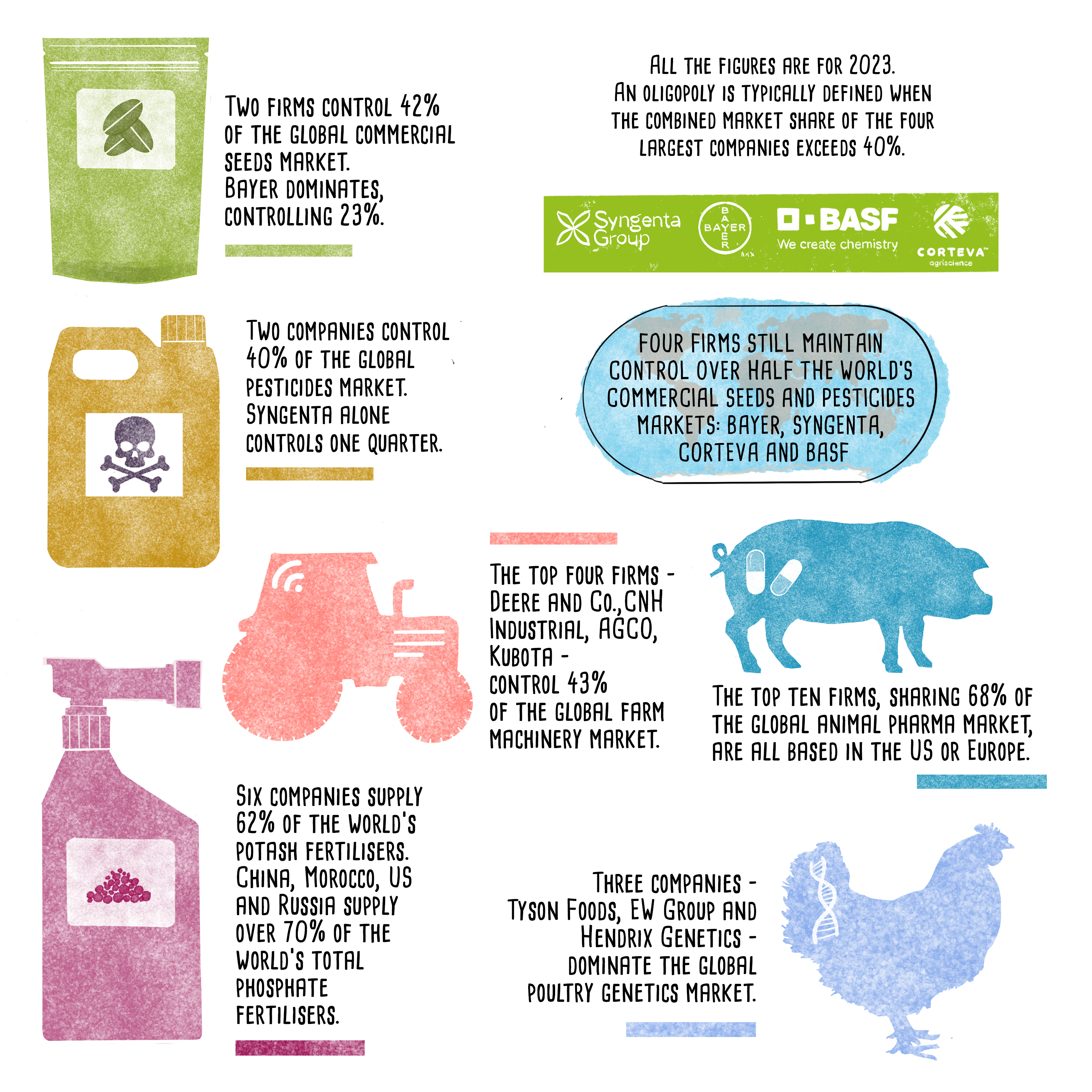
In this report, we examine the state of corporate concentration in six sectors critical to agriculture: commercial seeds, pesticides, synthetic fertilisers, farm machinery, animal pharmaceuticals and livestock genetics. Corporate consolidation has increased in most of these sectors and four of them– seeds, pesticides, agricultural machinery and animal pharmaceuticals– meet the definition of an oligopoly, in which four companies control more than 40% of a market.6 Concentration can be even higher at the national level, as is the case with synthetic fertilisers. In livestock genetics, where publicly available information is scarce, we focus on poultry – the largest sector within the meat industry – and its extreme and long-standing levels of corporate concentration.
This report also highlights corporate investment in new technologies, like digital platforms, artificial intelligence (AI) and gene editing, which are likely to deepen corporate power in the food system. It also looks at how they are buying up smaller companies in newly relevant sectors, and forging alliances with Big Tech companies and other corporations in the food sector to expand their dominance from seeds to supermarkets.7
Concentration gives corporations more power to dictate prices and lobby policy makers. They can use this power to disrupt scientific research, block regulations that protect people’s health and the environment, and undermine democratic participation in the shaping of food systems.8 Concentration increases their ability to crush alternatives and ensure the expansion of a model of agriculture that is immensely profitable for them while being hugely destructive for people and the planet. The industrial food system is responsible for a third of global greenhouse gas emissions and it is the leading source of soil and water pollution and biodiversity loss.9 It destroys local food systems and economies, displaces peasants and indigenous peoples from their territories and forces them to migrate far from their homes. It is also built on the severe exploitation of workers.10
Actions are urgently needed to take down the monopoly power of these corporations and to get power back into the hands of the world’s food producers, workers and consumers.
click on image for better resolution
Commercial seeds and pesticides11
The commercial seed sector refers to crop seeds (primarily proprietary field crop and vegetable seeds) sold via the commercial market and genetically modified crop traits. Farmer-saved seed and seed supplied by governments and public institutions are not included.
The pesticides sector includes herbicides, insecticides and fungicides which are different types of agrochemical products that target weeds, insects and fungi, respectively.
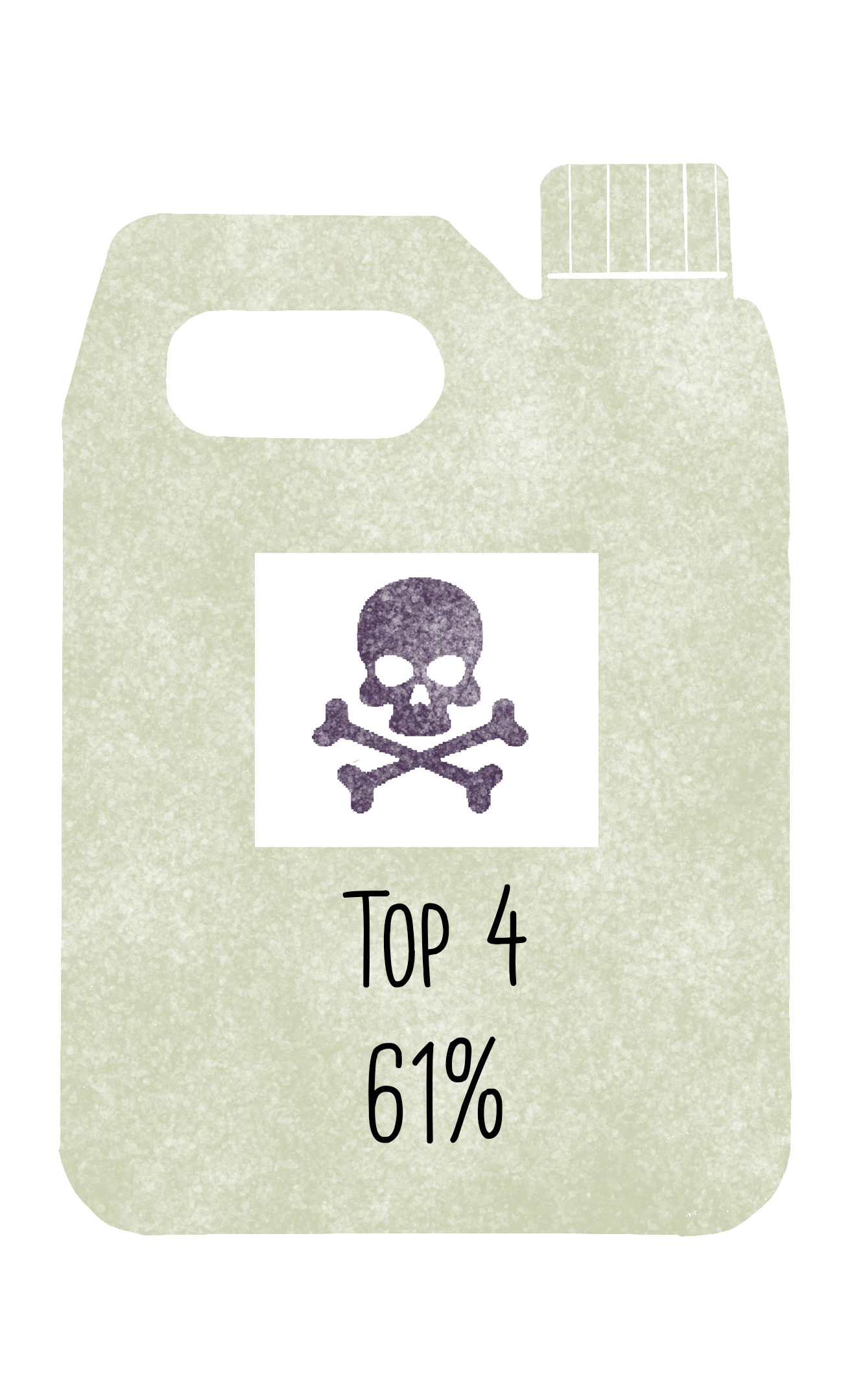
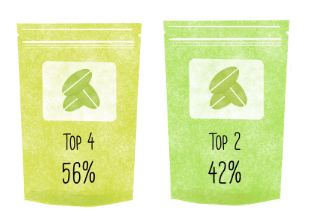
The slate of top companies in commercial seeds and pesticides are unchanged from 2022: BASF, Bayer, Corteva and Syngenta.12 They control 56% of the global seeds market (Bayer alone accounts for 23% of it), and 61% of the pesticides market (see Tables 1 and 2).
Compared to 2020, the revenues of these companies have increased significantly. But for Bayer all is not as well as it seems. Battered by an 80% decline in its share price since acquiring Monsanto in 2018, it initiated a restructuring in 2023, laying off about 7,000 employees to cut costs.13 Bayer’s financial problems are a result of multiple failures in court where juries have agreed with plaintiffs arguing that the company’s Roundup herbicide caused their cancers. It settled many claims in 2020 through a US$10.9 billion payout, but some 58,000 claims are pending.14 In April 2025, it was reported that Bayer might stop manufacturing glyphosate if it does not obtain court protection in the US against these lawsuits.15
The seed corporations continue their focus on genetically modified crops, and have introduced some new varieties, such as Bayer’s shorter “smart” GM maize and BASF’s GM soybeans resistant to soybean cyst nematodes.16 They are also increasingly integrating artificial intelligence (AI) into their plant breeding. For example, Syngenta has a partnership with InstaDeep, a UK based company now acquired by the German biotechnology company BioNTech. The aim is to use AI technology to “learn the language of plant DNA” and make predictions on how different genetic sequences perform and how to alter their performance.17 Bayer claims that using AI to analyse genomic data has shortened breeding cycles from 5-6 years to only 4 months.18
Table 1. Top 9 corporations in the commercial seeds sector
Ranking
Company (Headquarters)
Sales in 2023
(US$ millions)
% Global market share 19
1
Bayer (Germany)20
11,613
23
2
Corteva (US)21
9,472
19
3
Syngenta (China/Switzerland)22
4,751
10
4
BASF (Germany)23
2,122
4
Total top 4
27,958
56
5
Vilmorin & Cie (Groupe Limagrain) (France)24
1,984
4
6
KWS (Germany)25
1,815
4
7
DLF Seeds (Denmark)26
838
2
8
Sakata Seeds (Japan)27
649
1
9
Kaneko Seeds (Japan)28
451
0.9
Total top 9
33,695
67
Total world market29
50,000
100%
Another rapidly growing area of investment is biological pesticides and fertilisers.30 Biologicals (or bioinputs) describe a range of products derived from biological processes (as opposed to chemical synthesis), such as pesticides sprayed on crops or stimulants applied to soils to increase plant growth. But there is no standard definition, and regulations of these products are lax.31 According to industry estimates, the biologicals market is expected to grow to nearly US$22 billion by 2032, with an estimate of 1,200 companies engaged in the sector.32 All of the top pesticide companies are now heavily investing in it in order to ensure their dominance. Corteva, for example, recently bought up two biological manufacturers, Stoller and Symborg, while Syngenta signed a partnership with a Belgian startup to develop biostimulants.33 Biologicals’ sales by Bayer amounted to US$214 million in 2022, while in 2023, Corteva reported US$420 million in sales and Syngenta US$400 million.34
The top pesticide companies clearly state that their biological products are not meant to replace “traditional crop protection products” but, rather, to be used alongside them. Moreover, while the companies describe their biologicals as “natural products”, this can be misleading because the label is ambiguous and these products raise biosafety issues and can involve genetically modified microorganisms.35
Biologicals are part of a larger move by the top pesticide and seed corporations into what they call “regenerative agriculture”. This refers to a vaguely defined set of practices that can also include cover cropping, reduced tillage, crop rotation, genetically modified seeds, biologicals, and digital agriculture. Corporations claimwithout convincing scientific evidence, that their model of regenerative agriculture will sequester carbon into soils, among other benefits.36 Corporate regenerative agriculture programmes ensure companies the extraction of valuable agricultural data from farmers, giving them a competitive advantage in the market.37 The carbon credits generated by farmers are bought by companies that wish to continue their polluting operations and not reduce their greenhouse gas emissions.
Bayer sees a US$100 billion opportunity in the shift to regenerative agriculture through biologicals, agrofuels, digital agriculture and carbon farming.38 The growing focus on regenerative agriculture is driving collaborations and partnerships across the industrial food chain. While Syngenta has partnered with Pepsico, McDonalds and Lopez Foods to promote regenerative agriculture, BASF has initiated a project to assess the feasibility of a ‘nature-market’ among soybean farmers in Brazil.39
Digital technologies are central to corporate regenerative agriculture programmes. To derive commercial benefits from those, presumed impacts like reduced greenhouse gases and carbon sequestered in soils need to be measured at scale using digital tools. The top seed and agrochemical companies have their own proprietary digital platforms via which they obtain publicly available agricultural data, data from satellites, sensors, farm equipment, data from their own R&D wings and data that farmers share with these platforms.40 In the case of Bayer, it extracts data from more than 89 million hectares across 20 countries that are subscribed to its Climate FieldView platform. Syngenta’s digital platform covers about 88 million hectares across the world.41 The top agribusiness companies’ digital agriculture technologies are inextricably linked to Big Tech’s cloud servers and databases.42
The digital technologies that Big Ag are rolling out “assist” farmers in deciding when to plant their seeds, what type of seeds to use, how much and what kind of pesticides to spray. They claim to be able to predict disease outbreaks, measure soil health and even estimate yields. Farmers who are enrolled in these programmes have to adopt specific agricultural practices to be eligible to earn money from the production of carbon credits. These digital platforms allow corporations to effectively dictate agricultural practices and push their products on millions of hectares across the world.
 
Table 2. Top 10 corporations in the pesticides sector
Ranking
Company (Headquarters)
Sales in 2023
(US$ millions)
% Global market share
1
Syngenta (China/Switzerland)43
20,066
25
2
Bayer (Germany)44
11,860
15
3
BASF (Germany)45
8,793
11
4
Corteva (US)46
7,754
10
Total top 4
48,472
61
5
UPL (India)47
5,925
8
6
FMC (Germany)48
4,487
6
7
Sumitomo (Japan)49
3,824
5
8
Nufarm (Australia)50
2,056
3
9
Rainbow Agro (China)51
1,623
2
10
Jiangsu Yangnong Chemical Co., Ltd. (China)52
1,595
2
Total top 10
67,982
86
Total world market53
79,000
100
Another emerging set of alliances in this sector is between commodity trading corporations and fossil fuel companies. For example, Corteva has a partnership to develop canola hybrids for agrofuels with Chevron, the multinational oil and gas company, and Bunge, one of the world’s largest commodity trading corporations. Corteva also has a joint venture with the UK oil company BP that will contract farmers in Europe and the Americas to grow mustard seed, sunflower and canola feedstocks for agrofuels for aviation.54 In another example, Syngenta is collaborating with the US commodity trader ADM on research and commercialisation of low carbon-intensity oilseeds for agrofuels.55
Synthetic fertilisers
Industrial agriculture is highly dependent on synthetic fertilisers. They are differentiated by the type of nutrient they contain: nitrogen in the form of urea, phosphorus (as phosphate) and potassium (as potash). These nutrients (and the fossil fuels used for nitrogen fertiliser production) are globally traded commodities, making the sector particularly vulnerable to price fluctuations and trade disruptions.56
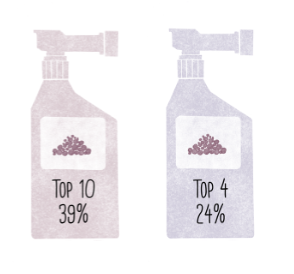
With a market value of US$196 billion, fertilisers is one of the most profitable sectors across the industrial food system, particularly at times of food price spikes.57 The revenues of the top 10 companies were US$76 billion in 2023 (see Table 3), an increase of 57% compared to 2020.58 And in 2022 they had been even higher, 130% more than in 2020.59 The World Bank explained the spike in fertiliser prices as a result of high natural gas prices from trade disruptions.60 But a study of Nutrien, Yara, Mosaic, ICL Group, CF Industries, OCP, PhosAgro, OCI and K+S found that they had generated these extreme profits in 2022 by taking advantage of the war in Ukraine raising prices above the increased cost of producing goods, and deepening the debt of farmers and entire countries as a result.61
The global fertiliser market is dominated by a small number of companies, and fertiliser production takes place in a small number of countries. Over 55% of global urea production occurs in four countries: China, India, Russia and the US. And only China, Russia, Saudi Arabia and Qatar account for 41% of nitrogen fertiliser exports. For phosphate fertilisers, 70% of world production and 61% of world exports are concentrated in China, Morocco, the US and Russia. Similarly, for potash fertilisers, Canada, Russia, Belarus and China account for 75% of world production and the first three alone are responsible for 77% of world exports.62 Many of the top fertiliser companies are based in these producer countries.
At a global level, the top 10 controls 39% of the total market. But this concentration increases when the market is considered by type of fertiliser or by country. For example, five companies, OCP (Morocco), Mosaic (US), ICL (Israel), Nutrien (US) and Sinofert (China) account for a quarter of the phosphate-based fertilisers market.63 But in the US, Mosaic controls 60% of domestic phosphate fertiliser production and until recently 90% of the domestic market.64 With potash fertiliser, just four companies– Nutrien, Mosaic, ICL and K+S– occupy 50% of the global market.65
Fertilisers are a leading source of greenhouse gas emissions in the agriculture sector. Nitrogen fertilisers alone are responsible for one in every 40 tonnes of total global emissions each year.66 There is thus growing international interest in reducing fertiliser use and, in response, the fertiliser companies are ramping up their greenwashing efforts. Like the pesticide companies, the fertiliser companies are investing in biofertilisers and biostimulants, and marketing these as “complementary” to their synthetic fertilisers, often through their digital platforms and carbon credit schemes.67 Yara, for instance, which recently acquired the Italian organic-based fertiliser company Agribios, has a digital carbon farming platform called Agoro Carbon that is used by farmers on over 809,000 hectares in the US.68
Yara and other fertiliser companies maintain that “green” energies can be utilised to produce nitrogen fertilisers, and thereby dramatically reduce emissions. Their main focus is on blue hydrogen, which is produced from fossil fuels but with carbon capture and storage (CCS), and on green hydrogen, which is produced using wind or solar energy. This is already opening up new markets, such as the inclusion of Yara’s “low-carbon” fertilisers in PepsiCo’s planned 2.8 million hectare regenerative agriculture projects in Latin America.69 But there is growing criticism of the social and environmental conflicts associated with CCS projects, as illustrated by the case of the residents of Ingleside in the US who are opposing a plant planned by Yara.70 And while the production of green hydrogen-based fertilisers is lower in its CO2 emissions, nitrogen oxide emissions still occur on farms. Green hydrogen projects are also increasingly linked to land, water and energy grabs in the Global South.71
Table 3. Top 10 corporations in the synthetic fertilisers sector
Ranking
Company (Headquarters)
Sales in 2023
(US$ millions)
% Global market share
1
Nutrien (Canada)72
15,673
8
2
The Mosaic Company (US)73
12,782
7
3
Yara (Norway)74
11,688
6
4
CF Industries Holdings, Inc, (US)75
6,631
3
Total top 4
46,774
24
5
ICL Group Ltd. (Israel)76
6,294
3
6
OCP (Morocco)77
5,967
3
7
PhosAgro (Russia)78
4,989
3
8
MCC EuroChem Joint Stock Company (EuroChem) (Switzerland/Russia)79
4,298
2
9
OCI (Netherlands)80
4,188
2
10
Uralkali (Russia)81
3,497
2
Total top 10
76,007
39
Total world market82
196,000
100
Farm machinery
Farm machinery here refers to manufactured equipment used in agriculture like tractors, haying and harvesting machinery and equipment used for planting, fertilising, ploughing, cultivating, irrigating and spraying. As farm equipment companies move towards digitalisation and automation, this sector can also include their proprietary digital platforms, drones, and robotic technologies.
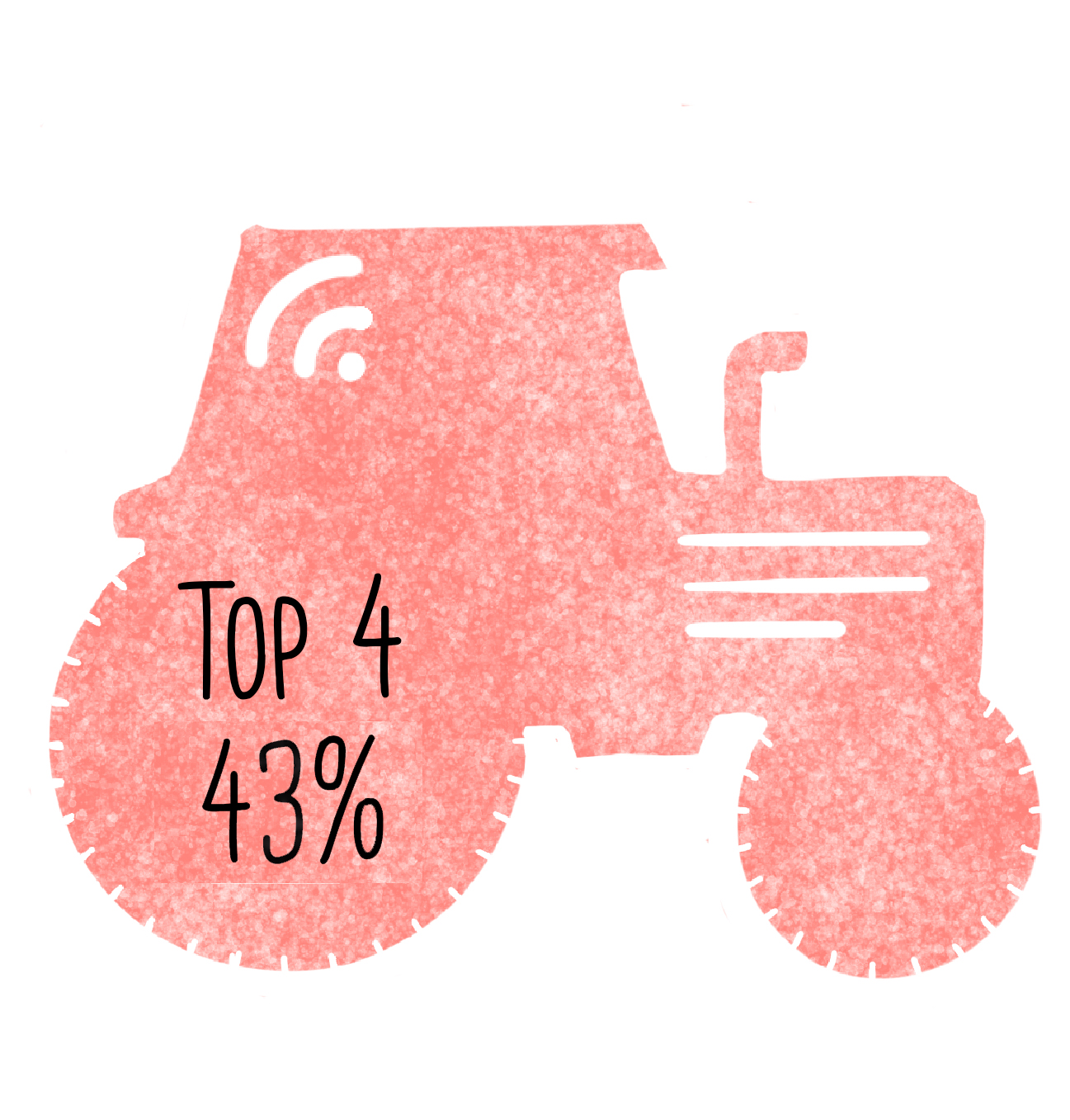
In the farm machinery sector, the top four companies control 43% of the global market according to 2023 sales figures (see Table 4). Much of the focus of these companies is now on integrating AI and digital technologies – through partnerships and acquisitions – to allow for more precision, as they claim, in the application of seeds, pesticides and fertilisers.
In 2023, for example, John Deere acquired Smart Apply, a US precision spraying equipment company. It is developing a technology to reduce indiscriminate agrochemical spraying in vineyards, orchards and nurseries by sensing the size and foliage of individual plants and adjusting the agrochemical volume to be sprayed.83 But while doing that, the technology will collect valuable on-farm data on pesticide application, canopy volumes, the number of trees, the health of individual trees, and other information to assess the profitability and productivity of the orchard or vineyard. Another technology John Deere is deploying, called See & Spray, uses cameras to detect weeds in farms. The company says this technology saved farmers from spraying approximately 8 million gallons of herbicide across over 400,000 hectares in 2024.84 See & Spray is being utilised in a partnership John Deere has with Syngenta and the US-based company InnerPlant to develop genetically modified “sensor plants” (like cotton, soybeans and maize). The GM plants will send out signals when stressed by drought, pests or fertiliser deficiencies which would then be detected by See & Spray and then treated with Syngenta’s pesticides. Innerplant calls it “the most exciting GM trait since Roundup Ready”.85
Syngenta also has a partnership with CNH Industrial to integrate its digital farming platform Cropwise with CNH’s farm machinery. This will likely give both corporations seamless access to the data accumulated by each other giving CNH access to Syngenta’s valuable on-farm data and Syngenta the opportunity to promote its products through CNH.
The farm machinery giants are also positioning their technologies to be part of regenerative agriculture and carbon farming programmes. John Deere, for instance, is partnering with Cargill’s regenerative agriculture programme RegenConnect to collect data on agricultural practices from farms, analyse if they fulfil Cargill’s sustainability criteria, and, eventually, buy and commercialise carbon credits.86 Another example is the partnership between Kubota and Tokyo Gas to reduce methane emissions from rice cultivation in the Philippines. Under the project, Filipino farmers are told how to select seeds, manage soil and implement a rice-growing technique to reduce methane emissions, with the companies extracting data to create carbon credits for Kubota and Tokyo Gas.87
Since the new machinery technologies under development require farms to have a high-speed internet connection, the farm machinery companies are partnering with telecom and satellite giants to expand rural internet connectivity. CNH, for example, is partnering with Telecom Argentina to expand internet connectivity across 500,000 hectares in Buenos Aires, while John Deere has a partnership with Elon Musk’s SpaceX satellite telecommunications company.88
Table 4. Top 10 corporations in the farm machinery sector
Ranking
Company (Headquarters)
Sales in 2023
(US$ millions)
% Global market share
1
Deere and Co. (US)89
26,790
15
2
CNH Industrial (UK/Netherlands)90
18,148
10
4
AGCO (US)91
14,412
8
3
Kubota (Japan)92
14,233
8
Total top 4
73,583
43
5
CLAAS (Germany)93
6,561
4
6
Mahindra and Mahindra (India)94
3,156
2
7
SDF Group (Italy)95
2,197
1
8
Kuhn Group (Switzerland)96
1,583
0.9
9
YTO Group (China)97
1,493
0.9
10
Iseki Group (Japan)98
1,057
0.6
Total top 10
89,629
52
Total world market99
173,000
100
Animal pharma
The animal pharmaceutical industry includes medicines and vaccines, diagnostics, medical services, nutritional supplements (medicated feed additives), veterinary and other related services for animal health.
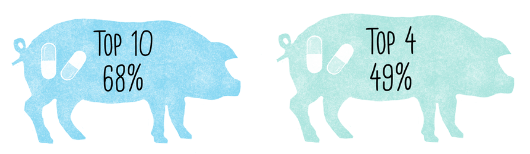
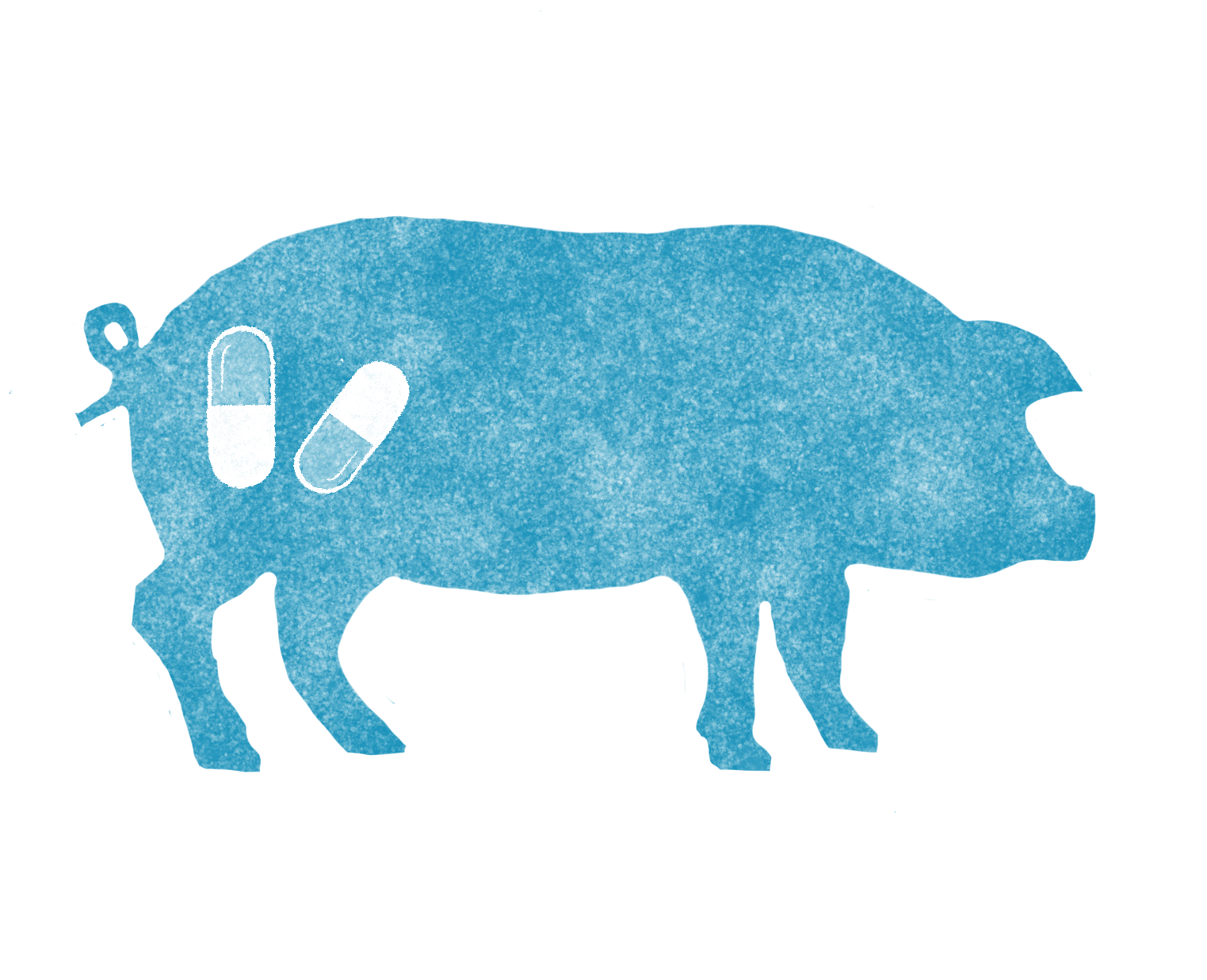
According to some estimates, global animal pharmaceutical sales totalled US$48 billion in 2023.100 The main markets are the US (42.3%) and Europe (27.3%), where the largest companies in the sector are based.101 In 2023, the top 10 controlled 68% of the market, with the top four companies accounting for almost half of all sales (see Table 5).
Most animal pharma revenues are generated from pets, not livestock. In 2023, livestock accounted for 45.8% of the animal pharma market, down from 59% in 2020.102 But this varies by country. For example, in 2023, Zoetis’ products for pets accounted for 80% of 2023 sales in the US, 70% in Japan and 69% in China, while in Brazil, livestock products represented 59% of its sales.103
Pets’ health has attracted players from other sectors, such as the US based Mars Inc., one of the world’s largest food companies. The corporation has been increasing its investment in the veterinary sector, and currently owns 3,000 veterinary clinics worldwide.104 As it is a private company, its revenues are not made public, but according to Mars, 60% of its US$50 billion in sales in 2023 came from the Mars Petcare segment, which includes pet food and veterinary care.105 Nearly half of Mars’ 150,000 workers are with its Mars Veterinary Health division.106 The large retailer Walmart is also moving into this sector, building veterinary clinics inside its US stores.107
Corporate concentration in this sector gives companies the power to exert strong pressure on governments to influence legislation in problematic sectors such as antibiotics. The global sales of farm antibiotics is valued at US$5.10 billion, with cattle accounting for near 40% of the use.108 For years, the industry has defended the use of antibiotics in farm animals by linking them to faster growth, better health, and “feed efficiency”.109 The problem, however, is that use of antibiotics in animals can lead to the emergence of bacteria that are resistant to antibiotics, including those critical to human health. Antibiotic resistance is already responsible for the deaths of 700,000 people around the world every year.110 Despite strong opposition from Elanco, Zoetis, Phibro and others, the European Union managed to reduce the overuse of antibiotics on farms, but widespread use continues in the US and elsewhere.111
As industrial livestock is a major source of greenhouse gas emissions, accounting for 14.5% of total emissions according to the IPCC, animal pharma companies are trying to show they are taking climate action by developing drugs that can reduce emissions.112 Elanco, for example, has won approval in the United States to market the drug Experior which claims to reduce ammonia gas in cattle.113 However, such techno-fixes can have only marginal overall impact, as livestock emissions occur across the whole industrial chain, from deforestation for feed crops, manure lagoons, to waste, to the use of fossil fuels throughout the production process.114
Table 5. Top 10 corporations in the animal pharma sector
Ranking
Company (Headquarters)
Sales in 2023
(US$ millions)
% Global market share
1
Zoetis (US)115
8,544
18
2
Merck & Co (MSD) (US)116
5,625
12
3
Boehringer Ingelheim Animal Health (Germany)117
5,100
11
4
Elanco (US)118
4,417
9
Total top 4
23,686
49
5
Idexx Laboratories (US)119
3,474
7
6
Ceva Santé Animale (France)120
1,752
4
7
Virbac (France)121
1,348
3
8
Phibro Animal Health Corporation (US)122
978
2
9
Dechra (UK)123
917
2
10
Vetoquinol (France)124
572
1
Total top 10
32,727
68
Total world market125
48,000
100
Livestock genetics
The genetic material used in the industrial production of meat, dairy and aquaculture is supplied by a small number of relatively unknown companies that are mostly privately owned. As detailed financial data is not publicly available for most of these companies, it is difficult to determine companies’ market shares and even the value of the global market. However, it was possible to arrive at some estimates for chicken, which tops global meat production (narrowly exceeding pigs).126
Corporate concentration is particularly acute with chicken. Just three companies dominate the poultry genetics market: Tyson Foods (US, public), EW Group (Germany, private) and Hendrix Genetics (Netherlands, private). Together, they supply more than 120 countries with breeds through licensing and distribution agreements or through their own farming operations.127
Tyson and EW Group control the two main hybrid breeds used in most of the world’s industrial broiler farms (chickens for meat): Cobb (Cobb-Vantress) and Ross (Aviagen).128 While Tyson does not provide a breakdown of sales from its genetics division, EW Group subsidiaries Aviagen Limited (UK) and Hubbard S.A.S reported sales of $252 million and $68 million respectively in 2023.129
Both Tyson and EW Group operate in the US, Brazil and China, where 51% of the world’s chicken production takes place.130 In the US, they supply the breeding stock for 98% of broilers, with Cobb-Vantress holding half of the market.131 In Brazil, the Cobb type accounts for 60% and Ross for 35% of all industrial breeds.132 China is still 70% dependent on imports of chicken genetics, with Cobb-Vantress and Aviagen breeding half of the domestic grandparent stock locally.133 But the Chinese state and Chinese companies are working to break this dependency, particularly in light of the outbreaks of bird flu in the US. Three local companies, Sunner Group, Yukou Poultry and Xinguang Nongmu, now have nearly 30% of the market, with Sunner holding over 20%.134 They have also started to export to countries such as Tanzania, Pakistan and Uzbekistan.135
Global companies in the sector are looking at the African market for growth, where, in many countries, indigenous chickens still account for 80% or more of the chicken population.136 In southern and eastern Africa, Tyson and EW Group’s Aviagen have merged with regional partners over the past decade, including cross-shareholdings. Some of the joint ventures are through companies registered in the tax haven of Mauritius.137 In Zambia, which is increasingly used as a hub for chicken exports to the region, Tyson and EW Group dominate the entire market, holding 45% and 55% market shares, respectively. Zambian regulators found in 2018 that the genetics companies were coordinating to restrict the supply of breeding stock and increase prices, thus affecting smaller producers and consumers. Similar behaviour was found in the US, resulting in fines.138
EW Group is also the top player in sales of genetics for chickens used for laying eggs (layer), through its subsidiaries Hy-Line International and Novogen S.A.S.139 Second is Hendrix Genetics, owned by private equity firm Paine Schwartz Partners, with layer genetics sales estimated at US$274 million in 2023.140 China is the main producer of eggs with 34% of global egg production, followed by the US, India and Indonesia with 7% each.141 Chinese reliance on imported grandparent layer breeders is also decreasing and is currently below 30%, but EW Group and Hendrix Genetics still supply genetics to several of China’s largest egg producing companies.142 In the US, EW Group and Hendrix Genetics not only have a monopoly on layer genetics, but also dominate the layer supply chain, through their control of hatcheries. In the recent ‘egg crisis’ that hit the country, there were allegations that the two companies colluded with dominant egg producers to keep prices high.143
The focus on uniformity, scale and high yields makes the breeds of these companies highly susceptible to diseases. Even with strict biosecurity measures on farms, disease outbreaks still occur, as can be seen in the massive number of outbreaks of bird flu at industrial farms in the US and Europe in 2024 and 2025. In response, genetics companies are trying to breed chickens resistant to bird flu and other diseases using gene editing techniques, like CRISPR-Cas9.144 For example, Cobb-Vantress co-funded research into the use of CRISPR to create chickens resistant to avian flu, which showed that multiple genetic modifications were needed to prevent “viral escape”.145 Companies are also genetically modifying chickens for increased growth rates and sex sorting.
 
Illustrations: Andre M. Medina (@andre_m_medina)
Notes:
1Hope Shand, Kathy Jo Wetter and Kavya Chowdhry, “Food Barons 2022: crisis profiteering, digitalization and shifting power”, ETC Group, September 2022, https://www.etcgroup.org/files/files/food-barons-2022-full_sectors-final_16_sept.pdf
2For an understanding of the history of corporate concentration in the seed, pesticide, fertiliser and agricultural machinery sectors, see Jennifer Clapp, “Titans of Industrial Agriculture. How a few giant corporations came to dominate the farm sectors and why it matters”, Massachusetts Institute of Technology, Cambridge, Massachusetts, 2025.
3See: SOMO, “Hungry for profits. How monopoly power tripled the profits of global agricultural commodity traders in the last three years”, 30 January 2024, https://www.somo.nl/hungry-for-profits/; GRAIN and IATP, “A corporate cartel fertilises food inflation”, 23 May 2023, https://grain.org/e/6988
4FAO, “FAO warns of ‘unprecedented’ avian flu spread, in call for global action”, 17 March 2025, https://news.un.org/en/story/2025/03/1161186
5Attempts towards mergers and acquisitions across the industrial food chain, like in commodity trading sectors, grocery retail, and food and beverage processing corporations continue full throttle. See: Bunge, “Bunge Shareholders Approve Viterra Combination”, 5 October 2023, https://www.bunge.com/Press-Releases/Bunge-shareholders-approve-viterra-merger; Jody Godoy, “Kroger’s $25-billion deal for grocery rival Albertsons blocked by US courts”, Reuters, 11 December 2024, https://www.reuters.com/legal/us-court-blocks-krogers-25-billion-acquisition-grocery-rival-albertsons-2024-12-10/; and Mars, “Mars to Acquire Kellanova”, 14 August, 2024, https://www.mars.com/en-in/news-and-stories/press-releases-statements/mars-acquisition-august-2024
7Nina Lakhani, “‘They rake in profits – everyone else suffers’: US workers lose out as big chicken gets bigger”, The Guardian, 11 August 2021,https://www.theguardian.com/environment/2021/aug/11/tyson-chicken-indsutry-arkansas-poultry-monopoly
8See: Corporate Europe Observatory, “Yara: Poisoning our soils, burning our planet,” 17 September 2019, https://corporateeurope.org/en/2019/09/yara-poisoning-our-soils-burning-our-planet; Corporate Europe Observatory, “Monsanto lobbying: an attack on us, our planet and democracy,” Undated, https://corporateeurope.org/sites/default/files/attachments/monsanto_v09_web.pdf; and Peter Waldman, Tiffany Stecker, and Joel Rosenblat, “ Monsanto was its own ghostwriter for some safety reviews”, Bloomberg, 9 August 2017, https://www.bloomberg.com/news/articles/2017-08-09/monsanto-was-its-own-ghostwriter-for-some-safety-reviews
9C. Costa et al. “Roadmap for achieving net-zero emissions in global food systems by 2050”, Scientific Reports, 12, 15064, 2022: https://doi.org/10.1038/s41598-022-18601-1; UNEP, “Driving finance for sustainable food systems: A roadmap to implementation for financial institutions and policy makers,” April 2023: https://www.unepfi.org/publications/driving-finance-for-sustainable-food-systems/
10ETC Group, “A long food movement: transforming food systems by 2045”, 29 March 2021, https://www.etcgroup.org/content/long-food-movement
11In this report, commas are used to separate thousands. Dots are used to separate decimals.
12Hope Shand, Kathy Jo Wetter and Kavya Chowdhry, “Food Barons 2022: Crisis Profiteering, Digitalization and Shifting Power”, ETC Group, September 2022, https://www.etcgroup.org/files/files/food-barons-2022-full_sectors-final_16_sept.pdf
13See: Chris Westfall, “Cutting middle management: Bayer’s costly experiment one year later”, 7 January 2025, Forbes, https://www.forbes.com/sites/chriswestfall/2025/01/07/cutting-middle-management-bayers-costly-experiment-one-year-later/; Anonymous, “‘Broken’ Bayer needs bolder action”, Financial Times, 7 March 2024, https://www.ft.com/content/c1d9b0a6-2c25-4184-9a92-6d4ea13546bc; Bayer Annual report 2024, p. 2, https://www.bayer.com/sites/default/files/2025-03/bayer-annual-report-2024.pdf
14Brendan Piersen, “ Bayer must pay $78 million in latest Roundup cancer trial, jury finds”, Reuters, 11 October 2024, https://www.reuters.com/legal/bayer-must-pay-78-mln-latest-roundup-cancer-trial-jury-finds-2024-10-10/
15Patrick Thomas, “Farmers’ favorite weedkiller nears its end, Bayer warns”, 14 April 2025, https://www.wsj.com/business/farmers-favorite-weedkiller-nears-its-end-bayer-warns-324da1e6
16See: BASF, “BASF unveils Nemasphere nematode resistance trait, the new standard of nematode management for soybean farmers”, 10 June 2024, https://www.basf.com/us/en/media/news-releases/2024/06/basf-unveils-nemasphere-nematode-resistance-trait–the-new-stand; Bayer, “Short corn is smart corn”, 10 March 2025, https://www.bayer.com/en/news-stories/short-corn-is-smart-corn
17“How InstaDeep and Syngenta are accelerating crop trait discovery”, Shoots By Syngenta, undated, https://shootsbysyngenta.com/success-story-syngenta-and-instadeep
18Bayer, “Unleashing the Potential of AI”, undated, https://www.bayer.com/en/innovation/unleashing-the-potential-of-ai
19Percentages in the figure indicate the shares in the total, and may not tally due to rounding.
20Bayer Annual report 2023, p. 83. Includes: corn seeds and traits value (6,857), soybean seeds and traits value (2,571), cotton seeds value (575), vegetable seeds value (735). Total: 10,738 million Euros. https://www.bayer.com/sites/default/files/2024-03/bayer-annual-report-2023.pdf[Exchange rate: 1.081488].
22Sources: Syngenta Annual report 2023, https://www.syngenta.com/sites/default/files/bond-investor-information/financial-results/financial-report-2023.pdf; and Capital IQ. Revenue for the Syngenta Seeds segment (including the sales of the subsidiaries in China). ChemChina figures are included.
24Vilmorin & Cie Annual report 2022-2023, https://www.vilmorincie.com. Total revenue: 1,894.4 million Euros [Exchange rate: 1.047471].
25KWS Annual report 2023,(1 July 2023 – 30 June 30 2024),p. 2, https://mediamaster.kws.com/04_Company/03_Investor_Relations/04_Financial_Report/2023_2024/Q4/KWS-SAAT-Annual-Report-2023-2024-1.pdf [Exchange Rate: 1.081668].
26DLF Seeds Annual report 2023, p. 74, https://dlf.com/about-us/annual-report[Exchange Rate: 0.140732].
28Kaneko Seeds Annual report, (1 June 1 2023 – 31 May 2024), p. 1, https://kanekoseeds-p.jp/en/financial/pdf/Financial_Summary_20240531.pdf[Exchange Rate: 0.007323].
29S&P Global, “Revisiting seed company sales and profit”, FAO, 2024, https://openknowledge.fao.org/server/api/core/bitstreams/0535a5cd-2373-414c-8758-2349227dd52e/content
30“Biologicals, a key building block in regenerative agriculture”, Bayer, https://www.bayer.com/en/agriculture/article/biologicals-building-block-in-regenerative-agriculture
31GRAIN, “Corporate bioinputs: Agribusiness’s new toxic trap”, 1 August 2024, https://grain.org/e/7175
32See: MarketResearch Biz, “Agricultural biologicals market”, 2023, https://marketresearch.biz/report/agricultural-biologicals-market/; The Mixing Bowl, “2023 Ag Biologicals Landscape”, 2023, https://www.mixingbowlhub.com/landscape/2023-ag-biologicals-landscape
33“Corteva Agriscience completes acquisitions of Symborg and Stoller”, Corteva, 2 March 2023, https://www.corteva.com/resources/media-center/corteva-completes-acquisitions-of-symborg-and-stoller.html
34GRAIN, “Corporate bioinputs: Agribusiness’s new toxic trap”, 1 August 2024, https://grain.org/e/7175
35Bayer, “Agriculture biologicals, innovation inspired by nature”, https://www.bayer.com/en/agriculture/agriculture-biologicals
36GRAIN, “Regenerative agriculture was a good idea, until corporations got hold of it”, 1 December 2023, https://grain.org/e/7067
37Hope Shand, Kathy Jo Wetter and Kavya Chowdhry, “Food Barons 2022: crisis profiteering, digitalization and shifting power”, ETC Group, September 2022, https://www.etcgroup.org/files/files/food-barons-2022-full_sectors-final_16_sept.pdf
38Gerson Freitas Jr, “Bayer sees €100 billion opportunity in cleaner-farming shift”, Bloomberg, 20 June 2023, https://www.bloomberg.com/news/articles/2023-06-20/bayer-sees-100-billion-opportunity-in-shift-to-regenerative-agriculture
39See: https://www.syngentagroup.com/regenerative-agriculture; “McDonald’s USA, Syngenta and Lopez Foods collaborate to help produce beef more sustainably in the US”, Syngenta, 14 November, 2024: https://www.syngenta.com/media/media-releases/2024/mcdonalds-usa-syngenta-and-lopez-foods-collaborate-help-produce-beef-more; and Verena Kempter, “BASF and Solidaridad team up to empower Brazilian farmers to foster biodiversity”, BASF, 3 April 2024, https://www.basf.com/global/en/media/news-releases/2024/04/p-24-142
40“Bayer demonstrates digital technologies as a key enabler for regenerative agriculture”, Bayer, 9 November 2023, https://www.bayer.com/media/en-us/bayer-demonstrates-digital-technologies-as-a-key-enabler-for-regenerative-agriculture/
41See: Thomas Eickhoff, “New Frontiers in Digital and Carbon Farming”, Bayer, 20 June 2023, https://www.bayer.com/sites/default/files/2023-07/New%20Frontiers%20in%20Digital%20and%20Carbon%20Farming_CS%20Innovation%20Summit%202023.pdf; and “Syngenta Group reports record $33.4 billion sales and $5.6 billion EBITDA in 2022”, Syngenta, 22 March 2023, https://www.syngentagroup.com/newsroom/2023/syngenta-group-reports-record-334-billion-sales-and-56-billion-ebitda-2022#:~:text=The%20Group’s%20digital%20solutions%20have,$0.5%20billion%2C%20up%2081%20percent; Jonathan Shoham, “Digital farming and biologicals. Presentation to ABIM” S&P Global,
42See: Hope Shand, Kathy Jo Wetter and Kavya Chowdhry, “Food Barons 2022: crisis profiteering, digitalization and shifting power”, ETC Group, September 2022, https://www.etcgroup.org/files/files/food-barons-2022-full_sectors-final_16_sept.pdfETC Group, “Behind sugar and spice and everything nice”, 9 May 2024, https://etcgroup.org/content/behind-sugar-and-spice-and-everything-nice; GRAIN, “Techno feudalism takes root on the farm in India and China”, 24 October 2024, https://grain.org/e/7196
43Sources: Syngenta Annual report 2023, https://www.syngenta.com/sites/default/files/bond-investor-information/financial-results/financial-report-2023.pdf; ADAMA Annual report 2023, https://s201.q4cdn.com/536806127/files/doc_financials/2023/q4/2023-Adama-Annual-Report.pdf; and Capital IQ. Figures include Syngenta Crop Protection segment and ADAMA’s revenue [Exchange rate: 0.141316]. ChemChina figures are included.
44Bayer Annual report 2023, p. 160. Includes: herbicides value (5,926), fungicides value (3,444), insecticides value (1,596). Total: 10,966 million Euros. https://www.bayer.com/sites/default/files/2024-03/bayer-annual-report-2023.pdf[Exchange rate: 1.081488].
49Sumitomo Annual report 2023,(1 April 2023 – 31 March 2024), p. 18, https://www.sumitomo-chem.co.jp/english/ir/library/annual_report/files/docs/scr2024e.pdf. This figure includes Sumitomo’s Agrosolutions Business, Environmental Health Business, Feed Additives Business, and Pharma Solution Business [Exchange rate: 0,00700374].
51Sino-Agri Leading Biosciences Co., Ltd., “Sino-Agri Leading Biosciences wins 4th place in Chinese Top 100 Pesticide Companies Ranking”, 24 May 2024,https://news.agropages.com/News/NewsDetail—50255.htm [Exchange rate: 0.141316].
52Sino-Agri Leading Biosciences Co., Ltd., “Sino-Agri Leading Biosciences wins 4th place in Chinese Top 100 Pesticide Companies Ranking”, 24 May 2024,https://news.agropages.com/News/NewsDetail—50255.htm [Exchange rate: 0.141316].
53S&P Global, “Revisiting seed company sales and profit”, FAO, 2024, https://openknowledge.fao.org/server/api/core/bitstreams/0535a5cd-2373-414c-8758-2349227dd52e/content
54See: “Corteva Agriscience, Bunge and Chevron announce collaboration to produce winter canola to meet growing demand for lower carbon renewable”, Chevron, 14 March 2023, fuels https://www.chevron.com/newsroom/2023/q1/corteva-agriscience-bunge-and-chevron-announce-collaboration-to-produce-winter-canola; and “Corteva announces intent to partner with bp to develop low carbon intensity bio-feedstock”, Corteva, 18 November 2024, https://www.corteva.com/resources/media-center/corteva-announces-intent-to-partner-with-bp-to-develop-low-carbon-intensity-bio-feedstock-for-aviation-fuel-production.html
55“ADM and Syngenta Group sign MoU to support low-carbon next-generation oilseeds and improved varieties to meet growing demand for biofuels and other products”, Syngenta, 28 September 2023, https://www.syngenta.com/media/media-releases/2023/adm-and-syngenta-group-sign-mou-support-low-carbon-next-generation
56See: Jennifer Clapp, “Titans of industrial agriculture. How a few giant corporations came to dominate the farm sectors and why it matters”, Massachusetts Institute of Technology, Cambridge, Massachusetts, 2025; and AMIS, “Fertiliser series. #2/2024”, 2024, https://storage.googleapis.com/amis-9189b-strapi/1_AMIS_Fertilizer_series_Fertilizer_production_073a82c786/1_AMIS_Fertilizer_series_Fertilizer_production_073a82c786.pdf
57S&P Global, “Revisiting seed company sales and profit”, FAO, 2024, https://openknowledge.fao.org/server/api/core/bitstreams/0535a5cd-2373-414c-8758-2349227dd52e/content
58Sinofert (China) and K+S (Germany) are not included in the table, but their revenues in 2023 (US$3,070 million and US$2,943 million respectively) are not far behind Uralkali (see: Sinofert Holdings Limited Annual report 2023”, https://www.hkexnews.hk/listedco/listconews/sehk/2024/0425/2024042502498.pdf; and K+S Annual report 2023, p.58,https://www.kpluss.com/.downloads/ir/2024/kpluss-annual-report-2023.pdf). For the figures for 2020, see: Hope Shand, Kathy Jo Wetter and Kavya Chowdhry, “Food Barons 2022: crisis profiteering, digitalization and shifting power”, ETC Group, September 2022, https://www.etcgroup.org/files/files/food-barons-2022-full_sectors-final_16_sept.pdf
59Source: Companies’ annual reports 2023 and Capital IQ.
60World Bank, “World Bank’s food for 10 billion podcast: fertilizer volatility and the food crisis”, 22 July 2022, https://www.worldbank.org/en/news/podcast/2022/07/22/fertilizer-volatility-and-the-food-crisis
61GRAIN and IATP, “A corporate cartel fertilises food inflation”, 23 May 2023, https://grain.org/e/6988
62See: UNCTAD, “15th multi-year expert meeting on commodities and development, 14-16 October 2024, Geneva”, 2024, https://unctad.org/system/files/non-official-document/monika-tothova_myem2024.pdf; and IFPRI, “Global fertilizer trade 2021-2023: What happened after war-related price spikes”, 5 April 2024, https://www.ifpri.org/blog/global-fertilizer-trade-2021-2023-what-happened-after-war-related-price-spikes/
63The estimate was made by looking at the phosphate fertiliser sales reported by companies in their annual reports for 2023. It was compared with global sales amounting US$54.6 billion (Globe Newswire, “8 key trends in the global phosphate fertilizer market”, 2 January 2024, https://www.agribusinessglobal.com/plant-health/npk/8-key-trends-in-the-global-phosphate-fertilizer-market/).
64As Jennifer Clapp explains, Mosaic deployed a strong lobbying effort in order the US imposes tariffs on fertiliser imports from Morocco and Russia in 2017. This gave Mosaic control over 90% of the phosphate fertiliser market. In 2023, the US lowered tariffs on Moroccan fertilisers and raised those on Russian phosphate fertilisers (See: Jennifer Clapp, “Titans of industrial agriculture. How a few giant corporations came to dominate the farm sectors and why it matters”, Massachusetts Institute of Technology, Cambridge, Massachusetts, 2025.
65According to K+2, its market share reached 10% in 2023 (K+S Annual report 2023, p. 37, https://www.kpluss.com/.downloads/ir/2024/kpluss-annual-report-2023.pdf).
66GRAIN and IATP, “A corporate cartel fertilises food inflation”, 23 May 2023, https://grain.org/e/6988
67See: Jennifer Clapp, “Titans of industrial agriculture. How a few giant corporations came to dominate the farm sectors and why it matters”, Massachusetts Institute of Technology, Cambridge, Massachusetts, 2025; and GRAIN, “Regenerative agriculture was a good idea, until corporations got hold of it”, 1 December 2023, https://grain.org/e/7067
69Sidhi Mittal, “PepsiCo launches regenerative potato farming programme”, 22 April 2025, https://www.edie.net/pepisco-launches-regenerative-potato-farming-programme/
71See for example: Inkota, “Green synthetic fertilisers: solution for soil, climate, water and communities or a dead end?”, 2024, https://www.inkota.de/sites/default/files/2024-12/greenfertilzer_discussionpaper_Final_%20ENG.pdf; and ODG, “The hydrogen trail”, 2024, https://odg.cat/en/publication/publication-the-hydrogen-trail/
72Nutrien Annual report 2023, https://www.nutrien.com/investors/financial-reporting. Includes: retail crop nutrients value (US$ 8,379 million, p. 52), nitrogen fertilisers value (US$ 2,450 million, p. 58), potash fertiliser value (US$3,759 million, p. 55), and phosphate fertiliser value (US$ 1,085 million, p. 60).
73The Mosaic Company Annual report 2023, p. 79, https://s1.q4cdn.com/823038994/files/doc_financials/2023/ar/2023-annual-report_final.pdf. Includes figures for net sales to external customers for phosphates (US$3,894.5 million), potash (US$3,203.1 million), Mosaic Fertilizantes (US$5,684.7 million). Excludes corporate, eliminations and other.
74Yara Annual report 2023, p. 229, https://www.yara.com/siteassets/investors/057-reports-and-presentations/annual-reports/2023/yara-integrated-report-2023.pdf. Includes the fertiliser and chemical products associated to the segments in Europe (US$3,634 million), Americas (US$5,555 million), Africa & Asia (US$2,489 million), Global plants & operational excellence (US$10 million).
76ICL Annual report 2023, p. 325, https://s27.q4cdn.com/112109382/files/doc_financials/2023/ar/20F-Final-2023_Accessibility.pdf. Includes potash value (US$1,973 million), phosphate solutions value (US$2,274 million), growing solutions value (US$2,047 million).
77OCP Annual report 2023, p. 16, https://ocpsiteprodsa.blob.core.windows.net/media/2024-04/Rapport%20Financier%20Annuel%202023.pdf. Includes fertiliser sales. [Exchange rate: 0.0987320919959963].
78Source: Capital IQ.
79Mineral fertilisers’ sales of MCC, EuroChem’s main production company (https://www.acra-ratings.ru/upload/iblock/a89/z8yg31w1fsja6k3hkxorny4m5t4jb7ay/20240724_EvroKHim_press_reliz_en.pdf). However, the groups figures may be higher as the Brazilian subsidiary Fertilizantes Heringer S.A. sales in 2023 amounted US$1 billion (source: Capital IQ).
80OCI Annual report 2023, p. 210, https://investors.oci-global.com/sites/default/files/2024-04/OCI-Annual-Report-2023-vf_0.pdf. Includes sales from nitrogen EU, nitrogen US and fertiglobe segments.
81Uralkali Annual report 2023, p. 9, https://www.uralkali.com/upload/iblock/196/i2noxv1ovukvqx4ipve8bwajxxxnjz5y/UralKali_annual_report_eng_full.pdf. The total sales figure may include some sales from other services and products not directly relevant to fertilisers.
82S&P Global, “Revisiting seed company sales and profit”, FAO, 2024, https://openknowledge.fao.org/server/api/core/bitstreams/0535a5cd-2373-414c-8758-2349227dd52e/content
83John Deere, “John Deere acquires Smart Apply”, 14 July 2023, https://www.deere.com/en/news/all-news/john-deere-acquires-smart-apply/
84John Deere, “See & Spray™ customers see 59% average herbicide savings in 2024”, 18 September 2024, https://www.deere.com/en/news/all-news/see-spray-herbicide-savings/
85See: “Syngenta Group and CNH Industrial connect digital applications to better serve farmers”,Syngenta, 13 November 2023, https://www.syngentagroup.com/newsroom/2023/syngenta-group-and-cnh-industrial-connect-digital-applications-better-serve-farmers; and InnerPlant’s website here: https://innerplant.com/join-innercircle/
86Cargill, “Cargill Regenconnect® and John Deere announce collaboration to enable new revenue streams for farmers adopting sustainable practices”, 12 July 2023, https://www.cargill.com/2023/cargill-regenconnect-and-john-deere-announce-collaboration
87Kubota, “Joint demonstration project to reduce methane emissions from paddy fields in the Philippines”, 28 February 2024, https://www.kubota.com/news/2024/20240228.html
88John Deere, “John Deere announces strategic partnership with SpaceX to expand rural connectivity to farmers through satellite communications”, 16 January 2024, https://www.deere.com/en/our-company/static/john-deere-partnership-with-spacex/
89Deere and Co. Annual report 2023, p. 32. Includes: values for production and precision agriculture operations.https://s22.q4cdn.com/253594569/files/doc_downloads/2023/12/deere-company-2023-10-k.pdf
92Kubota Annual report 2023, p. 17, https://www.kubota.com/ir/financial/release/data/134q4e.pdf[Exchange rate: 0.007132].
93CLAAS Annual report 2023, p. 26, https://annualreport.claas.com/2023/assets/downloads/en/CLAAS_powerful_2023.pdf[Exchange rate: 1.067923].
94Mahindra and Mahindra Annual report 2023, p. 363, https://www.mahindra.com/annual-report-FY2024/index.html[Exchange rate: 0.012457].
95SDF Group Annual report 2023, p. 3, https://www.sdfgroup.com/media/SDF_Risultati_2023_EN.pdf[Exchange rate: 1.081488].
96Bucher Annual report 2023, p. 21, https://d3v9db8ug40up8.cloudfront.net/s3fs-public/2023_01_Bucher_Annual-report_2023_EN_1.pdf [Exchange rate: 1.113604].
98Iseki Group Annual report 2023, p. 5, https://www.iseki.co.jp/global/cms/upload/pdf/ir/preset_material_2023_all_e.pdf[Exchange rate: 0.007323].
99World market estimate from VDMA (See: CLAAS Annual report 2023, p. 25, https://annualreport.claas.com/2023/assets/downloads/en/CLAAS_powerful_2023.pdf
101CEESA, “The global animal health industry in profile 2023”, 2023, https://ceesa.eu/wp-admin/admin-ajax.php?action=downloadpdf&pID=5543.
102See: CEESA, “The global animal health industry in profile 2023”, 2023, https://ceesa.eu/wp-admin/admin-ajax.php?action=downloadpdf&pID=5543; and Hope Shand, Kathy Jo Wetter and Kavya Chowdhry, “Food Barons 2022: crisis profiteering, digitalization and shifting power”, ETC Group, September 2022, https://www.etcgroup.org/files/files/food-barons-2022-full_sectors-final_16_sept.pdf
103“Zoetis Inc. SEC 10-K Report”, Trading View, 13 February 2025, https://www.tradingview.com/news/tradingview:4eb76e64ed6be:0-zoetis-inc-sec-10-k-report/
105See: Callum Jones, “Love of animals and love of profit? Inside the $500bn pet boom”, The Guardian, 29 June 2024, https://www.theguardian.com/lifeandstyle/article/2024/jun/29/mars-pet-care-food-businesseshttps://www.forbes.com/companies/mars/
106Luisa Beltran, “Candy maker Mars is the biggest vet provider in the country: Inside its sprawling operation”, Yahoo Finance, 14 January 2025, https://finance.yahoo.com/news/candy-maker-mars-biggest-vet-100000723.html
107Ross Kelly, “ Walmart to open own-branded veterinary practices “, 10 October 2024, https://news.vin.com/default.aspx?pid=210&Id=12320902&sx=269697569&n=3
109Mariano Enrique Fernández Miyakawa, Natalia Andrea Casanova, and Michael H. Kogut, “How did antibiotic growth promoters increase growth and feed efficiency in poultry?”, Poultry Science, Vol. 103, Issue 2, 2024, https://doi.org/10.1016/j.psj.2023.103278.
110Michaela Herrmann and Clare Carlile, “‘Narratives of delay’: how the animal pharma industry resists moves to curb the overuse of antibiotics on farms”, 20 December 2023, https://www.desmog.com/2023/12/20/narratives-of-delay-how-the-animal-pharma-industry-resists-moves-to-curb-the-overuse-of-antibiotics-on-farms/
111See: Kenny Torrella, “Why Big Pharma wants you to eat more meat”, 1 March 2025, https://www.vox.com/future-perfect/401172/antibiotics-meat-pharmaceutical-industry-agriculture;and Michaela Herrmann and Clare Carlile, “‘Narratives of delay’: how the animal pharma industry resists moves to curb the overuse of antibiotics on farms”, 20 December 2023, https://www.desmog.com/2023/12/20/narratives-of-delay-how-the-animal-pharma-industry-resists-moves-to-curb-the-overuse-of-antibiotics-on-farms/
112See: GRAIN, “Livestock and climate: the problem is the industrial system”, 1 October 2021, https://grain.org/e/6740; Kenny Torrella, “Why Big Pharma wants you to eat more meat”, 1 March 2025, https://www.vox.com/future-perfect/401172/antibiotics-meat-pharmaceutical-industry-agriculture
114GRAIN & Alianza Biodiversidad, “What does factory farming have to do with the climate crisis?”, 26 March 2020, https://grain.org/e/6435. “Techno-fix” refers to a technology addressing a social or environmental problem created by an earlier technological failure (see: Hope Shand, Kathy Jo Wetter and Kavya Chowdhry, “Food Barons 2022: crisis profiteering, digitalization and shifting power”, ETC Group, September 2022, https://www.etcgroup.org/files/files/food-barons-2022-full_sectors-final_16_sept.pdf).
117Boehringer Ingelheim Animal Health, “Boehringer Ingelheim reports strong growth in 2023 and accelerates late-stage pipeline”, 16 April 2024, https://www.boehringer-ingelheim.com/us/media/boehringer-ingelheim-reports-strong-growth-2023-and-accelerates-late-stage-pipeline
119Idexx Laboratories Annual report 2023, p. 48,https://www.idexx.com/files/10k20240222.pdf. Water and other sales excluded.
120Ceva Santé Animale Annual report 2023, p. 4,https://www.ceva.com/wp-content/uploads/2024/09/FINAL_CEVA_NFPS_23.pdf. [Exchange rate: 1.081488].
121Virbac Annual report 2023, p. 161,https://corporate.virbac.com/home/investors/financial-reports/2023.html. [Exchange rate: 1.081488].
122Phibro Animal Health Corporation, Annual report 2023 -2024, https://investors.pahc.com/financials/sec-filings/default.aspx
123Dechra Annual report 2023, (1 July 2022 – 30 June 2023),https://www.dechra.com/corporate/corporate-home[Exchange rate: 1.204523]
127See: https://www.tysonfoods.com/https://ew.group/es/growing-excellence-through-innovation-es/https://www.hendrix-genetics.com/en/. They are also the main suppliers to major chicken producers such as JBS, BRF, CP Group, Shandong Yashgen and BRF (Tak, Mehrosh, et al., “Identifying economic and financial drivers of industrial livestock production. The case of the global chicken industry”, 2022, https://www.issuelab.org/resources/40548/40548.pdf).
128See: Sumayya Goga, Simon Roberts, “Multinationals and competition in poultry value chains in South Africa, Zambia, and Malawi”, August 2023, https://www.researchgate.net/publication/375864070; Dani Sher, “Broiler chickens: Who are they and how long do they live?”, Farm Forward, 13 March 2023, https://www.farmforward.com/news/broiler-chickens/ ; and Simon Usborne, “The £3 chicken: how much should we actually be paying for the nation’s favourite meat?”, The Guardian, 24 November 2021, https://www.theguardian.com/food/2021/nov/24/the-3-chicken-how-much-should-we-actually-be-paying-for-the-nations-favourite-meat
129Source: Capital IQ. Hubbard S.A.S is a subsidiary of Aviagen Group Holding, Inc.
131United States District Court, Northern district of Illinois Eastern Division, “End-user consumer plaintiffs’ fifth consolidated amended class action complaint”, 2020, https://overchargedforchicken.com/assets/Docs/1.%20Redacted%20Fifth%20Amended%20EUCP%20Complaint.pdf(p. 114)
132Sumayya Goga and Teboho Bosiu, “Governance of poultry value chains. A comparative perspective on developing capabilities in South Africa and Brazil”, 2019, CCRED Working Papers Series 2019/10, https://www.competition.org.za/s/IDTT-2-Poultry-Working-Paper-9.pdf
133See: https://www.thepoultrysite.com/news/2025/03/china-expands-domestic-broiler-genetics-gainhttps://openknowledge.fao.org/server/api/core/bitstreams/5fcbf357-eac5-4e22-84ce-ec0936d5fb52/contenthttps://www.fas.usda.gov/data/production/commodity/0115000https://www.agripost.cn/2025/02/17/chinas-broiler-industry-in-2024-white-feather-broilers-gain-market-share-as-yellow-feather-chickens-decline/. Grandparent stock refers to primary breeding animals whose offspring (called parent stock) are the final generation of breeding birs. Then the offspring of the parent stock becomes the production animals used for chicken meat production and other poultry products (https://apps.fas.usda.gov/newgainapi/api/Report/DownloadReportByFileName?fileName=Poultry%20and%20Products%20Annual_Beijing_China%20-%20People%27s%20Republic%20of_CH2024-0108.pdf).
134See: Shen Weiduo and Zhao Juecheng, “Chinese homegrown poultry variety breaks decades-long monopoly by developed countries”, 23 July 2023, Global Timeshttps://www.globaltimes.cn/page/202307/1294882.shtml; “Domestic broilers expand market share in China – and head overseas”, eFeedLink, 13 January 2025,https://www.efeedlink.com/contents/01-13-2025/0d8ad06d-4c87-4922-8140-901d5b579a99-a001.html
137For example, in 2017, Tyson Foods invested in Buchan Ltd, who owns the distributor Cobb Africa, based in Mauritius, and Irvine’s units in Botswana, Mozambique and Tanzania (see: https://www.just-food.com/news/tyson-and-ex-ceo-donnie-smith-invests-in-african-poultry-business/?cf-view).
138See: Sumayya Goga, Simon Roberts, “Multinationals and competition in poultry value chains in South Africa, Zambia, and Malawi”, August 2023, https://www.researchgate.net/publication/375864070https://comesacompetition.org/wp-content/uploads/2024/04/Website-Notice-MHM-Africa-Poultry-Final.pdfhttps://www.cbh.africa/our-story/
139Hy-Line International’s revenue for 2023 is not available, but Novogen reported US$14 million (Capital IQ).
140See: https://www.hendrix-genetics.com/en/about/our-company/corporate-governance/https://www.hendrix-genetics.com/en/about/our-company/; Basel Musharbash, “Fowl Play: How Chicken Genetics Barons Created the Egg Crisis”, 12 March 2025, https://www.thebignewsletter.com/p/fowl-play-how-chicken-genetics-barons. [Exchange rate used to convert the company’s revenue from Eur to USD is: 1,081488].
141See: FAO, “World Food and Agriculture – Statistical Yearbook 2024”, 2024, https://doi.org/10.4060/cd2971en (p. 18).
143See: Basel Musharbash, “Hatching a conspiracy: A BIG investigation into egg prices”, 7 March 2025, https://www.thebignewsletter.com/p/hatching-a-conspiracy-a-big-investigation; Basel Musharbash, “Fowl play: How chicken genetics barons created the egg crisis”, 12 March 2025, https://www.thebignewsletter.com/p/fowl-play-how-chicken-genetics-barons; Farm Action, “Farm Action calls for an investigation into skyrocketing egg prices and restricted supply”, 12 February 2025, https://farmaction.us/farm-action-calls-for-an-investigation-into-skyrocketing-egg-prices-and-restricted-supply/
145Idoko-Akoh, A., Goldhill, D.H., Sheppard, C.M. et al. “Creating resistance to avian influenza infection through genome editing of the ANP32 gene family”. Nat Commun 14, 6136 (2023), https://doi.org/10.1038/s41467-023-41476-3
Source: Grain

Continue Reading

SPECIAL REPORTS AND PROJECTS

‘Food and fossil fuel production causing $5bn of environmental damage an hour’
Published

on

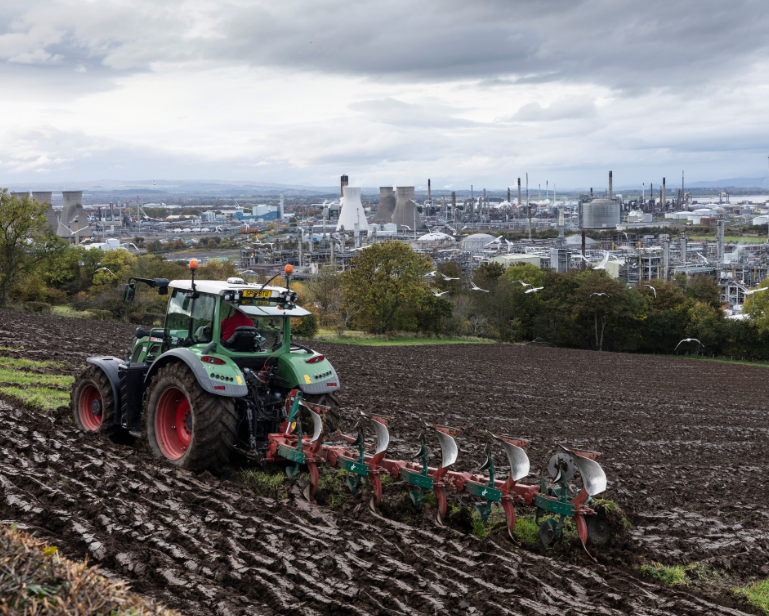
A farm worker ploughs fields overlooking Grangemouth petrochemical and refining plant in Scotland. Photograph: Murdo MacLeod/The Guardian

UN GEO report says ending this harm key to global transformation required ‘before collapse becomes inevitable’.

Continue Reading

SPECIAL REPORTS AND PROJECTS

Britain, Netherlands withdraw $2.2 billion backing for Total-led Mozambique LNG
Published

on

LONDON, Dec 1 (Reuters) – Britain and the Netherlands are withdrawing a combined $2.2 billion in support for the TotalEnergies-led Mozambique LNG project, they said separately on Monday, after both hired firms to probe human rights concerns surrounding the development.
Britain’s government said it was rescinding its $1.15 billion backing for project after promising in 2020 a $300 million loan and insurance worth about $700 million for the $20 billion project via UK Export Finance.
The Dutch government also said on Monday Total had withdrawn a $1.1 billion export insurance request for the project.
Atradius Dutch State Business authorised $1.3 billion in export insurance via two policies, the larger of which has been rescinded at the company’s request, the Dutch finance ministry said on Monday.
TotalEnergies declined to comment. Mozambique’s government did not respond to a request for comment.

CONSTRUCTION HALTED IN 2021, BUT DUE TO RESTART

Mozambique LNG’s construction was halted in 2021 due to an Islamist insurgency. Total lifted force majeure on its development in November, but made restarting conditional on the Mozambican government’s approval of a new budget, which the president said he may dispute.
“In preparation to restart the project, UKEF was presented with a proposal to amend the financing terms it had agreed originally,” British business minister Peter Kyle said in a statement.
“My officials have evaluated the risks around the project, and it is the view of His Majesty’s Government that these risks have increased since 2020.” The interests of UK taxpayers “are best served by ending our participation in the project at this time,” he added.
Jihadist attacks have been back on the rise in Mozambique, with Total bringing in workers and equipment this year by air and sea for security reasons.

PROJECT CAN PROCEED WITHOUT UK, DUTCH FINANCING, TOTAL HAS SAID

In April TotalEnergies CEO Patrick Pouyanne told investors that project partners could move forward without UK and Dutch financing, using equity.
More than 70% of the project’s financing is secured, and about 90% of the future gas production is commercialized via contracts with buyers.
Kyle said UKEF would pay back the project for any premium paid. A UKEF spokesperson declined to name the amount.
The Dutch finance minister on Monday said TotalEnergies had asked to cancel part of its insurance via a letter dated November 24, just as an independent human rights review ordered by the ministry was being finalised.
“This means that the Netherlands will no longer be involved in financing the project,” the statement reads.
A $213 million policy insuring Dutch contractor Van Oord remains in place, a ministry spokesperson said.
TotalEnergies holds a 26.5% operating stake in Mozambique LNG. Japan’s Mitsui (8031.T), opens new tab owns 20% in the project and Mozambique state firm ENH 15%, alongside smaller stakeholders including India’s ONGS and Oil India.

CRITICISM FROM ENVIRONMENTAL, HUMAN RIGHTS GROUPS

Human rights nonprofit ECCHR last month filed a criminal complaint against TotalEnergies, alleging it was complicit in torture and enforced disappearances allegedly carried out by government soldiers in Mozambique.
In April, UKEF hired law firm Beyond Human Rights Compliance LLP to investigate risks around Mozambique LNG following initial media reports of the alleged torture, three people interviewed by the firm told Reuters.
TotalEnergies has said those claims lack evidence.
The Dutch government said on Monday the two firms it hired to investigate — Clingendael and Pangea Risk — found the torture allegations credible, though they could not ascertain Total’s knowledge or role, if any.
A London court in 2023 dismissed a court challenge by environmental group Friends of the Earth against the British government’s funding for the project.

Continue Reading

SPECIAL REPORTS AND PROJECTS

The secretive cabal of US polluters that is rewriting the EU’s human rights and climate law
Published

on

Leaked documents reveal how a secretive alliance of eleven large multinational enterprises has worked to tear down the EU’s flagship human rights and climate law, the Corporate Sustainability Due Diligence Directive (CSDDD). The mostly US-based coalition, which calls itself the Competitiveness Roundtable, has targeted all EU institutions, governments in Europe’s capitals, as well as the Trump administration and other non-EU governments to serve its own interests. With European lawmakers soon moving ahead to completely dilute the CSDDD at the expense of human rights and the climate, this research exposes the fragility of Europe’s democracy.

Key findings

  • Leaked documents reveal how a secretive alliance of eleven companies, including Chevron, ExxonMobil, and Koch, Inc., has worked under the guise of a “Competitiveness Roundtable” to get the Corporate Sustainability Due Diligence Directive (CSDDD) either scrapped or massively diluted.
  • The companies, most of which are headquartered in the US and operate in the fossil fuel sector, aimed to “divide and conquer in the Council”, sideline “stubborn” European Commission departments, and push the European People’s Party (EPP) in the European Parliament “to side with the right-wing parties as much as possible”.
  • Chevron and ExxonMobil were in charge of mobilising pressure against the CSDDD from non-EU countries. The Roundtable companies endeavoured to get the CSDDD high on the agenda of the US-EU trade negotiations and also worked on mobilising other countries against the CSDDD, in order to disguise the US influence.
  • Roundtable companies paid the TEHA Group – a think tank – to write a research report and organise an event on EU competitiveness, which echoed the Roundtable’s position and cast doubt on the European Commission’s assessment of the economic impact of the CSDDD.

While Europeans were told that their governments were negotiating a landmark law to hold corporations accountable for human rights abuses and climate damage, a secretive alliance of US fossil fuel giants was working behind the scenes to destroy it. Collaborating under the innocent-sounding name ‘Competitiveness Roundtable’, eleven multinational enterprises have worked closely to eviscerate several EU sustainability laws, including the Corporate Sustainability Due Diligence Directive (CSDDD) and the Corporate Sustainability Reporting Directive (CSRD). This Competitiveness Roundtable may be unknown, but its members are a who’s-who of polluting, mainly US, multinationals, including Chevron, ExxonMobil, and Dow. The group seems to have run rings around all branches of the EU and the Trump administration to get what they want: scrapping, or at least hugely diluting, the CSDDD.
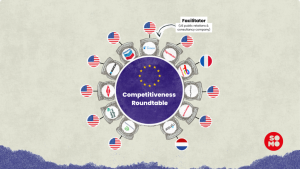
 

Leaked documents  obtained by SOMO reveal how, under the pretext of the now-near-magical concept of ‘competitiveness’, these companies plotted to hijack democratically adopted EU laws and strip them of all meaningful provisions, including those on climate transition plans, civil liability, and the scope of supply chains. EU officials appear not to have known who they were up against. But the documents obtained by SOMO show a high level of organisation and strategising with a clear facilitator: Teneo, a US public relations and consultancy company.

The documents indicate that many of the companies involved wanted to stay hidden from view. After all, if it were widely known that a secretive group of mostly American fossil fuel companies like Chevron, ExxonMobil, and Koch, Inc. was working as a coordinated organisation to dilute an EU climate and human rights law, that might raise questions and serious concern among the public and the policymakers they were targeting. Many of the companies in the Roundtable have never publicly spoken  out against the CSDDD.

Big Oil’s ‘Competitiveness Roundtable’

The Competitiveness Roundtable is dominated by fossil fuel companies, including three Big Oil companies (ExxonMobil, Chevron, TotalEnergies) and three other companies with activities in the oil and gas sector (Koch, Inc., Honeywell, and Baker Hughes). Other members are Nyrstar (minerals and metals, a subsidiary of Trafigura Group); Dow, Inc. (chemicals); Enterprise Mobility (car rentals); and JPMorgan Chase (finance).

Teneo, the Roundtable’s coordinator, has a track record(opens in new window) of working with fossil fuel companies, including Chevron, Shell, and Trafigura, and was hired by the government of Azerbaijan to handle public relations(opens in new window) when it hosted the COP29 climate conference.

In February 2025, the European Commission published the Omnibus I proposal(opens in new window), which aims to “simplify” several EU sustainability laws, including the CSDDD. The documents obtained by SOMO reveal that the Roundtable companies, which have been meeting weekly since at least March 2025, worked on deep interventions within each of the three EU institutions to get the Omnibus I package to align exactly with their views. The EU institutions are expected to reach a final agreement on Omnibus I by the end of 2025.

The documents reveal that the Roundtable companies’ activities in the Parliament are far more significant than what is visible in the EU Transparency Register(opens in new window) Eight of the Roundtable’s lobbying meetings during the Strasbourg plenary sessions of May and June 2025, listed in the Transparency Register, show Teneo as the only attendee, thereby failing  to disclose the names of other Roundtable companies that participated in these meetings. Another three meetings the Roundtable held were not found in the EU Transparency Register(opens in new window) at all.

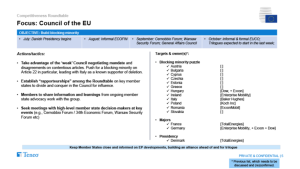
“Divide and conquer” the Council

In the European Council, the Roundtable plotted to “divide and conquer” EU governments to get the climate article in the CSDDD deleted. In June 2025, during the final weeks of negotiations in the Council on the Omnibus I proposal, the Roundtable discussed lobbying EU government leaders to “intervene politically” to ensure its priorities were included in the Council’s negotiation mandate. Subsequently, German Chancellor Merz and French President Macron reportedly(opens in new window) personally intervened(opens in new window) in the Council’s political process, leading to a dramatic dilution(opens in new window) of the texts(opens in new window) negotiated in the months before the intervention. Several of the changes made to the texts strongly align with the Roundtable’s demands, including delaying and substantially weakening the climate obligations, scrapping EU civil liability provisions, and limiting the responsibility of companies to take responsibility for their supply chains (the ‘Tier 1’ restriction).

Competitiveness Roundtable meeting document, 11 July 2025.

Additionally, the documents reveal that the Roundtable is still aiming to drum up a “blocking minority”  to overturn the Council’s negotiation mandate during the trilogue negotiations, which started in November 2025. By “tak[ing] advantage of the ‘weak’ Council negotiating mandate” and disagreements between EU Member States on “contentious articles”, the Competitiveness Roundtable companies hope to force the Danish Council presidency  to give up on including any form of climate obligations in the CSDDD – despite EU Member States’ agreement on this in the June 2025 Council mandate(opens in new window) .

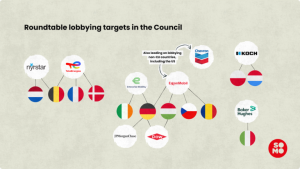
To implement the divide-and-conquer strategy, the Roundtable assigned specific companies to “establish rapporteurships” with different EU governments. TotalEnergies would target the French, Belgian, and Danish governments, and ExxonMobil would target Germany, Hungary, the Czech Republic, and Romania.
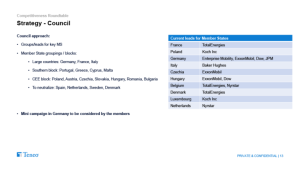
Competitiveness Roundtable meeting document, 16 May 2025.

Competitiveness Roundtable meeting document, 11 July 2025.

Circumventing “stubborn” European Commission departments

The Roundtable also discussed working on “circumvent[ing]” two “stubborn” European Commission departments involved in the Omnibus political process, DG JUST and DG FISMA,  which, in their view, were “unlikely to be willing to see our side of the story”. According to the documents, DG JUST opposed deleting the climate article and restricting the Directive’s scope to only very large enterprises. The Roundtable aimed to diminish the role of these departments by pressuring President Von der Leyen and Commissioners McGrath (DG JUST) and Albuquerque (DG FISMA) by “organising letters from Irish and German business groups” and using an event held by the European Roundtable for Industry to “target” Von der Leyen and McGrath.

Read full report: Somo.nl

Source: Somo

Continue Reading

Resource Center

Legal Framework

READ BY CATEGORY

Facebook

Newsletter

Subscribe to Witness Radio's newsletter


Trending

Subscribe to Witness Radio's newsletter