
NGO WORK
Documenting killings and disappearances of land and environmental defenders

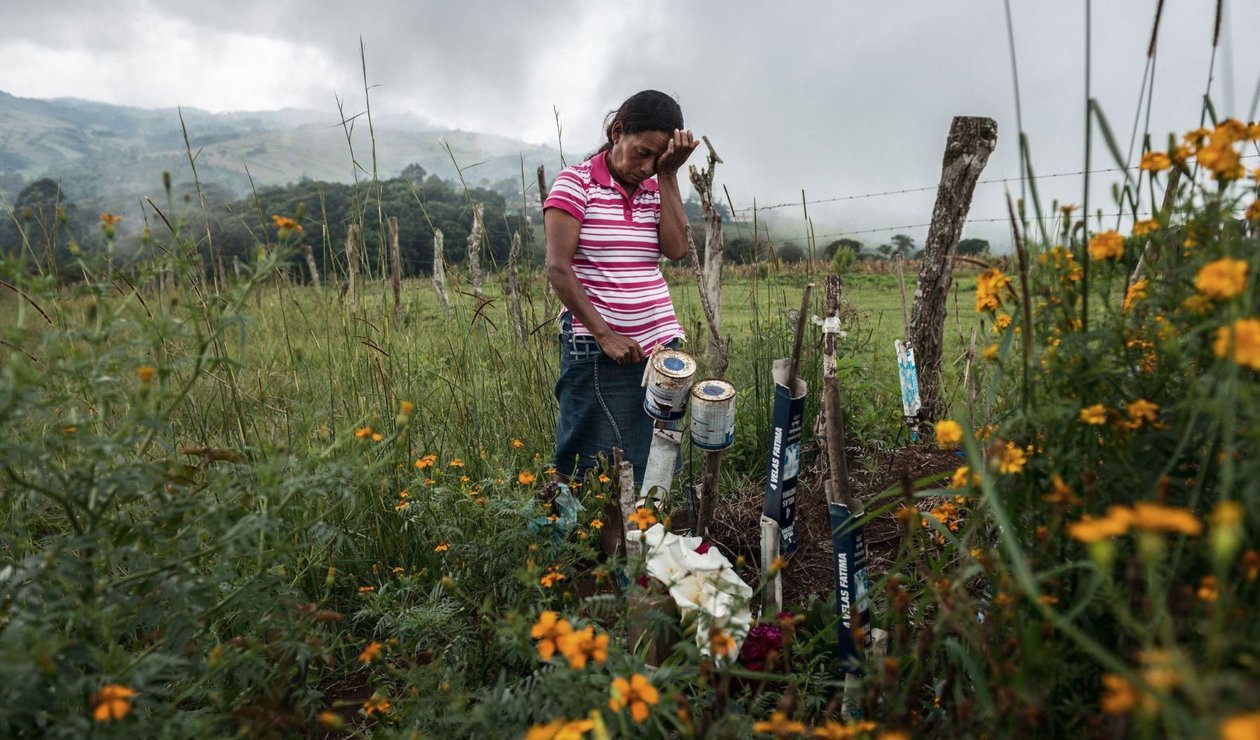
Julia Francisco Martínez stands at the graveside of her husband Juan, a Honduran Indigenous defender who was found murdered in 2015. Giles Clarke / Global Witness
Every year, Global Witness works with partners to gather evidence, verify and document every time a land and environmental defender is killed or disappeared. Our methodology follows robust criteria, yet undocumented cases pose challenges when it comes to analysing data
Global Witness documents killings and long-term disappearances of land and environmental defenders globally. In partnership with over 30 local, national and regional organisations in more than 20 countries, we produce an annual report containing these figures, and we have done so since 2012.
Our methodology involves a year-long process of cross-referencing data from different sources to ensure its credibility. Over 2,200 killings or long-term disappearances of defenders appear in our database since 2012 – with 146 cases documented in 2024.
Every year, we maintain a database to keep a record of these crimes and create a comprehensive global picture of the systematic violence defenders face.
The data provides a snapshot of the underlying drivers behind reprisals and indicates how some defenders and their communities face increased risks. Exposing these trends is the first of many steps to ensure that defenders and their communities are protected and can exercise their rights without fearing for their lives.
Killings and disappearances documented between 2012 and 2024
-
2,253
defenders have been killed or disappeared since 2012
Global Witness
-
146
of these attacks occurred in 2024
Global Witness
Classifying defenders’ cases
Most of the cases recorded in our database are killings – including assassinations by illicit actors, state murder and death in detention.
Our database also includes disappearances of defenders, where the individual has been missing for six months or more.
All reports prior to 2025 have combined killings and long-term disappearances into one single headline figure. For greater clarity, our latest report indicates a distinction between these two types of attack, and our reports will continue to make this distinction in future.

Lissette Chuñil makes a offering to honour her grandmother – a Mapuche woman and president of the Indigenous community of Máfil, who was disappeared in November 2024. Tamara Merino / Global Witness
Cases from prior years or those already included in our database are not continuously monitored. Where we receive updated information on an attack, we may retrospectively include or remove cases.
We document the killing or disappearance of a defender when there is a reasonable and suspected link to an individual’s activism or where the individual played a role in defence of the land or the environment.
As well as individuals directly involved in activism, we also document tangential violence against families, community members or others caught up in attacks.
Our definition covers a broad range of people and encompasses different types of land and environmental leadership. Crucially, this involves people who work in any capacity to protect rights linked to the exploitation of land or the environment.
How we define land and environmental defenders
Land and environmental defenders are a specific type of human rights defender – individuals or groups of people who act to promote, protect or strive for the realisation of human rights through peaceful action.
Their role as human rights protectors is recognised by the UN Declaration on Human Rights Defenders, principles also enshrined in other legally binding international instruments. This includes those working to protect human rights relating to the environment, including water, air, land, flora and fauna.
We define defenders as people who take peaceful action against the unjust, discriminatory, corrupt or damaging exploitation of natural resources or the environment.
Land and environmental struggles take different forms and are shaped by local contexts. For example, in every region of the world, communities strive against systematic land dispossession and environmental destruction from extractive industries.
For some the threat to territories is intimately connected to the degeneration of their sovereignty, culture, livelihoods and homes. Others are caught in wider conflicts which exacerbate land, environmental and climate injustices.
Defenders often live in communities whose land, health and livelihoods are threatened by the operations of mining, logging, agribusiness or other industries.
Some defend our biodiverse environment, while others support such efforts through their roles as lawyers, politicians, park rangers, journalists, or members of campaigns or civil society organisations.
Others are holders of traditional or Indigenous knowledge, working as Indigenous guards or community knowledge keepers.

Family members sift through photographs of Ricardo Arturo Lagunes Gasca, a human rights lawyer who disappeared with Indigenous leader Antonio Díaz Valencia after attending a community meeting in San Miguel de Aquila, Mexico. Luis Rojas / Global Witness
Identifying and documenting cases
We learn of killings and disappearances through reliable sources of online reporting, tip-offs and wider documentation efforts from civil society organisations.
We set up search engine alerts using keywords and conduct other searches online to identify relevant cases. We also share information with international and national organisations who report on attacks against human rights defenders.
We then research each case to assess whether the person killed or disappeared was a land and environmental defender, according to our definition.
Desk-based research has its limitations. Many attacks on land and environmental defenders receive little or no media attention, due to the remote location of attacks, stigmatisation by investigating authorities, or widespread government repression of the media.
In most instances, we supplement identified cases with additional research. This includes working closely to share information with trusted civil society organisations and communities who have gathered evidence through their own investigations.

Communities affected by the East African Oil Pipeline report receiving threats after refusing to leave their homes without adequate compensation. Jjumba Martin / Global Witness
Verifying information
We work closely with in-country partners to verify whether there is a reasonable and suspected link between the killing or disappearance and the person’s activism.
Testimony from families, communities and organisations working with targeted defenders often provides key information. Sometimes we review official documentation, including police reports or legal documents. This information is documented by Global Witness and not made public.
Navigating toxic narratives
Year after year, we are confronted with cases where the very nature of what it means to be a land and environmental defender is questioned.
Often governments, corporations and media outlets propagate a narrow view of land and environmental activism, excluding individuals and communities whose role defending land or environmental rights is less recognisable.
Across the world, defenders and their communities are often labelled as “criminals”, “agitators” or “communists”. These toxic terms are sometimes employed by the institutions and authorities that claim to uphold people’s rights.
Media can often repeat damaging narratives or even simply ignore reporting on these cases, making it difficult to verify whether an attack could be linked to a persons’ activism.
In these situations, we work closely with local organisations to clarify the contexts in which defenders work, and the patterns of stigmatisation they face, and gather more evidence of the role they played in environmental and land rights protection.

An Indigenous activist holds smoke bombs, tear gas canisters and other projectiles used by Guatemalan state authorities to prevent peaceful protest against a hydro-electric project. James Rodriguez / Global Witness
We also work alongside other organisations gathering national, regional and international reprisal-related data. This includes official UN sources of data collection as well as civil society initiatives.
Every data collection project has its own definitions and methodologies, which create challenges in collating this data into a global dataset on attacks against defenders. Some existing datasets overlap with ours, but often do not fully coincide.
For every case documented, we research and evaluate whether it fits our definition of a land and environmental defender.
Often, public reporting on attacks is circumstantial or lacks information. In some cases, attacks go unreported, particularly in rural areas and in certain countries.
In these cases, countries with restricted civic space – where civil society organisations, NGOs and other groups that monitor the work of defenders are less present, for example – are not able to fill the reporting gap.
This is further exacerbated by repression of the media, authoritarian governments and active political conflicts. Documenting massacres or reprisals in active conflict zones, areas under occupation or where organised crime groups have social or territorial control is also challenging.
These contextual challenges mean that our data is likely to underreport killings and disappearances in certain countries and regions of the world – particularly in areas of Asia, Africa and the Middle East.
Spotlighting our criteria
To meet our criteria, a case must be supported by the following available information:
- Credible sources of information. This can include online publications, official documentation on a case or collating information from families, colleagues and civil society organisations linked to a case.
- Details about the type of act and method of violence, including the date and location.
- Name and biographical information about the victim.
- Clear, proximate and documented connections to the protection and defence of environmental and land rights. This includes evaluating the various roles of defenders play and the wider contexts and underlying conflicts that affect them.

Many of the defenders working to protect land and environment also speak out against the harmful impacts of the climate crisis either because of the direct impact on their livelihoods and communities or in their role as lawyers, journalists or members of civil society organisations. Matheus Alves / Sumauma / Global Witness
Analysing the data
We seek to understand the most dangerous repercussions defenders face in the context of the territorial and environmental disputes taking place in their countries.
We also look to understand the characteristics of defenders and their communities – who they are as people and whether some face greater, more targeted risks.
Focusing on the most serious harms (killings and disappearances) enables us to confidently verify the threats defenders face and allows us to analyse geographical trends at regional, country and local level – though with recognised limitations.
We record whether a defender belongs to a marginalised group – Indigenous Peoples, Afro-descendants or rural communities – or if they act as a defender in their role as lawyers, journalists or members of civil society organisations. This enables us to understand more about the characteristics of defenders working to protect land and the environment.
We try to gather information on the rights defenders are striving to protect, such as whether they are engaged in a territorial dispute or preventing environmental damage.

Violence is often connected to wider territorial disputes linked to the expansion of extractive projects, devastating the homes and livelihoods of families and communities. Andrew Ball / Panos / Global Witness
We also aim to identify the underlying driver of the harms that led to their acts of protest – for instance, land disputes or industries linked to destructive practices or rights infringements.
Where possible, we record the alleged perpetrator of the crime – both the direct offender and the suspected intellectual authors.
Our dataset is reviewed and updated annually. Before we publish our data, documented cases from the previous year go through a rigorous fact-checking process to ensure confidence in the veracity of our data.
We do not proactively review historic cases in our database. If there are changes in the status of a case or if more information about an individual defender comes to light, we revise and amend our database accordingly.
In the weeks before the publication of our Annual Defenders Report, we temporarily halt the inclusion of new cases – any new cases or information received are kept on file and later added to the database.
Despite efforts to overcome the data access and verification challenges outlined above, our data is likely incomplete. The figures presented in Global Witness reports are therefore probably an underestimate and should be considered as only a partial picture of the extent of killings and disappearances of land and environmental defenders.
Read full article: globalwitness.org
Related posts:

 Human rights defenders show remarkable courage in the face of attacks and killings – new report
 #COP27: HUMAN RIGHTS ADVOCATES URGE PARTIES TO INCREASE RECOGNITION AND PROTECTION OF ENVIRONMENTAL AND LAND DEFENDERS.
 Toxic platforms, broken planet: How online abuse of land and environmental defenders harms climate action
 Defending tomorrow: The climate crisis and threats against land and environmental defenders

Related posts:
 Failed US-Brokered “Peace” Deal Was Never About Peace in DRC
 Profit off Peace? Meet the Corporations Poised to Benefit from the DRC Peace Deal
 Grain trader Cargill faces legal challenge in US over Brazilian soya supply chain
 Mps Are Likely To Defy Electorates On Age-Limit Constitutional Amendment – Survey

Minority Rights Group welcomes today’s decision by the African Court on Human and Peoples’ Rights in the case of Ogiek people v. Government of Kenya. The decision reiterates previous findings of more than a decade of unremedied violations against the indigenous Ogiek people, centred on forced evictions from their ancestral lands in the Mau forest.
The Court showed clear impatience concerning Kenya’s failure to implement two landmark rulings in favour of the indigenous Ogiek people: in a 2017 judgment, that their human rights had been violated by Kenya’s denial of access to their land, and in a 2022 judgment, which ordered Kenya to pay nearly 160 million Kenyan shillings (about 1.3 million USD) in compensation and to restitute their ancestral lands, enabling them to enjoy the human rights that have been denied them.
Despite tireless activism from the community and the historic nature of both judgments, Kenya has not implemented any part of either decision. The community remains socioeconomically marginalized as a result of their eviction and dispossession. Evictions have continued, notably in 2023 with 700 community members made homeless and their property destroyed, and in 2020 evicting about 600, destroying their homes in the midst of the Covid-19 pandemic.
Daniel Kobei, Executive Director of the Ogiek Peoples’ Development Program stated, ‘We have been at the African Court six times to fight for our rights to live on our lands as an indigenous people – rights which our government has denied us and continues to violate, compounding our plights and marginalization, despite clear orders from the African Court for our government to remedy the violations. This is the seventh time, and we were hopeful that the Court would be more strict to the government of Kenya in ensuring that a workable roadmap be followed in implementation of the two judgments.’

Kenya has repeatedly justified the eviction of Ogiek as necessary for conservation, although the forest has seen significant harm since evictions began. Many in the community see a connection between their eviction and Kenya’s participation in lucrative carbon credit schemes.
‘The Court’s decision underscores the importance of timely and full implementation of measures imposed on a state which has been found to be in breach of their internationally agreed obligations. Kenya must now repay its debt to the indigenous Ogiek by restituting their land and making reparations, among other remedies ordered by the Court’, said Samuel Ade Ndasi, African Union Advocacy and Litigation Officer at Minority Rights Group.
The decision states, ‘the court orders the respondent state to immediately take all necessary steps, be they legislative or administrative or otherwise, to remedy all the violations established in the judgment on merits.’ The court also reaffirmed that no state can invoke domestic laws to justifiy a breach of international obligations.
Both of the original judgments were historic precedents, breaking new ground on the issue of restitution and compensation for collective violations experienced by indigenous peoples and confirming the vital role of indigenous peoples in safeguarding ecosystems, that states must respect and protect their land rights, that lands appropriated from them in the name of conservation without free, prior and informed consent must be returned, and their right to be the ultimate decision makers about what happens on their lands. Today’s decision adds to this tally of precedents as it is the first decision of the African Court on Human and Peoples’ Rights concerning the record of a state in implementing a binding decision.
The case
In October 2009, the Kenyan government, through the Kenya Forestry Service, issued a 30-day eviction notice to the Ogiek and other settlers of the Mau Forest, demanding that they leave the forest. Concerned that this was a perpetuation of the historical land injustices already suffered, and having failed to resolve these injustices through repeated national litigation and advocacy efforts, the Ogiek decided to lodge a case against their government before the African Commission on Human and Peoples’ Rights with the assistance of Minority Rights Group, the Ogiek Peoples’ Development Program and the Centre for Minority Rights Development. The African Commission issued interim measures, which were flouted by the Government of Kenya and thereafter referred the case to the African Court based on the complementarity relationship between the African Commission and the African Court on Human and Peoples’ Rights and on the grounds that there was evidence of serious or massive human rights violations.
On 26 May 2017, after years of litigation, a failed attempt at amicable settlement and an oral hearing on the merits, the African Court on Human and Peoples’ Rights rendered a merits judgment in favour of the Ogiek people. It held that the government had violated the Ogiek’s rights to communal ownership of their ancestral lands, to culture, development and use of natural resources, as well as to be free from discrimination and practise their religion or belief. On 23 June 2022, the Court rejected Kenya’s objections and set out the reparations owed for the violations established in the 2017 judgment.
Source: minorityrights.org
Related posts:
 Trauma and Land Loss: New Study Focuses on Mental Health of Evicted Indigenous People
 Justice Denied: East African Court of Justice Grants Tanzanian Government Impunity to Trample Human Rights of the Maasai
 EACOP: East African Court of Justice will hear arguments on court’s jurisdiction
 Tanzanian High Court Tramples Rights of Indigenous Maasai Pastoralists to Boost Tourism Revenues
Related posts:
 30 civil society organizations have written to the World Bank Group demanding to publicly disclose the Africa Energy Approach paper.
 World Bank’s new scheme to privatize land in the developing world exposed
 World Bank is backing dozens of new coal projects, despite climate pledges
 Communities Under Siege: New Report Reveals World Bank Failures in Safeguard Compliance and Human Rights Oversight in Tanzania

CSOs push for reforms at the KFW Accountability Mechanism after experts discovered that it has weak remedies in addressing grievous harms caused by its investments.

UPDF General on the spot over fresh evictions in Hoima

Small-scale fishers and coastal communities are pushing to testify before a human rights commission investigating the causes of food inequality in South Africa.

The Kenyan government insists on maintaining provisions of the Seed Act that the court nullified: farmers and legal experts question the motive.

Evicted from their land to host Refugees: A case of Uganda’s Kyangwali refugee settlement expansion, which left host communities landless.

US-DRC Strategic Partnership Agreement Faces Constitutional Challenge in Court

Why govt is launching a comprehensive digital land registry

Indigenous communities in Eastern Nepal accuse the World Bank’s Linked Cable Car Project of rights violations.

Innovative Finance from Canada projects positive impact on local communities.

Over 5000 Indigenous Communities evicted in Kiryandongo District

Petition To Land Inquiry Commission Over Human Rights In Kiryandongo District

Invisible victims of Uganda Land Grabs
-
 MEDIA FOR CHANGE NETWORK1 week ago
Small-scale fishers and coastal communities are pushing to testify before a human rights commission investigating the causes of food inequality in South Africa.
-
 MEDIA FOR CHANGE NETWORK2 weeks ago
FEATURE: What Lagos Can Learn From Kenya, Morocco, Uganda’s Forced Evictions
-
 MEDIA FOR CHANGE NETWORK1 week ago
The Kenyan government insists on maintaining provisions of the Seed Act that the court nullified: farmers and legal experts question the motive.
-
 MEDIA FOR CHANGE NETWORK1 week ago
UPDF General on the spot over fresh evictions in Hoima
-
 MEDIA FOR CHANGE NETWORK2 weeks ago
13 years after the refugee host community was forcefully evicted to expand a refugee settlement, thousands remain unsettled.
-
 MEDIA FOR CHANGE NETWORK13 hours ago
CSOs push for reforms at the KFW Accountability Mechanism after experts discovered that it has weak remedies in addressing grievous harms caused by its investments.