MEDIA FOR CHANGE NETWORK
Well connected: The resistance against the fossil industry in East Africa.
Published
2 years agoon

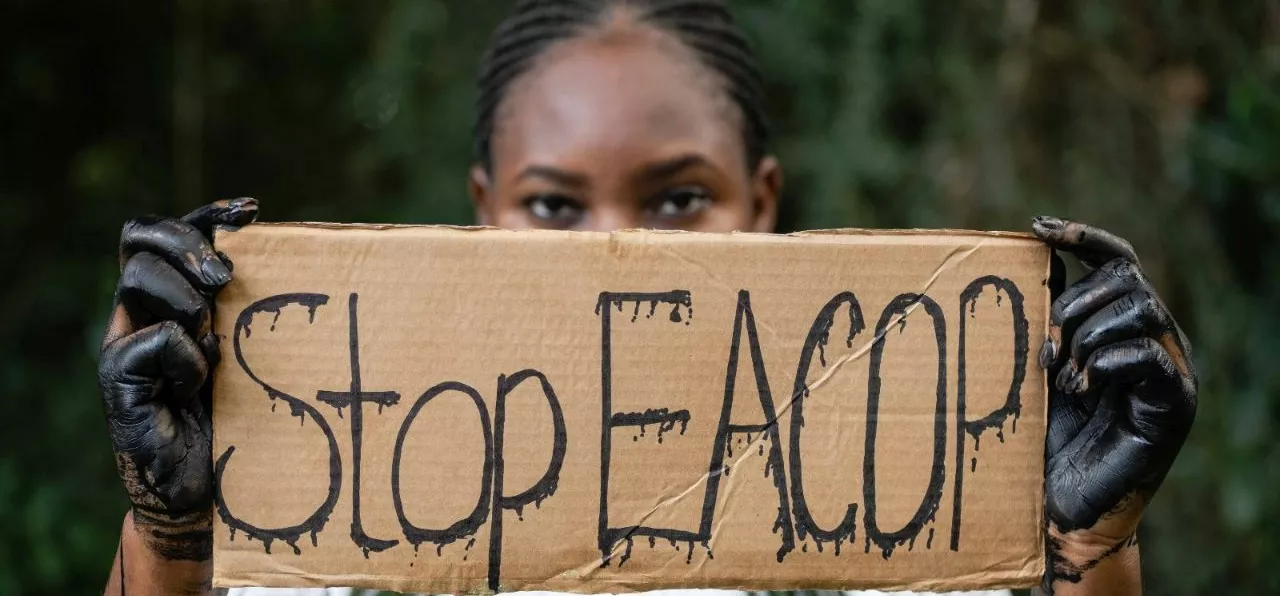
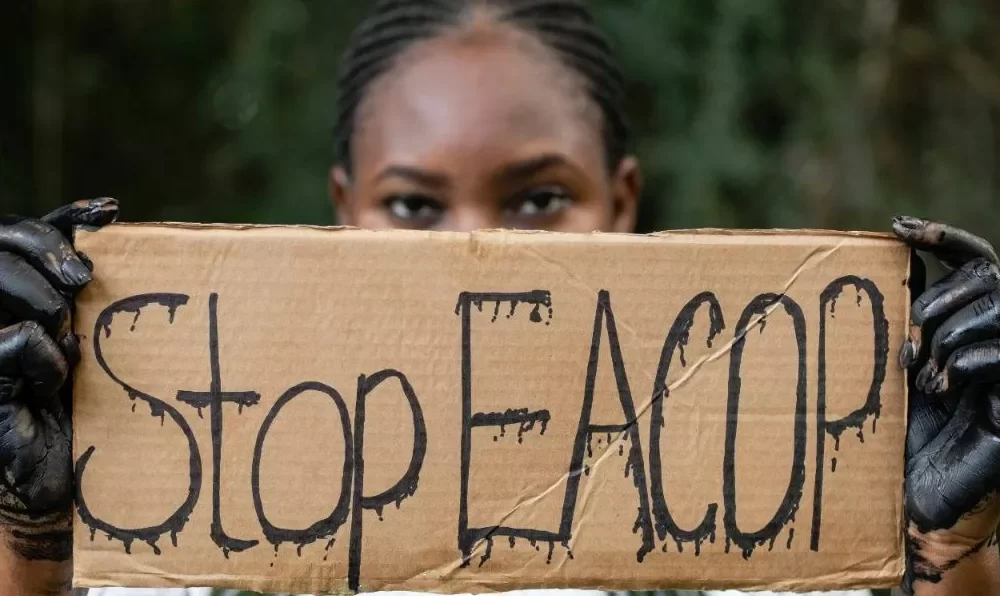
Uganda and Tanzania have created facts about the promotion of the fossil industry by launch on the construction of the East African crude oil pipeline. At the same time, the internationally networked resistance of civilian actors towards the booming oil production in East Africa is growing. Judicial complaints are a central element in their fight to uphold the rule of law, human rights and environmental protection.
Last year, the beginning of the end of the fossil era was ushered in at the world climate conference in Dubai. Some countries interpret this as follows: it is necessary to get the last fossil fuels out of the ground. This means drilling, dredging, pumping – to earn crude oil, gas and coal once again.
One example is the fossil industry in Uganda, which is trying to feed its last fossil occurrences from the ground into the global economy. It wants to pump the petroleum down there to the surface and through a heated pipeline into a deep-sea port into the Tanzanian tanga. From there, it, together with the French energy giant TotalEnergies and Chinese participation, is being shipped for the global oil industry.
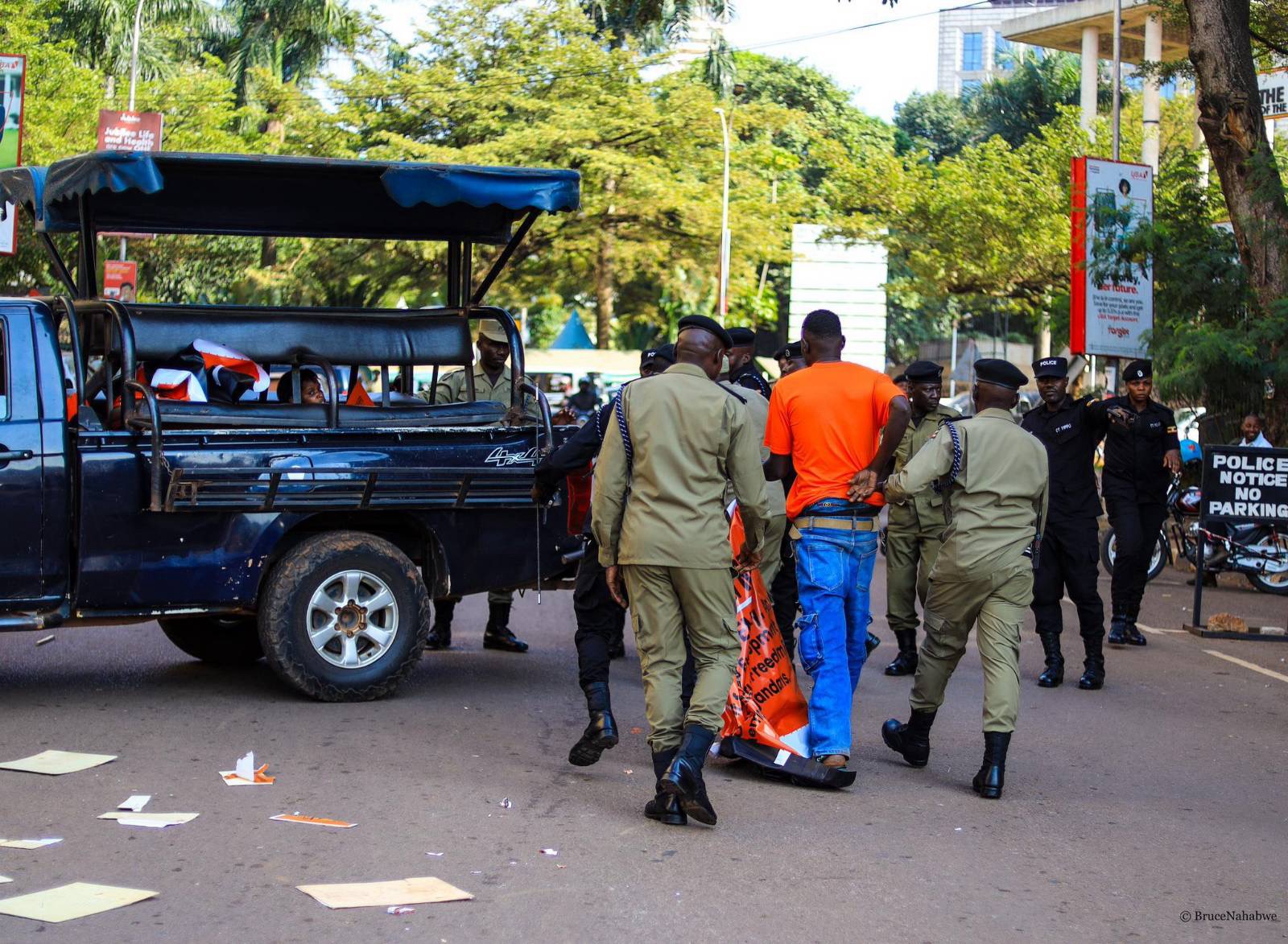
The oil project called the East African Crude Oil Pipeline (EACOP) with a targeted running time of 25 years has been under construction since this April. In Tanzania and Uganda, the scope of civilian actors who are fighting against land seizures for the 1,443-kilometre-long pipeline corridor and defending human rights is severely restricted. In Uganda, the police have arrested farmers, journalists, human rights and environmental defenders who have spoken out against the oil projects. Reporters Without Borders once again stated in May that freedom of the press and civil say are strictly curtailed. At the end of May, eight environmental activists were arrested when a letter of protest to the Chinese Embassy was arrested by Ugandan security forces. Obviously, governments sacrifice freedom of expression, human rights and livelihoods for their fossil utopianism.
Bizarre oil shops
Uganda’s government is not only pursuing an export strategy for its crude oil, which is stored in the Albertgraben on the border with the DR Congo. It also wants to modify its own oil import infrastructure. For this purpose, Ugandan President Yoweri Museveni initiated an old oil dispute with Kenya: In February, the neighbouring countries decided to resume the plan to expand the Mombasa-Eldoret-Kampala pipeline. This pipeline originates in the port of Mombasa/Kenya, on the Indian Ocean and currently leads via Nairobi to Eldoret in West Kenya. This part has been in operation since May 2014. For many years, plans to extend the pipeline have been circulating, first to Kampala on Lake Victoria, Ugandan, then on to Rwanda’s capital Kigali, possibly even to Lake Bujumbura Burundi around Lake Tanganyika.
This would mean that on the one hand, the export of crude oil is being produced, while at the same time the import of refined oil will be extended. This contradicts any economic logic that the finishing of a product is not outsourced as far as possible. While Uganda wants to transport its crude oil via the East African crude pipeleline EACOP to the port to Tanga and sell it from there on the world market, from Mombasa, 130 kilometres north of Tanga, refined oil via the Mombasa Eldoret pipeline to Kampala is to be pumped at the same time.
On the one hand, crude oil transport for the world market, on the other hand, import of refined oil – that is, of fishing-for fuels – for one’s own energy needs: this is an old pattern for asymmetric trade relations – or, as the Kenyan climate activist Omar Elawi said: business colonialism. Others will benefit from the refinement of the crude oil and transport. The oil, transported twice over thousands of kilometres, puts a heavy impact on the environment and undermines the social development of the adjacent municipalities. The economic dependence of the Global South is simply reproduced in terms of trade policy. And climate policy, the EACOP is also a disaster that undermines the fair energy transition in Uganda.
Problems and protest on the spot …
It is therefore not surprising that the sharpest critics of EACOP include many regional environmental and human rights defenders as well as initiatives affected. For example, Witness Radio Uganda documents land veins on an interactive map and has been providing legal assistance to people in rural areas affected by land expulsion for years. Tonny Katende from Witness Radio says: “We combine legal assistance and media work to mobilize the rural population. This is the only way she can protest with a strong voice against the injustices in land use and environmental destruction and advocate for equal access to resources in our country.”
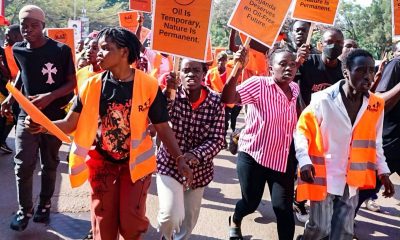
Another activist is Christopher Opio, founder of the Oil Refinery Residents Association (ORRA). The NGO with over 7,000 members recently protested before the Court in Hoima in Western Uganda. This is where the pipeline is to start, and 42 households have recently been sued by the government, because they refused to accept compensation for their country: “This means that these people are now being driven out of their country,” said Opio. At the protest on the 15th April the landowners moved through the city towards court. They hold signs high with messages such as “Do not attach our rights” and “do not self-elige us for oil”.
TotalEnergies has been drilling in Tilenga on the northern shore of Lake Albert on Lake Albert since June 2023. Four hundred holes are planned, one third of which are in a natural park. In the Kingfisher area further south of the lake, the Chinese company CNCOOC is taking hold to light since January 2023. Fishing communities of both places turn to the companies with a protest letter in April 2024: the light from the drilling rigs violates and distributes the fish, and nitrogen- and phosphorous-containing wastewater is burdening the water quality. The risks documented by international environmental organizations such as Les Amis de la Terre, Natural Justice and Greenpeace, as well as Human Rights Watch and BankTrack, are concerned about water and the health of over eleven million residents at Lake Albert: 426 wells ensure that water is pumped from Lake Lake Lake. The water is then heavily heavy metal and poses a threat to the population as wastewater. A leak would be a disaster for which no one is sufficiently prepared.
… and anti-imperial rhetoric of the revolt
Local civilian actors in Tanzania and Uganda, including lawyers, students and stakeholders, are often discredited by their own governments as an extended arm of imperial Western environmental extremists. An environmental journalist and a community worker temporarily left the country for persecution and intimidation.
Governments sacrifice the environment for their fossil utopianism
Activism does not arise from a capitalist lobby, but scientifically proven risks to the environment, dangers to the health of neighbouring communities, concrete human rights violations such as land displacements and expropriations, and de facto violent attacks by the police and the military – including rape and massive bodily injury to the rural population. On the basis of research and witness reports, problems are combated, such as the inadequate compensation of the oil lobby or the authoritarian behavior of the project operators. Here the anti-imperial rhetoric of the government side is like a diversionary manoeuvre.
The Chinese CNCOOC and TotalEnergies are now feeling resistance from all over the world in addition to the local protest. This is the international (instead of imperial) dimension of the debate. More than 260 civil society organisations are demanding a stop from EACOP. The political forms of action and protest of the well-connected movement against the construction of the EACOP are manifold: an important lever is legal complaints against violations by companies and governments. Another strategy is divestment. Potential investors or insurance companies should be persuaded not to invest in environmentally harmful and anti-social projects, or to deduct their capital from such projects.
Complained, divestment and political pressure
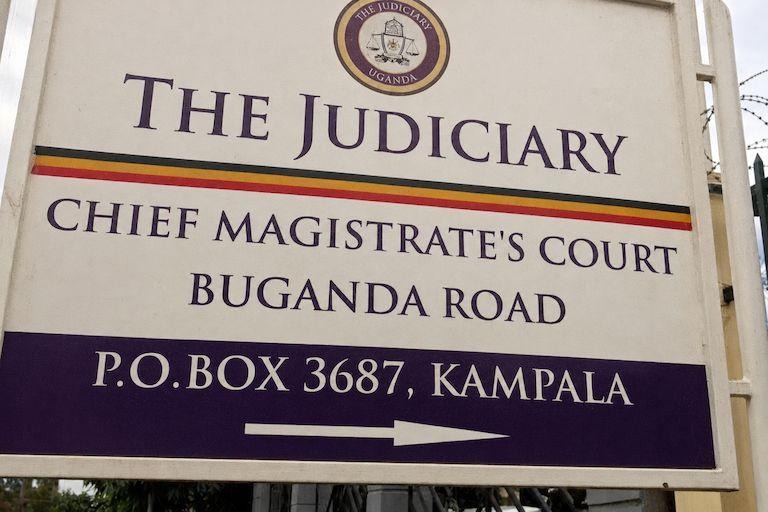
In November 2020, four East African civil society organisations, including AFIEGO, Natural Justice Kenya and the Tanzanian Strategic Litigation Centre (SLC), filed a complaint against EACOP at the East African Court (EACJ). After an initial dismissal, the Appeals Division of the East African Court requested the plaintiffs at the beginning of the year, until 22. March submit written comments. By the end of April, the defendants were again allowed to react to them in writing. The civilian plaintiffs see legal principles violated by the state, including the environmental and human rights standards enshrined in the Treaty of East African Community for the benefit of current and future generations, as well as compliance with international treaties.
The consortium of lawsuits is an expression of a regionally and internationally well-connected NGO community, which takes legal action against the fossil fuels, including its financial and reinsurance companies, through legal action. This means that among the global civilian NGO networks is growing know-how to strategies for how to take several tracks against the land grabbing of the climate-damaging fossil industry. With the worldwide campaign “StopEACOP, 29 investors have now been discouraged to be part of the pipeline project, including the second largest German insurance group Talanx.
In the fight against the large-scale fossil-fuel project EACOP, the strategy of divestment is considered promising, especially in Europe: Public pressure on the suppliers from the construction, insurance, logistics and credit institutions sectors is to prevent the cash flow for the project, which is still not financially secured. Another great success of the international campaign alliance “StopEACOP” was the withdrawal of the Japanese Sumitomo Mitsui Financial Group over a year ago. Meanwhile, 27 banks and 23 reinsurers as well as four export credit agencies have announced that they will not support EACOP. Therefore the mood on the Instagram account of the campaign alliance is sometimes euphoric.
The political pressure was also some success. International alliances confront politicians with studies such as “A Disaster in the Making” by Les Amis de la Terre or “Our Trust is Broken” by Human Rights Watch 2023. The European Parliament called on the governments of Uganda and Tanzania to comply with human rights standards in September 2022. In a decision on the COP27 climate conference, the German Bundestag spoke out against the financing of the EACOP in 2022.
Do the climate complain?
Lucien Limacher from the organisation Natural Justice from South Africa, one of the members of the plaintiffs against the EACOP before the East African Court, generally likes the effects of climate lawsuits. On the one hand, climate lawsuits are also increasing on the African continent. However, Limacher also says: “In the global North there is a misunderstanding about how we define climate processes. Africa will suffer massively from the consequences when global warming of more than 2.5 degrees is suffering.” In addition, in view of the 400 to 600 fossil projects that are up to 400 to 600, the climate cannot be saved solely through the route of the process. “So we need to think about how we proceed in legal disputes. A new way of thinking is emerging on the African continent: local climate lawsuits are no longer just about emissions, but about much more comprehensive risk factors such as access to food and water or land, because these areas that will be most severely affected.”
Despite the manifold resistance, the further construction of the EACOP is also progressing – and thus Uganda’s desire to become part of the ranks of the petrostate, half of which cover their economy from oil business. After the exit of European and Japanese banks from EACOP financing, the French energy giant TotalEnergies has signed a contract with China Petroleum Pipeline Engineering (CPP) for the construction and supply of line pipes. This means that the cross-border project has been relocated to Beijing, from where most of the still missing loans are likely to come from. During the recent visit of China’s head of state Xi Jinping to France in early May, there was no public talk of the oil shipping in Uganda. It is hardly conceivable that Macron and Xi of all people can silence the issue, because the resistance against the EACOP is great, especially in France.
The struggles for oil production in Uganda, with the words of the Ugandan anthropologist Paddy Kinyeras 1, show that pipelines as critical infrastructures represent physical manifestations of power geometry. The realization of the pipeline requires governmental power and strengthens it at the same time. Since the Paris Climate Agreement, the World Climate Summits have been a place to publicly confront this government and corporate power and to create political back pressure against the fossil industry. They also serve as an international networking area for the civilian actors.
At the end of 2024, after the United Arab Emirates in 2023, a fossil heavyweight will once again host the World Climate Summit: Azerbaijan. And thus for the third time in a row a country that plans to rely on fossil resources and revive oil and gas production before the agreed phasing-out. Once again, the summit will be headed by a long-standing employee of an oil company, Muchtar Babaiev. He is the Minister for the Environment of a host country that has little understanding for civilian engagement. It is not very promising to take place against the charged fossil lobby. This is one reason upon all, internationally networked environmental, research and human rights initiatives in the fossil industry. They are essential to open the oil business with protests, climate lawsuits, divestment campaigns and political pressure.
Source: www.iz3w.org

Related posts:

East African Court of Justice is to decide whether it has jurisdiction to try the EACOP case filed by Four East African NGOs today.

A reference filed by CSOs against the planned construction of the East African Crude Oil Pipeline (EACOP) is set for hearing.

The East African Court of Justice fixes the ruling date for a petition challenging the EACOP project.

Appellate Division of the East African Court of Justice (EACJ) to hear an Appeal filed by CSOs which seeks to reinstate a petition against the construction of the EACOP project tomorrow.
You may like
MEDIA FOR CHANGE NETWORK
Kassanda businessmen accused of a second attempt to grab an 86-year-old farmer’s land despite court orders.
Published
59 minutes agoon
May 5, 2026
Bacumikire’s son stands on their land in Kassanda District, allegedly fenced off by businessmen in a renewed attempt to grab the entire land.
By the Witness Radio team.
Kassanda-Uganda. Three businessmen in Kassanda District are accused of forcefully taking over land belonging to an 86-year-old resident of Kagasa village, Kiteredde Sub-county, Kassanda District, in what appears to be a second attempt to grab his entire land.
The accused, Mwesigye George, Busesire Geoffrey, and Eric Karamba Saizi, allegedly fenced off land belonging to Mr. Fred Bacumikire, depriving him of access to his farmland and grazing areas, which are his primary source of livelihood.
According to the family, this is not the first time the group has targeted the older man’s land. In 2022, two of the accused, Busesire Geoffrey and Eric Karamba Saizi, allegedly seized the entire land and wanted to evict Mr. Bacumikire, allocating themselves approximately 280 acres (113.312 ha) of Bacumikire’s land. The encroachment significantly reduced his access to the property and triggered a legal battle in which he sought full access to the property.
“They entered the whole land of about 640 acres (258.99 ha) forcefully and wanted to evict him, leaving him with only two acres,” said Mr. Mwebesa Richard, Bacumikire’s lawyer.
According to family members who spoke to Witness Radio, Mr. Bacumikire purchased the
land in 1995 from Samuel Ssekamwa under a running lease, covering approximately 640 acres. Before the sale, Ssekamwa had acquired the land from the original owner in 1972 under a 99-year lease.
“We have lived on this land since 1995, when Mzee bought it peacefully from Mr. Ssekamwa. But when Busesire and his accomplices surfaced, everything changed, and peace was lost,” Mr. Kazuga Lazarus, the eldest son of Bacumikire, said.
Kazuga added that the disputed land is located in Block 427, Plot 59, Kagasa Village, and measures approximately 640 acres.
In response to the land grab, Bacumikire, through his lawyer, filed a case at the Mubende High Court, seeking protection against eviction. The court issued an order restraining the defendants from evicting him, but the current enforceability of this order remains unclear, raising questions about legal protection for landowners.
“We went to court, I explained to the court, and they gave us an administrative order, ordering them not to evict Mr. Bacumikire.” His lawyer further added.
The lawyer says that the situation reportedly changed when a new judge temporarily took over the matter. Justice Karemani, who was holding brief for another judge, set aside the earlier court order under circumstances that the legal team questions.
According to Mr. Mwebesa, this development allowed the defendants to renew their attempts to evict the plaintiff, having already gained physical possession of 280 acres of the older man’s land. At the time, Mwesigye George owned approximately 180 acres, while Busesire Geoffrey owned about 100 acres.
Bacumikire’s legal team then appealed to the Court of Appeal in Kampala to restrain the defendants from violating the previous order.
“When the order was violated, I ran to the Court of Appeal specifically to challenge the setting aside of that order and to have it reinstated. So, when we went to the Court of Appeal, that’s now, we consented that Mr. Bacumikire and the defendants must remain on the land.” The lawyer further revealed
According to Court documents seen by Witness Radio, the deputy registrar of the Court of Appeal, Jane Mugala, issued a consent order on 3rd October 2024 ordering Mwesigye George (1st respondent) to retain physical possession of 180 acres of the land, and Busesire Geofrey (2nd respondent) to retain approximately 100 acres in the area. And that the remaining part of the land was to be left to Bacumikire. The court also ordered the complainant (Bacumikire) to be given reasonable access to a water point at Lake Wamala for his cattle.
Despite this agreement, the family now accuses the same individuals- Mwesigye George, Busesire Geoffrey, and Eric Karamba Saizi- of returning to seize the remaining land, marking what they have described as a second land grab attempt.
“They have come back again and fenced off all the land we were left with, even before the High Court case is concluded,” said Kazuga Lazarus, Bacumikire’s son, in an interview with Witness Radio, emphasizing the ongoing distress and urging authorities to intervene in what he described as an abuse of power and impunity.
This latest development, according to the family, has cut the older man and his family off from his land and left his household in distress, with reports that several of his cattle have died.
“They have fenced off the entire land, blocked access to water sources, and denied us the use of our own property. They are acting above the law, evicting us despite valid court orders and clear proof of ownership. This is land my father bought in 1995,” he said, underscoring the importance of legal protections for landowners.
He added that the situation has worsened, with four cattle already dead. He said the animals have been left without water and grazing land for a long time, a situation he blames on the alleged land grabbers.
The chairperson of Lwamugenyi village, Jamil Kibuuka, affirms that the consent order clearly states that Mwesigye and Busesire are to remain on part of the land. At the same time, the rest is used by Bacumikire. He, however, wonders why the accused abandoned this order and chose to violate it instead.
Tamale Elidadi, a resident of Kagasa village, urged authorities and stakeholders to intervene and support Bacumikire’s pursuit of justice.
“He is an old man, and these grabbers are using money and influence to buy off whoever
supports Bacumikire. He needs to be supported because his cattle are perishing due to inadequate water and pasture, yet he acquired all the land with his hard-earned money.” Mr. Tamale added.
Should the land grab succeed, the older man will be evicted from his land and left with no place to call home, highlighting the severe consequences of the ongoing violations for his family and community.
Related posts:

Hearing of a case against a 72-year-old woman for disobeying NEMA orders is kicking off today..
RDCs, Local Leaders Accused of Grabbing 70-Acre Ancestral Land
Makindye Magistrate Court grants bail to a 72-year-old for fighting for her land.
Court orders eviction of prison
MEDIA FOR CHANGE NETWORK
East African women unite and meet in Nairobi to develop strategies to protect communal tenure systems and collectively resist false climate solutions.
Published
1 week agoon
April 27, 2026
By the Witness Radio team.
Women in East Africa are on the front lines of land and climate struggles against harmful extractive investments, land grabs, and land giveaways that have not only damaged their livelihoods but also continued to harm the environment.
In Tanzania’s Manyara and Arusha regions, Maasai pastoralists face environmental disasters and land conflicts driven by encroachment and land degradation.
Paulina Peter, a Community Development Officer with the KINNAPA Development Program in Kiteto District, Tanzania, has witnessed these changes firsthand.
“Deforestation for agriculture is a major challenge. Some pastoralists are diversifying into crop farming, which affects environmental conservation. At the same time, population growth and land degradation are driving migration into pastoralist areas.” She explains, in an interview with Witness Radio
These pressures are not only ecological, but they are also fueling conflict. According to Paulina, disputes have emerged between local communities and incoming agriculturalists seeking access to community lands, sometimes escalating into legal battles.
To address these challenges, KINNAPA is supporting pastoralist communities through land rights awareness, environmental education, and the development of village land use plans. These initiatives, particularly the formalization of shared rangelands, have helped reduce conflict and promote more sustainable land use.
While Tanzanian communities struggle with gradual encroachment, the story of the Mosopisyek of Benet Indigenous community in Eastern Uganda reflects a more abrupt and violent history of land loss, which has had an overwhelming impact on thousands of local communities for decades.
The Benet Indigenous community in Uganda lost its ancestral land in 1993 when it was designated as a national park, causing decades of displacement and hardship.
“In 1993, the government evicted hundreds of people without compensation. During the initial giveaway of our land, we were not consulted to give consent,” Chelangat Scovia, a women’s leader of the Mosopisyek of Benet Indigenous community, told Witness Radio, recalling the trauma of forced evictions from their ancestral lands on Mount Elgon.
The government has promised to resettle them, but the affected communities in Sebei still await justice after more than 30 years, underscoring their resilience.
Following the 1993 evictions, thousands were left in temporary settlements without adequate land or support. In 2008, again, the government further displaced more than 170 families and destroyed homes in a violent eviction.
Today, many Benet remain landless, surviving through casual labor or relying on aid, while continuing to face harassment when they attempt to access their ancestral lands for grazing or cultural practices.
Despite these challenges affecting their communities, women like Paulina and Chelangat are not only victims but also inspiring leaders driving efforts to defend and reclaim the commons.
Both are attending the East Africa Women’s Land and Climate Justice Convergence in Nairobi, where grassroots women leaders, activists, and organizations from Uganda, Kenya, and Tanzania have gathered from April 26 to May 1 to confront land dispossession, extractivism, and false climate solutions.
The convergence comes at a critical moment when Africa’s commons—land, forests, water, and cultural systems—are under growing threat. Most land on the continent is held under communal tenure systems that sustain rural populations. However, weak legal protections continue to expose these systems to state control, corporate exploitation, and large-scale land grabs.
While communal systems are vital, they are also shaped by deeply entrenched patriarchal norms. Women, despite being the backbone of food production, often access land through male relatives. This leaves them particularly vulnerable during moments of crisis such as widowhood, divorce, or family disputes.
The convergence seeks to challenge this model by advancing a different vision, one that strengthens, rather than dismantles, the commons while centering women’s leadership.
The convergence aims to build collective strategies to protect communal lands and resist extractive industries and false climate solutions, empowering communities to act together.
“The convergence will also explore the new threats to the commons in the form of mega ‘green’ energy and mining projects, and the false solutions to the climate crisis, such as carbon capture and storage, as well as REDD+, typically involving the capturing and privatization of land, forests, and water bodies. We will also explore the question of climate debt and how it is deeply interlinked with the continued commodification of the commons,” Says Womin in its press release.
Bringing together 35 to 45 participants, primarily women living under communal tenure systems, the convergence includes farmers, fisherfolk, pastoralists, indigenous women, and activists resisting extractive projects. Organized by Womin in partnership with allied organizations, the gathering runs until May 1.
Witness Radio will continue to provide updates on all developments from the convergence.
Related posts:

Women’s Climate Assembly, 2024: African women vow to protect human and environmental rights amidst an influx of destructive land-based investments on the continent.
African women unite on the frontlines of the Climate Crisis
African Women forge bold actions for climate justice at the 2024 Women’s Climate Assembly in Senegal.
African women push for reparations and environmental accountability after landmark Climate Justice Day.
MEDIA FOR CHANGE NETWORK
African women push for reparations and environmental accountability after landmark Climate Justice Day.
Published
1 week agoon
April 25, 2026
By Witness Radio team
Women’s community organizations and grassroots movements across Africa are intensifying calls for climate reparations and environmental accountability following the inaugural African Women’s Climate Justice Day, marked on April 15.
Organized by the West and Central African Women’s Climate Assembly (WCA) under the theme “Our Lands, Our Voices: African Women United for Reparations and Climate Justice,” the convergence took place across multiple parts of the continent, highlighting how women in regions like West and Central Africa face unique climate impacts such as droughts and land degradation, demanding tailored solutions.
The WCA provides a powerful space to analyze the intersecting crises affecting their communities collectively and to develop strategies of resistance rooted in climate justice, food sovereignty, and the Right to Say NO to destructive extractivist and mega-development projects that displace communities, erode ancestral ways of life, and destroy ecological futures.
Since 2022, women from across Central and West Africa have gathered annually through the Women’s Climate Assembly (WCA) — a growing Pan-African, grassroots-led platform that brings together over 120 activists, ecofeminist leaders, and community organizers to collectively build strategies for climate justice, strengthen solidarity across movements, and advance community-led resistance against harmful, destructive projects while amplifying women’s voices.
On the 15th, the Women’s Alliance on Natural Resources Governance (WANRG) led nationwide actions across four districts in Sierra Leone, bringing climate justice conversations directly to communities most affected by environmental degradation. In the West African country, Climate change has had a significant impact on agriculture, exacerbating the existing challenges of low productivity and food insecurity.
According to the Food and Agriculture Organization (FAO), women make up almost 70% of Sierra Leone’s agricultural workforce, and FAO’s support aims to empower women to adapt to climate shocks that threaten food production and household incomes.
These impacts, including unpredictable rainfall patterns, prolonged droughts, and increasing occurrences of extreme weather events such as floods and storms, are disrupting farming activities and resulting in declining crop yields. Further, environmental concerns caused by extractive projects are adding salt to the injury.
In the eastern districts of Kono and Kenema, outreach efforts focused on women working on the front lines of natural resource management, highlighting how extractive activities and climate change are eroding livelihoods.
“Climate justice is a women’s rights issue! Across four districts, we took bold action to ensure women’s voices are at the heart of environmental protection,” the organization’s statement read.
The alliance brought together local leaders and policymakers in Bo District for a stakeholder dialogue to develop and implement gender-sensitive climate policies, with commitments to integrate women’s voices into national climate strategies and to demonstrate tangible policy support for climate justice.
“When women lead, the planet wins. We are not just victims of climate change; we are the leaders, the innovators, and the defenders of our land,” The organization’s statement highlighted. This should inspire the audience with pride and confidence in women’s vital role in climate justice.
Across the continent, similar demands were echoed. In Liberia, the Natural Resource Women Platform (NRWP) described the moment as critical, warning that climate change continues to disproportionately affect women in rural, coastal, and resource-dependent communities.
“Across Liberia and the wider region, women are experiencing the harsh impacts of environmental degradation, land dispossession, and the growing burden of sustaining livelihoods amid the climate crisis,” the organization said in a statement from Monrovia.
The group pointed to worsening coastal erosion in Buchanan, increasing urban pollution, and challenges for women farmers due to erratic rainfall and soil decline. These realities should evoke empathy and a sense of urgency in your audience to support community-led solutions.
Central to the demands raised during the day of action are calls for reparations for communities affected by historical and ongoing environmental exploitation, an end to destructive extractive practices, and greater accountability from governments and corporations driving climate harm.
These calls were reinforced by regional movements such as the Global Convergence of Struggles for Land, Water, Seeds, Forests, Savannas, and the Sea in Central Africa, which framed the climate crisis as part of a broader system of dispossession.
“Land, water, forests, and the sea are fundamental rights, not commodities,” the coalition declared, calling for the dismantling of extractivist systems and for communities to be placed at the center of decisions affecting their territories.
In Central Africa, women’s organizations are already moving from declarations to strategy. In the Democratic Republic of Congo, the Indigenous Women and Local Communities for Sustainable and Participatory Development (FACID) brought together civil society groups to develop joint action plans and strengthen advocacy for climate justice.
“These are our struggles, and African women across the region have come together to reflect on climate change issues. There is drought, water pollution, air pollution, and soil pollution, as well as deforestation. All these scourges of climate change are affecting the African continent. Since we cannot work in isolation, we have established the Constituent Assembly of African Women on Climate Justice to fight for climate justice through actions that bring about solutions that serve everyone,” said Marie Dorothée Lisenga, a coordinator with FACID, adding that women are at the forefront of the fight against climate change, and their leadership must shape the response.
As momentum builds beyond the April 15 mobilizations, organizations say the focus is now on sustaining pressure through advocacy, alliance-building, and grassroots action to ensure that climate justice is not reduced to rhetoric.
“We commend the growing movement of African women rising in unity to demand systemic and transformative change. Their call for reparations is not only for compensation; it is for dignity, justice, and the restoration of lives, lands, and livelihoods,” The group emphasized. This framing should foster respect and moral support among your readers.
The African Women’s Climate Justice Day was organized by NGO partners, civil society, and community-based organizations, and allies across Africa, including Women and Development (Nigeria), WoMin African Alliance, SynDev (Senegal), Green Development Advocates, and RADD (Cameroon), among others, who hosted solidarity actions and activities.
Related posts:

African Women forge bold actions for climate justice at the 2024 Women’s Climate Assembly in Senegal.
Breaking: West and Central African women meet in Senegal over the climate crisis.
Press Release | African Women in Action: AfDB, Reparations NOT Debt!
Women’s Climate Assembly, 2024: African women vow to protect human and environmental rights amidst an influx of destructive land-based investments on the continent.
Kassanda businessmen accused of a second attempt to grab an 86-year-old farmer’s land despite court orders.
East African women unite and meet in Nairobi to develop strategies to protect communal tenure systems and collectively resist false climate solutions.
African women push for reparations and environmental accountability after landmark Climate Justice Day.
Nigerian Banks under fire over ESG failures as a new report exposes Weak Climate and Human Rights Compliance.
Breaking: Ugandan Court jails eight Anti-EACOP activists as crackdown on dissent deepens.
African women are rising for climate justice and reparations on the inaugural continental day of action.
Ugandan Farmers Sue EACOP in London in Last Minute Effort to Stop Crude Oil Pipeline
Agroecological farming: EAC Bill moves to Parliament to establish a regional legal framework to protect and promote sustainable farming and food systems.
Innovative Finance from Canada projects positive impact on local communities.
Over 5000 Indigenous Communities evicted in Kiryandongo District
Petition To Land Inquiry Commission Over Human Rights In Kiryandongo District
Invisible victims of Uganda Land Grabs
Resource Center
- Land And Environment Rights In Uganda Experiences From Karamoja And Mid Western Sub Regions
- REPARATORY AND CLIMATE JUSTICE MUST BE AT THE CORE OF COP30, SAY GLOBAL LEADERS AND MOVEMENTS
- LAND GRABS AT GUNPOINT REPORT IN KIRYANDONGO DISTRICT
- THOSE OIL LIARS! THEY DESTROYED MY BUSINESS!
- RESEARCH BRIEF -TOURISM POTENTIAL OF GREATER MASAKA -MARCH 2025
- The Mouila Declaration of the Informal Alliance against the Expansion of Industrial Monocultures
- FORCED LAND EVICTIONS IN UGANDA TRENDS RIGHTS OF DEFENDERS IMPACT AND CALL FOR ACTION
- 12 KEY DEMANDS FROM CSOS TO WORLD LEADERS AT THE OPENING OF COP16 IN SAUDI ARABIA
Legal Framework
READ BY CATEGORY
Newsletter
Trending
-
MEDIA FOR CHANGE NETWORK1 week agoAfrican women push for reparations and environmental accountability after landmark Climate Justice Day.
-
MEDIA FOR CHANGE NETWORK1 week agoEast African women unite and meet in Nairobi to develop strategies to protect communal tenure systems and collectively resist false climate solutions.
-
MEDIA FOR CHANGE NETWORK1 week agoNigerian Banks under fire over ESG failures as a new report exposes Weak Climate and Human Rights Compliance.
-
NGO WORK2 weeks agoUN Experts Put Tanzanian Government on Notice – “Ensure Transparency and Respect for Indigenous Peoples’ Rights in Ngorongoro”
-
MEDIA FOR CHANGE NETWORK2 weeks agoMaasai protest evictions from Ngorongoro as UN experts warn conservation must respect rights
-
MEDIA FOR CHANGE NETWORK2 weeks agoEnvironmentalists Call for Stronger Enforcement as Wetland and Forest Destruction Accelerates
-
MEDIA FOR CHANGE NETWORK2 weeks agoNabakooba Urges Judicial Integrity in Land Cases Amid Rising Evictions
-
MEDIA FOR CHANGE NETWORK59 minutes agoKassanda businessmen accused of a second attempt to grab an 86-year-old farmer’s land despite court orders.