Connect with us

MEDIA FOR CHANGE NETWORK

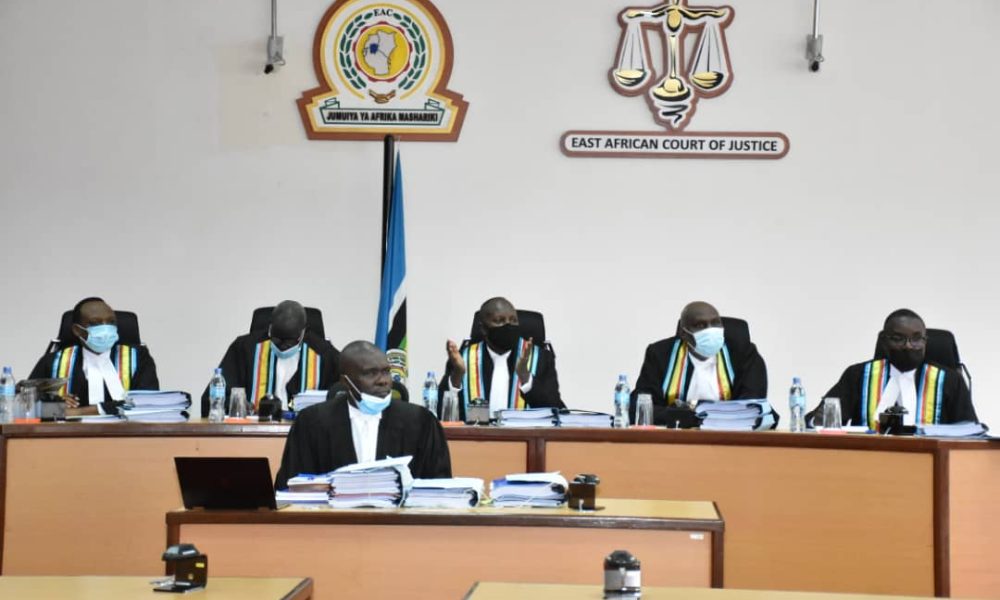
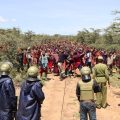
East African Court of Justice is to decide whether it has jurisdiction to try the EACOP case filed by Four East African NGOs today.

Published

on

By Witness Radio team

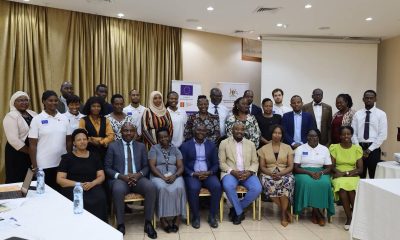
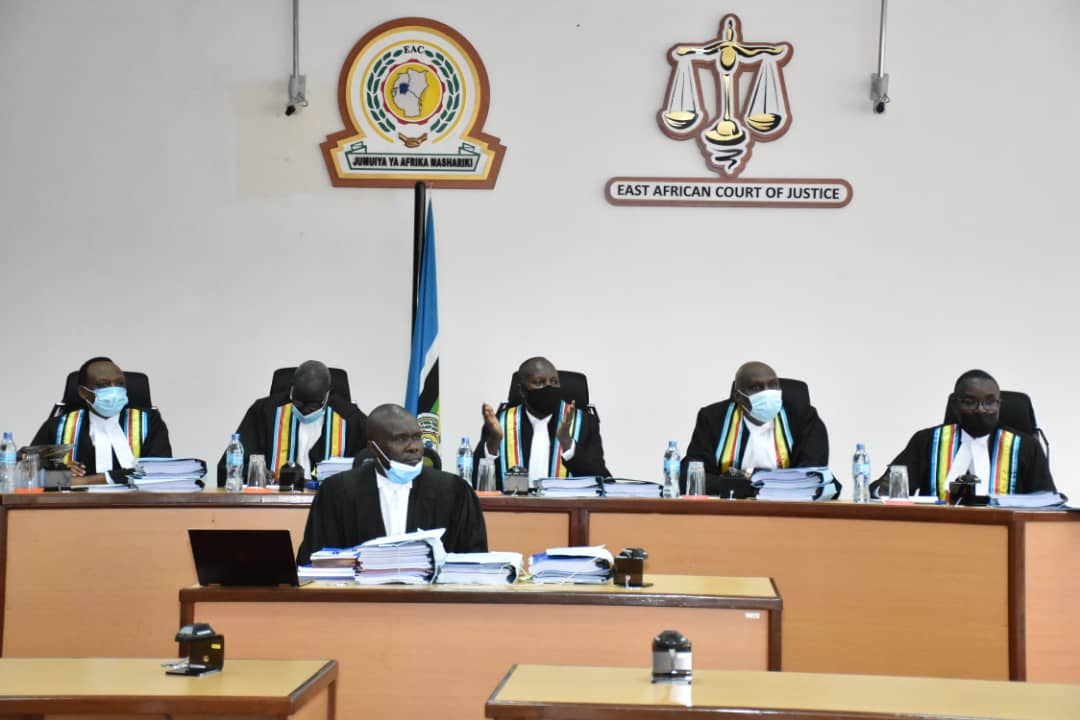
The East African Court of Justice (EACJ) is delivering a ruling on the preliminary objections raised by Tanzania’s solicitor general regarding the court’s jurisdiction to hear a case filed against the East Africa Crude Oil Pipeline (EACOP) project today, the 29th of November 2023.

According to the ruling notice seen by Witness Radio, the regional Court will deliver the ruling at 9:30 East Africa Standard Time.

The Court consists of Honorable Mr. Justice Yohane Bokobora Masara Principal Judge, Honorable Justice Dr. Charles Nyawello Deputy Principal Judge, Honorable Mr. Justice Richard Muhumuza, Honorable Mr. Justice Richard Wejuli, and Honorable Justice Dr. Gacuko Leonard.

On 6th November 2020, four East African Non-Government Organizations (NGOs) including; Natural Justice, Africa Institute for Energy Governance (AFIEGO), the Centre for Strategic Litigation, and the Centre for Food and Adequate Living Rights (CEFROHT) Limited filed a petition against the governments of Uganda and Tanzania and the Secretary General of the East African Community (EAC) challenging the construction of the EACOP project.

The basis of the Applicants’ petition rests on the assertion that the EACOP project violates multiple provisions of the Treaty of the Establishment of East African Community. The project further violates the Protocol for the Sustainable Management of the Lake Victoria Basin, the African Charter on Human and People’s Rights, the African Convention on Conservation of Natural Resources, the post–2020 Convention on Biological Diversity, and the Paris Climate Accords.

Furthermore, the Applicants argue that the entities backing the EACOP project, such as Total Energies, China’s National Offshore Oil Corporation, and the Governments of Uganda and Tanzania, failed to carry out thorough and meaningful public engagement and consultation processes and additionally did not conduct comprehensive assessments of both the human rights and climate impacts before initiating the EACOP project.

After numerous hearings of the case at the EACJ, in March 2022, Mr. Gabriel Malata, the Solicitor General of the United Republic of Tanzania, raised several preliminary objections, which include his argument that the EACJ has no jurisdiction to hear both the main case and the application for temporary injunction filed by the NGOs.

In its upcoming ruling, the EACJ will delve into three pivotal preliminary issues concerning the involved parties in the case. These issues include determining whether the case pertains to interpreting the EAC Treaty, whether the case was filed within the stipulated timeframe, and whether the organizations’ pleadings were appropriately verified in adherence to the EACJ Rules of Procedure, among other aspects.

The East Africa Crude Oil Pipeline (EACOP) connects the Tilenga and Kingfisher oilfields in western Uganda with the port of Tanga in eastern Tanzania will be the longest heated crude oil pipeline in the world and crosses through 10 districts in Uganda and 25 districts in Tanzania.

Uganda’s President, Mr. Yoweri Museveni Tibuhaburwa, has often celebrated the oil projects calling a success. He firmly believes that the oil discovery represents a significant catalyst for economic development and will bring benefits to the local communities, but the current reality is a reverse to his statements.

Instead, the EACOP project has triggered significant concerns among communities and civil society groups due to its detrimental impacts on thousands of individuals in Uganda and Tanzania. The most affected have been the Project Affected Persons (PAPs) and human rights activists who stand against the project. Reports have highlighted cases of land grabbing, the displacement of host communities, inadequate compensation, and the troubling trend of harassing and arresting community leaders and rights activists.

On the 14th of September 2022, the European Union Parliament passed an advisory resolution to suspend the oil pipeline for a year citing disastrous human and environmental rights violations associated with the project.

The resolutions put forth by the European Parliament legislators echo the distressing issues raised by affected communities regarding the oil pipeline project.

Continue Reading

MEDIA FOR CHANGE NETWORK

Rising fertilizer dependence sparks debate over Africa’s agricultural future; experts call for urgent critical review process.

Published

on

By Witness Radio Team.

In March this year, the United Nations World Food Program (WFP) warned that the number of people facing acute hunger globally could rise sharply if escalating conflict in the Middle East continues to destabilize the global economy, projecting that nearly 45 million additional people could slide into acute food insecurity.

Since 28 February 2026, the United States and Israel have been engaged in a war with Iran and its regional allies. The conflict began when the US and Israel launched airstrikes on Iran, targeting military and government sites and assassinating several Iranian officials, including Supreme Leader Ali Khamenei. Iran responded with missile and drone strikes on Israel, US bases, and US-allied Arab countries in West Asia, and the temporary closure of the Strait of Hormuz, disrupting global trade.

As global tensions continue, experts have revealed that they are disrupting fertilizer supply chains and driving up prices, an issue likely to threaten food security and make policymakers feel responsible for safeguarding Africa’s future.

A recent report by GRAIN, an international Non-Governmental Organization (NGO), argues that Africa’s increasing reliance on imported chemical fertilizers is exposing farmers and food systems to economic, political, and environmental risks.

Titled “Can African Food Systems Thrive Without Chemical Fertilizers?”, the report links recent fertilizer price spikes to conflicts such as the Russia-Ukraine war and the recent escalation involving Iran, Israel, and the United States. According to the report, these crises have disrupted the movement of fertilizers and raw materials, such as natural gas and sulfur, pushing prices beyond the reach of many African farmers.

According to the report, the African fertilizer market is currently worth around US$10–15 billion and is projected to grow to US$20 billion over the next four years. It adds that the largest fertilizer manufacturers — including Yara of Norway, OCP of Morocco, PhosAgro of Russia, Nutrien of Canada, and Mosaic of the United States — are seeking to expand their presence in this fast-growing, highly profitable market.

GRAIN researcher Ange David Baimey told the Witness Radio team that growing concerns about the ongoing impact of global conflicts on African agriculture drove the investigation.

“As you can see, the recent crisis involving Iran, the USA, and the Middle East created a lot of uncertainty concerning how fertilizers can continue reaching African countries. Before this, we also had the Ukraine crisis and COVID-19. If you look at the last six years, these crises have seriously affected agriculture in Africa.” Ange, who participated in the research, told Witness Radio.

For decades, many African governments, donors, and agribusinesses have promoted chemical fertilizers as essential for increasing food production. However, the report highlights that relying on organic and sustainable practices-such as indigenous knowledge, crop diversity, and soil fertility methods-can be safer and more resilient. Showcasing successful case studies can help policymakers see practical alternatives to dependency.

“The only solution to the best agricultural practices is not chemical fertilizers. Farmers have tested and agreed that organic fertilizers are the answer. Ange further mentioned.

According to the report, the push for chemical fertilizers accelerated during the Green Revolution period, driven largely by multinational agribusiness interests seeking profits from agricultural inputs.

“The Green Revolution is not the beginning of agriculture in Africa. Our systems existed before chemical fertilizers. What we see now is a system where companies are making profits while creating dependency.” He said.

The report notes that many African countries import significant quantities of fertilizers from Gulf countries, including Saudi Arabia, Qatar, and Oman. Countries including Sudan, Tanzania, Kenya, and Mozambique remain highly dependent on these imports, making them vulnerable to supply disruptions and rising global prices.

Although African governments spend billions of dollars on fertilizer subsidy programs, many small-scale farmers still struggle to afford the products. In some countries, fertilizer prices are significantly higher than global averages due to import dependency, market concentration, and the dominance of multinational corporations in the supply chain.

“In our research, we also discovered that African farmers often pay more for the same fertilizers than farmers in Europe or the United States. The market is controlled by powerful companies whose goal is profit.” Ange explained.

The report identifies major corporations such as Yara International, OCP Group, and Dangote Group as key players shaping Africa’s fertilizer markets.

“These companies have huge influence and power in African agriculture. Governments must examine even discussions around continental trade agreements carefully because the same multinational companies may continue dominating the market.” Ange observed.

Beyond economic concerns, the report also highlights environmental and health impacts associated with chemical fertilizers, including soil degradation, water pollution, and increased pesticide use. The report advises African countries to adopt organic approaches to improve their yields, human and soil health, and to avoid environmental shocks.

“A change of course off the chemical fertilizer treadmill and towards agroecology is even more urgent in the face of the climate crisis. Climate scientists are calling today for a 42% global reduction in fertilizer use by 2050, to keep the planet livable.” The report noted.

Experts urge African leaders to use these global shocks as an opportunity to rethink Africa’s agricultural direction. “If you are dependent upon another person for your food, what happens when that person cuts off access? That is the situation Africa is in. The COVID crisis, the Ukraine war, and now the Gulf crisis all prove that reliance on imported fertilizers is dangerous. Africa can feed itself. The question is whether governments are willing to assist with that transition.” He concluded.

Continue Reading

MEDIA FOR CHANGE NETWORK

A community in Yumbe district has raised serious concerns about allegations of land-grabbing involving an aspirant for Uganda’s Parliamentary Speakership, affecting over 50 families.

Published

on

By Witness Radio Team.

More than 50 families in Ochinga village, Aringa South Constituency in Yumbe district, are feeling vulnerable as they face eviction from the land they have lived on for decades.

The families accuse the area Member of Parliament, Alion Odria Yorke, of fraudulently acquiring their land with the support of a clan member, raising questions about transparency and abuse of power.

“He has started evicting us. And he has already started clearing part of the land. We hear he is preparing it for his cocoa farming business project,” one of the affected, Richard Ayimani, told Witness Radio.

Forty-six-year-old Asiku Victor Yada is among those facing eviction. A resident of Ochinga Village, he says he owns 21 acres of land he inherited from his parents, land that has been passed down through generations.

“I was born and raised on this land. After my father’s death, I inherited it, just as he had inherited it from his father. This has been our generational land,” Asiku told Witness Radio, sharing his deep connection and concern over the ongoing dispute.

He expressed frustration over the ongoing dispute, accusing the MP of abusing his position.

“He talks about corruption and abuse of office by others, yet he is also doing the same by using our nephew to grab our clan land. We cannot accept losing our land through what we believe is a fraudulent process,” he added.

The disputed land, estimated at 519 acres (210 ha), is part of the Kiranga clan, which the community uses for farming and cattle grazing, forming the backbone of their livelihoods.

However, Hon. Alion has dismissed the allegations, insisting that he legally purchased the land from members of the Kiranga clan on May 18, 2025, for UGX 25 million (approximately USD 6,667.91). Yet, the community disputes the transaction’s legality, raising questions about the transparency and proper consultation involved in the sale.

“I have evidence of ownership, including documents and witnesses,” The MP claimed in an interview with Witness Radio. However, affected residents strongly dispute this, insisting they were neither consulted nor aware of any such transaction, raising concerns about the authenticity of the evidence presented.

“He was duped. The person he talks to is our sister’s son, and he does not have the authority to sell clan land without our understanding. Yassin is not our clan leader or landlord as the MP alleges; he belongs to another clan called the Aupi clan,” Mr. Richard explained, highlighting the need for clarity on who has the authority to sell clan land.

Witness Radio was unable to obtain a comment from the alleged land seller, Yassin, as repeated calls to his known phone contacts went unanswered.

One of the complainants, Ayiman Richard, told Witness Radio that he is the rightful heir and custodian of the land. He argues that those who allegedly sold the land were only caretakers appointed after the death of his father.

“This land belonged to my late father, Peter Nakara Ondia. After his death, I inherited it as his heir. My nephews were only given the responsibility to look after the land while I was still young. That does not make them clan leaders or landowners,” he said.

Other residents say they were never informed or involved in the alleged sale and are now living in fear of eviction, feeling betrayed and powerless.

“How can a legislator use fraudulent means to acquire our land? We were not aware of any sale, and we cannot just surrender our land,” one resident added.

Local leaders have also raised concerns over the transaction. The LCIII Chairperson of Ariwa Sub-county, Mr. John Kale, said he was not consulted during the sale process and disputes claims that Yassin is the clan leader.

“It is very surprising that I, as the local council chairperson, did not know about the sale of this land. The Honorable Member of Parliament must have been duped,” he said, before calling on the minister to stop grabbing community land.

As tensions rise, affected families say they have nowhere to go, as the land is not only their ancestral home but also their primary source of livelihood.

Land conflicts have increased in Uganda, where politically connected individuals have found it easy to grab land belonging to poor and vulnerable communities with impunity.

Continue Reading

MEDIA FOR CHANGE NETWORK

A Ugandan minister is in the hot seat over the grabbing of land from a peasant in Kiryandongo district.

Published

on

By Witness Radio Team.

At 62, Edward Balikagira says he should be enjoying the fruits of his old age after working very hard to attain what he owns now. Instead, he finds himself trapped in a prolonged land dispute with a Ugandan minister, whom he accuses of forcibly seizing his land, which has devastated his livelihood and well-being.

“I have stress, which is even affecting my life. I can’t support or manage my extended family,” Mr. Balikagira told Witness Radio in an exclusive interview.

The land under contention is located in Kinyara 2 village, Kigumba subcounty in Kiryandongo district. Balikagira accuses the current minister in charge of Karamoja affairs of unlawfully seizing 100 acres of his land, raising questions about the legal validity of his claim, the land registration process, and the evidence supporting his ownership.

Balikagira, in an interview with Witness Radio, revealed that he obtained full authority over the land after successfully purchasing it from John Bitagassa on 10th February 1996.

“A friend of mine (George Bugumirwa) alerted me about this land, which was on sale in the mid-1990s. It was in a good location, and this prompted me to buy it.” He added.

According to the father of 19, the dispute began during the processing of land title documentation for land linked to Minister Peter Lokeris. At the time, Balikagira was serving as chairperson of the sub-county Area Land Committee overseeing the process.

“We informed residents about the day when boundaries for the minister’s land were to be opened. But during the exercise, the surveyors almost encroached on my land. Later, the minister proposed that I sell my land to him.” Balikagira explained.

Balikagira says he agreed to the arrangement and negotiated a price of 500,000 Ugandan shillings per acre, totaling 50 million shillings. Trusting that payment would eventually be made, he allowed the minister to use the land temporarily while awaiting compensation.

However, according to Balikagira, the promised payment never came. He says he made several trips to Kampala to meet the minister and demand the agreed-upon money, but all his efforts proved futile.

“I had an idea that if the minister pays me, I would then buy another piece of land. I then followed up on the verbal agreement that we had with the minister, but I have yielded nothing; he failed to fulfill his promises, and now he claims he is the rightful owner of the land.”  The victim stated.

Before losing his land, Balikagira says agriculture was the main source of his family’s livelihood.

“Maize was one of the major crops I used to grow, and it was very profitable in those days. Besides other crops, I cultivated maize on about 25 acres and, in a season, I could earn up to twenty million Ugandan shillings.” He revealed.

Nearly 19 years after allegedly losing his land, Balikagira says the emotional toll has been overwhelming, leaving him distressed and feeling abandoned by the system he trusted to protect his rights.

“The situation is very terrible. My family has fallen into deep economic distress, forcing me to sell remaining assets, including small plots of land, to meet basic needs such as school fees. This has disrupted my children’s education, with some dropping out of school,” he said.

He added that the prolonged struggle has also taken a heavy emotional and psychological toll, leaving him stressed, financially unstable, and unable to support his extended family adequately.  This situation highlights the need for greater awareness of land rights and the legal protections available to landowners like Balikagira who allege unlawful land seizures by powerful officials.

“I have gone to the RDC’s office and many other government offices seeking justice over this matter, but I have not received any help. Maybe it is because an ordinary person is fighting against a minister,” Balikagira said.

The minister, in an interview with a local Television station, denied these claims, asserting that he is the rightful owner of the land and dismissing Balikagira’s allegations as false.

Balikagira pleads with the government, and in particular the president of Uganda, to advise his minister to evacuate his land. He says, “Lokeris knows that he is an honorable minister, and since I am poor, I cannot do anything to him. I therefore request the president to help me so that the minister evacuates my land.”

The Deputy Resident District Commissioner (D/RDC) of Kiryandongo District, Jonathan Akweteireho, told Witness Radio that Balikagira has repeatedly reported the land dispute to his office over the years.

“He says the minister is his neighbor who grabbed his land. He maintains that the minister is not the rightful owner of the land,” Akweteireho said.

According to the deputy RDC, the RDC’s office has already written to the Ministry of the Presidency requesting intervention and investigations into the rightful ownership of the contested land.

“We wrote to our line ministry to take up the matter since we could not directly reach the minister involved. However, we have not yet received any response,” he explained. “We also wrote to the Kiryandongo District Land Board to follow up on the matter and establish the rightful owner of the land, but we have not yet received feedback from them either.”

Continue Reading

Resource Center

Legal Framework

READ BY CATEGORY

Facebook

Newsletter

Subscribe to Witness Radio's newsletter


Trending

Subscribe to Witness Radio's newsletter