Connect with us

MEDIA FOR CHANGE NETWORK

United States withdraws from core United Nations climate institutions

Published

on

  • United States withdraws from the UN Framework Convention on Climate Change, Green Climate Fund and Intergovernmental Panel on Climate Change.
  • Global leaders warn decision will weaken climate cooperation, economic resilience and clean energy investment.
  • The move raises concerns for climate finance flows and international scientific collaboration.

The United States has formally withdrawn from the United Nations Framework Convention on Climate Change, the treaty that underpins global action on climate change, marking one of the most far reaching reversals of international climate engagement by the country to date.

On 7 January the country’s president Donald Trump cut ties with 66 international bodies as he continued a push to dismantle US involvement in global efforts to fight climate change and safeguard biodiversity.

The decision, announced by the White House and confirmed by senior United States officials, includes immediate withdrawal from the Green Climate Fund and the Intergovernmental Panel on Climate Change, the world’s leading scientific body assessing climate risks and mitigation pathways. United States scientists have historically played a central role in the IPCC’s assessment reports.

United Nations climate chief Simon Stiell described the move as a serious strategic error, warning it would undermine the United States economy, employment and long term prosperity. He said that as climate related disasters intensify globally, disengaging from cooperation and science would leave the country less secure and less competitive.

The UN Framework Convention on Climate Change requires industrialised nations to reduce emissions, report transparently on climate performance and support developing countries through finance and capacity building. Its mechanisms are central to climate finance flows into emerging markets, including across Africa, where adaptation and clean energy investment needs remain substantial.

United States Treasury Secretary Scott Bessent confirmed the country would also exit the governing board of the Green Climate Fund, a key channel for funding renewable energy, resilience and low carbon development projects in developing economies. For African governments and project developers, the withdrawal raises uncertainty over future funding commitments and partnership continuity.

The move has drawn strong criticism from European leaders and environmental groups. European Union climate commissioner Wopke Hoekstra said the UN climate convention underpins global climate action and called the United States retreat regrettable and unfortunate. European Commission Vice President Teresa Ribera said the decision signalled a lack of concern for environmental protection, public health and human suffering.

Former United States Vice President Al Gore warned that withdrawing from the UNFCCC and IPCC risks dismantling decades of diplomatic progress and weakening trust in climate science at a critical moment.

The climate withdrawals form part of a broader policy shift under President Donald Trump, whose administration has exited dozens of international organisations. Nearly half of the affected bodies are linked to the United Nations, including agencies working on climate change, development, gender equality and conflict prevention. The White House said the organisations no longer serve American interests and promote agendas that conflict with national sovereignty and economic priorities.

Although the formal withdrawal from the UNFCCC will take up to a year to complete, the United States has already ceased active participation in many climate forums and declined to attend recent global summits. The administration has also blocked United States scientists from attending international meetings, raising concerns that future IPCC reports could face delays.

For African energy markets, the decision underscores the growing importance of diversified climate finance sources and regional leadership in clean energy deployment. While the United States steps back, other governments like South Africa, Kenya and Egypt plus private sector players are expected to continue advancing renewable energy and climate resilient infrastructure across the continent.

Author: Bryan Groenendaal

Source: greenbuildingafrica.co.za

Continue Reading

MEDIA FOR CHANGE NETWORK

AGRA at 20: New report reignites debate over Africa’s farm model

Published

on

Twenty years after AGRA’s launch, a report built on 18 years of FAO data paints a contrasting picture: fertiliser use and crop area surged, overall yields disappointed and undernourishment rose in the focus countries.

On 24 August 2026, a report presented in Dakar for the twentieth anniversary of the Alliance for a Green Revolution in Africa (AGRA) scrutinised nearly two decades of public and philanthropic support for a model built on fertilisers, commercial seeds and subsidies, just as the African Union fine‑tunes its 2026‑2035 agricultural strategy. Drawing on 18 years of FAO data for 13 countries targeted by AGRA, the document concludes that input use and cultivated area have risen sharply, while productivity gains have been more modest than expected and undernourishment has increased significantly.

According to the analysis, fertiliser use in the focus countries more than doubled between 2006 and 2024, while cultivated area grew by 46 %; yet average annual yield growth for the main crops reached only 1.2 %, compared with 1.3 % in the twelve years preceding AGRA’s creation. This finding echoes work published a few days earlier by the Alliance for Food Sovereignty in Africa (AFSA) and a Tufts University researcher, who argue that the original promise to double smallholders’ yields and incomes while halving hunger has not been met in the participating countries.

Maize‑centred gains at the expense of crop diversity

The authors point out that maize, the flagship crop of this approach, shows contrasted performance: yields are reported to have increased by 40 %, but on the back of a 71 % expansion in maize area, while yields for millet fell by 17 %, for roots and tubers by 10 % and for groundnuts by 11 %. This reallocation has reduced the share of millet and sorghum in cultivated land from about 26 % to 16 %, even though these cereals remain central to diets and climate resilience across large Sahelian and Sudanian zones.

Farmer networks and agroecology experts stress that this shift of land and public support towards hybrid maize and nitrogen fertiliser has increased farms’ dependence on imported inputs and weakened food systems built on traditional cereals, legumes and root crops.

Rising undernourishment in the focus countries

The report links these technical choices to food security trends: in the studied countries, the number of chronically undernourished people is estimated to have risen from 94.6 million in 2004‑2006 to 149.6 million in 2022‑2024, a 58 % increase, with Nigeria accounting for a large share of the deterioration. This trajectory matches the estimates used by AFSA and its partners, who recall that AGRA originally set a goal of halving undernourishment in its focus countries, a target later revised under the AGRA 3.0 strategy.

The authors underline, however, that national situations diverge: Ethiopia and Ghana have reduced the number of undernourished people, while Nigeria accounts for more than half of the increase and countries such as Malawi have seen hunger rise despite higher cereal yields.

Senegal as a comparator outside the AGRA focus group

Beyond the AGRA countries, Senegal is used as a comparator; the report notes stronger performance on some yield indicators without claiming causality, and highlights the role of greater crop diversity and locally anchored agroecological initiatives. Senegalese agroecology specialists recall that the country combines targeted input schemes with support for value chains such as millet, cowpea and irrigated horticulture, partly limiting the monoculture effects observed in some AGRA focus states while leaving open questions around soil fertility and exposure to external markets.

The 2026‑2035 agricultural strategy shaped by AGRA’s scorecard

As the African Union finalises its 2026‑2035 continental agricultural strategy under the CAADP/Malabo framework, AGRA’s evaluations are feeding a broader debate on how to combine public investment, development‑finance institutions and family farming in transforming food systems. A report released in March 2026 by AFSA on African Development Bank‑backed farm projects already pointed to a persistent bias towards input‑intensive models, at the expense of diversification, soil fertility and farmer‑managed seed systems.

The Dakar report explicitly recommends that African agricultural policies give more weight to crop diversification, agroecology, farmer‑managed seed systems, soil fertility, public research and extension services, instead of treating commercial inputs as the sole engine of transformation.

Upcoming AFSA report on twenty years of the Green Revolution

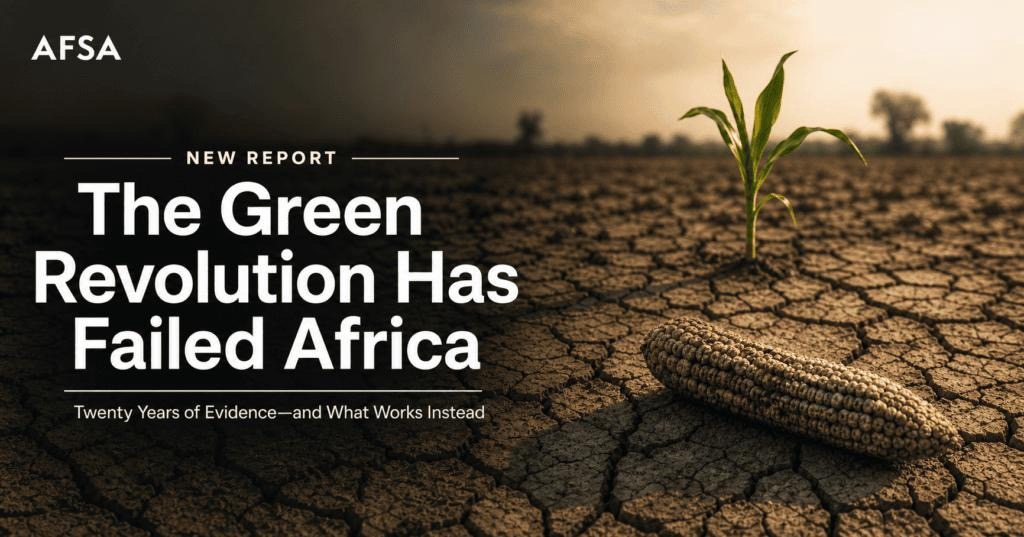
These findings will feed into the discussion around AFSA’s report The Green Revolution Has Failed Africa: Twenty Years of Evidence and What Works Instead, to be launched on 24 August 2026 at a continental webinar on lessons from the AGRA experience and farmer‑led alternatives. AGRA, for its part, is marking its twentieth anniversary by highlighting a shift in its mandate towards food systems and policy support, emphasising closer partnerships with governments, research centres and the private sector to strengthen the foundations of agricultural productivity.

For now, the quantified scorecard presented in Dakar and the parallel release of AFSA’s review send a clear signal that the coming decade of African agriculture will have to arbitrate more explicitly between subsidies for inputs, crop diversification and the scale‑up of agroecological models before the 2026‑2035 strategy is formally adopted.

Source: capmad.com

Continue Reading

MEDIA FOR CHANGE NETWORK

Thirteen years after the Karuma Hydropower Project broke ground, countless people forced from their homes are still waiting for the compensation and resettlement they were promised.

Published

on

By the Witness Radio team.

Envisioned as a cornerstone of Uganda’s energy future, the Karuma Hydropower Project aimed to boost the nation’s power supply, lower electricity costs, and secure lasting energy stability.

In 2013, work began on the 600-megawatt Karuma Hydropower Station, nestled along the River Nile in Kiryandongo District. Led by China’s Sinohydro Corporation, the project transformed over 465 hectares with an underground power station and sprawling infrastructure.

China largely financed the project, with the Ugandan government contributing alongside the Export-Import Bank of China.

Karuma was heralded as a game-changer for Uganda’s electricity landscape, set to light up more homes and fuel the nation’s ambitions for industrial and economic growth.

Yet as the power station finally became reality in 2024, many who gave up their land and homes say they are still waiting for the government’s decade-old promises of compensation and resettlement.

Over 400 households remain caught in the heart of an unresolved compensation battle, urging the government to honor its responsibility and ensure those who lost everything are finally compensated or resettled.

According to the Parliamentary Committee on Environment and Natural Resources’ report on the Ministerial Policy Statements for the financial year 2026/27, the government owes approximately UGX 70 billion to Project Affected Persons (PAPs) under the Karuma Hydropower Project.

For many victims, these delays have meant years without the land and livelihoods that once sustained them.

“I am growing old and don’t have a permanent job. It is becoming hard to survive after losing my land that was my family’s source of livelihood,” Owelo told the Witness Radio team.

Owelo Patrick, now 53, is still waiting for compensation. When the project claimed his eucalyptus plantation in Ayuda Village, he lost not just land, but the lifeline that once supported his family.

Thirteen years on, he finds himself renting a modest house and scraping by on odd jobs to survive.

“At this age, I work for anyone who calls me because I want to survive with my family,” Owelo adds.

He says the wait has grown more painful as some fellow claimants have died before seeing justice.

“The government should keep its promise because most of our colleagues promised compensation are dying, and for those of us alive, our patience has run out,” he says.

Apaco Suprianto Adyeeri is another whose life the project upended.

Now renting a small house along Obote Road in Karuma Town, Apaco recalls losing two acres of fertile land where she once grew cassava and other crops.

“Life is difficult because I have no money and struggle to care for my grandchildren. I don’t have a permanent house and survive on a small bar business that raises minimal income, which cannot support my family,” she says.

To make ends meet, Apaco now hires small plots of land to grow cassava, maize, and beans, hoping to earn just enough to get by.

“If the government can’t compensate us, let them give us land elsewhere to live. We expected help to rebuild our livelihood after losing our land. But 13 years later, we continue to suffer,” she reveals.

The $1.7 billion Karuma project swept through Kiryandongo District, displacing residents from villages like Nora, Akuridia, Karuma, Bedmot, and Awo.

Residents recResidents say they were forced to leave their homes and fields before any compensation arrived, destroying their farms, businesses, and means of living. Affected residents interviewed by Witness Radio said that after the eviction, the government also promised to resettle some of the affected families in Nwoya District, with each family expected to receive two acres of land and a constructed house.

Yet residents say the promised resettlement remains little more than words and has never fully materialized.

For farming families, losing land meant scrambling to rent plots elsewhere to grow food or earn a living. Others have been pushed into rented homes and still struggle to survive.

The long wait has come at a steep human cost, with some affected residents dying before receiving the compensation promised.

Seeking justice, affected families have sent repeated petitions to the President and government bodies, pleading for action on their long-overdue compensation and resettlement.

Some of their concerns are also documented in a written complaint dated 14 August 2024, signed by William Ogik and other Project Affected Persons from Karuma.

The letter, addressed to relevant authorities and copied to the Permanent Secretary in the Ministry of Energy and Mineral Development, Kiryandongo District leadership, the Chief Government Valuer, the Speaker of Parliament, Sinohydro and the Chinese Embassy in Uganda, formally outlines the communities’ grievances and calls for government intervention.

The communities voiced grievances over delayed compensation, claims of undervalued property, and the devastating loss of their farmland.

Ochaya Washington, former District Councilor and chief petitioner for the vulnerable, warns that the situation is now dire for elderly and at-risk residents who have waited years for the government to keep its word.

“People are all dying. I call upon the government and the Ministry to intervene and help these people before they perish,” he says.

Uganda’s drive for progress comes with a lesson from Karuma: true development must include timely compensation, real resettlement, and safeguarding livelihoods. Thirteen years later, many families are still waiting to piece their lives back together.

Continue Reading

MEDIA FOR CHANGE NETWORK

Ahead of COP17, development banks must confront mining’s role in accelerating desertification

Published

on

Environmental defenders warn ahead of UNCCD’s COP17 in Mongolia that development banks are financing critical mineral projects that accelerate desertification, water depletion and deforestation while claiming to support a just energy transition.

When governments gather in Ulaanbaatar from 17 to 28 August for the 17th Conference of the Parties (COP17) to the UN Convention to Combat Desertification (UNCCD), they will pledge to restore degraded land and strengthen resilience to drought. Yet many of these same governments, as shareholders of public development banks, continue to finance large-scale mining projects that degrade fragile ecosystems, deplete scarce water resources, and accelerate desertification.

That contradiction is already evident in the run-up to the summit. In a communiqué ahead of COP17, Mongolia’s foreign minister highlighted the country’s ambition to combat desertification through artificial intelligence data centres powered by renewable energy. But while presented as part of a green future, data centres and the infrastructure that supports them are driving demand for critical minerals such as copper, lithium and rare earth elements. Their expansion risks intensifying the very mining impacts that contribute to land degradation and water scarcity in arid regions.

The production of one metric ton of lithium, for instance, requires between 1 and 2 million liters of water to produce. Gold and copper mining operations use chemicals for exploration and extraction, which need further water to be diluted; and this water, once contaminated, is then discharged back into the natural world. Over the years, the mining sector has developed standards to address or mitigate these impacts. Way too often, however, companies fail to comply with such benchmarks.

Mongolia, this year’s COP17 host, illustrates this tension well. Nearly 80 per cent of the country’s land is already degraded or affected by desertification, according to the government. Yet,  development banks are expanding support for critical mineral mining in the country, while failing to ensure compliance with social and environmental safeguards.

For more than a decade, pastoralist communities and environmental defenders in Mongolia have warned that Rio Tinto’s Oyu Tolgoi copper mine is heavily affecting South Gobi’s scarce water resources. Herders report that their land and wells have become increasingly dry since the mine began operating. Yet, the European Bank for Reconstruction and Development (EBRD) and the International Finance Corporation (IFC) invested a combined US$350 million in the project in 2024.


Oyu Tolgoi mine with caption

Development banks are financing desertification

Historically, public development banks have been cautious about investing directly in large-scale mining projects, due to the high social and environmental risks involved. In recent years, however, they have been heavily investing in this sector.

In November 2025, the Asian Development Bank (ADB), after avoiding mining investments for four decades, approved a controversial new Energy Policy that opens the door to financing critical mineral extraction. One of its flagship projects is the Reko Diq mine in Balochistan, Pakistan, which several development banks are funding. The mine, which sits in a highly militarised and conflict-affected region, threatens an already hyper-arid desert ecosystem with further land degradation and desertification.

In May 2026, also the World Bank Group unveiled a new strategy for metals and minerals, pledging to “quintuple support to the sector in the next five years”. Argentina is one of the target countries for this new strategy: since 2024, the World Bank has already committed nearly USD 2 billion in loans and an additional USD 1.9 billion in guarantees to support projects involving reforms and deregulation of the energy and mining sectors, as well as investments in logistical and strategic infrastructure for those sectors. These investments feed into the Incentive Scheme for Major Investments (RIGI), a government program granting extensive fiscal, legal and export benefits to large-scale extractive projects.

The World Bank and IDB Invest also funded the controversial Sal de Vida lithium mine, in a salt flat in the Catamarca province affected by seven other lithium mines. Water, already scarce in this arid territory, is disappearing quickly. As a result of mining activities, the Trapiche River has completely dried up and for local herders finding water and food for their llamas, goats or sheep is becoming a daily challenge.

Protest against lithium mining by indigenous communities in Salinas Grandes, Jujuy, Argentina. Credit Tomas Saraceno

In Zambia’s Copperbelt, approximately 5,000 people across eight communities surrounding the Nchanga and Konkola copper mines have endured decades of water and soil pollution. These impacts are rarely described as desertification, yet the loss of fertile soil, vegetation, water and agricultural livelihoods feeds directly into the wider degradation of productive land.

Zambia’s own commitments under the UNCCD set a target to rehabilitate all land degraded by mining and quarrying by 2030, in part to mitigate current desertification trends. Nevertheless, the World Bank’s US$65.6 million Zambia Mining and Environmental Remediation and Improvement Project, which explicitly targeted polluted mining areas in Chingola, brought no direct remediation to these eight communities.


Mining-affected communities call for stronger safeguards

From Mongolia to Pakistan, to Zambia and Argentina, local communities and civil society groups are sounding the alarm around the irreversible harms of this new wave of extractivist projects undertaken in the name of the “just” energy transition.

According to the UN, “up to 40% of the world’s land is degraded, affecting more than 3 billion people worldwide and with dire consequences for our climate, wildlife and livelihoods.” Drought, land degradation and desertification are already costing the global community an estimated US$ 878 billion every year. Yet, the concerns of mining-affected communities and environmental activists are either being ignored or used as a pretext to stigmatise them as “anti-development”, criminalise them and attack them.

The UNCCD promises, “we have the power to bring land back to life”. But to do so, governments and public development banks need to go beyond slogans and explicitly recognise the impacts that productive sectors like large-scale mining have on land degradation, water resources and the ecological integrity of ecosystems.

Ana Pandigracio, Biodiversity Director at Fundación Ambiente y Recursos Naturales (FARN), a former elected member of the UNCCD CSO Panel for Latin America and the Caribbean (2022–2024) and former elected IUCN Councillor (2021–2025), recommends that, to mitigate these impacts, they commit to not supporting further mining expansion in arid zones and require existing projects to comply with robust environmental safeguards and the highest applicable standards, including those set out by the  International Union for Conservation of Nature (IUCN).

As a group of CSOs recommended during a previous UNCCD conference, governments and development banks should also support community-led initiatives, particularly those led by women, youth, pastoralists and Indigenous Peoples, and integrate their knowledge into drought management strategies.

Economic development should not come at the cost of greater land degradation, worsening water scarcity or mounting social and environmental harms for current and future generations. Instead, public development banks need to invest in community-led solutions that protect, restore and sustainably manage ecosystems while respecting the rights of the communities that depend on them.

Source: rightsindevelopment.org

Continue Reading

Resource Center

Legal Framework

READ BY CATEGORY

Facebook

Newsletter

Subscribe to Witness Radio's news and report updates


Trending

Subscribe to Witness Radio's news and report updates