Connect with us

MEDIA FOR CHANGE NETWORK

Stop violating the EITI principles and Make the Shareholders Agreement, Tariffs, and Transportation agreement for the EACOP project public.

Published

on

By Afiego, Witness Radio and Cefroht under the Hotspots program.

On June 12, 2023, during a Twitter space meeting hosted by Solomon Serwanja to discuss the Update on Uganda’s Oil and Gas Sector. Gloria Mugambe head of Uganda National Extractive Industries Transparency Initiative (EITI) noted that Uganda has declined Shareholders Agreement (SHA) and the Tariffs and Transportation agreement (TTA) signed for the EACOP project exposed to the public.

It is noteworthy that the governments of Uganda and Tanzania together with Total to signed the Shareholders Agreement (SHA), Tariffs and Transportation agreement (TTA) for the EACOP project on April 2021.

Before this, in September 2020, the Ugandan government signed the Host Government Agreement (HGA) with the Tanzanian government for the EACOP project with Total E &P.

The signings were a major milestone that brought Uganda closer to producing crude oil and to economic prosperity. However, no information was provided to the public to understand what the contents of the HGA were.

This happened at a time when citizens were worried about the bad Environmental and Social Impact Assessments being approved without complete mitigation plans to manage the oil risks.

However, it’s now close to three years and the government of Uganda has never shared these agreements with the public despite several formal requests by some of the civil societies working to ensure that oil activities do not damage our biodiversity and violate citizens’ land rights.

It should be noted that these agreements help the public, civil societies, and political representatives like Members of Parliament have a clearer and more informed viewpoint.

It should be noted that failure to make these agreements public violates the EITI principles that the member states are obligated to follow in the extractives processes in the country.

It is notable that even before the signing ceremony, Ugandan parliamentarians, who are the people’s representatives, had noted in March 2021 that even they didn’t have access to the HGA, SHA, and TTA. This is unfortunate.

Worthy to note, in August 2020, the government of Uganda was officially admitted as an Extractive Industries Transparency Initiative (EITI) member state to improve transparency and accountability in the management of extractives resources.

In her own comments after Uganda’s approval in joining the EITI community, EITI Board Chair, Rt Hon. Helen Clark, said: “EITI implementation can help lay the foundation for transparent and accountable management of the country’s natural resource wealth. We welcome Uganda as an implementing country and look forward to the EITI promoting inclusive public debate.”

Additionally, the Minister of Finance, Planning, and Economic Development representing Uganda, Matia Kasaija, said Uganda’s decision to join the EITI was informed by the appreciation of the value of transparency as we progress our plans to develop Uganda’s natural resource wealth, a clear indication that the government of Uganda had to adhere to the EITI standard.

The EITI standard encourages member states to publicly disclose any contracts and licenses that provide the terms attached to the exploitation of oil, gas, and minerals that are entered into.

Among the EITI principles violated include principles 6, 9, and 12 which demand for greater transparency for contracts and laws as well as involving the participation of citizens in the extractives sectors.

Therefore, the secrecy in oil and gas dealings has continued to compromise the efforts of environmental conservation and such activities have allowed oil projects to take place in critical biodiversity areas like forests, National Parks, wetlands, lakes, rivers, and other eco-sensitive areas that support agriculture, tourism, fisheries, employment and others.

Uganda/ Ministry Energy must make the Shareholders Agreement (SHA), Tariffs, and Transportation agreement public and present them to relevant stakeholders including parliament, CSOs, religious leaders, Uganda Law Society, and others as a sign of commitment to transparency by the government.

The Uganda EITI multi-stakeholder committee must demand disclosure of the agreements.

The government must ensure transparency at all levels of oil and gas processes including initiating, negotiating, signing, and implementing any decisions regarding the oil and gas projects in addition to oil revenues management.

Continue Reading

MEDIA FOR CHANGE NETWORK

Govt targets land grabbers with first national public-land register

Published

on

Officials say a nationwide inventory will finally let the state prove what it owns — from school compounds to road reserves — but the exercise is beginning on a shoestring.

Continue Reading

MEDIA FOR CHANGE NETWORK

Experts rally the region to unite behind East Africa’s transformative Agroecology Bill.

Published

on

By the Witness Radio team.

Across East Africa, experts and agricultural advocates are urging a united front for the proposed East African Community (EAC) Agroecology Bill, believing its passage could revolutionize food systems, empower food sovereignty, and uplift millions of farmers’ lives.

In mid-April 2026, the East African Legislative Assembly (EALA) officially began the legislative process for the EAC Agroecology Bill, 2026, after the Agriculture, Tourism and Natural Resources Committee chairperson, Hon. Gideon Gaptan Thoar, received parliamentary leave to draft and introduce it. The drafting committee is now in the final stages of tabling the bill before parliament.

This rallying cry echoed through an online webinar hosted by the Center for Food and Adequate Living Rights and broadcast live on Witness Radio. The event gathered agricultural experts, food sovereignty champions, and regional legislators to explore the bill’s promise and the hurdles it may face.

If passed, it would lay the foundation for a unified regional legal framework championing agroecological farming throughout the East African Community. Supporters believe this could be a powerful tool to combat food insecurity, protect farmers’ rights and indigenous seeds, address climate change and biodiversity loss, and tackle challenges faced by smallholder farmers.

Mr. Andrew Adem, Program Coordinator for Food Systems at the Alliance for Food Sovereignty in Africa (AFSA), said the region must learn from the shortcomings of the Green Revolution model, which prioritized increased yields and external agricultural inputs.

He pointed out that although the model aimed to boost yields and farmers’ incomes, it left them vulnerable when harvests fell short.

Adem noted that in tough seasons, farmers often bear the high costs of expensive inputs, while intensive farming erodes agricultural diversity and time-honored knowledge.

To address these challenges, he said, agroecology flips the script by putting farmers and their wisdom at the heart of agricultural progress.

“In Africa, food is more important than yields because it carries a lot of things. Therefore, the Green Revolution failed, and hence the Agroecology Bill presents an opportunity for us to stand up and protect the sovereignty of food in Africa,” Adem said during the Webinar meeting.

He explained that agroecology inspires farmers to break free from expensive external inputs, nurture healthier soils, diversify their crops, and tap into the wealth of local knowledge and resources.

Unlike systems fixated on monocultures and quotas, advocates say agroecology embraces nutrition, culture, biodiversity, and the enduring wellbeing of farming communities.

This legislative push arrives as hunger casts a long shadow over Africa. Jean Leonard from the Food and Agriculture Organization (FAO) highlighted that the continent bears the World’s largest hungry population, with around 309 million people affected.

He described agroecology as a holistic approach, weaving together ecological and social principles to shape and guide agricultural systems.

“Agroecology seeks to optimize interaction between people, markets, agriculture and ecosystems while addressing environmental, social and economic systems simultaneously rather than focusing on single technologies,” Leonard said.

Leonard outlined key ingredients for the success of the Bill: dedicated lawmakers, appropriate budgets, robust funding, supportive laws, and genuine involvement from farmers. She urged greater investment in youth, believing that empowering young people with resources and opportunities could open fresh paths into agriculture and speed the shift to agroecological farming.

Hon. Jackline Amongin, a Ugandan member of the East African Legislative Assembly (EALA), said the proposed legislation is intended to create a common framework for agroecological farming across the EAC.

She emphasized that the East African Community’s unique character calls for unity, not fragmented efforts, in transforming agriculture.

“We shall have the best, but all efforts must be put on enacting the Bill into law. Once the law is put in place, all the desired issues of implementation and execution will be agreed on. Other factors will follow,” she added.

Advocates stress that agroecology is more than a farming method. They see it as a philosophy that links agriculture to environmental care, social justice, cultural heritage, nutrition, and economic vitality.

This approach inspires farmers to exchange wisdom, broaden their crops, and craft solutions tailored to their unique landscapes.

According to the Bill memorandum, the purpose of the EAC Agroecology Bill, 2026, is to mainstream agroecological farming by promoting agroecology principles across agri-food systems. It seeks to integrate ecological, social and participatory approaches while combining scientific and traditional knowledge to enhance biodiversity, ecosystem services, resilience, livelihoods and food sovereignty.

“The Bill will therefore be tabled and gazetted before being subjected to public consultations, hearings and participation by members of the public. It will then proceed to a second reading before being referred to the whole House Committee for detailed consideration. Once all these processes are duly followed, the Bill will be presented for a third reading and passage by EALA. It will then go through the EAC process before ultimately becoming an Act.” She concluded.

Continue Reading

MEDIA FOR CHANGE NETWORK

Four youth activists now face public nuisance charges after their arrest during a bold march toward Parliament.

Published

on

By the Witness Radio team.

At Buganda Road court, four youth activists from the Rooted in Resistance Movement were charged with public nuisance after their arrest during a passionate plea to Parliament for an oil-free Uganda.

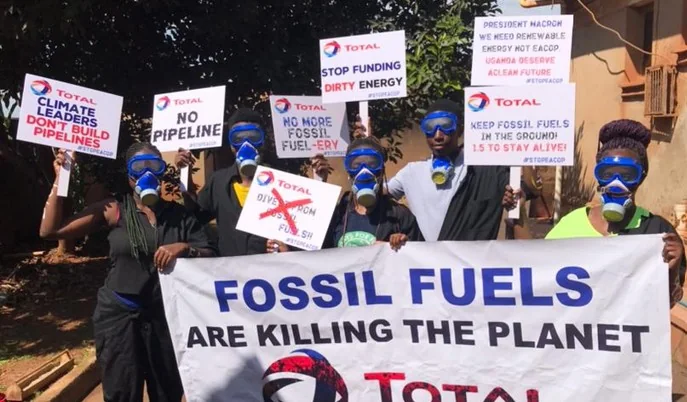
Activists Ssembalirwa Aniwally, Mugoya Hassan, Aron Patrick Ariong, and Okanya Ivan were detained by parliamentary police as they marched with determination toward Parliament, urging the Ugandan government to abandon oil dependency in favor of an ‘oil-free economy’ built on economic freedom, sustainability, and citizen involvement.

According to the charge sheet seen by Witness Radio, the prosecution alleges that on August 10, 2026, at about 9:00 am, the four activists, along with others still at large, were at King George Way Street in Kampala Central. They wore orange T-shirts bearing the words “Rooted in Resistance” and carried placards with messages including “Prioritize Other Sectors of the Economy,” “Oil Is Temporary, Nature Is Permanent,” and “Oil Today, Problems Tomorrow.”

Prosecutors claim the activists stood on the road, disrupting traffic and creating hazards.

The activists appeared before Grade One Magistrate Her Worship Rophine Achayo at Buganda Road court yesterday, where they were charged with being a nuisance on the public road, contrary to Section 67(1) of the Road Act, Cap. 346.

Section 160(1) of the Penal Code Act, which defines a common nuisance, provides that any person who does an act not authorized by law or fails to discharge a legal duty and thereby causes “any common injury, or danger or annoyance,” or obstructs or causes inconvenience to the public in the exercise of common rights, commits the misdemeanor of common nuisance and is liable to imprisonment for one year.

The four pleaded not guilty and now await their fate in Luzira Prison, remanded until August 28, 2026.

The group’s mission was to urge Parliament to rethink Uganda’s reliance on petroleum, warning that true prosperity cannot be built on a resource that will one day run out.

The activists contend that despite years of promises—jobs, industry, infrastructure, and poverty relief—oil’s benefits have reached only a privileged few, while many others remain trapped in poverty.

“Our demand for an oil-free economy is not a rejection of development, but a demand for a different development model, one that places Ugandan citizens, productive sectors and sustainable wealth creation at the center of national planning,” the group said.

They call for bold investment in other sectors, insisting Uganda should chart a path toward sustainable wealth, citizen empowerment, and true economic independence instead of clinging to petroleum.

These arrests are part of a troubling pattern as more Ugandans face criminal charges for protesting oil projects or demanding accountability for their social and environmental costs.

12 environmental activists were arrested in Kampala in August 2025 during a protest against the East African Crude Oil Pipeline (EACOP). Eight out of the 12 activists were later convicted and sent to prison to serve an eleven (11) month sentence. They were released from Luzira Prison on April 21, 2026, as time spent on remand had effectively covered their 11-month sentences.

The other four, including Ivan Wamboga, Baker Tamale and Habibu Nalungu, pleaded guilty and were released on November 19, 2025, after being ordered to perform community service. Mark Makoba also pleaded guilty and was released on November 6, 2025, without any additional penalty.

These cases reveal the risks faced by those who challenge Uganda’s oil agenda. Even after release, the activists’ ordeals have intensified fears for freedom of expression and assembly across civil society.

Continue Reading

Resource Center

Legal Framework

READ BY CATEGORY

Facebook

Newsletter

Subscribe to Witness Radio's news and report updates


Trending

Subscribe to Witness Radio's news and report updates