Connect with us

MEDIA FOR CHANGE NETWORK

Uganda: StopEACOP Campaign Condemns Standard Bank’s Decision to Fund EACOP

Published

on

Kampala — The StopEACOP Campaign is appalled by Standard Bank’s decision to help finance the East African Crude Oil Pipeline (EACOP) project and condemns this decision in the strongest possible terms. This decision follows a years-long review process, during which environmental and social concerns raised by numerous stakeholders were evidently ignored.

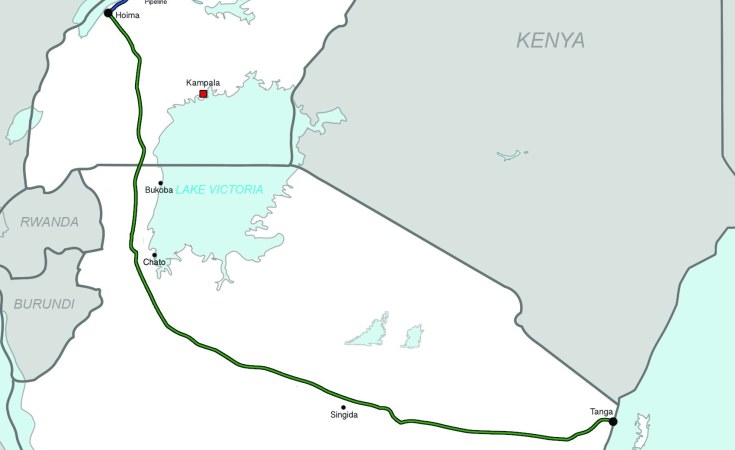
The $5 billion EACOP project, spearheaded by TotalEnergies, aims to transport crude oil from Uganda’s oil fields to a terminal in Tanga, Tanzania. Despite significant opposition from affected communities and environmental and human rights groups, Standard Bank, Africa’s largest lender, has decided to support this disastrous project.

Standard Bank chair Nonkululeko Nyembezi stated in a recent interview that they had conducted comprehensive environmental and social due diligence. However, the claim contradicts the project’s grave climate, environmental and human rights risks. The decision of Standard Bank is also at odds with the assessment of its peers, who have ruled out support for the EACOP for climate, environmental, and social concerns.

Standard Bank’s decision ignores local opposition and human rights abuses 

In the last month alone, 11 pipeline critics have been arrested in Uganda and Tanzania after expressing their concerns about the project. In addition, one of the community leaders from the Kingfisher region in Uganda was abducted by the Uganda Peoples’ Defense Forces, bringing condemnation from the UN Special Rapporteur on Human Rights Defenders. Standard Bank’s untimely announcement of their decision to finance EACOP, in the midst of a brutal crackdown on human rights, environmental and land defenders in Uganda and Tanzania, illustrates their level of detachment from the realities and experiences of communities on the ground and calls into question their claim to have done thorough due diligence.

Environmental and human rights groups have persistently highlighted the potential hazards of the controversial EACOP, including severe impacts on wildlife habitats, the displacement of communities, and the exacerbation of climate change through increased greenhouse gas emissions. Many field investigation reports, including a recent Human Rights Watch report, have also documented and denounced the inadequate compensation and significant disruption experienced by residents displaced by the pipeline’s construction. Against this backdrop, Standard Bank’s decision to finance EACOP shows blatant disregard for the voices and rights of the communities in Uganda and Tanzania who will bear the brunt of the environmental and social devastation caused by this project.

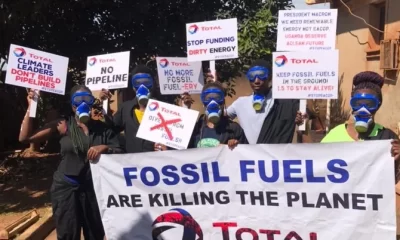
Standard Bank cannot feign ignorance in relation to the concerns surrounding EACOP. It has faced consistent pressure from communities and climate and social justice organisations and groups in South Africa who have demonstrated outside the bank’s offices in Rosebank, Johannesburg on numerous occasions. These demonstrations, including a large protest with hundreds of participants on the day of the bank’s AGM in 2023, a 3-day-long occupation of the bank’s entrance in September of the same year, and weekly pickets held outside the bank’s parking lot by Extinction Rebellion, sought to bring the demands and experiences of EACOP-affected communities to their attention.

Standard Bank has refused to engage in meaningful and constructive dialogue and instead, its response has been characterized by repression and increased militarisation. The South African Police Service has also intervened to protect the interests of the bank and has arrested peaceful demonstrators on two occasions. It is a stark demonstration of Standard Bank’s prioritization of profit over people and the planet and its lip-service commitment to constructive dialogue and meaningful engagement with frontline communities and other key stakeholders.

Standard Bank is also ignoring clear business risk

The decision to bankroll the project also casts doubt on Standard Bank’s assessment of the business and reputational risks stemming from the risks to local communities, environment and climate posed by the project.

Standard Bank’s decision comes after major financiers and insurers from North America, Europe, and Japan have publicly ruled out support for EACOP due to global outcry over the harmful project. The expected finance from China has also been delayed, while the Chinese state-owned insurers and banks have taken prolonged time to assess the outstanding risks. As a result, the EACOP project is facing significant challenges and  project sponsors are reportedly in a cash crisis to fill the funding gap, which threatens to stall the construction.

These delays come as a result of the immense pressure that potential financiers have come under from communities, civil society, the international community and even shareholders and investor groups who express grave concern over the catastrophic socio-economic, biodiversity and climate change risks of the project.

Standard Bank’s decision to finance the EACOP project starkly contradicts industry trends, as leading banks and insurers have distanced themselves from this controversial initiative. This decision exposes Standard Bank to significant risks, including the potential for stranded assets, especially as the global economy transitions towards clean energy solutions. Furthermore, with Uganda already facing a severe debt crisis, worsened by the country’s oil induced borrowing spree, the environmental and social costs associated with EACOP could precipitate an economic disaster for the people of Uganda as well as financiers and their shareholders who opt to engage with this project.

It is clear that investing in EACOP threatens the stability of vulnerable communities and jeopardizes the financial health and reputational integrity of those who support it. A 2022 report assessing the EACOP and associated oil fields against internationally recognized environmental and human rights standards for financial institutions found numerous violations, putting banks at risk if they sign on to support the project. The assessment, undertaken by the Africa Institute for Energy Governance (AFIEGO), Inclusive Development International (IDI) and BankTrack, suggests that the project is not in compliance with many of the criteria set forth in the Equator Principles and the Environmental and Social Performance Standards of the International Finance Corporation (IFC), two internationally recognized standards for responsible finance.

We demand that Standard Bank review and rescind its decision to finance the EACOP project immediately. While it may be too late for Standard Bank to redeem its supposed commitment to people and the planet, there is still time for other potential lenders, particularly Chinese state-owned banks, to demonstrate their dedication to human rights and sustainability by refusing to support EACOP. We call upon the global community to continue its unwavering support for the StopEACOP campaign and the communities on the frontlines. It is not too late to halt this disastrous project and prevent the extensive environmental, social, and economic damage it promises to inflict.

Quotes

“For years, we have campaigned tirelessly against Standard Bank, bringing the grievances and aspirations of impacted communities directly to their doorstep time and time again. Each time, we are met either with deafening silence or with outright violence from an institution that has shown itself to be truly heartless and utterly indifferent to the well-being of ordinary people. Let it be known that this announcement will not deter us. We will continue to stand in solidarity with the communities affected by EACOP and will escalate our actions against Standard Bank in the coming months.”  – Zaki Mamdoo, StopEACOP Campaign Coordinator

“Standard Bank prides itself on financing Africa’s development. However, the bank’s decision to finance the EACOP, not to mention its financing of other fossil fuel projects across Africa, earns the institution the title of an anti-people and an anti-development bank. Fossil fuel projects like EACOP that cause livelihood losses, enslave Ugandans by worsening indebtedness and drive all of us deeper into the climate crisis should not be financed by any bank.”  – Diana Nabiruma, Senior Communications Officer, AFIEGO

“Standard Bank is contributing to the devastation of our communities including through the immense loss of land and livelihood. They have chosen to ignore the plight of our people and to support our exploitation and suffering at the hands of greedy multinational corporations. This is a decision that places them squarely on the wrong side of history and which marks them as an institution with no regard for human rights and justice.” –  Richard Senkondo, Executive Director at the Organization for Community Engagement, Tanzania.

Original Source:350Africa.org  Via allafrica.com

Continue Reading

MEDIA FOR CHANGE NETWORK

Experts rally the region to unite behind East Africa’s transformative Agroecology Bill.

Published

on

By the Witness Radio team.

Across East Africa, experts and agricultural advocates are urging a united front for the proposed East African Community (EAC) Agroecology Bill, believing its passage could revolutionize food systems, empower food sovereignty, and uplift millions of farmers’ lives.

In mid-April 2026, the East African Legislative Assembly (EALA) officially initiated the legislative process for the EAC Agroecology Bill, 2026 after the Agriculture, Tourism and Natural Resources Committee chairperson, Hon. Gideon Gaptan Thoar, received parliamentary leave to draft and introduce the bill. Currently, the House is under a consultative process.

This rallying cry echoed through an online webinar hosted by the Center for Food and Adequate Living Rights and broadcast live on Witness Radio. The event gathered agricultural experts, food sovereignty champions, and regional legislators to explore the bill’s promise and the hurdles it may face.

If passed, the Bill would lay the foundation for a unified regional legal framework championing agroecological farming throughout the East African Community. Supporters believe this could be a powerful tool to combat food insecurity, climate change, biodiversity loss, and the mounting challenges faced by smallholder farmers.

Mr. Andrew Adem, Program Coordinator for Food Systems at the Alliance for Food Sovereignty in Africa (AFSA), said the region needs to learn from the shortcomings of the Green Revolution model, which prioritized increased yields and the use of external agricultural inputs.

He pointed out that although the model aimed to boost yields and farmers’ incomes, it left them vulnerable to serious risks, especially when harvests fell short.

Adem noted that in tough seasons, farmers often shoulder the high costs of pricey inputs, while intensive farming erodes both agricultural diversity and time-honored knowledge.

To address these challenges, he said, agroecology flips the script by putting farmers and their wisdom at the heart of agricultural progress.

“In Africa, food is more important than yields because it carries a lot of things. Therefore, the Green Revolution failed, and hence the Agroecology Bill presents an opportunity for us to stand up and protect the sovereignty of food in Africa,” Adem said during the Webinar meeting.

He explained that agroecology inspires farmers to break free from expensive external inputs, nurture healthier soils, diversify their crops, and tap into the wealth of local knowledge and resources.

Unlike systems fixated on monocultures and quotas, advocates say agroecology embraces nutrition, culture, biodiversity, and the enduring wellbeing of farming communities.

This legislative push arrives as hunger casts a long shadow over Africa. Jean Leonard from the Food and Agriculture Organization (FAO) highlighted that the continent bears the World’s largest hungry population, with around 309 million people affected.

He described agroecology as a holistic approach, weaving together ecological and social principles to shape and guide agricultural systems.

“Agroecology seeks to optimize interaction between people, markets, agriculture and ecosystems while addressing environmental, social and economic systems simultaneously rather than focusing on single technologies,” Leonard said.

Leonard outlined key ingredients for the Bill success: dedicated lawmakers, well-matched budgets, robust funding, supportive laws, and genuine involvement from farmers. She urged greater investment in youth, believing that empowering young people with resources and opportunities could open fresh paths into agriculture and speed up the shift to agroecological farming. Agroecological farming.

Hon. Jackline Amongin, a Ugandan member of the East African Legislative Assembly (EALA) and chairperson of the Committee on Agriculture, Natural Resources and Tourism, said the proposed legislation is intended to create a common framework for agroecological farming across the EAC.

She emphasized that the East African Community’s unique character calls for unity, not fragmented efforts, in transforming agriculture.

“We shall have the best, but all efforts must be put on enacting the Bill into law. Once the law is put in place, all the desired issues of implementation and execution will be agreed on. Other factors will follow,” she added.

Advocates stress that agroecology is more than a farming method. They see it as a philosophy that links agriculture to environmental care, social justice, cultural heritage, nutrition, and economic vitality.

This approach inspires farmers to exchange wisdom, broaden their crops, and craft solutions tailored to their unique landscapes.

According to the Bill memorandum, the purpose of the EAC Agroecology Bill, 2026, is to mainstream agroecological farming by promoting agroecology principles across agri-food systems. It seeks to integrate ecological, social and participatory approaches while combining scientific and traditional knowledge to enhance biodiversity, ecosystem services, resilience, livelihoods and food sovereignty.

“The Bill will therefore be scrutinized and considered before being subjected to public consultations, hearings and participation by the committee. It will then proceed to a second reading before being referred to the whole House Committee for detailed consideration. Once all these processes are duly followed, the Bill will be presented for a third reading and passage by EALA. It will then go through the EAC process before ultimately becoming an Act.” She concluded.

Continue Reading

MEDIA FOR CHANGE NETWORK

Four youth activists now face public nuisance charges after their arrest during a bold march toward Parliament.

Published

on

By the Witness Radio team.

At Buganda Road court, four youth activists from the Rooted in Resistance Movement were charged with public nuisance after their arrest during a passionate plea to Parliament for an oil-free Uganda.

Activists Ssembalirwa Aniwally, Mugoya Hassan, Aron Patrick Ariong, and Okanya Ivan were detained by parliamentary police as they marched with determination toward Parliament, urging the Ugandan government to abandon oil dependency in favor of an ‘oil-free economy’ built on economic freedom, sustainability, and citizen involvement.

According to the charge sheet seen by Witness Radio, the prosecution alleges that on August 10, 2026, at about 9:00 am, the four activists, along with others still at large, were at King George Way Street in Kampala Central. They wore orange T-shirts bearing the words “Rooted in Resistance” and carried placards with messages including “Prioritize Other Sectors of the Economy,” “Oil Is Temporary, Nature Is Permanent,” and “Oil Today, Problems Tomorrow.”

Prosecutors claim the activists stood on the road, disrupting traffic and creating hazards.

The activists appeared before Grade One Magistrate Her Worship Rophine Achayo at Buganda Road court yesterday, where they were charged with being a nuisance on the public road, contrary to Section 67(1) of the Road Act, Cap. 346.

Section 160(1) of the Penal Code Act, which defines a common nuisance, provides that any person who does an act not authorized by law or fails to discharge a legal duty and thereby causes “any common injury, or danger or annoyance,” or obstructs or causes inconvenience to the public in the exercise of common rights, commits the misdemeanor of common nuisance and is liable to imprisonment for one year.

The four pleaded not guilty and now await their fate in Luzira Prison, remanded until August 28, 2026.

The group’s mission was to urge Parliament to rethink Uganda’s reliance on petroleum, warning that true prosperity cannot be built on a resource that will one day run out.

The activists contend that despite years of promises—jobs, industry, infrastructure, and poverty relief—oil’s benefits have reached only a privileged few, while many others remain trapped in poverty.

“Our demand for an oil-free economy is not a rejection of development, but a demand for a different development model, one that places Ugandan citizens, productive sectors and sustainable wealth creation at the center of national planning,” the group said.

They call for bold investment in other sectors, insisting Uganda should chart a path toward sustainable wealth, citizen empowerment, and true economic independence instead of clinging to petroleum.

These arrests are part of a troubling pattern as more Ugandans face criminal charges for protesting oil projects or demanding accountability for their social and environmental costs.

12 environmental activists were arrested in Kampala in August 2025 during a protest against the East African Crude Oil Pipeline (EACOP). Eight out of the 12 activists were later convicted and sent to prison to serve an eleven (11) month sentence. They were released from Luzira Prison on April 21, 2026, as time spent on remand had effectively covered their 11-month sentences.

The other four, including Ivan Wamboga, Baker Tamale and Habibu Nalungu, pleaded guilty and were released on November 19, 2025, after being ordered to perform community service. Mark Makoba also pleaded guilty and was released on November 6, 2025, without any additional penalty.

These cases reveal the risks faced by those who challenge Uganda’s oil agenda. Even after release, the activists’ ordeals have intensified fears for freedom of expression and assembly across civil society.

Continue Reading

MEDIA FOR CHANGE NETWORK

Youth activists detained as they boldly petition Parliament, demanding a future for Uganda free from oil dependency.

Published

on

By the Witness Radio team.

Four young members of Rooted in Resistance were arrested as they tried to deliver a petition urging Parliament to steer Uganda away from oil dependency toward an ‘oil-free economy’ built on economic freedom, sustainability, and active citizen involvement.

Ssembalirwa Aniwallh, Mugoya Hassan, Aron Patrick Ariong, and Okanya Ivan were taken into custody by parliamentary police early in the day as they marched toward Parliament to submit their petition.

According to Witness Radio sources, the four were detained nearly the entire day before being taken to Kampala Central Police Station.

The group aimed to persuade Parliament to rethink Uganda’s investment in petroleum extraction and infrastructure, insisting that true prosperity cannot survive on a resource that will run out.

In their petition, Rooted in Resistance invoked several provisions of the Constitution, including Article 38, which provides for citizens’ participation in the affairs of government, as well as provisions relating to freedom of expression and assembly, environmental protection, fair administrative treatment and the management of natural resources in the interests of present and future generations.

The activists point out that oil has long been touted as the answer to Uganda’s economic woes, promising jobs, industry, and progress. They warn these promises often fail to reach everyday Ugandans.

“Petroleum development carries significant economic, social and environmental risks and must be resisted. Our demand for an oil-free economy is not a rejection of development, but a demand for a different development model, one that places Ugandan citizens, productive sectors and sustainable wealth creation at the center of national planning,” the group says in its petition.

They highlight that petroleum development demands massive capital, depends on foreign corporations, and involves complex investments and sprawling infrastructure.

They say this approach falls short of creating the widespread jobs needed for Uganda’s fast-growing population.

They warn that relying on oil risks turning Ugandans into bystanders, watching their resources extracted instead of taking part in building the nation’s wealth.

“Economic freedom will be difficult to achieve through dependence on an exhaustible resource largely controlled through capital-intensive investments, multinational corporations and complex petroleum agreements,” the group argues.

Rooted in Resistance envisions an economy where Uganda invests in sectors that open doors for all citizens: agriculture, manufacturing, tourism, renewable energy, technology, and homegrown businesses.

They believe Uganda’s future should be rooted in its people, rich land, abundant water, vibrant biodiversity, and entrepreneurial spirit, not a resource destined to run dry.

The activists’ petition arrives at a pivotal moment, as Uganda speeds up its petroleum projects and prepares to launch commercial oil production.

Uganda discovered commercially viable oil deposits in 2006 and is now expected to begin commercial production in late September 2026.

As of June 30, 2026, the Tilenga project was 74 percent complete, with 234 wells drilled, exceeding the minimum 170 wells required for production.

The Kingfisher project had reached 79 percent completion. In comparison, the East African Crude Oil Pipeline (EACOP) stood at about 90 percent overall progress, with more than 1,443 kilometers of pipeline welded across Uganda and Tanzania.

In July, Irene Bateebe, the Permanent Secretary in the Ministry of Energy and Mineral Development, said Uganda remained on course to begin commercial oil production in September. As the country moves closer to its first barrels of commercially produced oil, environmental and social concerns continue to accompany the petroleum push.

Activists and researchers have sounded the alarm about oil development’s potential toll on communities, wetlands, wildlife, and Uganda’s precious biodiversity.

The activists urge Parliament to look past the lure of quick oil profits and reflect on the legacy Uganda will leave for generations to come.

Continue Reading

Resource Center

Legal Framework

READ BY CATEGORY

Facebook

Newsletter

Subscribe to Witness Radio's news and report updates


Trending

Subscribe to Witness Radio's news and report updates