Connect with us

The Dawn At Witness Radio

Published

on

Continue Reading

MEDIA FOR CHANGE NETWORK

USA, Israel, and Iran War effects: Why the world cannot afford to delay the renewable energy transition?

Published

on

By the Witness Radio team.

When conflict erupted in the Middle East, oil and gas prices surged within hours. Insurance premiums increased, shipping routes became uncertain, and inflation followed. The 2024 World Energy Investment report notes that the Middle East accounts for about 30% of global oil production.

Now, with the ongoing conflict between the USA, Israel, and Iran, the Strait of Hormuz is closed, and any ship attempting to pass will be fired upon by Iran, according to a senior Iranian Revolutionary Guards official on Monday.

“The Strait (of Hormuz) is closed. If anyone tries to pass, the heroes of the Revolutionary Guards and the regular navy will set those ships ablaze,” Ebrahim Jabari, a senior adviser to the Guards commander-in-chief, said in remarks carried by state media.

The Strait is the world’s most vital oil export route, connecting the largest Gulf oil producers, such as Saudi Arabia, Iran, Iraq, and the United Arab Emirates, with the Gulf of Oman and the Arabian Sea.

The closure came after Israeli and American strikes on Iran on February 28, with the intention of weakening its government. Iran retaliated by firing missiles at the United Arab Emirates, Saudi Arabia, and Oman in addition to launching missile barrages toward Gulf nations that house American military installations, such as Qatar, Kuwait, and Bahrain.

These developments demonstrate the extent to which fossil fuel geopolitics continue to influence the world economy.

For energy policy expert Sandrine Dixson-Declève, these recurring shocks expose a structural weakness in the global economy.

“Energy is not just about electricity. It is about geopolitical power. As long as we remain dependent on fossil fuels, we will remain vulnerable to conflict, price volatility, and political leverage.” Sandrine says in an exclusive interview with the Witness Radio team.

The global push toward renewable energy, she argues, is not driven solely by environmental idealism. It is rooted in security, sovereignty, and economic resilience.

Energy dependence has always had a geopolitical component. Experts say the oil crises of the 1970s revealed how exposed industrialized nations were to supply disruptions in the Middle East. Decades later, similar dynamics re-emerged when Europe relied heavily on Russian gas delivered through projects like Nord Stream 2 before the invasion of Ukraine.

“We have known since the 1970s that dependency on fossil fuels creates political fragility. And yet we failed to reduce that dependency structurally.” Sandrine Dixson-Declève maintains.

The war in Ukraine, alongside renewed tensions involving Israel and Iran, underscores the same vulnerability. Energy-importing nations find their foreign policy constrained by supply risks.

“The only way to break that cycle is to shift the demand side of the equation. We need to reduce dependence on fossil fuel supply altogether and think of alternatives, such as the transition to renewable energy.” The expert adds.

Geopolitical tensions alone make a strong case for accelerating the energy transition. However, climate science makes the need even more urgent. The planet has already temporarily exceeded 1.5°C of warming above pre-industrial levels — the limit governments committed to avoid under the Paris Agreement.

“We are already seeing the consequences: floods, desertification, water stress, extreme storms, Tornados. So, the weather and people’s lives and livelihoods will be increasingly affected. And the number one source of greenhouse gas emissions is the burning of fossil fuels. So, it is that dual reason, both the geopolitical dependency, but also the need to shift towards renewables, that is really driving this transition.” Adds Sandrine.

She warns that the economic consequences of inaction are mounting. “The cost of climate inaction is already estimated at around 3 percent of global GDP annually. At higher levels of warming, that figure could rise dramatically. Governments that think delay is cheaper are fundamentally mistaken. So, if governments really want to buffer GDP and ensure they preserve and build more resilient economies for the future, they have to move towards decarbonized energy. We have to reduce our impact on climate change.”

The primary source of greenhouse gas emissions remains the combustion of fossil fuels. According to the Intergovernmental Panel on Climate Change (IPCC), fossil fuels — coal, oil, and natural gas — account for roughly three-quarters of global greenhouse gas emissions and nearly 90 percent of carbon dioxide (CO₂) emissions. The energy sector alone, including electricity, heat production, transport, and industry, is responsible for the largest share of global emissions. Coal-fired power plants remain the single biggest contributor, while oil dominates transport emissions, and gas is playing an increasingly important role in power generation and industry.

“This is a dual crisis: it’s geopolitical dependency, and it’s climate destabilization, and both point in the same direction: transition. Globally, we continue to subsidize fossil energy at enormous levels. At the same time, oil and gas companies have made extraordinary windfall profits.” Sandrine says.

For Dixson-Declève, this reflects a structural distortion in the market. “We have created a perverse system where fossil fuels are artificially cheaper than renewables because of subsidies and the absence of proper taxation.” She maintains.

Attempts to secure a global commitment to phase out fossil fuels have repeatedly encountered political resistance. At the 2023 climate Summit, COP28 — held under the framework of the United Nations Framework Convention on Climate Change — governments agreed for the first time to “transition away from fossil fuels in energy systems.

“There are countries that continue to block progress. Without stronger financial and regulatory pressure, change remains slower than it should be.” She adds.

The Secretary-General of the United Nations, António Guterres, recently accused world leaders of slowing the transition at COP30 in Belém, Brazil, citing nations’ inaction and lack of commitment to ending fossil fuels.

“Fossil fuels still receive huge public subsidies, spending billions on lobbying, deceiving the public, and hindering progress. Too many corporations are making record profits from the climate devastation they cause. Too many leaders remain hostage to fossil fuel interests,” Mr. Guterres stressed.

But Dixson argues that eliminating fossil subsidies and taxing windfall profits would significantly accelerate the shift. “If we correct the economic signals, the transition speeds up. Beyond national-level commitments, we need commitments at the corporate, business, and industrial levels to reduce the impact of emissions from their production processes. This really calls for transitioning away from fossil fuels and energy systems and tripling global renewable energy capacity by 2030.” Sandrine advises.

Despite political resistance, economic trends suggest that renewables are gaining momentum.

“Solar and wind are now cheaper than new fossil fuel projects in most parts of the world. The market fundamentals are increasingly in favor of renewables.” Sandrine notes.

Continue Reading

MEDIA FOR CHANGE NETWORK

COVID-19 unending effects: Demand for land to host refugees in Uganda caused forced land displacement and pushed the refugee-hosting community into Internally Displaced Camps (IDPs).

Published

on

By Witness Radio Team

As the world was grappling with a global pandemic (COVID-19), which was accompanied by impromptu lockdowns and economic uncertainty. For the residents who lived around the Kyangwali Refugee Settlement, the crisis was far more severe than the effects of the lockdown; the second phase of the lockdown was taken advantage of to carry out a massive and illegal land eviction by a Ugandan government Ministry.

According to affected residents, Uganda’s Office of the Prime Minister (OPM) used the 2020 COVID-19 lockdown to illegally evict more than 20,000 people from Kyangwali Sub-county in what many describe as a calculated operation carried out under the cover of pandemic restrictions.

The Prime Minister’s Office had previously displaced thousands during a 2013 eviction that affected over 60,000 people. At the time, the OPM claimed the residents were unlawfully occupying land designated for refugees. Some residents later returned after government officials reportedly acknowledged irregularities in the earlier eviction.

“After three weeks, the government responded with a delegation from the Prime Minister’s office led by Minister Hillary Onek, who then said that the exercise was not right, it was a wrong one, and that they are sorry for the actions of OPM individuals and that we should return to our land,” Ampumbuza explained.

However, in 2020, residents described what they called a “second phase” of evictions targeting more than 35 villages in Bukinda and Katikala in Kyangwali. According to testimonies gathered by Witness Radio, security forces, including the Uganda People’s Defence Force (UPDF), were deployed along key roads and trading centers, effectively sealing off the settlement and surrounding communities.

Residents say that COVID-19 control measures were manipulated to facilitate illegal evictions, while security personnel enforced movement restrictions that barred journalists, politicians, and civil society actors from accessing the area.

“During 2020, they announced that there was a high outbreak of COVID-19 in Kyangwali Refugee Camp, and people are dying at a high rate, like flies. And so, they slammed us with a total lockdown, and there was no journalist or political leader allowed in the area. The announcement was made on all local radio stations in the area, and the whole place was deployed by the UPDF, so that no movement of people was seen.” Mr. Ahumuze Busingye, a leader of the affected group, told Witness in an exclusive interview.

Busingye further revealed that the officials acted smartly and evicted the community with no interference, “Now what is shocking here is that the security intentionally acted smartly and took advantage of the 2020 COVID-19 outbreak to cordon off the whole refugee settlement land and made false announcements that the area had rampant death in the zone and so no movements were allowed.”

Mbambali Fred, another affected resident, claims the lockdown created an environment where security personnel operated with impunity.

“Residents were rounded up, beaten, and ordered to vacate land described as government property designated for refugees,” he said. “When we asked why they were beating us, they replied that they wanted us to leave because the land was not ours.”

Residents named OPM officials, including Bafaki Charles and Kebirungi Joy, as leading the eviction efforts. According to the evictees, officials maintained that the land was reserved for refugees and that occupants were unlawful settlers.

During the height of the pandemic, the Ugandan government imposed strict restrictions to curb the spread of COVID-19, including bans on movement, public gatherings, and rallies. At the same time, the Ministry of Lands, Housing, and Urban Development issued directives halting evictions nationwide. Yet residents say these safeguards were disregarded in Kyangwali.

This was the second eviction. Earlier, in 2012, more than 60,000 people had been evicted by the same office without compensation. The OPM claimed the evictees were occupying refugee land, but some later returned.

In 2016, President Yoweri Museveni issued a directive to reopen and verify the 1998 land boundaries and compensate individuals affected by prior demarcations. An implementation team reportedly visited the area in 2018 but did not immediately displace the residents.

“And then in 2018, we saw a team coming to implement the president’s directive. They did all they could and left without touching us, and some of our colleagues had stayed at the sub-county camp.” Busingye further added.

It was not only the displaced residents who faced injustice after being uprooted from their land. Mr. Mbambali, a landowner before the 2020 evictions, was not spared. He, too, was evicted by the Office of the Prime Minister (OPM).

He says the deepest injustice lies in the fact that the land in Kyeya, which he acquired through years of hard work, was later used to resettle people displaced from Bukinda and Katikala, without his consent and without compensation.

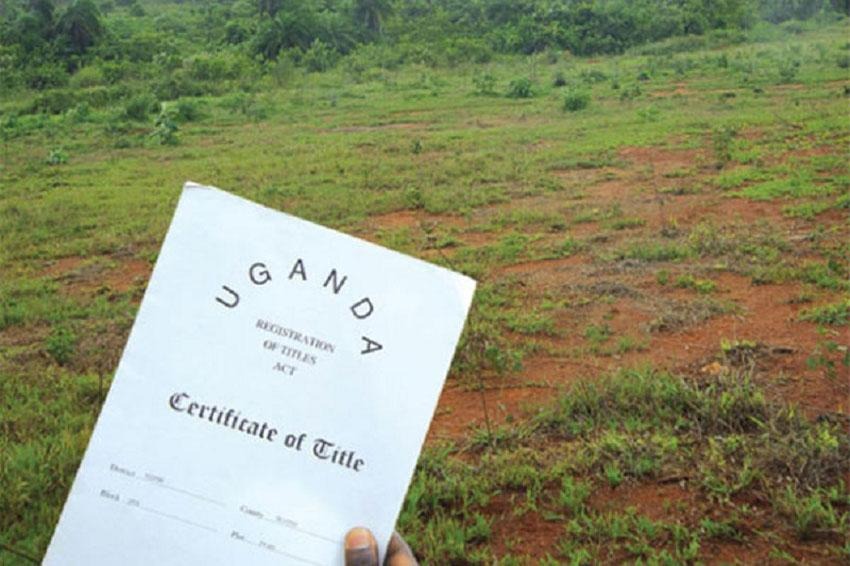
“Five people, including me, hold land measuring 778.570 hectares. But the OPM grabbed it and settled people in. Personally, I was tortured and evicted without compensation despite holding a land title for the said land.” He added.

During an interview with Witness Radio, the middle-aged, brown, and slim defender broke into tears, displaying big scars all over his body, which he says emerged as a result of beatings and torture during the evictions.

“They named me a land grabber who was resisting vacating land, which they called government land. They beat and tortured me.” The defender told Witness Radio

“I hold scars, and I have a lot of pain that those people caused me. My family is currently suffering because of greed from the big shots.” He added.

Whereas some of the evictees were eventually resettled, leaders of the affected communities reveal that serious injustices marred the process. Local land rights defenders, including Ahumuza, say the resettlement exercise was riddled with irregularities. They claim it triggered yet another violent eviction, as the land onto which the government relocated residents had itself been irregularly and allegedly illegally acquired.

“The process was not fair at all. The government never settled many of us, which is why we are now camping in an internally displaced camp. Some people were settled on land belonging to private individuals like Mbambali.” Ahumuza added.

Uganda has long been praised for its progressive refugee policies, including land allocation and freedom of movement, yet behind this lies evictions of nationals, which raises concern about balancing refugee resettlement with the land rights of host communities.

While refugees in Kyangwali remain settled and supported under national and international protection frameworks, many evicted host community members say they now live in informal, unrecognized settlements without compensation or redress.

Like the thousands of evictees who remain without justice and are now confined to an informal camp in Kiziranfumbi, Mr. Mbambali — himself a lawful landowner — has endured repeated dispossession alongside many others.

Despite repeated appeals, residents say government authorities have remained hesitant to address the dispute, leaving thousands in protracted uncertainty.

Continue Reading

MEDIA FOR CHANGE NETWORK

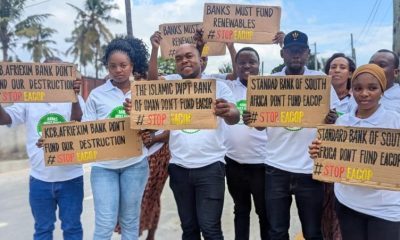
StopEACOP raises alarm over €1.5bn back door funding for TotalEnergies

Published

on

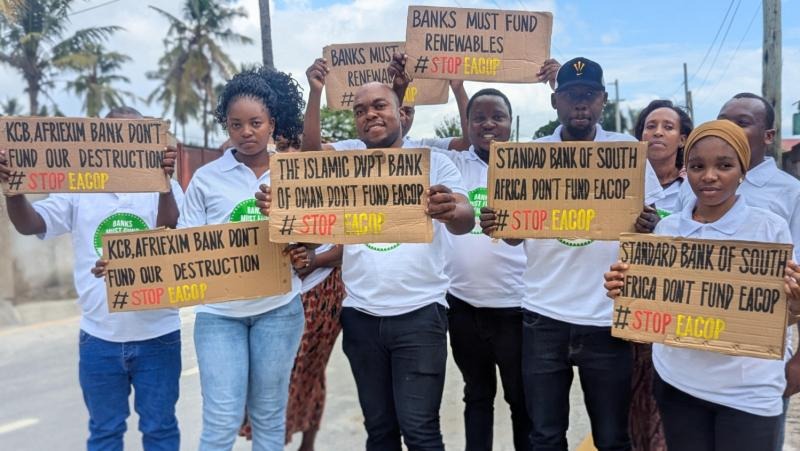
  • StopEACOP coalition says €1.5bn bond creates “back door” funding channel for EACOP and Mozambique LNG.
  • Over 40 global banks previously declined direct EACOP financing on ESG and climate grounds.
  • Coalition calls for shift from project exclusions to client based exclusions.

The StopEACOP coalition has raised alarm over a €1.5bn bond issued by TotalEnergies this week, arguing that the transaction exposes a critical gap in global banks’ ESG and climate commitments.

According to the coalition, several international banks that had publicly distanced themselves from the controversial East African Crude Oil Pipeline project participated in underwriting the bond. While more than 40 global banks have declined to directly finance EACOP, campaigners argue that facilitating corporate bond issuances for TotalEnergies effectively provides the company with unrestricted capital that can be allocated to any of its projects.

These include both EACOP and the Mozambique LNG development in Mozambique, another project facing sustained international scrutiny.

Among the banks that had previously announced they would not support EACOP are Société Générale in 2021, followed in 2022 by HSBC, Intesa Sanpaolo, J.P. Morgan and Mizuho. BBVA made a similar announcement in 2025.

Campaigners argue that although these institutions avoided direct project finance exposure, their participation in corporate level fundraising undermines the intent of those commitments. Bond proceeds are typically unrestricted, enabling companies to allocate capital internally, including to subsidiaries such as EACOP Ltd.

Zaki Mamdoo, StopEACOP Campaign Coordinator, said banks were seeking reputational protection while maintaining financial relationships that sustain fossil fuel expansion. He argued that bond underwriting allows lenders to benefit from fees and returns while distancing themselves from direct project finance scrutiny.

The coalition maintains that the €1.5bn raised strengthens TotalEnergies’ ability to internally finance projects that have struggled to attract external lenders due to environmental and social risk concerns. Recent risk briefings from BankTrack noted that public pressure has made it increasingly difficult for EACOP sponsors to secure conventional project finance.

EACOP, a planned 1 443 km heated crude oil pipeline linking oilfields in western Uganda to the Tanzanian coast, has faced sustained opposition over land acquisition, biodiversity risks and human rights concerns. Project affected communities in Uganda have reported land disputes and delayed compensation, while activists allege judicial and security pressures against opponents of the development.

Rachael Tugume, a project affected person from Hoima, said that once TotalEnergies channels internal funding to EACOP Ltd, the capital raised through bonds becomes directly linked to on the ground impacts, including land loss and livelihood disruption.

The coalition has called on banks to move beyond project specific exclusions and adopt client based exclusions. Under such a framework, financial institutions would decline to finance companies pursuing projects deemed incompatible with climate and human rights commitments, rather than simply avoiding individual transactions.

As TotalEnergies, alongside project partners including CNOOC and host governments in Uganda and Tanzania, continues to target first oil by July 2026, the financing structure behind the project is drawing renewed scrutiny from civil society.

Diana Nabiruma of the Africa Institute for Energy Governance said banks must align their financing practices with stated commitments to human rights, biodiversity protection and climate leadership. She argued that continued capital market support for companies expanding fossil fuel infrastructure erodes public confidence in ESG frameworks.

The controversy highlights a broader debate within global finance over the effectiveness of project level exclusions in driving climate aligned capital allocation. For African energy markets seeking to balance development priorities with environmental safeguards, the outcome of this debate will carry significant implications for future upstream oil and gas financing across the continent.

Source: greenbuildingafrica.co.za

Continue Reading

Resource Center

Legal Framework

READ BY CATEGORY

Facebook

Newsletter

Subscribe to Witness Radio's newsletter


Trending

Subscribe to Witness Radio's newsletter