STATEMENTS
One Year Later, Justice is Delayed: A joint statement on the implementation of the KIIDP-2 Kawaala Community Agreement
Published
2 years agoon

Date: June 4, 2024
Last week, 31st May 2024 marked a year since the signing of the dispute resolution agreement between the Kawaala community and the Kampala Capital City Authority (KCCA), facilitated by the World Bank Dispute Resolution Service (DRS), concerning the Second Kampala Institutional and Infrastructure Development Project (KIIDP-2). The process that led to this signing was hurried and confusing, but also hopeful. Hopeful that the agreement would mitigate the significant impacts of the drainage channel project on the Kawaala community’s livelihoods; hopeful for a way forward.
There is a more objective way of investigating the impact of the DRS process on the KIIDP-2 on the lives of the Kawaala community. The most obvious would be to look at the dispute resolution agreement and evaluate if what was agreed has been implemented. However, this agreement was declared confidential, and the DRS, unlike many of its peer accountability mechanisms, provided no summary or insight as to the content of the agreement. The alternative is to remind ourselves of the issues raised by the community in the complaint – the harm or anticipated harm by KCCA in undertaking this project – and assessing whether those issues have since been resolved. It is the findings of this method that has led us, Witness Radio and Accountability Counsel, as advisors to the community, to express our profound disappointment in the DRS’s management of the post-agreement phase and KCCA’s obligations in compensation, resettlement, and livelihoods restoration of the community.
At the time of the Complaint, the Kawaala community worried that their land would be taken away without adequate compensation. A year later, we are disappointed that there are still affected people who have not been paid the agreed compensation. Women, identified among the vulnerable groups in this project are yet to benefit from targeted initiatives to elevate their socioeconomic status and reduce their vulnerability to risk of abuse including sexual abuse.
Furthermore, some members of the community worried that the remains of their departed family members would be lost. Some of these affected community members are yet to be compensated for this loss and have not been able to restore their loved ones’ grave sites.
The community was anxious about food shortages as they were not farming their lands due to uncertainties caused by threats of eviction and disruptions by the project. A year on, the community is not yet fully resettled and restored in a way that empowers them to sustain their families through farming. There is still sewer seepage into farms, KCCA is yet to finalize the infrastructure necessary to ensure the flow of water in the drainage, so it still floods when it rains, and crops are carried away and contaminated.
The community had concerns over the safety and welfare of their children, fearing their children would fall into the drainage and get hurt. Unfortunately, this is still a concern as the project area is yet to be fenced off. Pathways including bridges to enable children to cross the drainage safely when going to school are yet to be constructed. There are no signages indicating restricted areas where it would be dangerous for children to play.
To add salt to injury, the rushed conditions under which the agreement was signed led to mistrust and division within the community, significantly affecting the cohesion and collective action needed for follow-up advocacy. Besides, the strict confidentiality of the agreement – in contravention of the norms of similar dispute resolution processes – limits the transparency and access to information necessary to ensure full implementation.
Through it all, we wish to recognize and applaud the Kawaala Community for their unwavering commitment and resilience in pursuing the fulfilment of the agreement. Despite facing significant challenges and setbacks, their dedication to seeing the agreement implemented and their lives improved remains unshaken. This steadfast commitment inspires our continued advocacy and support.
On this first anniversary, we call for immediate action from both the KCCA and the DRS:
To the KCCA:
- Pay everyone: We demand that KCCA, without any further delay, pay the agreed compensation to all affected people whose land they took in connection with this project.
- Address Livelihood Concerns: We demand that the KCCA work diligently on the livelihood concerns of the community living around the project area to ensure they are not left in a worse state due to the project’s impacts.
To the DRS:
- Provide a Comprehensive Update: We demand a detailed report on the steps taken since the signing of the agreement, specifically regarding the promised livelihood restoration efforts.
- Commit to Effective and Inclusive Monitoring: We urge the DRS to commit to an effective, inclusive, and transparent monitoring mechanism that genuinely addresses the community’s ongoing challenges and ensures the fulfilment of the agreement’s terms. We urge DRS to continue its monitoring role until the full implementation of the agreement.
- Put pressure on KCCA: We urge the DRS to put pressure on KCCA where implementation has stagnated; to demand accountability for what remains outstanding; and to require KCCA to perform its obligations as agreed under the agreement.
To the World Bank Group (WBG):
- Exert Influence for Implementation: We call on the World Bank Group to step in and exert influence to ensure the implementation of the agreement. The WBG has suffered reputational damage due to the harm financed under this project, which remains unaddressed. The WBG’s active involvement is crucial to mitigate(remedy?) the harm done and ensure justice for the Kawaala community.
The Kawaala Community deserves justice and a steadfast commitment to improving their lives as initially promised. We, as advisors, stand ready to assist in this process but require a renewed sense of duty from the DRS, KCCA, and WBG.
Sincerely,
Witness Radio
Accountability Counsel
Luganda Version
Oluvannyuma lw’Omwaka, Obwenkanya Bujjukirwa
Ekitegeeza Ekimu okuva ewa Witness Radio ne Accountability Counsel ku Kuteeka Mu Nkola Endagaano ya KIIDP-2 mu kyaalo kya Kawaala
Olunaku: 3 June 2024
Wiiki ewedde, nga 31 May 2024, omwaka guweera okuva ekyaalo kya Kawaala lwe kyateeka omukono ku ndagaano eye tesaganya ne Kampala Capital City Authority (KCCA), ekitongole kya World Bank Dispute Resolution Service (DRS), ku nsonga ya Second Kampala Institutional and Infrastructure Development Project (KIIDP-2). Okusaininga endagano kwayakuyizibwa ate era tekwali kulamulukufu wadde nga kwaali kuuwa essuubi. Essuubi nti endagaano eno yandiyambye okukendeeza ku bizibu ebingi ebyali bituuse ku bantu be Kawaala; essuubi ly’okufuna enkulakulana.
Waliwo engeri ey’omugaso ey’okwekebejja engeri DRS gyeyatambuzaamu endagaano ku KIIDP-2 mu bulamu bw’ekyaalo kya Kawaala. Engeri eyangu yandibadde okulaba ku ndagaano eyateekebwako omukono okulaba oba ebyakkirizibwa byatuukirizibwa. Naye, endagaano eno yategeerekebwa nga ya kyama, era DRS, okwawukaana kumikutu Emilala ejja Accountability mechanism, teyasobora kutegeza kubyakirizibwako mundagano. Engeri yooka jetusobola okutebereza ebyakanyizibwako, tuliina okugobelela ebizibu abantu byebaawa mukiwandiko kyogwemulugunya. Enkola nga ezo zezaretedde Accountability Counsel ne Witness Radio nga abaawabuzi ba bemulugunya okuvaayo netulaga obwenyamivu bwaffe eri enkola za DRS ne KCCA mukutukiriza kubyakanyizibwako nga; okusasula abantu, okusengula abantu no kubadeza obulamu bwabwe nga webwali.
Okongerezako, abantu abamu abekyaalo kya Kawaala baali betide nti ettaka lyabwe lyanditwaliddwa awatali kuliyirirwa mu ngeri eyituufu. Oluvanyuma olwomwaka gumu, turibenyamivu nti abantu abawerako batwaliddwako ettaka kyokka nga tebaanasasulwa nsimbi z’obuliyirizi ezakkirizibwa. Abakyala, abategeerekebwa nga bantu abali mu kibinja ekitali kya bulijjo mu projekiti eno, tebannafuna kyamagero ebyabateekebwa okubayamba mu by’enfuna n’okuweddemu obuzibu bw’okwonoona omubiri omuli n’okuvumbibwa.
N’ekirala, abamu ku kubemulukunya baalina okutya nti ebyo ebiva ku b’emikwano gyabwe abafa byandibula. Abamu ku memba z’ekibinja abali ku by’ekibanja kino tebannasasulwa ku nfuufu y’abalime ne banyizibwa okuzza mu nsi ebifo ebyo.
Ekyaalo kyali kyeraliikirivu ku by’okulya kubanga tebakyalima mu byalo lw’okusoberwa okwava mu kutya okw’okugobwa n’okubotobolwa kwa projekiti. Olw’omwaka gumu, ekibinja tekannakutulawo era ntegeka ey’ekitiibwa mu ngeri ey’okubayamba okufuna ebyetaago byabwe ebikozesebwa okuyamba amaka gaabwe mu bulimi. Waliwo okufuna okutuula mu byalo mu nfufu, KCCA tekannamaliriza kuzimba ebisenge ebisobola okuba n’emigga, era bwekikya.
Abazzade baali beeraliikirivu ku by’okutebenkeza n’obulungi bw’abaana baabwe, okutya nti abaana baabwe bayinza okugwa mu migga ne bakosebwa. Wabula kino tekinakolebwako. Enzirukanya omuli ebifo by’okutambulira ebisobola okuyambako abaana okweyongerayo ne basomero biri bituukirizibwa. Nti waaliwo obulabe obuli ku baana okukola ku nsi etali nsibuko.
Okwongera omunyu Munbwaa, enyanguyaa yokusininga endagano, Yyaleeta enjawukaana nobutesingangana ku kyalo ekitukosezamu kugeri yokugobeelela ebintu nga webitabula ne nsonga kii zitwetaga otekako ensira. Nga ojjeko ekola ekakali eye kyama, nga enkola ezo kwemulugumya endaala ezifananako nga eno, enkola eye kyama, tewaa beetu ya bintu kubera bilamulukufu, na bantu okufuna emiwandiko ebyamakulu okusobora ogobelela Yokosuka ebyakiriziganyako mukoola.
Mubyona, twebaaza abemulugunya okukola obutawera okulaaba nti ebyakanyizebwako betukirizibwa wadde nga bayita mubeera eyo kunyigirizibwa. Kino kituzamu amanyi nga abawabuzi bamwe akusigala nga tutambulila wamu namwe nokusigala nga tulwanirila enkyoka.
N’olwekyo, tusaaba KCCA ne DRS ekole kusonga ze kawaala mubunambilo.
Eri KCCA:
- Sasula Buli Omu: Tusaba KCCA, awatali kulwawo, esasule ensimbi ezakkiriziddwa eri abantu bonna abaatwaliddwako ettaka ku nteekateeka eno.
- Ggolokamu Eby’enfuna By’Obulamu: Tusaba KCCA ekole nnyo ku by’enfuna by’e kyaalo ekiri okumpi n’enteekateeka y’enteekateeka eno okulaba nti tebalekebwawo mu mbeera embi olw’enteekateeka eno.
Eri DRS:
- Waayo Lipoota Enkomeredde: Tusaba lipoota enkomeredde ku bikolebwa okuva lwe baateeka omukono ku ndagaano, nga bulijjo ku by’enkulaakulana mu by’obulamu.
- Kikole Ku Kulondoola Okuyisa Obulungi N’okugattibwa: Tusaba DRS ekole ku kulondoola okw’obulungi, okutunuulirwa n’okutegerekeka okukuuma okulaba nti enteekateeka eyatuukiriza amagezi.
- Teekawo Ekirwadde KCCA: Tusaba DRS ekome KCCA ekisigaza okw’okukola; era ekkirize KCCA okukola ku buvunanyizibwa bwe nga bwakolebwa mu ndagaano.
Eri World Bank Group:
- Teekawo Obusobozi Okulaba Ng’Ekirwadde Kiyindiddwa: Tusaba World Bank Group eyingire okulaba ng’endagaano eno eraba ekituukiriza. WBG tetekeddwa kuleka obuvunaanyizibwa kubanga omusango gwasindikibwa mu kugattika okw’enkomerero. Kibakakatako okukola ku ky’amagero kyabwe ekitali kyatuukirizibwa.
Ekibinja kya Kawaala kirina okufuna obwenkanya n’obukwatibwa obutuukirivu okulaba nga bulamu bwabwe buterede ng’ekisoka kye kyateebwa. Ffe nga abakubiriza, tuteekeddwa okukkiriza okukwatibwa okuva mu DRS, KCCA, ne WBG.
Mu bwesimbu,
Witness Radio
Accountability Counsel
Related posts:

Joint Statement on World Bank Accountability Mechanism’s Decision to Limit Application of Operating Procedures

Breaking: Kawaala Community land rights defender has been kidnapped.
The Court charges another Community land rights defender from Kawaala and remands him to prison.
Joint statement: AfDB should open spaces for civil society and communities, during the Annual Meetings and beyond.
You may like
STATEMENTS
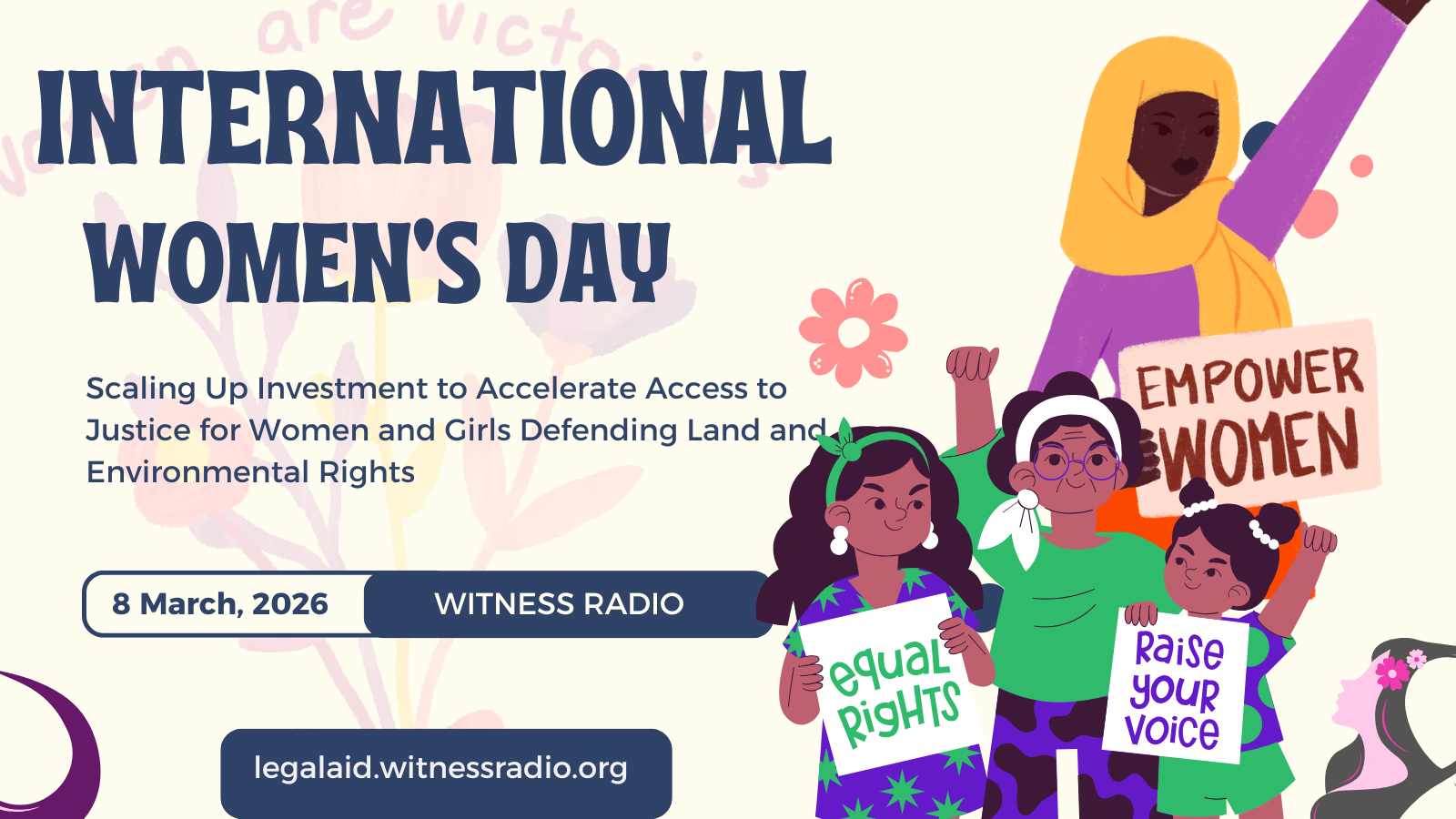
Statement by Witness Radio- Legal Aid Clinic on International Women’s Day 2026; Scaling Up Investment to Accelerate Access to Justice for Women and Girls Defending Land and Environmental Rights
Published
1 month agoon
March 8, 2026
As the world commemorates International Women’s Day, Witness Radio Legal Aid Clinic joins voices across Uganda and globally in calling for urgent and transformative action to accelerate access to justice for women and girls, particularly in protecting land rights, advancing environmental justice, and safeguarding community livelihoods.
Across Uganda’s rural communities, women are the backbone of families and local economies. They cultivate the land, produce food, and sustain household livelihoods. Despite being the primary users and custodians of land and natural resources, women remain systematically excluded from ownership, control, and decision-making over the very land that sustains their families and communities. Through our legal aid work supporting communities affected by forced land evictions, large-scale land acquisitions, and environmental degradation, Witness Radio has consistently observed that women bear the greatest burden of land injustices as cultural norms and patriarchal systems in many communities continue to treat land as the domain of men. As a result, women are frequently excluded from community meetings, negotiations, mediations, and decision-making regarding land use, land acquisition, and compensation processes.
Additionally, the increasing wave of large-scale land investments and commercial agriculture across Uganda has further exposed and deepened long-standing inequalities that marginalize women from fair, prompt compensation, decision-making processes, land usage, and ownership rights. Compensation is often paid to male heads of households, while the rights, interests, and contributions of women are overlooked. Many women who depend on the land for farming, food production, and family survival are neither consulted nor recognized as rights holders.
In numerous cases, once compensation is paid to men, women are abandoned with children and left without land, resources, or economic security. This reality exposes the deep lack of justice and tenure security for women, particularly in customary land settings, where their rights are rarely documented or formally recognized. Women who speak out against land grabbing, forced land evictions, or environmental destruction often face intimidation, social backlash, and isolation. Yet despite these challenges, many women continue to stand as frontline defenders of land, environment, and community survival.
Unfortunately, access to justice for these women remains limited. Existing grievance redress structures, cultural institutions, and traditional justice systems often fail to recognize or include women in the justice process, and administrative frameworks and formal legal processes are exorbitantly expensive, lengthy, and inaccessible to rural communities. Social barriers such as cultural norms, poverty, and illiteracy also prevent women from seeking remedies or participating fully in justice mechanisms. Without intentional efforts to dismantle these barriers, the promise of equality under the law and access to justice remains out of reach and a rumor for many women and girls.
Accelerating access to justice for women and girls, therefore, requires transformative action. It requires strengthening community legal empowerment, ensuring women’s meaningful participation in land governance and administration, and guaranteeing that grievance and compensation mechanisms recognize women as legitimate rights holders. In addition, it requires government institutions, cultural leaders, development partners, and private investors to ensure that investments and development projects respect human rights and actively protect women’s land rights rather than undermine them. Responsible investment must include gender-responsive and inclusive land governance and administration practices in a bid to strengthen recognition and protect women’s land rights.
Investors and development actors must ensure that women are consulted, included in negotiations, and fairly compensated where compulsory land acquisition occurs. Development should empower communities, not deepen existing inequalities.
As Witness Radio Legal Aid Clinic, we remain committed to supporting women land and environmental defenders, strengthening community land rights awareness, and amplifying the voices of women who continue to resist dispossession and demand accountability. Through legal aid, documentation of human rights abuses, and advocacy for equitable land governance, we stand in solidarity with women who are courageously defending their rights and the future of their communities.
As we mark this International Women’s Day, we honor the resilience of women across Uganda who continue to speak out for justice, dignity, and equality. Their struggle is not only about land, but also about justice, survival, and the protection of future generations.
“The soil remembers, my child. Even when men steal, even when papers lie, the land never forgets who sang to it, who bled for it, who are buried beneath it.”
Truly,
Witness Radio Legal Aid Clinic
Related posts:

Know Your Land rights and environmental protection laws: a case of a refreshed radio program transferring legal knowledge to local and indigenous communities to protect their land and the environment at Witness Radio.
Bridging the access to justice gap: Witness Radio trains paralegals ahead of Uganda’s general election.
Upholding Women’s Land Rights in the implementation of development projects will accelerate progress.
In memory of land and investment women victims in Uganda on the International Women’s Day 2021
STATEMENTS
Joint Statement Response by Advisers of PAPs to the DRS Follow-Up Report on the Uganda KIIDP-2 Case
Published
5 months agoon
November 25, 2025

Joint Statement Response by Advisers of PAPs to the DRS Follow-Up Report on the Uganda KIIDP-2 Case
KAMPALA, 25th NOVEMBER 2025
Introduction
On 30th October 2025, the World Bank’s Dispute Resolution Service (DRS) published its final Follow-up Report on the Uganda KIIDP-2 case, a community-led complaint regarding forced evictions and project-related harms under the Kampala Infrastructure and Institutional Development Project. The case began in 2021 and closed in 2023.
We welcome the publication of the Follow-up Report as it provides important reflections on dispute resolution practice. We appreciate that feedback from stakeholders, including some of our own, was incorporated into the Report. However, the Report presents an overly positive narrative that fails to reflect critical issues experienced by community members negatively impacted by the KIIDP-2 project. These omissions not only distort the record but undermine the legitimacy and objective of the accountability process and learning.
Gaps in Report
Project harms continue: It is paramount to begin here. The affected community filed a complaint to the Inspection Panel of the World Bank in 2020 to complain about harm they were experiencing with the ongoing KIIDP II project. The project designers and implementers failed to engage meaningfully with people who would be impacted by the project, and as a result, there was inadequate compensation for negative impacts, health risks and other hazards were associated with mismanagement of the drainage channel, and people lost their livelihoods. Over five years later–and even after a mediation process–the issues persist. The project remains incomplete even after the project closeout date. Clogged passages with dirt, persistent flooding of peoples homes and farms with dirty water, lack of access to homes, and incomplete infrastructure remain unresolved. The posture of the Follow-up Report assumes implementation is complete and everything is well, but the reality couldn’t be further from that.
No livelihood restoration: Livelihood support was a core demand from community members and a central topic throughout the mediation. Although interim agreements were reached on this issue, they were not included in the final agreement, and no livelihood programs have since been implemented. The community’s health, safety, and economic conditions continue to deteriorate as a result.
Women’s issues ignored: Gender-specific harms raised in the complaint and during the case process were never addressed and are completely absent from the final report.
Retaliation, intimidation, and threats of eviction: The report fails to acknowledge threats, harassment, and attempted evictions faced by community members during the process.
The process felt coerced and rushed: The Follow-up Report fails to capture DRS’ own challenges in managing the timelines to ensure a successful outcome. Although the mediation process spanned 18 months, community members report that they felt pressured to sign the agreement on the final day. In part this is because there was confusion about whether the dispute resolution process had officially concluded, and representatives and advisors were not informed in advance that the signing would take place that day. The Follow-Up Report also fails to capture the serious concerns associated with the signing of the agreement that led the community to feel coerced to sign the agreement. For example, the presence of government security officials at the signing created an intimidating atmosphere, further contributing to the sense of coercion.
Undermined decision-making: In the final stages, the DRS changed the previously agreed community representation and decision-making structure, sidelining duly elected representatives and diminishing the voice of minority or dissenting perspectives. The DRS made a unilateral decision–on the day of signing of the agreement–that the representatives previously elected by impacted community members were no longer going to make decisions on behalf of the community, and that instead, every member of the community was required individually to sign the agreement if they wanted to benefit from its provisions. Furthermore, the DRS had earlier communicated that if the agreement was signed, no unresolved issues could be referred to the compliance process, effectively discouraging individuals from dissenting or withholding their signature.
Confidentiality limitations: Unreasonably strict confidentiality restrictions during the mediation process limited community representatives’ ability to consult with other community members, the media, and allies. This lack of openness undermined transparency, community-wide participation, and meaningful ownership of the process. Towards the end of the process and during the implementation phase, the DRS interpreted these confidentiality provisions in a way that denied advisors access to key documents, including the mediation agreement and drafts of the Follow-Up Report. This made it extremely difficult for the advisors to support the community with timely and informed guidance. The removal of the Implementation Committee on the day of signing the agreement, without mutual agreement or any formal communication, further isolated the advisors. As a result, they were unable to monitor implementation or receive feedback through project-affected people (PAPs), with DRS insisting that the agreement remained confidential. The continued denial of access under the guise of confidentiality infringed on the community’s right to adequate representation.
Exclusion from Inspection Panel referral: The report omits that requesters were excluded from bringing unresolved issues to the Inspection Panel for investigation. This shift contradicted earlier expectations and closed off a key accountability route. Read more here.
To support transparency and learning, we commissioned an independent consultant to gather community feedback on the process, outcomes, and roles of various actors. Once complete, this analysis will be shared with the DRS and the World Bank to inform future DRS processes and strengthen accountability for other communities.
Conclusion
We believe in the potential of dispute resolution to provide meaningful remedy, but to realize that potential, there must be bold, transparent, and inclusive implementation. The DRS must account for all aspects of the mediation process and its outcomes. Livelihoods, gender-specific harms, and reprisals are not peripheral issues; they are central to justice, and they are left unresolved.
We thank the DRS for its work and call for further dialogue to ensure the spirit of the agreement is honored, and the dignity of the Kawaala community upheld.
Witness Radio
Accountability Counsel
Statement: 19.11.25 Statement Re DRS Report
Related posts:

Joint Statement on World Bank Accountability Mechanism’s Decision to Limit Application of Operating Procedures
PAPs and advisors cry foul over the mismanagement of the remedy agreement with the Uganda Government facilitated by the World Bank’s IAM.
Acknowledging Community’s Agreement while Raising Concerns with World Bank’s Dispute Resolution Service
Joint statement: AfDB should open spaces for civil society and communities, during the Annual Meetings and beyond.
STATEMENTS
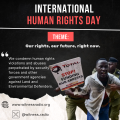
Witness Radio Statement on the International Human Rights Day 2024: A call to the government of Uganda to protect Land and Environmental Rights Defenders and Communities affected by irresponsible land-based investments in Uganda.
Published
1 year agoon
December 10, 2024
For immediate release
Statement on International Human Rights Day 2024:
Witness Radio calls out the government of Uganda to protect Land and Environmental Rights Defenders and Communities affected by irresponsible land-based investments in Uganda.
Wakiso: Uganda, December 10th, 2024; Anchored to the UN Declaration on the Right and Responsibility of Individuals, Groups, and Organs of Society to Promote and Protect Universally Recognized Human Rights and Fundamental Freedoms, Witness Radio stands together with Land and Environmental Rights Defenders, communities affected by irresponsible land-based investments in Uganda, and Human Rights Defenders across the globe in urging Government of Uganda to uphold and fulfill their obligations to protect and respect human rights in the context of land-based business operations and to ensure access to an effective remedy for individuals and groups affected by such activities, specifically land and environmental rights defenders.
As the world commemorates International Human Rights Day on December 10th, 2024, under the theme;
Our rights, our future, right now, Witness Radio has, in a period of the first 6 months of the year 2024, documented over 360,000 people who faced forceful evictions from the lands that had fed them for generations. This has led to various unbearable environmental and social issues, including violations of community rights during forceful evictions and threats to water sources, the environment, and food security. For instance, the use of agrochemicals in the newly acquired lands has led to pollution, affecting the health of the local communities.
Communities whose rights and interests on land have been forcefully transferred to land-based investors in agribusiness, carbon-offset tree plantations, oil and gas extraction, mining, and infrastructural development projects highlight concerns over food shortages, livelihoods; inadequate compensation; restricted land access; and impacts on children’s education, safety, and welfare, including gender-based violence (GBV) and reproductive health issues.
A recent report by Witness Radio Uganda, released in November 2024, paints a dire picture. Between January and June 2024, more than 360,000 people faced violent evictions, with over 121,000 hectares of land under threat. Nearly four cases of land evictions were reported weekly, affecting approximately 15,126 people and threatening 5,060.12 hectares of land across the country. An estimated 2,160 Ugandans faced evictions daily to give way to investments, with 723 hectares of land at risk of being grabbed daily. This is a crisis that demands immediate attention.
The land grabs are happening on abandoned national ranches and forests, which have long since been settled and farmed by people who came to the area fleeing war and natural calamities in neighboring areas. Although compulsory land acquisition falls within government powers in Uganda, corporations interested in specific land and their agents have been left responsible for managing much of the process and setting compensation values. This has led to serious problems with how the land acquisition process is being conducted, resulting in severe impacts on affected communities, which have infringed on the rights to property, involuntary resettlement, housing, earning a livelihood, food, private and family life, and trading and disposing of natural wealth and resources.
Land and Environmental Rights Defenders are the unsung heroes in this battle for justice. They are often the only force between ordinary people and unbridled power. However, their efforts are frequently met with judicial harassment in the form of criminalization for offensive gatherings, criminal trespass, and strategic lawsuits against public participation (SLAPPs) to discourage peaceful demonstrations against unlawful evictions, arbitrary detention, and defamation. Their importance cannot be overstated, and the injustices they face are a stark reminder of the need for change.
On this International Human Rights Day, it is crucial that duty-bearers recognize the gravity of the crisis in Uganda. The Government of Uganda should commit to and urgently implement universal respect, protection, and fulfillment of human rights for everyone and everywhere in the country. This is not just a call for action but a demand for justice and equality. We urge the government to act now, before more lives and livelihoods are lost.
Our Rights, Our Future, Right Now
Signed by;
Jeff Wokulira Ssebaggala.
For Witness Radio – Uganda
Related posts:

Witness Radio, private companies, CSOs and local government officials are meeting to discuss alternative remedies to salvage the appalling land and environmental rights situation in Kiryandongo district.
Uganda: Land-grab victim communities will join counterparts in commemorating the 2024 International Day of Struggle Against Industrial Plantations.
Land and environmental rights defenders, CSOs, scholars, and government to meet in Kampala to assess Uganda’s performance on the implementation of the UN Guiding principles on Business and Human Rights in Uganda.
Breaking: Witness Radio and Partners to Launch Human Rights Monitoring, Documentation, and Advocacy Project Tomorrow.
Agroecological farming: EAC Bill moves to Parliament to establish a regional legal framework to protect and promote sustainable farming and food systems.
African women are rising for climate justice and reparations on the inaugural continental day of action.
Africa is capturing just 2% of its carbon credit potential
Ugandan Farmers Sue EACOP in London in Last Minute Effort to Stop Crude Oil Pipeline
The South African High Court concludes hearing a landmark case challenging TotalEnergies’ Deep-Water Drilling project and offers to deliver its ruling on notice.
Oil-affected residents and civil society organizations reject TotalEnergies’ Tilenga Progress Report, citing unfairness in their operations.
U.S. Peace Efforts in the DRC: Protecting Communities or Minerals?
Sham Presidential Commissions Rubber Stamp Tanzanian Government’s Efforts to Evict Indigenous Maasai from Ngorongoro Conservation Area
Innovative Finance from Canada projects positive impact on local communities.

Over 5000 Indigenous Communities evicted in Kiryandongo District

Petition To Land Inquiry Commission Over Human Rights In Kiryandongo District

Invisible victims of Uganda Land Grabs
Resource Center
- Land And Environment Rights In Uganda Experiences From Karamoja And Mid Western Sub Regions
- REPARATORY AND CLIMATE JUSTICE MUST BE AT THE CORE OF COP30, SAY GLOBAL LEADERS AND MOVEMENTS
- LAND GRABS AT GUNPOINT REPORT IN KIRYANDONGO DISTRICT
- THOSE OIL LIARS! THEY DESTROYED MY BUSINESS!
- RESEARCH BRIEF -TOURISM POTENTIAL OF GREATER MASAKA -MARCH 2025
- The Mouila Declaration of the Informal Alliance against the Expansion of Industrial Monocultures
- FORCED LAND EVICTIONS IN UGANDA TRENDS RIGHTS OF DEFENDERS IMPACT AND CALL FOR ACTION
- 12 KEY DEMANDS FROM CSOS TO WORLD LEADERS AT THE OPENING OF COP16 IN SAUDI ARABIA
Legal Framework
READ BY CATEGORY
Newsletter
Trending
-
MEDIA FOR CHANGE NETWORK2 weeks agoGlobal Peasant Movement calls for action against escalating land grabs and repression.
-
MEDIA FOR CHANGE NETWORK1 day agoAfrican women are rising for climate justice and reparations on the inaugural continental day of action.
-
MEDIA FOR CHANGE NETWORK7 days agoUgandan Farmers Sue EACOP in London in Last Minute Effort to Stop Crude Oil Pipeline
-
NGO WORK1 week agoTwo dead as Siaya protests against gold mining firm turn tragic
-
DEFENDING LAND AND ENVIRONMENTAL RIGHTS4 days agoAfrica is capturing just 2% of its carbon credit potential
-
MEDIA FOR CHANGE NETWORK1 week agoMinister Cancels Contested 12-Square-Mile Land Title in Mubende
-
MEDIA FOR CHANGE NETWORK1 day agoAgroecological farming: EAC Bill moves to Parliament to establish a regional legal framework to protect and promote sustainable farming and food systems.