The South Durban Community Environmental Alliance (SDCEA) stand in solidarity with small‑scale coastal fishing communities on the West Coast as they challenge TotalEnergies SA’s Deep‑Water Orange Basin drilling approval in the Cape Town High Court.
By the Witness Radio team.
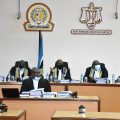
Cape Town, South Africa- The Western Cape High Court has concluded a two-day hearing in a landmark environmental justice case challenging the approval of ultra-deep-water oil and gas exploration by TotalEnergies in the Deep Western Orange Basin (DWOB), off South Africa’s West Coast.
The case, brought by environmental organizations including The Green Connection and Natural Justice, alongside the Aukotowa Primary Fishing Co-operative, challenges the legality of the environmental authorization granted by the Department of Mineral and Petroleum Resources.
The applicants argue that the decision was unlawful, irrational, and inconsistent with South Africa’s constitution and environmental laws, particularly in its evaluation of the environmental, climate, and socio-economic risks of the proposed exploration.
The Director General, Department of Mineral & Petroleum Resources, the Minister of Forestry, Fisheries & the Environment, and Total Energies EP South Africa S.A.S are the respondents in the case, which has sparked debate on environmental concerns likely to be caused by the project.
Neville van Rooy, the outreach ambassador for The Green Connection, told the Court that the project introduces unprecedented risks.
“The DWOB presents conditions unlike anything South Africa has ever faced – both in water depth and technical complexity. Neville van Rooy emphasized that the Environmental Impact Assessment (EIA) did not adequately address these unprecedented risks, which could have serious environmental consequences.”
The case dates back to 23 October 2023, when the Department of Mineral and Petroleum Resources granted environmental authorization, and appeals were dismissed on 24 April 2024, highlighting the ongoing legal process.
In October 2024, the applicants filed a case in the Western Cape High Court challenging the environmental authorization. They are also seeking to have both the Director-General’s decision and the Minister’s dismissal of their appeal reviewed and set aside.
The nearly 100 small-scale fishers and community members protested outside the Western Cape High Court, voicing concerns about marine ecosystems and the threat to local livelihoods posed by the project.
The demonstrators highlighted threats to marine ecosystems, declining fish stocks, and the livelihoods of coastal communities already facing the growing impacts of climate change.
“The State failed to meaningfully assess how this project will affect our livelihoods, food security, cultural heritage, and constitutional rights – effectively prioritising corporate interests over vulnerable fishing communities. We have the right to be heard and the right to a healthy environment. But the approval process ignored our lived realities and the warnings we have repeatedly raised.” Walter Steenkamp, the chairperson of Aukotowa Fisheries, a small-scale fishing cooperative in Port Nolloth, revealed.
The applicants argued that the government failed to assess the project’s need and desirability properly, downplayed the risks of ultra-deep drilling, ignored the socio-economic impacts on coastal communities, and overlooked obligations under the Integrated Coastal Management Act. They also maintain that the project conflicts with South Africa’s net-zero commitments and that the narrative of gas as a ‘bridge fuel’ is unsupported by science.
“Decision-makers disregarded key environmental laws, particularly the Integrated Coastal Management Act (ICMA). The public trustee duty requires the State to safeguard coastal public property for current and future generations. Both the Director-General and the Minister failed to apply mandatory criteria on coastal public property, public interest, and intergenerational justice, rendering their decisions unlawful.” Melissa Groenink-Groves, Programme Manager of the Defending Rights Programme at Natural Justice, emphasized.
Further, Steenkamp criticized the Environmental Impact Assessment (EIA) for downplaying the risks associated with drilling at depths greater than 2,000 metres below sea level.
“Without robust, site-specific scientific evidence and a Blow-out Contingency Plan tested in South African waters, approving this project violates the precautionary principle, which requires decision-makers to act with heightened caution where activities pose the risk of serious or irreversible harm.”
In response, the government of South Africa and TotalEnergies defended the approval, arguing that the process complied with national laws, including the National Environmental Management Act (NEMA).
On the issue of “need and desirability,” the respondents submitted that the project’s value lies in the knowledge to be gained through exploration, which is critical for informing future energy planning and resource management. They insisted that it would be premature and legally inappropriate to assess the impacts of production at this stage.
Addressing concerns about oil spill risks and socio-economic impacts, the respondents pointed to several technical studies—including the Oil Spill Modelling Report, Fisheries Impact Assessment, and Socio-Economic Impact Assessment respondents argued that the decision-makers relied on credible global datasets to assess the socio-economic impacts on small-scale fishers in the final ESIA, which presented a full evaluation of the potential consequences in a range of scenarios, including the socio-economic impact of an oil spill on small-scale fishers.
Regarding compliance with coastal protection laws, government lawyers argued that the principles outlined in the Integrated Coastal Management Act were substantively addressed within the broader ESIA process.
The respondents further argued that the applicants had failed to establish sufficient legal grounds to challenge the decisions, urging the Court to dismiss the case and order the applicants to cover legal costs.
This case is part of a broader wave of resistance by communities opposing projects they say threaten their survival and ecosystems. Large oil corporations have faced mounting criticism for financing projects associated with environmental destruction and, in some cases, for fueling conflict and social disruption.
In Uganda, for example, TotalEnergies has faced criticism over its involvement in major oil developments, including the East African Crude Oil Pipeline. These projects have been linked to widespread displacement, livelihood losses, and social disruption affecting more than 100,000 people.
For South African Communities and civil society groups, projects like DWOB threaten marine biodiversity, traditional livelihoods, and South Africa’s climate commitments.
“Decisions made in Cape Town about TotalEnergies and Shell will have a major impact on the future of our fishing industry. For generations, our families have relied on traditional fishing to put food on the table. Oil exploration threatens our ability to provide for our children and support our communities.” Ernest Titus from Lambert’s Bay added.
The Court is expected to announce the judgment soon, a decision that could have significant implications for South Africa’s fishing communities, marine ecosystems, and future offshore oil exploration.