Connect with us

MEDIA FOR CHANGE NETWORK

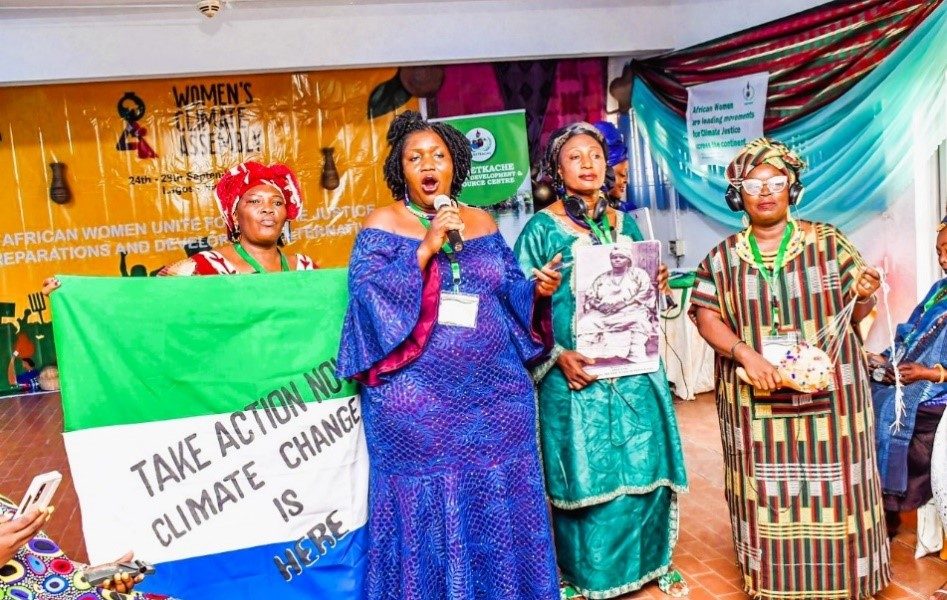
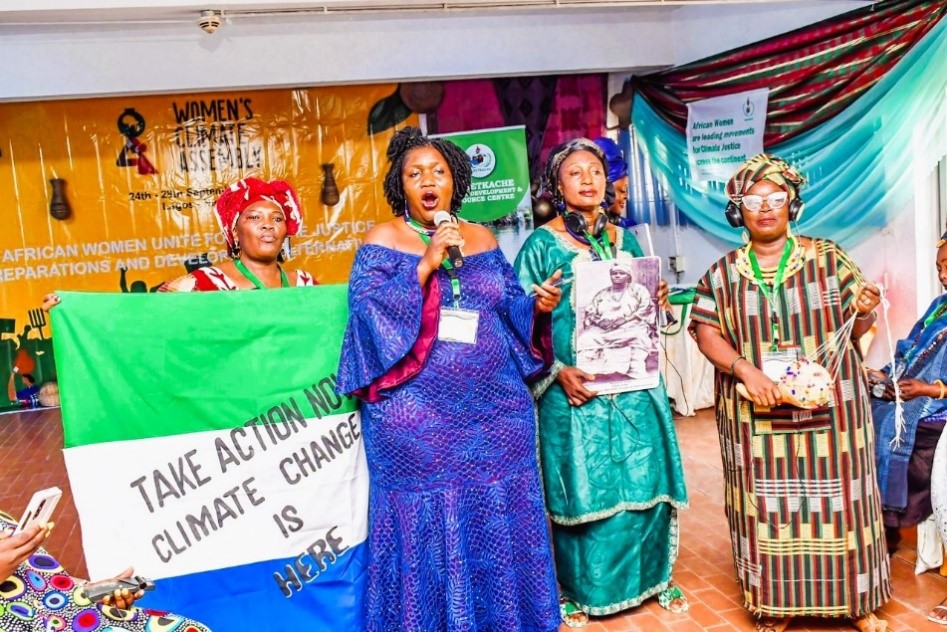
Women’s Climate Assembly, 2024: African women vow to protect human and environmental rights amidst an influx of destructive land-based investments on the continent.

Published

on

By Witness Radio team.

Africa’s path to recovery from the scars of destructive development projects will take decades. These projects, often presented as “development initiatives,” have caused untold suffering, including deaths, homelessness, infertility among women, food insecurity, flooding, and the relentless pollution of lands that were once flourishing homelands. This fallout is catastrophic for the environment and the people who depend on it.

In a radio program at Witness Radio, which was part of the Women’s Climate Assembly (WCA) 2024, women activists from across Africa, representing western and central African regions, revealed the dark reality behind projects disguised as “development,” which genuinely devastates their communities, lands, and the environment.

The rise of these destructive projects has galvanized African women to fight back. They demand alternative development solutions and projects that uplift women, support families, and sustain communities while protecting the environment.

Siya Foyoh, a community activist working with WoME from Kono District in Sierra Leone, shared the horrors her region faces from mining and deforestation. Kono, Sierra Leone’s one of the leading diamond-producing districts, has seen an increase in child deaths due to uncovered mining pits, which flood during the rains. “Every month, we lose one or two children who fall into these pits. This never happened before the mining began,” Foyoh explained.

Beyond the immediate dangers, the chemicals used in mining have led to widespread health crises. “In my district, hepatitis B is rampant because of these chemicals. Our health is suffering greatly,” she added.

But what is more disheartening is the response from government authorities. “When we report these tragedies to the government, we are told the mining companies are too powerful to be challenged,” Foyoh lamented.

Foyoh also pointed to the growing problem of timber logging in Sierra Leone, accelerating deforestation and disrupting rainfall patterns.

“This year, our community saw little and late rainfall, leading to food shortages. Deforestation is driving us toward famine,” she further added.

Another activist, Florence Naakie, from Nigeria’s Lokiaka Centre, highlighted the devastating impact of oil extraction on women and their communities. She revealed that “Countries may be different, but the struggles we face are the same,” recounting stories of coastal erosion in Senegal, deforestation for timber, and the increasingly erratic weather patterns affecting farming communities across Africa.

In Nigeria’s Niger Delta, Oil development operations have ravaged the land and waters, and farmers and fisherfolk are facing an ecological disaster. “Our soil is infertile; even when we use fertilizers, there’s no yield. Fisherwomen report catching fish that smell of crude oil, which we know can cause cancer,” Naakie explained.

She painted a bleak picture of life in the Niger Delta: “We’re being pushed to the brink. People cannot farm or fish, and the pollution has led to widespread infertility and cancer among women. Some of the babies born in these areas are deformed.”

In Nigeria, the oil spill crisis is staggering. The Nigerian Oil Spill Monitor recorded over 1,150 spills in 2023 alone.”Oil pollution has destroyed our environment, caused infertility in young women, and left us battling diseases like cancer,” Naakie added, with emphasis on the devastating impact on women, who bear the brunt of providing for their families in the face of environmental destruction.

“We have many women between the ages of 25 and 30 and above who are now unable to conceive because they have been exposed to a polluted environment. When these women go fishing, they come into contact with crude oil, leading to serious health consequences like cancer. We are seeing rising cases of skin cancer, cleft lips, and deformities in infants born to these women,” Naakie added.

Despite the overwhelming challenges, African women are refusing to back down. They call for projects restoring degraded lands and water sources and for the collective power to stand up to mining companies, governments, and other entities pushing harmful ” development ideas.”

“We will not give up,” vowed the activists. We are fighting for projects that prioritize women, families, and communities. We want a future where we can live dignified lives without fear for our children or our land.”

In-case you missed the live program,

Continue Reading

MEDIA FOR CHANGE NETWORK

Breaking: Ugandan Court jails eight Anti-EACOP activists as crackdown on dissent deepens.

Published

on

By the Witness Radio team.

KAMPALA, Uganda—The Buganda Road Chief Magistrate’s Court sentenced eight environmental activists to 11 months in prison for “public nuisance.” The court ruled that their protest against the East African Crude Oil Pipeline unlawfully disrupted traffic in central Kampala.

The group includes Akram Katende, Ismail Zziwa, Teopista Nakyambadde, Shammy Nalwadda, Dorothy Asio, Shafik Kalyango, Noah Kafiiti, and Keisha Ali. They were sentenced on Friday, April 17, 2026, by a Grade One Magistrate. The court convicted them of nuisance on the road, contrary to section 65(e) of the Road Act Cap. 346.

In a judgment delivered by Chief Magistrate H/W Achayo Rophine, the court found that the activists had “placed themselves on the road in a manner that caused danger or inconvenience to traffic.

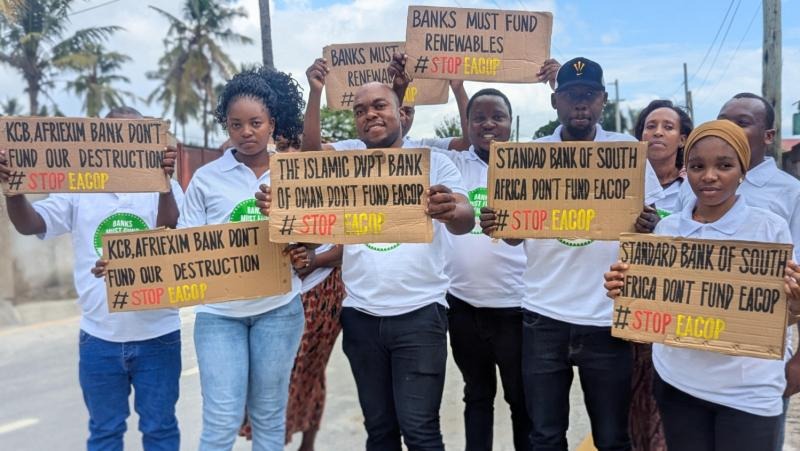
The activists, operating under the umbrella of Rooted in Resistance, formerly Students Against EACOP Uganda, were arrested on August 1, 2025, while marching toward Stanbic Bank Uganda’s headquarters. They were protesting the bank’s alleged role in financing the controversial East African Crude Oil Pipeline (EACOP).

They have been on remand for more than eight months after being repeatedly denied bail.

In her ruling, Magistrate Achayo relied heavily on police testimony and video evidence, which she said showed the activists standing and sitting in the middle of Hannington Road, holding

placards reading “Stop EACOP” and refusing orders to disperse.

The court concluded that the protest constituted an unlawful assembly, noting that the group had not notified authorities in advance and had failed to comply with police instructions to clear the road.

Citing Article 43 of the Constitution, she ruled that the activists’ actions prejudiced the rights of other road users and the public interest, particularly by causing a traffic jam in a busy section of Kampala.

“The accused persons… caused inconvenience on the road with their unlawful assembly,” the judgment reads.

Despite the relatively minor nature of the offense, which carries a maximum sentence of one year, the activists had already spent most of that time in detention before conviction.

Their prolonged remand has drawn criticism from legal observers and human rights advocates, who argue that the case reflects a broader pattern of punitive pre-trial detention.

Defense lawyer Kato Tumusiime condemned the ruling and announced plans to appeal to the High Court, describing the decision as an attack on fundamental freedoms.

He argued that the conviction is “intended to silence freedom of expression and speech in Uganda.”

“The judgment is unfair, and we intend to appeal it,” lawyer Kato Tumusiime said.

The case is part of a growing number of arrests linked to opposition to the East African Crude Oil Pipeline, a major regional infrastructure project.

In April 2025, another group of activists, commonly known as KCB 11, protesting against KCB Bank Uganda’s involvement in the project, were detained for three months under similar circumstances.

Campaigners say these cases point to a systematic use of the justice system to deter protest against powerful economic interests.

The East African Crude Oil Pipeline (EACOP) is a 1,443-kilometer heated crude oil pipeline designed to transport crude oil from western Uganda’s Lake Albert region to the port of Tanga in Tanzania. The project is being developed by a consortium led by TotalEnergies and China National Offshore Oil Company, alongside the governments of Uganda and Tanzania.

Supporters of the project say it is central to Uganda’s economic ambitions, expected to generate revenue, create jobs, and enable the country to become an oil exporter.

However, environmental groups and civil society organizations have raised concerns about its impact. Critics point to the displacement of communities during land acquisition, potential risks to ecosystems, and the project’s contribution to global carbon emissions.

Despite opposition, the project has already entered the implementation phase. Construction activities are ongoing in both Uganda and Tanzania, and land acquisition processes have largely progressed, although some disputes remain. Uganda continues to target its first oil production within the next few years.

These concerns have fueled a wave of protests, targeting financial institutions seen as backing the pipeline.

Campaigners have also criticized companies and financiers linked to the project for failing to speak out. StopEACOP Campaign Coordinator Zaki Mamdoo has argued that corporate silence in the face of arrests is not neutral, pointing to evidence of communication between project developers and Ugandan authorities.

“At COP28, when I confronted TotalEnergies CEO Patrick Pouyanné over the arrest of yet another group of anti-EACOP activists, he confirmed to me that the company was in direct communication with Ugandan authorities over the detention of those activists. That demonstrates that the companies behind EACOP are not passive observers of the repression meted out by the authorities”, said StopEACOP Campaign Coordinator, Zaki Mamdoo.

Continue Reading

MEDIA FOR CHANGE NETWORK

Govt launches war on land fraud, illegal evictions

Published

on

The government has warned that the growing wave of land-related crimes across the country, caused by unscrupulous land agents, fraudulent transactions, and family inheritance disputes, is increasingly undermining investment confidence and tenure security.

Lands Minister Judith Nabakooba said the persistent rise in land offences is eroding public trust in the land administration system and slowing down wealth creation efforts, especially in both urban and peri-urban areas.

“The trend is mainly being contributed to by unscrupulous land agents, overzealous administrators of estates, forgeries of land transaction documents, absentee landlords and tenants who disregard their obligations, and this has hurt investment and wealth creation, necessitating immediate coordinated intervention,” Ms Nabakooba said.

She explained that many of the disputes occur in high-risk settings such as unregistered customary land, contested ownership, inheritance wrangles, and large-scale land transactions where verification systems are weak, bypassed, or manipulated by actors familiar with legal loopholes.

Despite Uganda’s existing legal safeguards, including Article 237 of the Constitution, the Land Act, the Succession Act, and the Mortgage Act, officials say enforcement gaps continue to be exploited.  Data from the ministry’s Sustainable Urbanization and Housing Programme report shows that the level of digitised land services has increased from 45 percent to 82 percent, significantly improving efficiency and reducing delays in service delivery.

 The same report indicates that the time taken to conduct a land search has reduced from five days to one day at physical offices, and to as little as five minutes through online platforms. Processing times for land transactions such as transfers and mortgages have also dropped from 15 days to about 11 days, marking progress in service delivery reform.

In addition, systematic land demarcation and certification efforts have expanded, with surveyed land parcels increasing from 66,148 to 469,656. Certificates of Customary Ownership have also risen significantly from 9,325 to 80,898, reflecting government efforts to formalise tenure systems and reduce disputes in customary land areas.

 To curb illegal evictions and related abuses, government introduced Administrative Circular No. 1 of 2025, which tightened procedures governing evictions nationwide. The directive requires that no eviction be carried out without the involvement of District Security Committees in consultation with the Ministry of Lands.

“Eviction or demolition shall only be carried out between 8am and 6pm, and no eviction or demolition shall be carried out during weekends or public holidays. Each demolition shall be carried out in a manner that respects and upholds human rights and dignity,” Ms Nabakooba said.

 Beyond enforcement measures, the ministry says it is pushing broader reforms aimed at strengthening governance and reducing fraud.  These include allowing tenants to deposit nominal ground rent (busuulu) with the Uganda Revenue Authority in cases where landlords are absent or refuse payment, alongside plans to deploy blockchain technology and artificial intelligence in land transactions.

Also mass land titling to resolve boundary disputes is being undertaken.  “Government remains committed to ensuring social justice and harmony in land ownership, and all stakeholders must comply with established legal procedures. All Resident District Commissioners should remain vigilant in maintaining law and order,” Ms Nabakooba added.

 However, concerns remain about enforcement at district level, particularly in high-conflict areas where vulnerable groups continue to face intimidation and forced evictions.  Mr Twaha Ssembalirwa, a legal expert from Atlas Advocates, said the rise in land-related crimes reflects weak enforcement rather than a lack of legislation.

“Uganda has a fairly robust legal framework on land, but the challenge lies in enforcement. Corruption in land transactions is mostly among the big wigs in most of the cases we handle, plus low public awareness, especially among people dealing with customary and unregistered land,” he said.

Original Source: monitor.co.ug

Continue Reading

MEDIA FOR CHANGE NETWORK

Agroecological farming: EAC Bill moves to Parliament to establish a regional legal framework to protect and promote sustainable farming and food systems.

Published

on

Hon. Gideon Gatpan Thoar, Chairperson of the EALA Committee on Agriculture and Natural Resources, presenting during a plenary sitting of the Assembly.

By the Witness Radio team.

The East African Legislative Assembly has taken a critical procedural step toward introducing the EAC Agroecology Bill, 2026, as the Chairperson of the Committee on Agriculture and Natural Resources was formally granted leave from the House to draft and table the proposed law.

The move marks the Bill’s official entry into the legislative process, which could significantly impact regional farmers, policymakers, and civil society by reshaping food systems and governance across East Africa.

The Bill aims to empower smallholder farmers and promote inclusivity by embedding agroecology into law across the East African Community, fostering hope for a more sustainable future for these farmers.

In an interview with Witness Radio, the Chairperson of the Committee on Agriculture and Natural Resources in the East African Legislative Assembly (EALA), Hon. Gideon Gatpan Thoar, described the Bill as a long-overdue effort to give legal backing to a system already practiced by millions of farmers across the region.

“The purpose of this bill is to establish a regional legal framework to mainstream agroecological farming,” the Chairperson said, emphasizing that the law seeks to move agroecology from policy discussions into enforceable regional commitments.

The proposed law draws from the 13 FAO principles, integrating indigenous knowledge, cultural practices, and scientific innovation to strengthen its regional relevance.

“We want to promote practices that are consistent with our people, that are known to our cultures and traditions, and integrate them with science. There must be co-creation and inclusivity, especially for smallholder farmers,” he explained.

This framing positions agroecology not just as a farming method, but as a knowledge system shaped by communities themselves, challenging dominant agricultural models often driven by external actors.

The Bill emerges amid the ongoing expansion of industrial agriculture supported by global corporations and financiers, which may resist the shift towards agroecology. Understanding how the Bill will navigate or counteract this resistance is crucial for stakeholders concerned about regional agricultural transformation.

Despite this well-developed narrative, smallholder farmers remain the highest food producers. Yet the Chairperson acknowledged this imbalance of power, noting that agroecology faces stiff competition.

“There is a big fight from conventional agriculture. Big corporations are sponsoring data; they have a lot of money, and they have subsidized it,” he said.

Rather than banning industrial agriculture, whose adverse impacts on both smallholder farmers and the environment are evident, the Bill introduces a different strategy, one centered on protection and choice. It seeks to create legal and economic space for agroecological farmers, many of whom have historically been marginalized.

“We are not forcing a transition. We are creating a situation where there is choice and support for those who have been left behind, mainly women, youth, and smallholder farmers,” He clarified. This approach aims to foster hope and confidence that the new law will support sustainable options for all farmers.

The proposed law will also avoid the usage of highly hazardous pesticides and synthetic fertilizers, instead relying on ecological processes.

“We are very keen on highly hazardous agrochemicals… agroecological farmers will not be using them,” the Chairperson stated, emphasizing that support systems will drive the transition, fostering optimism for farmers’ sustainable options.

Uganda recently ordered the phase-out and restrictions on several commonly used agricultural chemicals, citing risks to human health, the environment, and the country’s ability to compete in the export market. The Ministry of Agriculture, Animal Industry, and Fisheries (MAAIF) said the decision was made after its Agricultural Chemicals Review Committee reviewed the chemicals and their “safety, trade, and national interest concerns.”

The Ministry said in the letter, “The actions and decisions made by the government are based on concerns for safety, trade, and the national interest.” Alpha-cypermethrin, atrazine, butachlor, dimethoate, and propanil are some of the chemicals that will be phased out. Importation will be banned right away, and the chemicals will be completely removed by the end of 2026.

While several East African countries already have agroecology strategies, such as Uganda’s NAS and Kenya’s strategy, these lack enforcement mechanisms. The regional Bill aims to establish binding compliance measures that will guide and harmonize national laws, ensuring effective implementation across the region.

“The regional law will be an anchor, reflecting in national systems to foster trust and regional unity,” the Chairperson explained, encouraging confidence in the legislative process.

The legislative process is ongoing, with the Bill expected to undergo drafting, committee review, and public consultations before a final vote, likely within several months.

Continue Reading

Resource Center

Legal Framework

READ BY CATEGORY

Facebook

Newsletter

Subscribe to Witness Radio's newsletter


Trending

Subscribe to Witness Radio's newsletter