By the Witness Radio Team
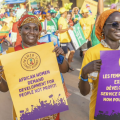
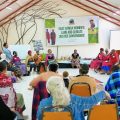
Stories of displacement, land loss, and resilience filled the room as 45 women from six African countries gathered for the East Africa Women’s Land and Climate Justice Convergence in Nairobi, organized to raise awareness and explore resistance strategies against land dispossession and climate injustice.
Representing communities from Kenya, Uganda, Tanzania, the Democratic Republic of Congo, Zimbabwe, and South Africa, the women came together not only to learn but also to speak, listen, heal, and feel the weight of their struggles, resisting destructive extractive projects and reclaiming what belongs to them, despite the immense impacts they have endured.
Africa is often described as having vast unused or underutilized land. This narrative has attracted investors, especially from the Global North, into large-scale industrial agriculture and other land-based investments. However, a 2025 report by the Alliance for Food Sovereignty in Africa (AFSA), PLAAS, and the Institute for Agriculture and Trade Policy challenged this claim, showing that such narratives have fueled large-scale land grabs, ecological destruction, and community dispossession across the continent.
In Uganda, the land eviction crisis has intensified due to increasing land-based investments that have dispossessed local communities with impunity, with oil development activities among them. According to human rights groups, this has led to more than 100,000 people in Uganda and Tanzania permanently losing their land to make way for the pipeline and related projects.
Jenniffer Kiiza, a resident of Hoima, is among those whose land was taken for oil development.
“The project has had severe negative impacts, especially on vulnerable groups like women,” she said, highlighting how delayed compensation, gender-based violence, and food insecurity disproportionately affect women and their families.
“We face dispossession, and sadly, we are paid very little money, which comes late and is no longer enough to buy land elsewhere. Hunger and malnutrition in adults and babies have increased, and this is affecting us as women and our families.” Kiiza added.
Kiiza has continued to speak out despite growing repression against dissent, advocating for justice for her community, especially women, even as opposing such mega-projects comes at a high cost.
“These developments have caused hunger, increased gender-based violence, family breakdowns, school dropouts, and early marriages. There has also been a rise in prostitution, as women struggle to provide for their children after losing their land.” She added.
Meanwhile, in Uganda alone, the Uganda Police’s Annual Crimes Report, 2025, released early April, recorded 663 cases of land fraud, an indicator of the country’s escalating land crisis.
In Zimbabwe’s Midlands province, particularly in Shurugwi, communities are facing similar challenges linked to mining activities, including land dispossession and environmental harm. Jecha Benenia a women’s rights defender from a community affected by Unki Mine, shared her experience during the convergence.
“We are facing many challenges from the miners. Chinese investors are coming into our area and evicting us. They tell us to leave, and if we refuse, they come with bulldozers and destroy everything, including our homes. We are left with no shelter and nowhere to go,” she said.
She added that abandoned open pits left by mining companies have become deadly hazards.
“When it rains, the pits fill with water. Our livestock fall into them, and even our children have fallen in. We are losing both animals and lives, and the danger is ever-present,” She added.
Communities in Zimbabwe also report water pollution from mining activities, which threatens their health and livelihoods. “The water we use is our source of livelihood, serving domestic needs, drinking, and our animals. However, after consuming it, we have experienced illnesses like cholera, and pregnant women face severe complications,” she added.
Her revelations echo concerns raised at the 2025 Zimbabwe Alternative Mining Indaba (ZAMI). The 14th edition of the Indaba, convened by the Zimbabwe Environmental Law Organization (ZELO) and partners in September 2025, highlighted multiple challenges within a sector that contributes about 12% to 13.3% of the country’s Gross Domestic Product (GDP).
In its December 2025 communiqué, ZAMI noted that unsustainable resource extraction is driving widespread environmental damage, including water pollution, habitat loss, soil degradation, and deforestation.
It further pointed to displacement, inadequate compensation, and the absence of Free, Prior, and Informed Consent (FPIC), particularly affecting marginalized communities whose exclusion from governance processes has resulted in violence, disempowerment, and the entrenchment of poverty in resource-rich areas, worsened by weak oversight that has enabled environmental violations and illicit financial flows.
Amid these challenges affecting their communities, the women shared, the convergence concluded with a renewed sense of solidarity, forming a network of resilient women committed to defending Africa’s commons—land, forests, water, and cultural systems—now under increasing threat.
According to the organizers, the meeting was particularly significant in creating a platform for women to share lived realities that are often excluded from formal land governance discussions. Participants exchanged insights on the challenges they face and identified collective strategies to strengthen their land rights.
“The convergence brought together women to reflect on their experiences with customary and communal land tenure systems. We will continue to build on this knowledge and strengthen solidarity plans at both national and regional levels with the women,” WoMin’s Sizaltina Cutaia told Witness Radio.
Participants described the gathering as a transformative learning space that not only exposed shared struggles but also equipped them with the skills and knowledge to defend their rights collectively.
“And a message I can give to a woman in the struggle is to keep fighting for her goal. She should not give up, but continue until she achieves what she wants. This cuts across countries and brings us together through networking. When we unite as women, we realize we share one goal—as mothers in our communities and countries—because land is our motherland,” said Sarah Osas from Nakuru in Kenya.
Despite powerful companies taking over their land, women defenders say they are determined to continue resisting and reclaim what is rightfully theirs.
“We are fighting back so that we can reclaim our natural resources, including land and water. Many women are facing serious health challenges, including stress and stroke, as a result of these struggles. But we are not going back. We are fighting to reclaim our commons through demonstrations, cultural resistance, and petitions led by marginalized communities.” Jecha mentioned.