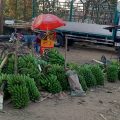
Ms Beatrice Nankera, a 63-year-old farmer in Budaka District, says: “Cassava was our insurance crop. Even when rains failed, we could count on it. Today, the yields are too low, diseases are many, and the profits are not worth the effort.”
Ms Nankera explains that many families depended entirely on cassava cultivation and considered it as a backbone of their livelihoods. “Families without a big garden of cassava were considered food insecure. They were not respected,” she added.
Her experience is echoed by many farmers across Bukedi, where changing weather patterns, pests, diseases, declining soil fertility and limited market opportunities are making cassava farming increasingly difficult.
Many households have now switched to growing rice and maize, although according to local leaders, the shift has instead fuelled food insecurity in the region.
“The resources and time invested in cultivating rice are huge compared to the output,” said Mr Bernard Tazenya, a local farmer. “People are planting rice not by choice, but because of the high poverty levels,” he added.
Bukedi was once among the top cassava-producing regions, followed by the Teso Sub-region. However, the resurgence of diseases, particularly cassava mosaic and cassava brown streak, has posed significant threats to production. The viral infections, spread largely by whiteflies and infected planting materials, leave plants stunted, destroy tubers and reduce yields.
The National Agricultural Research Organisation (Naro) has introduced resistant cassava varieties, but many farmers remain discouraged.
Mr Godfrey Mugoga, an agricultural extension worker, says many farmers continue to recycle cuttings from infected plants due to limited access to clean, disease-resistant varieties.
“When one farmer plants infected stems, the disease spreads quickly across neighbouring gardens. Without coordinated action, controlling these diseases becomes difficult,” Mr Musoga says. Although cassava is known for being a resilient crop even amidst prolonged dry spells, low yields have caused fears of food insecurity.
Bukedi has experienced increasingly unpredictable weather patterns in recent years, with delayed rains and extended droughts affecting crop production.
Climate experts warn that unless farmers adopt climate-smart practices such as moisture conservation, mulching and improved water management, cassava production will continue to decline.
Beyond production challenges, farmers also face difficulties accessing reliable markets. Unlike maize and rice, which benefit from direct market access, cassava markets remain largely informal and unpredictable.
Prices fluctuate widely depending on the season and demand, leaving farmers vulnerable to losses. Limited investment in cassava processing industries has further constrained opportunities for value addition.
“Most farmers sell raw cassava or dry chips at low prices,” said a local trader in Pallisa District who preferred anonymity. “There is no factory to process cassava into high-value products such as starch, ethanol, and industrial flour.”
Agricultural experts believe cassava still has potential if farmers are given the right support. Mr Badrru Kirya, the chairperson of the Bagwere Cultural Council, says, “For generations, cassava has helped Bukedi communities withstand hunger and economic shocks. Its decline is a warning sign about the vulnerabilities facing smallholder farmers in a changing climate and economy.”
As policymakers, researchers and development partners focus on boosting agricultural productivity, many farmers believe cassava deserves renewed attention. “If the current trend continues, Bukedi risks losing not only an important source of food and income, but also a crop deeply-rooted in its history and identity,” Kirya explains.
Eastern Uganda accounts for roughly 36.7 percent of the nation’s cassava production, with Bukedi once having the largest population of cassava farmers.
Currently, due to scarcity, cassava is being bought from neighbouring districts such as Namutumba, with prices ranging from Shs1,200 to Shs1,300 per kilogramme. Previously, when cassava was abundant, prices remained low and stable.
Kibuku District Production Officer, Michael Mbayo explains that cassava now faces a serious setback as more farmers lose interest in planting the crop.
“Farmers should not just abandon cassava cultivation. Most households now having only a single meal a day,” Mbayo says.
Opinion leaders and elders have also voiced concerns about the declining production of cassava, attributing it to modern lifestyles among the youth.
Source: monitor.co.ug