By the Witness Radio team.
For more than eight years, the landscape of Kiryandongo district in western Uganda has undergone significant changes, shifting from being occupied by local farmers to a violent takeover by multinational companies.
What used to be small farms, homesteads, and community life is now dominated by endless stretches of sugarcane and grain plantations, disrupting local economies and social bonds. Families who once cultivated food and built futures now face displacement, dispossession, and uncertainty about their livelihoods and community cohesion.
“They found us living in peace. Now everything is broken: families, dreams, livelihoods. investors forcibly took away our land.” Benon Beryaija told Witness Radio, recalling the past.
Despite displacement, criminalization, and fear, some land defenders remain steadfast, inspiring the audience to value resilience and collective resistance.
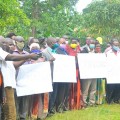
Benon Beryaija, the chairperson of the Kiryandongo land eviction victims, is at the center of the resistance and continues to organize locals despite threats, arrests, and violence.
“The bigger group left, but we remain resolute. “We are defending what belongs to us; our land that was grabbed by multinationals. It is a very hard fight, and it is threatening my life. I have been arrested and tortured for defending my people.”
His experience reflects a broader pattern across Uganda and beyond, where land and environmental defenders increasingly face intimidation, legal harassment, and violence.
The situation in Kiryandongo mirrors a growing global crisis. A global coalition of small-scale farmers and rural movements has issued a strong call for international mobilization against land dispossession, state repression, and what it describes as a growing “neocolonial offensive” targeting rural communities worldwide.
In a statement released ahead of the International Day of Peasant Struggles on April 17, La Via Campesina warned that agribusiness expansion, militarisation, and restrictive trade policies are accelerating land grabs and undermining food sovereignty across continents.
Founded in 1993, La Via Campesina brings together millions of peasants, landless workers, Indigenous peoples, pastoralists, fishers, migrant farmworkers, and rural women and youth, all of whom advocate for food sovereignty and peasant agriculture.
The annual commemoration marks 30 years since the Eldorado do Carajás Massacre in Brazil, where military police killed 21 landless workers during a protest for agrarian reform. The movement says the anniversary is a reminder of “ongoing violence in our territories” and the continued impunity for crimes against land defenders.
Peasant movements warn that land grabbing is being accelerated by agribusiness expansion, extractive industries, and global financial interests often backed by foreign capital and state support.
“They do not come to restore democracy,” the statement reads. “They come to steal the land we cultivate,” accusing multinational corporations and governments of turning land and ecosystems into “speculative assets.”
Recent findings from the Food and Agriculture Organization, in collaboration with the International Land Coalition and CIRAD, reinforce these concerns. Their “Status of Land Tenure and Governance” report estimates that more than 1.1 billion people, about 23 percent of the global adult population, live under constant fear of losing their land or homes within the next five years.
The report identifies commercial pressures as a major driver of land insecurity, echoing concerns raised by peasant movements.
The statement also criticizes global trade systems, particularly agreements negotiated under the World Trade Organization, arguing that they favor multinational corporations at the expense of smallholder farmers.
La Via Campesina has called for agriculture to be removed entirely from WTO frameworks, saying free trade agreements undermine national sovereignty and expose local producers to unfair competition.
“We WARN that the capitalist and neocolonial offensive is not limited to direct violence: neoliberal trade policies are also deadly for rural life. Free Trade Agreements (FTAs), such as Mercosur’s with the European Union and others, are instruments of submission that dismantle national sovereignty to favor transnationals. We reject treating food as a commodity and trade as a weapon; we demand that tariffs be legitimate tools to protect small producers from dumping, not levers of geopolitical coercion wielded by empire.” The statement adds.
Beyond economic pressure, the group reveals what it calls the systematic criminalization of those defending land, water, and natural resources. Across Latin America, Africa, and Asia, activists are increasingly labeled as “terrorists,” arrested, or subjected to prolonged legal battles.
“The capitalist and colonial system that represses and dispossesses our peoples continues unabated to this day, enabling land grabbing, protecting the elites, and criminalizing those who fight for the land through laws and selective judicial processes and other forms of persecution.” The statement from the group mentioned
This trend is evident in many countries, including Uganda, where communities resisting land-based investments, including infrastructure, oil, and plantation projects, have faced arrests, intimidation, and shrinking civic space.
As April 17 approaches, La Via Campesina is calling for coordinated global action from protests and community dialogues to solidarity campaigns.
It is also urging governments to implement international frameworks such as the United Nations Declaration on the Rights of Peasants and the United Nations Declaration on the Rights of Indigenous Peoples to protect land rights and food sovereignty.
“There is no peace without justice. And no justice without resistance and collective action,” the movement said.