By the Witness Radio team.
More than 60,000 people, evicted over a decade ago, remain landless, poverty-stricken, and without redress, highlighting the urgent need for authorities to be held accountable and address their concerns.
The violent evictions, which took place in September 2013, followed a controversial re-survey and boundary re-opening exercise linked to the expansion of the Kyangwali Refugee Settlement.
According to the 2021 report by the Committee on Presidential Affairs, a 2013 survey extended into land occupied by indigenous communities, an action believed to have directly triggered the violent land eviction.
Before being displaced, the local communities of Bukinda reportedly co-existed peacefully with refugees hosted in Kyangwali. Land boundaries were formally surveyed as early as 1998 by Makerere Technologies Consult, separating land designated for refugees from land belonging to host communities.
The survey allocated approximately 5000 hectares (50 square kilometers) to the refugee settlement, while 3600 hectares (36 square kilometers) to the more than 60,000 people who hitherto lived next to the refugee settlement camp.
Community leaders say the situation changed abruptly in August 2013, when officials from the Office of the Prime Minister (OPM), accompanied by police and Uganda People’s Defence Forces (UPDF) soldiers, arrived to enforce what residents describe as a sudden, violent land eviction that took place in September 013.
Ahumuza Busingye, Chairperson of the Internally Displaced Youth of Kikuube and a witness to the calamity, says they were given just hours to vacate the land they had occupied for generations.
“In 2013, it was an abrupt move when we saw OPM Officials coming to us and saying that we had been given 3 hours to leave this place. The group led by OPM official Bafaki Charles informed us that we had wrongly occupied our land and that we should leave immediately.” Ahumuza narrates.
28 villages, including Bukinda A and B, Bukinda II, Kavule, Bwizibwera A and B, Kyeya A and B, Nyaruhanga, Kabirizi, Nyamigisa A and B, Katoma, and others in Kasonga parish, Kyangwali sub-county, were forcefully evicted.
According to multiple accounts, security government forces arrived in pickup trucks, armed with guns and batons. People’s homes and gardens were destroyed, people were beaten, and people’s livestock scattered, as many fled to save their lives.
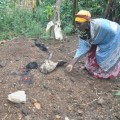
“They were using police and Army pickup vehicles and armed with guns, batons, and with threats, they paraded people, and one could think that there were rebels. And so, they started shooting and beating up people and breaking their houses, and the people dispersed.” Ahumuza said, adding that; Many families lost land titles, homes, food reserves, and livestock, which were their primary sources of livelihood.
Later, the displaced residents sought temporary refuge at the sub-county headquarters before a handful of victims were resettled at Kyeya Valley Farm in Kyangwali Sub-county around 2020. However, local leaders, including Kabulala and Ahumuza, say irregularities marred the resettlement process. They claim it sparked yet another violent eviction, as the land on which the government resettled the residents had itself been illegally acquired.
“The process was not fair at all. The government never settled many of us, which is why we are now camping in an internally displaced camp. Some people were settled on land belonging to private individuals.” Ahumuza added
“What is disheartening is that even the private individuals who had land titles on their land were evicted by the OPM to resettle evictees it had earlier evicted.”
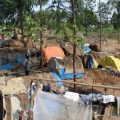
Since then, families have lived in misery in IDP camps or as informal occupants on other people’s land, unable to farm or establish permanent homes, which continues to devastate their livelihoods and underscores the need for urgent intervention.
Several attempts to seek justice have yielded little progress, from government offices, such as presidential directives to investigate the matter, and promises of resettlement, yet, thirteen years later, they remain landless, destitute, and vulnerable.
Without access to land, they cannot engage in agriculture, their traditional means of survival, leaving households trapped in stinking poverty.
“The land was our life; without it, we are nothing.” Says Kabulala Oliver, one of the displaced persons.
Uganda continues to be praised internationally for its progressive refugee-hosting policies. However, the unresolved plight of Kyangwali’s displaced host communities shows the cost borne by citizens when land governance, accountability, and compensation mechanisms fail. Affected families say meaningful resettlement, restitution, or compensation remains long overdue.