By Witness Radio Team
As the global push for clean energy accelerates, African governments are under mounting pressure to move away from fossil fuels and embrace renewable energy. But economists, political leaders, and climate justice advocates are warning that Africa’s transition could reproduce the same unequal economic structures established during colonialism unless the continent gains greater control over its resources, industries, and financing systems, inspiring a sense of agency and possibility.
Although Africa contributes less than 4 percent of global greenhouse gas emissions, it is among the regions most vulnerable to climate change. The continent continues to suffer disproportionately from a crisis largely caused by industrialized nations, including prolonged droughts and devastating floods, which greatly affect its people.
Governments across Africa are increasingly adopting renewable energy policies promoted as pathways toward sustainable development. Despite being promoted, a growing number of experts argue that the transition risks becoming another extractive project in which African resources fuel foreign industries while local communities remain impoverished.
The global transition to clean energy has sharply increased demand for minerals such as cobalt, lithium, graphite, manganese, and copper, which are abundant across Africa and critical for batteries, electric vehicles, and renewable energy technologies.
At the same time, the continent possesses vast renewable energy potential. According to the International Renewable Energy Agency (IRENA), Africa could generate significantly more renewable energy than it currently consumes.
In an interview with Witness Radio, Tunisian economist and President of the Global Institute for Sustainable Prosperity, Fadhel Kaboub, said Africa’s role in the global transition should go beyond merely supplying raw materials to industrialized countries.
“We cannot decarbonize a system that hasn’t been structurally economically decolonized yet. Africa has the potential to become an energy powerhouse globally, an industrial powerhouse, and as a result, an economic and geopolitical powerhouse.” Kaboub reveals.
Kaboub argued that the current global economic system continues to place African countries at the bottom of supply chains, echoing colonial patterns. This pattern is vital for economists and global citizens to understand.
“Africa was assigned the role of supplying cheap raw materials while importing finished products and technologies. The danger is that the green transition is reinforcing the same model instead of transforming it,” he added.
Across the continent, activists and researchers are increasingly raising concerns about what they describe as “green colonialism,” where climate and environmental projects dispossess communities while benefiting foreign governments and corporations.
In several African countries, including Uganda, large-scale carbon offset projects have been linked to land conflicts and forced displacement. Critics say some carbon markets allow polluting corporations in the Global North to continue emitting greenhouse gases while using African land and forests to offset their emissions.
Environmental advocates warn that unless African governments ensure local ownership and value addition in mining linked to renewable energy, the continent risks repeating the history of raw material extraction, which is key for informed policy decisions.
Africa’s green transition discussions also focused on climate financing as a key point of debate. African leaders have repeatedly criticized rich countries for not sufficiently financing adaptation and renewable energy projects, despite their historic role in spewing the bulk of the World’s carbon emissions.
At the COP29 climate Summit in November 2024 in Azerbaijan, His Excellency Bola Ahmed Tinubu, the president of the Federal Republic of Nigeria, warned that many African countries are trapped between debt repayment obligations and climate adaptation needs.
“Africa did little to cause the climate crisis, yet the debt climate trap has saddled many of its nations with a tragic choice: Eschew repayments to fund adaptation to climate shocks and risk default- a financial purgatory where development indicators plummet; or honor obligations and compromise on resilience, thus entrenching vulnerability to development-shuttering climate events,” he added.
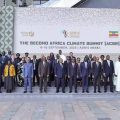
Speaking during the Africa Climate Summit 2025, former Ethiopian Prime Minister Hailemariam Desalegn said debt restructuring must become part of global climate discussions.
“Unless we confront the debt crisis head-on, efforts to finance Africa’s climate ambitions will continue to fall short,” Desalegn said.
Kaboub believes the financing crisis reflects a broader historical injustice. “The industrialized world has consumed most of the global carbon budget that creates a climate debt owed to Africa and the Global South.” He revealed.
Some African economists and climate justice groups are calling for climate reparations, not more loans that deepen dependency, to address historical injustices and support equitable development.
“The future of Africa’s green transition depends on who controls it. If Africa controls its resources, industries, and development path, the transition could become a tool for liberation. If not, it risks becoming another phase of exploitation under a green banner.” Kaboub concluded.