By the Witness Radio team.
Women in East Africa are on the front lines of land and climate struggles against harmful extractive investments, land grabs, and land giveaways that have not only damaged their livelihoods but also continued to harm the environment.
In Tanzania’s Manyara and Arusha regions, Maasai pastoralists face environmental disasters and land conflicts driven by encroachment and land degradation.
Paulina Peter, a Community Development Officer with the KINNAPA Development Program in Kiteto District, Tanzania, has witnessed these changes firsthand.
“Deforestation for agriculture is a major challenge. Some pastoralists are diversifying into crop farming, which affects environmental conservation. At the same time, population growth and land degradation are driving migration into pastoralist areas.” She explains, in an interview with Witness Radio
These pressures are not only ecological, but they are also fueling conflict. According to Paulina, disputes have emerged between local communities and incoming agriculturalists seeking access to community lands, sometimes escalating into legal battles.
To address these challenges, KINNAPA is supporting pastoralist communities through land rights awareness, environmental education, and the development of village land use plans. These initiatives, particularly the formalization of shared rangelands, have helped reduce conflict and promote more sustainable land use.
While Tanzanian communities struggle with gradual encroachment, the story of the Mosopisyek of Benet Indigenous community in Eastern Uganda reflects a more abrupt and violent history of land loss, which has had an overwhelming impact on thousands of local communities for decades.
The Benet Indigenous community in Uganda lost its ancestral land in 1993 when it was designated as a national park, causing decades of displacement and hardship.
“In 1993, the government evicted hundreds of people without compensation. During the initial giveaway of our land, we were not consulted to give consent,” Chelangat Scovia, a women’s leader of the Mosopisyek of Benet Indigenous community, told Witness Radio, recalling the trauma of forced evictions from their ancestral lands on Mount Elgon.
The government has promised to resettle them, but the affected communities in Sebei still await justice after more than 30 years, underscoring their resilience.
Following the 1993 evictions, thousands were left in temporary settlements without adequate land or support. In 2008, again, the government further displaced more than 170 families and destroyed homes in a violent eviction.
Today, many Benet remain landless, surviving through casual labor or relying on aid, while continuing to face harassment when they attempt to access their ancestral lands for grazing or cultural practices.
Despite these challenges affecting their communities, women like Paulina and Chelangat are not only victims but also inspiring leaders driving efforts to defend and reclaim the commons.
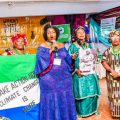
Both are attending the East Africa Women’s Land and Climate Justice Convergence in Nairobi, where grassroots women leaders, activists, and organizations from Uganda, Kenya, and Tanzania have gathered from April 26 to May 1 to confront land dispossession, extractivism, and false climate solutions.
The convergence comes at a critical moment when Africa’s commons—land, forests, water, and cultural systems—are under growing threat. Most land on the continent is held under communal tenure systems that sustain rural populations. However, weak legal protections continue to expose these systems to state control, corporate exploitation, and large-scale land grabs.
While communal systems are vital, they are also shaped by deeply entrenched patriarchal norms. Women, despite being the backbone of food production, often access land through male relatives. This leaves them particularly vulnerable during moments of crisis such as widowhood, divorce, or family disputes.
The convergence seeks to challenge this model by advancing a different vision, one that strengthens, rather than dismantles, the commons while centering women’s leadership.
The convergence aims to build collective strategies to protect communal lands and resist extractive industries and false climate solutions, empowering communities to act together.
“The convergence will also explore the new threats to the commons in the form of mega ‘green’ energy and mining projects, and the false solutions to the climate crisis, such as carbon capture and storage, as well as REDD+, typically involving the capturing and privatization of land, forests, and water bodies. We will also explore the question of climate debt and how it is deeply interlinked with the continued commodification of the commons,” Says Womin in its press release.
Bringing together 35 to 45 participants, primarily women living under communal tenure systems, the convergence includes farmers, fisherfolk, pastoralists, indigenous women, and activists resisting extractive projects. Organized by Womin in partnership with allied organizations, the gathering runs until May 1.
Witness Radio will continue to provide updates on all developments from the convergence.