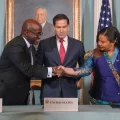
Oakland, CA – In a landmark legal action in January 2026, Congolese lawyers and human rights defenders filed a constitutional challenge against the US-DRC Strategic Partnership Agreement, signed on December 4, 2025, in Washington, DC.
Signed alongside the US-brokered “peace deal” between Rwanda and the DRC – known as the Washington Accord – the agreement grants the United States preferential access to Congolese mineral reserves and requires the DRC to amend its national laws and potentially its Constitution. The agreement further establishes a joint governance mechanism that gives Washington a direct role in overseeing the management of Congo’s mining sector.
The lawyers argue that the agreement violates the Congolese Constitution, which requires that any amendment to national laws and/or the Constitution be subject to democratic review and approval by Parliament or by popular referendum. In particular, the agreement contravenes Article 214 of the DRC’s Constitution, which governs the ratification of international agreements that alter domestic law. The petition also contends that the agreement violates Articles 9 and 217, which enshrine national sovereignty over natural resources, as well as Article 12, which guarantees equality before the law.
“By filing this case with the Constitutional Court, we are assuming our responsibility as Congolese citizens to protect the sovereignty of our country and safeguard our patrimony for future generations,” said Attorney Jean-Marie Kalonji, one of the plaintiffs.
In October 2025, the Oakland Institute released Shafted: The Scramble for Critical Minerals in the DRC, warning that US diplomatic initiatives, including the Rwanda-DRC peace deal — were being used to advance mineral extraction interests under the guise of bringing peace to the region.
“The Partnership Agreement makes it clear that these concerns were legitimate. The Congolese people have been sidelined, with an agreement focused on extraction and exploitation and a peace deal that shockingly overlooks the need for justice and for holding perpetrators accountable,” said Anuradha Mittal, Executive Director of the Oakland Institute. “While the US mining firms secure privileged access to Congo’s vast reserves of critical minerals, promises of peace and security remain hollow with Rwanda and M23 still occupying large swaths of land in mineral-rich eastern DRC,” Mittal continued.
In mid-January 2026, the DRC government took a major step towards implementing the agreement by providing Washington with a shortlist of state-owned assets — including manganese, copper, cobalt, gold and lithium projects – marked for potential US investment.
The lawyers and human rights defenders behind this case are calling for a nationwide mobilization to defend Congolese sovereignty and are urging the international community to support their legal action and uphold international law at a time when it faces an unprecedented threat.
“The Oakland Institute will continue to stand by its partners to support this mobilization and promote a Congolese-led path for peace, justice, and prosperity for the DRC instead of Trump’s hyperbole of peace and security accomplished through its mineral deal,” concluded Mittal.
Source: oaklandinstitute.org