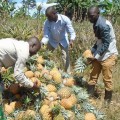
While farmers in Teso region are known for commercial growing of oranges, some of them have found a niche in growing grapefruit.
During the recently concluded Trade Show at the Uganda Manufacturers Association (UMA) showground, selected farmers displayed the rare grapefruit, appealing to many.
The orange-like fruit weighed about 1- 2kg.
In Science Direct, a scientific publication, experts say grapefruit (citrus paradise) is a heavy citrus fruit that originated as hybrid of a variety called pomelo crossed to sweet orange, characterised by its oblate shape.
The varieties are both seed and seedless, with red and white flesh attributed to carotene and lycopene pigments.
Grapefruits, with 6 percent of world production, are the fourth most important commercial group within the edible citrus species, with China leading in production.
Stable production over the last 20 years is now being influenced by new cultivars having lower acid levels and red pigmented flesh.
These factors are creating renewed interest by growers, marketers and consumers for fruit or processed products.
Dr Gabriel Ddamulira, the programme leader, Horticulture and Oil Palm Programme said interested farmers picked scion for grafting and processing seedlings from an old orchard at NaSARR in Serere and Ngetta Zonal Agricultural Research and Development Institute in Lira.
“It is not true that only a few farmers picked interest in growing grapefruits in the Teso region. They picked and multiplied these as individual seedling multipliers for farmer adoption,” he said.
The fruit produces a lot of juice and is believed to be medicinal but the challenge is that it has specialised market since most Ugandan fruit consumers do not know about it.
“Currently, the fruit is not one of priority plants for research as gazetted by the Agriculture ministry. But we keep it as germplasm for future use and this does not stop farmers from growing it if they have identified market for it,” Dr Ddamulira says.
Health benefits
There are several health benefits associated with fresh citrus consumption, such as being a source of Vitamin C, dietary fibre, folate and potassium.
The experts say grapefruit is a nutrient dense citrus fruit that is also low in calories, and provides an antioxidant that protects cells from bacteria and viruses.
It also contains Vitamin A and beta-carotene to help fight inflammation and high water and fibre content can reduce overall calorie intake, which lowers blood pressure.
Farmers’ take
Most farmers growing grape fruit are concentrated in Serere District because it was easy to obtain the seedlings from the research institute.
Mr James Oriokot, a farmer and director of Eden Farm Products in Amuria District has allocated five acres for grapefruit farming.
He ventured into growing grapefruit in 2008 having identified a market potential with Koreans and Chinese who are working in Teso Sub-region.
“The fruit grows in two years and its starts fruiting. One tree can produce over 30 fruits and we sell each fruit at Shs10,000, though the farm gate price is Shs5,000 per fruit,” Ariokot says.
He also multiplies seedlings, selling the six-month-old propagated seedlings at Shs100, 000 while the three months seedling goes for Shs50,000.
He encourages farmers in other parts of the country to embrace grapefruit farming for export market.
“Apparently, the Asians are purchasing it for local consumption but they have intentions to purchase in bulk for export,” he says.
Origin
Grape fruit was introduced in Uganda in the I990s by agricultural scientists from Food and Agriculture Organisation, particularly in the National Agricultural Semi-Arid Resources Research Institute (NaSARRI) where farmers picked seedlings.
Source: monitor.co.ug