By the Witness Radio team.
On August 24th this year, as Namala Christine turns 66, she might have been celebrating her life. Instead, she wonders what went wrong and now faces her next birthday homeless.
“I do not know why I am being punished to this extent,” she told the Witness Radio Journalist.
In 1968, at age eight, Namala joined her grandfather, Mr. Sam Walakira Musoke, on land in Kawaala Zone II, Rubaga Division. He bought it in 1955. Since then, Namala and her family have lived there. Today, NEMA classifies this land as a wetland.
Namala herself has lived on the land for more than 58 years.
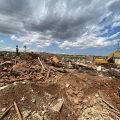
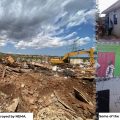
On June 4th this year, the National Environmental Management Authority (NEMA) removed Namala from the land where she had lived for many years. When Witness Radio visited, she sat quietly on broken bricks, what was left of her home. Her face showed shock, sadness, and worry as she thought of her next step.
“As we grew up, each of us was given a portion of the land to settle on. Today, I am the eldest in the family, and I was entrusted with the responsibility of caring for our family’s land,” Namala revealed.
In my talk with her, as she remembered what happened on June 4, her voice shook, and tears came to her eyes as she spoke of how armed men tore down her house and everything the family owned.
“Everything has been destroyed; there is nothing I can show, not even household items. They didn’t allow me to remove any of my belongings from the house,” She told our team.
She now lives by chance. At night, she and other people who lost their homes sleep at the site in old clothes and bags.
“This is what my neighbors gave me. I use it as a mattress and blanket,” she said, explaining that they make a fire at night to keep warm.
After witnessing years of political and social change, Namala finds herself homeless and uncertain about the future.
“I hoped to live well up to death, but look, I don’t even know the next move. I don’t know what to do with my family,” she reveals.
Namala is among the hundreds of villagers in Kawaala Zone II who were evicted from their land.
A Witness Radio investigation found that many people forced out had lived on what is now called “a wetland by NEMA” as land users since the 1940s.
“We have people that we call Bataka (elders) in our Buganda culture. Those people lived on this land starting in the 1940s, and those are the people most of us bought land from,” Mr. Abbas Ssegujja, another resident who lost property worth millions during the evictions, told Witness Radio.
Some documents seen by Witness Radio show that those forced out had paid fees to the Buganda Land Board (BLB) since the 1940s. The families lived on Mailo land, one of Uganda’s forms of land ownership, which belonged to the Buganda Kingdom and is administered by the BLB.
According to Witness Radio’s Team Leader, Jeff Wokulira Ssebaggala, these families living in Kawaala Zone II are accepted by Ugandan law. Jeff says that when residents have real proof of land use or legal stay, government offices must check their claim before removing them.
He added that, in addition to people taking over wetlands, NEMA must also follow the rules. Otherwise, people forced out deserve to be paid for what they lost, and their houses should be rebuilt. NEMA’s committee responsible for overseeing eviction processes is expected to ensure that investigations into lawful occupation status are conducted before any eviction takes place.
“NEMA is in a better position to establish and understand the historical and social attachment of this land to the urban poor community before passing a judgment of eviction and implementing it,” Ssebaggala stressed.
Article 26 of Uganda’s Constitution (1995) gives everyone the right to own property, alone or with others, and says the government cannot take property unless it is needed for public use, and where prompt, fair, and adequate compensation is paid before the taking of possession, Article 237(8) of the Constitution protects the rights of those who legally live on Mailo, Freehold, or Leasehold land, and the Land Act, Cap. 236, also protects Ugandans like Namala.
Uganda has four land ownership types: Mailo, Freehold, Customary, and Leasehold. Mailo is split into two: private and official Mailo. In Kawaala Zone II, people have lived on official Mailo land.
In Uganda, a Kibanja holder is a tenant who uses land without an official ownership paper. The 1995 Constitution and the Land Act (Cap 236) state that Kibanja holders are legal or true tenants. This provides them with strong protection and keeps them safe from removal without a fair reason.
“The government has not clearly matched laws protecting the environment with property rights where people already live in protected places. Because there are no clear plans for moving people, environmental groups focus on restoring the land, and affected families look to property laws for help. So, even though the government has the right to repair and protect wetlands, any removal or demolition must comply with the rules, provide fair compensation, and involve those affected. If needed, they must also help people find new homes.” He added.
Notices seen by Witness Radio indicated that Namala and others were occupying a wetland. Residents had been directed to remove their structures at their own expense before the forced demolition.
NEMA’s Public Relations Officer, William Lubuulwa, told Witness Radio that the affected people are occupying a wetland. He insists that the evictions are lawful. Namala and others had lived on their land since at least the 1940s. This was long before the older NEMA Act CAP 153, which was replaced with CAP 181 in 2019, was enacted.