




Connect with us

DEFENDING LAND AND ENVIRONMENTAL RIGHTS

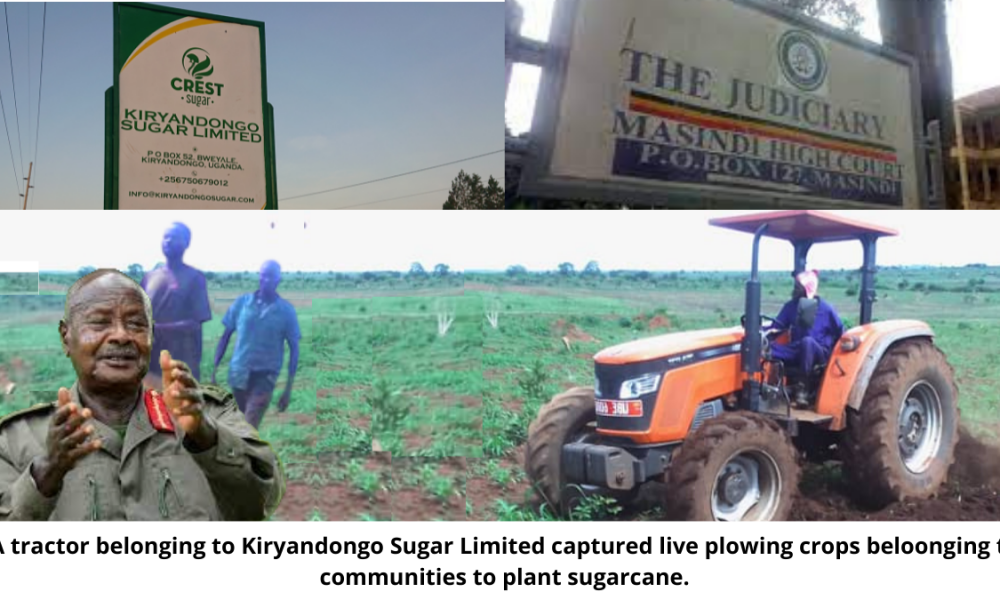
As the court starts to hear a case filed against Kiryandongo Sugar Limited, president Museveni offers to compensate forced eviction victims

Published

on

By Witness Radio Team

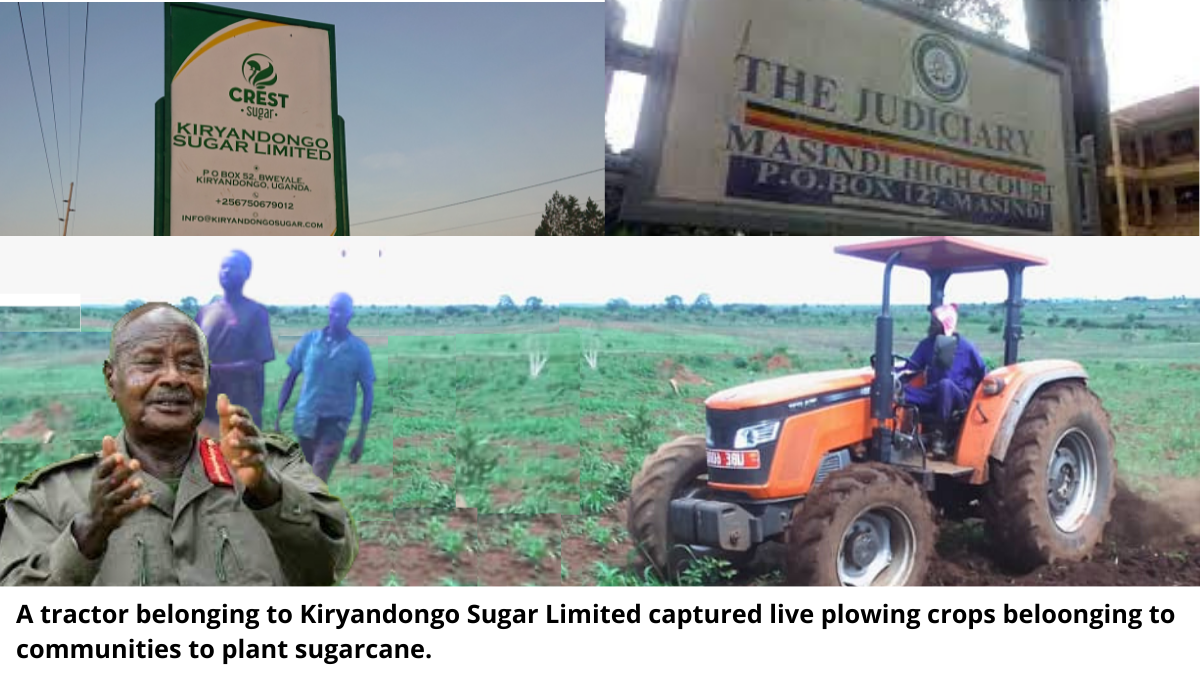
President Yoweri Museveni pledged to compensate Kiryandongo Sugar Limited forced eviction victims shortly after the Masindi High court fixed a hearing date.

Today, the 30th May 2022, Witness Radio lawyers, representing the victim community are in court as the hearing of the case kicks off.

A victim community that is part of a bigger group of 35,000 people being forced off their land by several multinationals, has suffered unabated violence and gross human rights violations/abuses orchestrated by government soldiers that grab land on behalf of the company.

Since 2017, a year after the company arrived in the area, human rights violations/abuses ranging from abduction, torture, and inhuman and degrading treatment, keeping people in kangaroo detention centers, rape, defilement, demolition of houses, cutting down food plantations for community members, demolishing of schools and private health centers to plowing gardens have been committed against local communities.

Kiryandongo Sugar Limited is one of the many companies owned by the Rai Group of Mauritius. The dynasty owns several other companies in DR Congo, Kenya and Malawi, and Uganda. A dynasty owns companies such as West Kenya Sugar (which owns Kabras Sugar), Timsales Limited, Menengai Oil Refineries, RaiPly, and Webuye Panpaper.

In Uganda, the Rai Group of Mauritius owns Nile Ply limited, Kinyara Sugar Limited, and Masindi Sugar Limited among others and one of its directors is a shareholder of a British Virgin Islands company, which was listed in the Panama Papers database recently.

The same company has fraudulently gotten a license to replace part of Bugoma natural forest with sugarcane plantation.

Mrs. Anna Maria Mukabaryanga, a mother of 5 is one of the hundreds of victims that have tested the wrath of the army. She sustained serious injuries during forced evictions.

“I was sternly beaten by Uganda People’s Defense Forces soldiers (UPDF) on my back while I was pregnant. They were very many and eventually got a miscarriage and lost my twins. I did not get enough treatment since I did not have money to cater for the bills. I have visible scars and I cannot afford to do any work due to severe pain. It is hurting that I continue to suffer when the foreign company is reaping big on grabbed land. Whereas I lost everything during the evictions, I was not compensated nor treated. I am deeply suffering up to now.” The 32-year-old recounts.

Although Anna Maria and her community have been tormented by forceful and violent evictions, they were blocked to open a case with the area police against the company.

“The police officers attached to Kiryandongo and Kimogola police units refused us to open cases of criminal trespass and destruction of property against the company. When we went to report, we were threatened with arrests, which caused us to abandon our fight for justice,” Anna revealed.

The area Woman Member of Parliament, Hon. Hellen Max Kahunde said her office had been receiving several complaints of forced evictions, human rights violations by armed soldiers guarding Kiryandongo Sugar Company, and the little compensation offered to them.

“People were beaten, arrested, tortured, and forcefully evicted by the company on the land that they called home. People have visible scars resulting from the torture by the army on behalf of the investors. Can you imagine even the company went ahead to deduct the already undervalued properties by 40%? It’s very unfair,” she added.

While commissioning the $60 million equivalent to Uganda Shillings 216 billion, factory last week in Kimogora village in Kiryandongo, President Museveni said that the government will compensate the people despite encroachment on government ranch land.

In his speech quoted by one of Uganda’s dailies, the Daily monitor on Monday 16th, Museveni said, “The squatters had encroached on government ranch land and were not bona fide occupants but are our people. Bonafide occupants are those who had stayed on the land before 1983, but these came much later. The NRM government, however, we will compensate them.”

In 2020, the Kiryandongo affected victims through their lawyers from Witness Radio lodged a case at Masindi High court against the Kiryandongo Sugar Limited over forced eviction and committing human rights abuses/violations. The victims are seeking compensation and to be returned to their land.

The Masindi resident Judge Hon Jessie Byaruhanga fixed the hearing of Miscellaneous Cause Number 12 of 2020 of Otyaluk Ben Wilson and 8 others vs. Kiryandongo Sugar Company

Continue Reading

DEFENDING LAND AND ENVIRONMENTAL RIGHTS

Africa is capturing just 2% of its carbon credit potential

Published

on

From left: Andrew Gilder, director of Climate Legal; Olivia Tuchten, principal climate change adviser at Promethium Carbon; and Dr Olufunso Somorin, carbon markets coordinator at the African Development Bank, at a pre-summit carbon workshop, where Somorin outlined Africa’s carbon market potential. Image: Robyn Joubert

Africa is not living up to its carbon credit potential, despite rapidly growing global demand for emissions offsets. With more projects emerging in South Africa and across the continent, and agriculture uniquely positioned to develop them, carbon markets could unlock billions in investment.

Africa is generating barely 2% of its carbon credit potential and stands on the threshold of a multibillion‑dollar climate finance transformation. With the global carbon market currently valued at roughly US$1 trillion (around R16,8 trillion) and projected to grow to US$2,4 trillion (R40,2 trillion) by 2030, Africa could claim its share if it acts quickly and credibly.

“There is vast potential for Africa to use high-integrity carbon projects to not only achieve emissions reductions but also development interventions on the ground. […] But we need to scale up and do more,” Dr Olufunso Somorin, African Development Bank (AfDB) carbon markets coordinator, said at a pre-summit carbon workshop ahead of the Africa’s Green Economy Summit in Cape Town in late February.

He described the current moment as a ‘second global carbon order’; a shift from the Kyoto Protocol’s Clean Development Mechanism (CDM) to the new market architecture under Article 6 of the Paris Agreement.

Africa underperformed in the first crediting period, between 2007 and 2011, when it captured only a tiny slice of the more than US$200 billion (R3,2 trillion) invested in CDM projects.

“Close to 1 800 projects were approved globally. Only 33 were in Africa and only 16 in South Africa. We took too long to embrace the opportunity,” Somorin added.

Carbon markets

Carbon markets have expanded significantly since then. According to Somorin, around 28% of global greenhouse gas emissions are currently covered by carbon pricing mechanisms, compared with barely 5% two decades ago.

The compliance market, where regulated entities purchase or trade emission allowances, was valued at more than US$850 billion (R13,5 trillion) in 2021 and reached roughly US$1 trillion (R18,7 trillion) in annual traded emissions by the end of 2024.

The voluntary carbon market (VCM) is significantly smaller, valued at about US$2 billion (R33,5 billion) globally but projected to grow rapidly.

“Total demand for voluntary credits is expected to increase at least 15-fold by 2030, reaching between US$10 billion [R167 billion] and US$25 billion [R419 billion], and could expand up to 100-fold by 2050, reaching between US$90 billion [R1,5 trillion] and US$480 billion [R8 trillion],” Somorin said.

Africa’s small slice of the pie

He added that Africa accounts for roughly US$200 million (R3,4 billion) in the VCM (about 8% by value) while generating around 16% of global voluntary credits. About 100 carbon credit projects across 20 African countries generate an estimated 90 million tons of emission reductions annually.

VCM trading in Africa is concentrated in five countries: Kenya, Zimbabwe, the Democratic Republic of the Congo, Ethiopia, and Uganda. Together, they account for about 70% of Africa’s carbon credit activity, with Kenya responsible for roughly 25% of the continent’s credits.

Credits are generated mainly from avoided deforestation and clean cooking projects, as well as land use, hydropower, wind, and solar energy.

Increasing scrutiny

However, the VCM has faced a lot of scrutiny in recent years. Trading volumes dipped in 2024 amid integrity concerns, although Somorin expects a reset under tighter standards.

The demand outlook is shaped by rising global temperatures. According to the Climate Action Tracker’s ‘Warming Projections Global Update November 2024’, the world is not on track to limit warming to 1,5°C and is heading towards 2,7°C by 2100.

“Many African countries are already achieving emissions reductions through carbon development projects, but they are not structuring them according to verification protocols. This limits their ability to earn carbon credits,” Somorin said.

Private climate flows

Africa holds an estimated 15% of global carbon sequestration potential, which could generate up to US$82 billion (R1,4 trillion) annually by 2050 under high-integrity market conditions.

Yet private capital flows into Africa’s climate finance sector remain low, accounting for roughly 18% of total flows.

“On average, Africa needs about US$280 billion [R4,7 trillion] in annual climate finance. We are attracting only US$52 billion [R872 billion] annually, which is only 20% of our needs. We need to close the gap,” Somorin said.

To boost readiness, in 2025, the AfDB launched the Africa Carbon Support Facility (ACSF), capitalised with US$100 million (R1,7 billion) to catalyse private investment, support regulatory development, and advance policy and Article 6 reforms.

“What I can tell you today is that we don’t have a demand problem. We have a supply problem of high-integrity credits, and a lot of financial interventions are required to close the gap,” he added.

Snapshots of successful carbon projects in Africa

Dr Olufunso Somorin highlighted several African carbon projects with the potential to deliver significant environmental and social benefits:

Rwanda: SPOUTS’ ceramic water filter project has issued more than 350 000 filters, delivering safe drinking water to more than 1,5 million people and avoiding about 1,5 million tons of carbon dioxide equivalent (tCO₂e) by eliminating the need to boil water using non-renewable wood. This high-integrity project prevents more than 150 000t of wood use annually, thus protecting forests, and cutting indoor air pollution by around 90%.

South Africa: the uMkhanyakude Restoration Project in KwaZulu‑Natal is a high-integrity carbon project aimed at restoring degraded grasslands in the Maputaland–Pondoland–Albany biodiversity hotspot. Led by AfriWild and verified under Verra’s Grouped Landscape Management framework, the project will work closely with local communities, land stewards, and conservation managers to prevent overgrazing, enhance grassland regeneration, and increase market access for livestock and wildlife products. It has the potential to remove 10 million tCO₂e across more than 300 000ha, support more than 10 000 people, and provide habitat protection for more than 1 200 endemic species and critical megafauna.

Kenya: the Udongo Mzuri Biochar Carbon Project, led by Women in Climate Change & Renewable Energy, converts organic waste and invasive water hyacinth into biochar, with each ton sequestering three tCO₂e. With seven hubs planned over the next decade, the project targets approximately 20 000 tCO₂e per hub annually, linking production to 10 000 cookstoves per year while achieving a 20% increase in soil moisture retention.

Nigeria: the Ago Owu Forest Reserve Carbon Project in Osun aims to restore and protect 23 000 ha of degraded tropical high forest, creating more than 500 nursery jobs, formalising forest stewardship contracts for residents in the buffer zone, and sequestering carbon at scale through replanting and forest protection. The project is a collaboration between aDryada/Noblesse Green Energy, the Nigerian Presidency, and the National Council on Climate Change.

Source: farmersweekly.co.za

Continue Reading

DEFENDING LAND AND ENVIRONMENTAL RIGHTS

Court Alert: Court Grants Bail to Jailed Defender and Wife.

Published

on

By Witness Radio team.

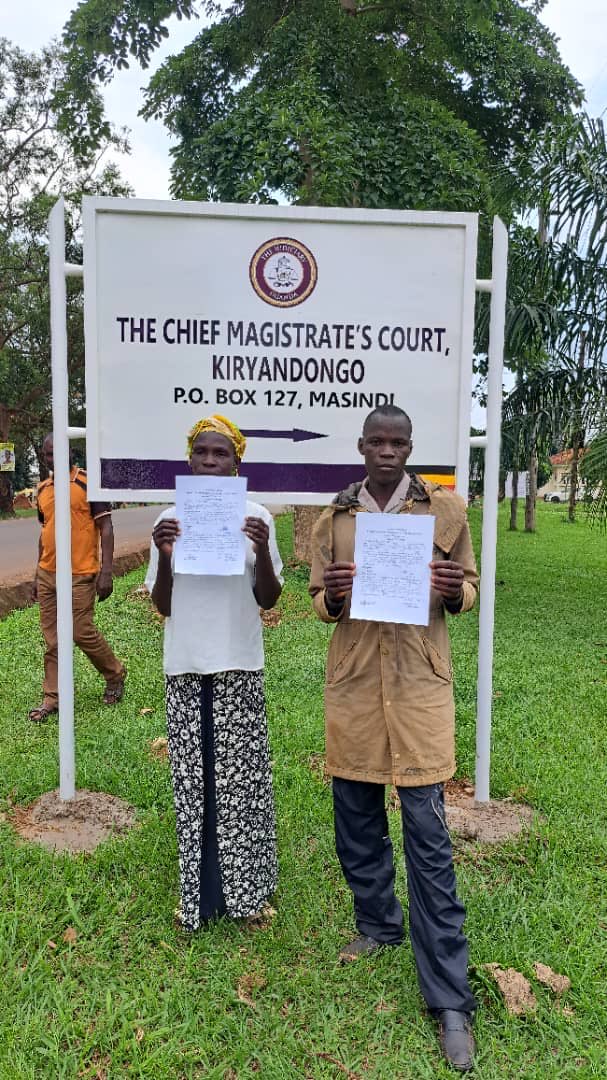
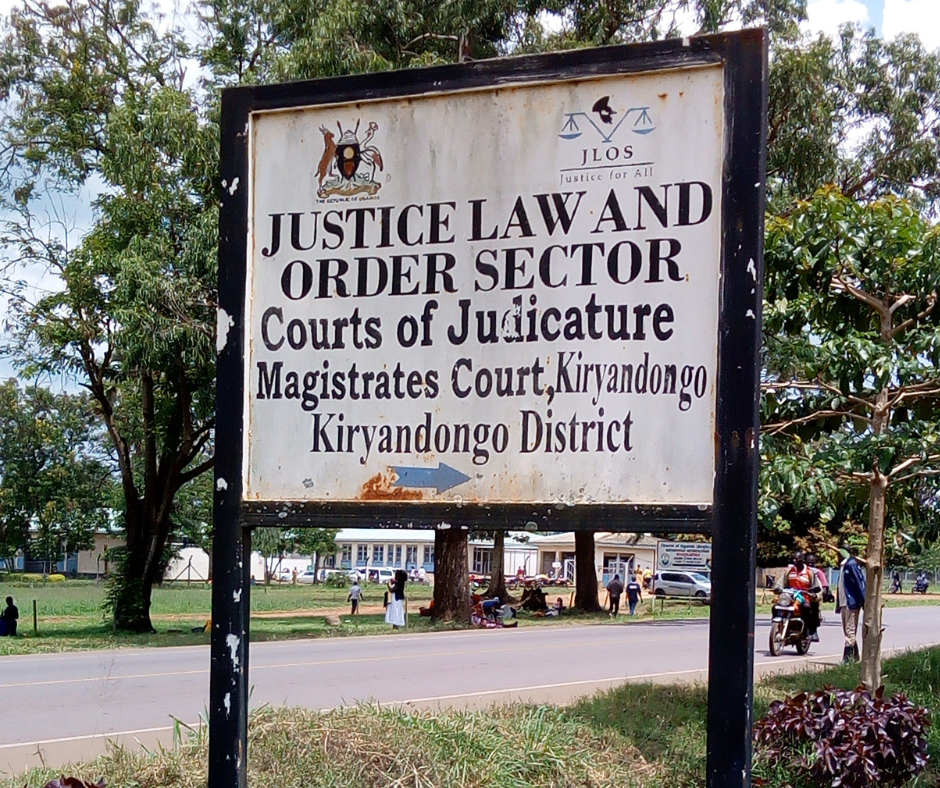
After a significant legal engagement, a magistrate court in Kiryandongo District has decided to release a community land rights defender and his wife on bail. This decision comes after they spent 40 days in prison.
Olupot James, a community land rights defender from Kikungulu village, Kibeeka Parish, Kapundo Sub-county, in Kiryandongo District, and his wife, Apio Sarah, were charged with malicious damage to property on June 5th, 2025, and were remanded to different prisons, including Dyang Prison.

The arrest of the defender and his wife has had a profound impact on their four children, leaving them in a state of grief and pain. They were left without parental care in a house surrounded by the sugar plantation.

According to the prosecution, the duo allegedly uprooted sugarcane plants belonging to Kiryandongo Sugar Limited and replaced them with maize on land neighboring the defender’s home. The multinational claims ownership of the land.

The Penal Code Act, Cap. Section 312 (1) of Uganda states that any person who willfully and unlawfully destroys or damages any property commits an offence and is liable on conviction to up to five years’ imprisonment.

Since 2017, Olupot and several other community land defenders have been in and out of prison, a testament to their unwavering resistance against illegal land evictions. Their resilience is a source of inspiration for many. Thousands of families claim they have lost their land to the multinational without following any law, without receiving any compensation, and without being offered an alternative settlement.

Through Witness Radio Legal Aid Chambers, the duo was granted a non-cash bail of two million Shillings, and their case has been fixed for hearing on July 28th, 2025.

The children, who have been enduring the absence of their parents, are now experiencing a sense of relief and joy as the family is reunited.

Continue Reading

DEFENDING LAND AND ENVIRONMENTAL RIGHTS

A land rights defender and his wife have been arrested, charged, and sent to prison.

Published

on

By Witness Radio team.

Kiryandongo District – A community land rights Defender at Nyamutende Cell in Kiryandongo District, and his wife have been sent to prison by a magistrate’s court in Kiryandongo District, Witness Radio confirms.

Olupot James and his wife, Apio Sarah, were charged with malicious damage to property after a multinational company, Kiryandongo Sugar Limited, accused them of destroying its crops. The area police later picked them up.

Since 2017, Kiryandongo Sugar Limited, a subsidiary of Rai Holdings Private Limited, has been among the three multinationals that have forcibly displaced over thirty-five thousand (35,000) people in Kiryandongo District without following due diligence or offering alternative settlement options.

Community land Rights defender Olupot James and his wife Apio Sarah are amongst a few remaining families that resisted the company’s violent eviction and repression. Their home is currently trapped in the middle of the sugar plantation after they lost their land, which was dug up to the house by the multinational. Despite their peaceful resistance, Olupot has been arrested, charged, and imprisoned more than six times, a clear indication of the injustice they are facing.

Since late May this year, the duo has been reporting to Kiryandongo police station on Criminal Case Number CRB No. 316/2025, until they were arrested and aligned before the court and imprisoned. Olupot was remanded to Dyang while Apio is in Kiryandongo prison.

The state alleges that Olupot and Apio committed the offence of malicious damage to property in Kikungulu village, Kiryandongo District, a region with a complex history of land-related conflicts.

The Witness Radio’s legal aid team is monitoring the case and will appear in court to apply for their bail.

Continue Reading

Resource Center

Legal Framework

READ BY CATEGORY

Facebook

Newsletter

Subscribe to Witness Radio's newsletter


Trending

Subscribe to Witness Radio's newsletter