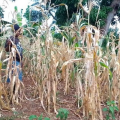
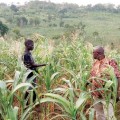
Ex-combatants in Lango Sub-region are counting losses after prolonged dry spells destroyed much of their maize crop during the first planting season, threatening a government-backed project aimed at improving food and feed security.
The project, funded by the Ministry of Defence and Veterans Affairs and the Ministry of Agriculture, Animal Industry and Fisheries (MAAIF), supports army veterans to engage in commercial maize and animal feed production.
Under the programme, veterans receive agricultural inputs including seed, fertiliser and pesticides, while the National Enterprise Corporation (NEC) buys their produce after harvest.
In 2025, ex-combatants in Lango supplied NEC with more than 1,200 tonnes of maize grain, generating income for members and supporting their household livelihoods.
However, unreliable rainfall in 2026 affected both the first and second planting seasons, leaving farmers struggling to recover their investments.
Julius Peter Odur, chairperson of Apac District Veterans Sacco, said the dry spell affected farmers who planted late during the first season.
“We planted our crops and along the way sunshine came and most of us who planted a little late didn’t harvest anything after investing heavily in it,” Odur said.
He was speaking during an inspection of the veterans’ farm on September 24 by Defence and Veterans Affairs Minister Huda Oleru.
Odur appealed for additional government support, particularly tractors, to reduce the cost of land preparation and improve production.
“Currently the cost of labour is too high, we are requesting for the tractors to help our members in reducing the cost of cultivating land and increasing production,” he said.
Margret Aguma, the wife of an army veteran, said her family spent heavily on maize production during the first season but lost the crop because of unreliable rainfall.
“We spent over Shs 2 million but at the end our maize dried out and we harvested nothing then we prepare the land for the second season harvest but rainfall disappeared and it has just rained yesterday yet the season is about to end,” she said.
Minister proposes irrigation
Oleru said the government would explore irrigation as a way of reducing veterans’ dependence on increasingly unreliable rainfall.
She asked local governments to help identify large blocks of land where irrigation infrastructure could be installed in partnership with the Ministry of Water and Environment and MAAIF.
“The local government must help these veterans they must get big land at least 100 acres and above so that we work with the ministry of water and ministry of agriculture to install them irrigation system and you can’t just put irrigation in small pieces of land,” Oleru said.
She also urged the veterans to adopt recommended agricultural practices and use improved seed varieties that can withstand diseases.
“We shall continue to train them with better agricultural practicing methods and we shall also encourage them to buy good seeds which are resistance to diseases so that they can do better and all their problems we have noted them and we shall continue to help them,” she said.
The minister’s proposal comes as farmers in Lango face growing uncertainty over the reliability of rainfall, with veterans seeking mechanisation and irrigation to protect their investments and sustain commercial production.
Source: monitor.co.ug