By the Witness Radio team.
At Buganda Road court, four youth activists from the Rooted in Resistance Movement were charged with public nuisance after their arrest during a passionate plea to Parliament for an oil-free Uganda.
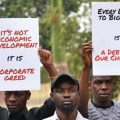
Activists Ssembalirwa Aniwally, Mugoya Hassan, Aron Patrick Ariong, and Okanya Ivan were detained by parliamentary police as they marched with determination toward Parliament, urging the Ugandan government to abandon oil dependency in favor of an ‘oil-free economy’ built on economic freedom, sustainability, and citizen involvement.
According to the charge sheet seen by Witness Radio, the prosecution alleges that on August 10, 2026, at about 9:00 am, the four activists, along with others still at large, were at King George Way Street in Kampala Central. They wore orange T-shirts bearing the words “Rooted in Resistance” and carried placards with messages including “Prioritize Other Sectors of the Economy,” “Oil Is Temporary, Nature Is Permanent,” and “Oil Today, Problems Tomorrow.”
Prosecutors claim the activists stood on the road, disrupting traffic and creating hazards.
The activists appeared before Grade One Magistrate Her Worship Rophine Achayo at Buganda Road court yesterday, where they were charged with being a nuisance on the public road, contrary to Section 67(1) of the Road Act, Cap. 346.
Section 160(1) of the Penal Code Act, which defines a common nuisance, provides that any person who does an act not authorized by law or fails to discharge a legal duty and thereby causes “any common injury, or danger or annoyance,” or obstructs or causes inconvenience to the public in the exercise of common rights, commits the misdemeanor of common nuisance and is liable to imprisonment for one year.
The four pleaded not guilty and now await their fate in Luzira Prison, remanded until August 28, 2026.
The group’s mission was to urge Parliament to rethink Uganda’s reliance on petroleum, warning that true prosperity cannot be built on a resource that will one day run out.
The activists contend that despite years of promises—jobs, industry, infrastructure, and poverty relief—oil’s benefits have reached only a privileged few, while many others remain trapped in poverty.
“Our demand for an oil-free economy is not a rejection of development, but a demand for a different development model, one that places Ugandan citizens, productive sectors and sustainable wealth creation at the center of national planning,” the group said.
They call for bold investment in other sectors, insisting Uganda should chart a path toward sustainable wealth, citizen empowerment, and true economic independence instead of clinging to petroleum.
These arrests are part of a troubling pattern as more Ugandans face criminal charges for protesting oil projects or demanding accountability for their social and environmental costs.
12 environmental activists were arrested in Kampala in August 2025 during a protest against the East African Crude Oil Pipeline (EACOP). Eight out of the 12 activists were later convicted and sent to prison to serve an eleven (11) month sentence. They were released from Luzira Prison on April 21, 2026, as time spent on remand had effectively covered their 11-month sentences.
The other four, including Ivan Wamboga, Baker Tamale and Habibu Nalungu, pleaded guilty and were released on November 19, 2025, after being ordered to perform community service. Mark Makoba also pleaded guilty and was released on November 6, 2025, without any additional penalty.
These cases reveal the risks faced by those who challenge Uganda’s oil agenda. Even after release, the activists’ ordeals have intensified fears for freedom of expression and assembly across civil society.