By the Witness Radio team.
Safeguarding ancestral land often comes at the cost of heartbreak and loss. Across continents, those who stand against land grabbing and environmental destruction are met with violence, threats, and endless legal battles. In 2025, at least 124 land and environmental defenders were killed, with land disputes fueling more than half of these tragedies, Global Witness reports. Indigenous Peoples and small-scale farmers remain at the epicenter of this ongoing crisis.
The dangers reach far beyond physical harm. At times, the law itself becomes a weapon, recasting defenders of land and livelihoods as criminals in the eyes of the state.
Global Witness, a UK-based organization that investigates links between environmental destruction, conflict, corruption, and human rights abuses, describes criminalization as creating, amending, or reinterpreting laws to make previously legitimate activities illegal, or to increase the severity of penalties and sentences.
In northern Tanzania, these fears reignited when five Maasai men were arrested and detained in Ngorongoro. Indigenous communities now feel the pressure on their ancestral lands intensifying.
Nangei Meitaya, Salangat Makko, Ezekiel Kishau, Dickson, and Thadeus Clamian were taken into custody on the night of October 6 and held at Arusha Central Police Station before release the following night. According to the Oakland Institute, four of the men work for the Pastoral Women’s Council (PWC), a local organization empowering Indigenous pastoralist women and girls in northern Tanzania.
Although the five men have been released, their ordeal shines a harsh light on the wider crisis confronting Maasai communities. Human rights groups point to a troubling pattern of arrests, intimidation, and restrictions that threaten access to land and essential services.
Joseph Moses Oleshangay, a Maasai human rights lawyer and activist from Ngorongoro District, described the detention as part of what he sees as a broader effort to intimidate community members.
“The abduction and subsequent detention of our community members is one of the many incidents of lawless targeting of the Maasai people in Ngorongoro – a deliberate campaign to instill fear and censorship, designed to make state dispossession and displacement easy,” Oleshangay said.
He added that when abductions become routine, it signals a complete breakdown of reason and compassion.
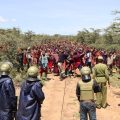
These arrests unfold against a backdrop of rising tension in northern Tanzania. The Oakland Institute notes that more than 30 community members have been detained in just two months, with thousands of livestock seized in nearby Loliondo.
The organization also reported that authorities barred the five men from seeing their families or legal counsel during detention. Meanwhile, officials allegedly searched the homes of other Pastoral Women’s Council staff without consent.
These incidents raise urgent questions about whether community organizations, human rights defenders, and local leaders can keep working safely as land and conservation disputes escalate.
The Oakland Institute argues that the mounting pressure on Maasai communities is part of a broader effort to diminish their presence in the Ngorongoro Conservation Area and pave the way for expanded tourism and conservation projects.
Anuradha Mittal, the organization’s executive director, said the arrests should not be viewed as an isolated incident.
“Far from an isolated incident, this is a calculated campaign of intimidation. Driven by its goal to attract eight million safari tourists by 2030, the Tanzanian government is escalating pressure to evict the Maasai from their ancestral lands,” Mittal said.
She added that as conditions worsen across the region, some community leaders have once again been driven into hiding.
The Ngorongoro Conservation Area is celebrated as one of Tanzania’s crown jewels for conservation and tourism. Yet it remains the ancestral heartland of Maasai communities, whose traditions, way of life, and social bonds are woven into the very fabric of this land.
The region is celebrated worldwide for its ecological significance and is a UNESCO World Heritage Site.
Mittal warned that international tourism is inseparable from the realities faced by the communities whose lands draw visitors. She urged those planning safari tours to Tanzania to recognize that tourism revenues are inadvertently fueling the government’s violent campaign against Maasai communities, whose ancestral lands are being taken in plain sight.
In August 2026, the United Nations Committee on the Elimination of Racial Discrimination (CERD), an independent expert body that monitors the implementation of the International Convention on the Elimination of All Forms of Racial Discrimination, called on Tanzania to immediately halt the forced evictions of Maasai Indigenous Peoples from their ancestral lands in Ngorongoro and Loliondo.
The committee cited allegations of displacement, restrictions on access to land and natural resources, arbitrary arrests, intimidation and excessive use of force.
CERD also expressed alarm over reports that significant numbers of Maasai had been uprooted from their ancestral lands in the two areas in the name of conservation and tourism, without adequate and meaningful consultation or obtaining the communities’ free, prior and informed consent.