By the Witness Radio team.
Africa’s efforts to tackle climate change and biodiversity loss are fueling a surge in renewable energy, conservation, restoration, biofuels, and carbon projects. Researchers caution that these green solutions can dramatically alter who controls land and natural resources.
Stories from Uganda, Nigeria, and Burkina Faso, shared during the ILC’s “Whose Land, Whose Transition?” webinar, revealed how climate and environmental projects collide with land rights, livelihoods, and the deep bonds communities have with their land.
The regional webinar brought together organizations, researchers, donors, and other key players to explore new land conflicts sparked by the green transition and consider how land governance might address the climate and biodiversity crises.
Jeremy Bourgoin, Knowledge Management Lead at the International Land Coalition, said the urgency of addressing climate and biodiversity challenges should not obscure the consequences projects can have on people whose land is needed for those interventions.
“The climate and biodiversity crisis still demand urgent and far-reaching action,” Bourgoin said.
He pointed out that many of these promoted solutions—conservation, restoration, renewable energy, and carbon projects—require land, often clashing with the rights and livelihoods of those already living there.
“The question is not only on what kind of transition is needed but also on whose lands it relies upon,” he added.
He emphasized that the green transition is not a one-size-fits-all story across Africa. The unique land systems, institutions, and communities in each place shape its impact.
“These three streams asked us to examine the green transition without treating the region as a single uniform context. The case studies show how these dynamics unfold in particular places, through particular institutions, and for particular groups of people,” he said.
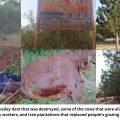
In northern Uganda, Dr Theresa E. Auma presented research on what she described as the exclusion and exploitation of communities around green energy activities linked to Bukona Agro Processing Factory in Koch-Goma Subcounty, Nwoya District.
Drawing on data from 2022 to 2025, the research examined how large-scale investments affect nearby communities and explored ways to prevent human rights abuses.
Auma described how communities worry about being pushed off their land, facing harsh labor conditions, and dealing with pollution that threatens their environment.
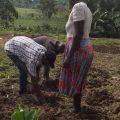
She She reported that workers often labored in hazardous conditions without proper safety gear, many lacking formal contracts and facing delayed or missing wages. The payment is either delayed, and people have to struggle, or in many cases, they did not receive the payments, like when they work on planting maize or things like that in the factory,” Auma said.
“The factory is Indian-owned, and so the racial question comes between the Indian and black workers in the factory, that the Indian workers are taken as a higher class of workers compared to the black workers, Ugandan workers,” she added.
In Nigeria, Chinwike Okereke from the African Law Foundation presented research on farmer-pastoralist land conflicts in Benue State, focusing on how the conflicts affect women differently.
The conflict is fueled by a mix of forces: growing populations, increasing resource pressures, fierce competition for land and water, cattle theft, armed groups, and uncertainty over land rights and pastoral movement.
Okereke explained that climate change adds another challenge, disrupting agriculture and making it even harder for people to access vital resources.
He noted that these hardships hit women hardest, since they are usually the ones tasked with gathering food, water, and other essentials for their families.
“It increased women’s workload and caused many hardships and poverty as women spend extra hours reaching land and water sources and often go into debt due to harsh economic conditions,” he said. In Burkina Faso, Saud Ata shared a case study from Darkwei Kelesuk, spotlighting how traditional knowledge helps communities protect biodiversity and steward their land.
She introduced participatory mapping, a tool that empowers communities to chart their territories and weave together diverse strands of knowledge.
“Different ways of knowledge can be combined without transferring the control of the territory far from the community,” Ata said.
Ata stressed that this approach is vital, since local people rely on their ecosystems for everything from breeding and gardening to crafting and managing forest resources.
She underscored how these ecosystems are lifelines, supporting both biodiversity and the daily realities of community life.
“The ecosystems in the area are key for biodiversity and the land conditions of the communities,” she said.